
SLIDE 1
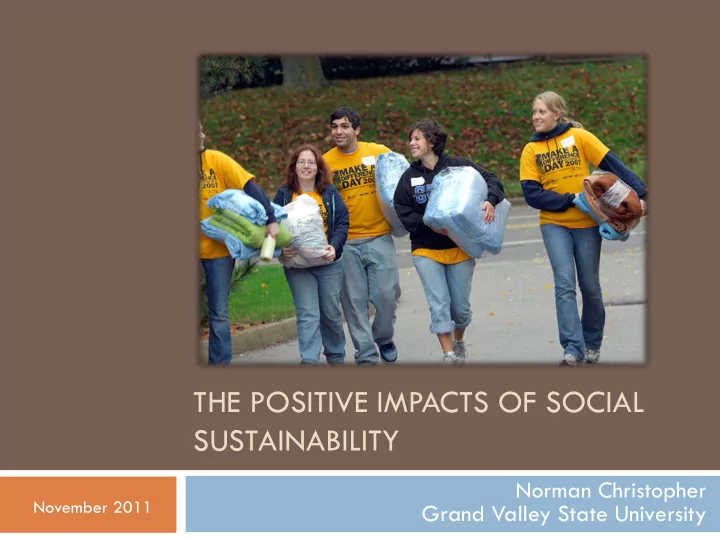
THE POSITIVE IMPACTS OF SOCIAL SUSTAINABILITY
Norman Christopher Grand Valley State University
November 2011
SUSTAINABILITY Norman Christopher November 2011 Grand Valley State - - PowerPoint PPT Presentation
THE POSITIVE IMPACTS OF SOCIAL SUSTAINABILITY Norman Christopher November 2011 Grand Valley State University The Sustainability Lens! BUSINESS (competitiveness, CASE profitability, growth) Resource Prosperity Eco Socio scarcity
November 2011
Source: Adapted Wiley and Sons: T. Dvllick
BUSINESS CASE NATURAL CASE SOCIETAL CASE
Eco Effectiveness Eco Efficiency Socio Efficiency Socio Effectiveness Sufficiency Ecological Equity
(competitiveness, profitability, growth)
Resource scarcity conflict Prosperity conflict Services conflict
(resource use, conservation, environment) (education, employment, health, quality of life)
Your Organization
Media Customers/Client/ Consumers Competitors Suppliers/ Partners Employees/Labor Unions Shareholders/ Private Investors Investment Community Local Neighborhood and Community Insurance Companies City Government Schools, Colleges, Universities Regulatory Agency Banks NGO’s First Nations Credit Rating Agencies Institutional/ Pension Fund Managers Trade/ Professional Organizations Faith Based Communities
Forms
Capital
Natural Economic Community Human Social Networking Manufactured Cultural Knowledge Shared Advocacy
Source: Adapted Toward Sustainable Communities
“Continuing commitment by business to behave ethically and
Transparent business practices Ethical values Compliance with legal requirements Respect for people, communities, environment Beyond making profits Responsibility for totality of their impact on people and planet
Source: mcf.org/conference/corporatecitizenship.pdf
“a recognition that a business, corporation, or business like
Exhibiting constant life-long life-wide learning; inclusivity; transparency;
social and ethical accountability
Providing community leadership e.g. visioning Portraying a leadership role model within host community and its
stakeholders
Having stated sustainable guiding principles, values, and purpose Requiring absolute commitment, and willingness to change
Source: mcf.org/conference/corporatecitizenship.pdf
Social Entrepreneurship encourages taking a new approach to broad social problems, directing the drive, imagination, discipline and accountability inherent in entrepreneurship at society’s most pressing issues and thereby creating a mechanism for creating lasting social value. It holds the breathtaking prospect of creating nothing less than the next generation of social problem-solvers and leaders. When one thinks of the seemingly intractable difficulties that will confront our children and our children’s children in the decades to follow --- global warming, nuclear proliferation, international competition for energy and natural resources, large and growing inequities in income in the United States, spreading prosperity to the developing world, the creation of a new definition of national and international security --- it is clear that a very new set of tools will be needed. The emerging field of Social Entrepreneurship offers the prospect of creating those tools: crossing disciplines and sectors to frame solutions, finding new incentive structures, applying new ideas and techniques to solving society’s most pressing problems, and offering new exciting
A generation from now, the laurels for solving some enormous problems may well go to some “Social Entrepreneur.”
Source: J.C. Canepa, February 7, 2006
Source: David Bornstein, How to Change the World
Delinks from traditional business frameworks that does not accommodate new objectives within existing frameworks
Exists to solve social problems while using business technologies and models
Offers options to investors by operating in a open economy with free choice
Enhances competition and freedom of choice by giving more people more choices of goods and services
Offers promising alternatives to failed government programs
Is less exposed to downside risk during economic downtimes
Represents a new way to express entrepreneurism
Provides an outlet for creativity
Affords opportunity for individual renewal
Is a great learning process
Helps the public and private sectors share the burden of responsibilities for social change
Can help solve neighborhood problems and concerns
Source: Muhammad Yunus, Building Social Value
Nothing expected Small, not a major value Social and cultural emphasis Better to give then to receive Hope that receiver will appreciate
gift
Something expected in return Large, of major value Business emphasis A penny earned is a penny saved Expectation that gift will perform
Investment Gift
Source: Tom Ralser, ROI for Non-Profits
Social responsibility
Source: Strathcona County