Sustainability of the Omani Aflaj Abdullah Al-Ghafri The University - - PowerPoint PPT Presentation

sustainability of the omani aflaj
SMART_READER_LITE
LIVE PREVIEW

Sustainability of the Omani Aflaj Abdullah Al-Ghafri The University - - PowerPoint PPT Presentation

Sustainability of the Omani Aflaj Abdullah Al-Ghafri The University of Nizwa, Oman Ibri 25-26 January 2016 Falaj systems Aflaj are complex, common-pool farming communities that depend Human on maintaining the balance between several


slide-1
SLIDE 1

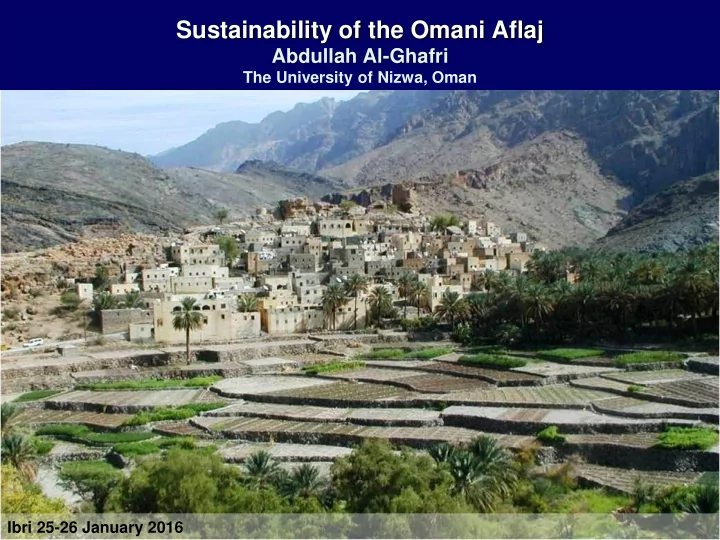
Ibri 25-26 January 2016

Sustainability of the Omani Aflaj

Abdullah Al-Ghafri

The University of Nizwa, Oman
slide-2
SLIDE 2

Falaj systems

 Aflaj are complex,

common-pool farming communities that depend

  • n maintaining the

balance between several spheres of influence.

 In order to have survived

and thrived for thousands

  • f years, Aflaj

communities have had to constantly adapt to assure the longevity of these interdependent systems.

Falaj

Environment Technology Human

slide-3
SLIDE 3

Sustainability of falaj system

Falaj system Inherited system Adaptation Stable system Environmental Human Some aflaj are more than 2500 years old Sustaining aflaj = sustaining life

slide-4
SLIDE 4

Key factors of Aflaj Sustainability

  • Continues adaptation to social and environmental changes:

maintenance, water rights adjustments…

  • Water market
  • Gray water use
  • Recycling resources: Soil, nutrients
  • Organic farming
  • Increase land productivity: multi cropping with carefully

selected crops

  • Crop rotations
  • Social solidarity
  • Peaceful coexistence between races and religions
  • Choosing date palm as the principal crop
  • Flexible land use
slide-5
SLIDE 5

The Falaj System: “Cash” flow

Water market Agriculture: Products market Domestic The Water supply

+

Donations

+

Source Conveyance Management Money supply Agriculture Water utilization Revenue Wages

slide-6
SLIDE 6

Characteristics of water rights

  • Owned life time
  • Can be sold, leased or rented
  • Separated from land
  • All leasing, renting or selling are registered in

legal way and recognized at country level

  • Government has no influence on the water

market, it is done at falaj level and the price depend on flow rate, agricultural seasons and number of participants

  • Auction is done weekly, monthly, every three

months or yearly

slide-7
SLIDE 7

Types of water rights

  • Free
  • Private
  • Community service
  • Charity
  • The ratio of each type depend on falaj

type, size and other social factors

slide-8
SLIDE 8

Free water rights

  • Free to all the village members and

visitors

  • Human basic needs

– Drinking – Cooking – Washing – Etc

  • Watering animals
slide-9
SLIDE 9

Private water rights

  • Owned by individuals or families
  • Most dominant
  • The total percentage is fixed but the

allocation is dynamic

– Fixed with land:

  • Should be sold with the land. Not for rent.

– Not fixed with a land:

  • Can be sold or rented separately
slide-10
SLIDE 10

Service water rights

  • Devoted for community service:

– Falaj structure maintenance – Wages of the falaj administration and workforce

  • Can not be sold. It is for auction only
  • The ratio and allocation is fixed
slide-11
SLIDE 11

Charity water rights (waqf)

  • Devoted for charity:

– Mosques services – Schools – Care of orphans

  • Can not be sold but rented
  • Increase by time, depending on

donations

  • Now, it is controlled by the Ministry of

Awqaf and Religious Affairs

slide-12
SLIDE 12

Water rights in Falaj AL-Hageer

2 5 8 8 9 9 9 9 10 10 14 15 16 24 11 15 18 24 34 38 48 1 2 3 4 5 6 7 8 9 10 11 12 13

Falaj

15 16 17 18 19 20 21

Athars

10 20 30 40 50 60 Athars

1st irrigation

2 5 8 8 9 9 9 9 10 10 7 14 15 7 16 11 24 10 10 14 2

2nd irrigation

4 8 7 14 24 24 22

3d irrigation

24

Owners

Dawran = 7 days =336 Athars Service

4.5%

Private

95.5% 321 15

slide-13
SLIDE 13

Water efficiency/gray water use

  • Another

sustainable aspect of Aflaj system involves the gray water aspects of how Aflaj water is used.

Drinking Mosques and forts Men bath Women bath Washing Seasonal crops Drain Date palms and trees Domestic Agricultural Water Source

slide-14
SLIDE 14

Falaj Maintenance

Falaj Al-Khaoud, October 2008

slide-15
SLIDE 15
  • A. Al-Ghafri, 2007

Falaj Daris, October 2006

slide-16
SLIDE 16

Date palm is the major crop: Date palm is chosen. (90% of irrigated area).

  • Perennial crop.
  • Salinity tolerant.
  • Drought tolerant.
  • Wide range of climates.
  • High productivity.
  • Wide range of utilizations:
  • Food.
  • Shade.
  • Animal feed.
  • Energy source.
  • Wood for construction.
  • Raw materials for

furniture.

Al-Hageer, May 1996

slide-17
SLIDE 17

Harat Al-Siybani, Falaj AL-Khutmain. 2012

Products of Aflaj used in buildings

slide-18
SLIDE 18
  • A. Al-Ghafri, 2007
slide-19
SLIDE 19

Water security

  • This is especially important in Oman as well as other countries in

the Middle East, North Africa and Southwest Asia, where the

  • veruse of aquifers, increased demand and climate change have

pushed domestic water security to brink.

  • Aflaj communities have shown that many systems can last

centuries even millennium without taking more than the environment provides and with efficient use of land.

  • Therefore, Aflaj must be considered Omans only indigenous,

naturally occurring, sustainable supply of irrigation water that is in harmony with the environment.

slide-20
SLIDE 20
  • In contrast, Aflaj depend on relatively modest

investments of money and are not vulnerable to dynamic factors that could destabilize food production and trade drastically within a short period of time.

  • Thinking sustainable then Oman must invest in

its 1000’s of Aflaj as they can pay a vital role in the general well being of Omanis and national security.

slide-21
SLIDE 21

Gravitational pull

  • By design Aflaj work in synchronicity with the
  • environment. They work by gravitational pull and

direct relation to existing water tables and recharge

  • rates. For this Aflaj do not over exploit water supplies

in the same way that mechanical pumping often does.

  • While relief wells, damming efforts, and secondary

water supplies used to maximize Aflaj production. Aflaj must be viewed from with a sustainable context and planned carefully the base flow of Aflaj systems which are sustainable.

slide-22
SLIDE 22

Water efficiency/Multi cropping/New Irrigation techniques

  • The Aflaj institution of flood irrigation can also be viewed as a

sustainable practice as it maximizes the efficiency of water use in several ways.

  • First through intercropping multiple crops can be grown in high

density manner, increasing the land productivity per square meter, with each crop aiding the other. For example date palms, not only produce dates and provide shade but also serve as windbreaks and micro-climate conditioner for crops like banana and papaya as nitrogen fixing crops like sorghum and legumes assist date production while enjoining the protection of the dates.

  • This aspect of water use efficiency is particularly important as

modifications, such as drip irrigation are explored to combat evaporation rate and maximize water use efficiency. Trade off between these irrigation measures are likely and as such investigation is needed to assist farmers to make the correct choices.

slide-23
SLIDE 23

Increasing land productivity

Al-Mudhaibi, Feb. 2011

slide-24
SLIDE 24

Soil recharge/nutrient cycle

  • Aflaj communities are also sustainable through

the complex nutrient cycles found through the

  • system. For example, dates burned at the end of

their usefulness and nitrogen fixing crops have assisted the soil in Aflaj communities to remain nutrient rich after centuries of use.

  • Another important variable in soil health involves

the transportation nutrients through water supply and the geo-chemical and organic-chemical interactions throughout the system.

slide-25
SLIDE 25

Organic farming

  • Hence traditional Aflaj are organic agricultural systems,

which relates to sustainability and environmental health as pesticides have been linked to several health hazards.

  • Inorganic fertilizers rationally is not applied, instead Aflaj

build off and taking advantage of the nutrient cycle described previously, organic fertilizers such as dried fish and manure have been employed by Aflaj farmers.

  • NPK rates were maintained and managed naturally rather

than through the use of artificial fertilizers.

slide-26
SLIDE 26

Circulation of resources and nutrients in falaj system

Agriculture Village

Food Manure

slide-27
SLIDE 27

Equity/common pool

  • One of the most important aspects of

sustainable regarding Aflaj is social aspects of water division which provides for water to be divided on a relatively high level of equity.

  • As a common pool resource with complex

traditional management techniques, water not usually manipulated by an individual as in the case of well. This bond allows for a more equal distribution of output and return as well as stress

  • n community cohesion over conflict.
slide-28
SLIDE 28

Threats/needs

  • Even though they are sustainable, Aflaj are under
  • stress. Over pumping from competing wells, socio-

economic pressures and climate change are impacting many Aflaj in adverse ways.

  • However, these threats do not mean that Aflaj are

relicts of past doomed to fail. Rather it is simply means that Omani Aflaj need protection, cost effective proper maintenance, strategies, better market options and multidisciplinary research approach.

slide-29
SLIDE 29

Religious reference books and monographs

  • We looked to religious manuscripts as a

religious resource only, however it contains valuable information and data for many research disciplines.

slide-30
SLIDE 30

Information and data from these books

  • Legal material on:

– Protecting water sources – Reduce water pollution – Regulating water use – Insure equality in water distribution – User-user relations – User-community relations – User-state relations – Community-community relations – Community-state relations – Records of water and land disputes and solutions

  • Information on:

– Water and land use – Records of history of water management and aflaj – Technical information on traditional irrigation and farming techniques

slide-31
SLIDE 31

Conclusions

  • In conclusion, Aflaj are not just artifacts or relicts of Oman Past.
  • Although an integral part of Oman heritage and an example of core

sustainable values in Oman past, they should be regarded as living, breathing communities capable of producing locally grown food and playing a vital roe in Oman food/water security.

  • They are Oman’s only naturally occurring sustainable water supply

and should be protected.

  • Significant work needs to go in to retaining the potential for Omani

Aflaj from within Oman food/water security frame work. As well as to assist these systems to meet the challenges of the 21st century and to integrate the ideas from both traditional wisdom and modern approaches.

slide-32
SLIDE 32

32

Thank you for your attention!