Susan Warfield, MSW, LICSW Program Director, Student Parent HELP - - PowerPoint PPT Presentation

susan warfield msw licsw program director student parent
SMART_READER_LITE
LIVE PREVIEW

Susan Warfield, MSW, LICSW Program Director, Student Parent HELP - - PowerPoint PPT Presentation

Susan Warfield, MSW, LICSW Program Director, Student Parent HELP Center Student Parents: Transitioning to College with Children. Transitioning to Parenthood in College. Speaker: Background Twelve years with the SPHC, seven as Program


slide-1
SLIDE 1

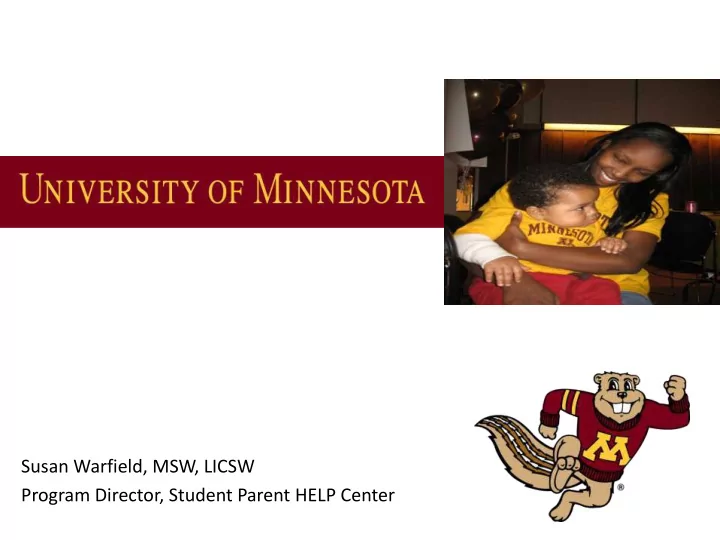
Susan Warfield, MSW, LICSW Program Director, Student Parent HELP Center
slide-2
SLIDE 2

Student Parents: Transitioning to College with

  • Children. Transitioning to Parenthood in

College.

slide-3
SLIDE 3

Speaker: Background

  • Twelve years with the SPHC, seven as Program Director
  • 25 years experience working with children and families as a

social worker, K-12 and Higher Ed

  • Founding officer of the first student parent service personnel
  • rganization in higher education: HEAASC
  • Co-founder and inaugural chair of NASPA Adult Learners and

Students with Children KC

  • Served on Office of Adolescent Health/Pregnancy Assistance

Fund Expert Work Panel: What Works for Pregnant and Parenting Teens

slide-4
SLIDE 4

SPHC Overview SPHC Quick Facts

  • University of Minnesota-Twin Cities
  • Housed within the Office for Student Affairs
  • 300 to 400 undergraduate student parents
  • Wide range of services
  • Non-traditional students since 1967
  • Low income undergraduate student parents

exclusively since 1984

slide-5
SLIDE 5

Program Model and Philosophy

  • Weekly Parents as Students Support Group (PASS)
  • Social Work Model: most staff are MSW or MSW

Grad Interns

  • Strengths based model
  • No strings attached, students can pick and chose

services they wish or none at all

  • Centers around a dedicated, family friendly student

parent specific space

  • Large, state sponsored child care grant co-managed

by SPHC and financial aid

slide-6
SLIDE 6

What Do Students Need Most

  • Staff whose expertise goes beyond the boundaries of

campus

  • Child care assistance and other financial support
  • A community: they need each other
  • A child friendly space to hang out
  • Family and academic focused resource and referral
  • Voice and visibility
  • Advocacy
slide-7
SLIDE 7

SPHC Demographics

slide-8
SLIDE 8
slide-9
SLIDE 9
slide-10
SLIDE 10
slide-11
SLIDE 11

Composition of SPHC Student Population

  • New to college, new to parenting, first time

parents

  • Older than average transfer student parents
  • Typically aged transfer student parents
slide-12
SLIDE 12

The 6 Cs of Serving Student Parents

  • CASH
  • CHILD CARE
  • COMMUNITY
  • COUCHES…a space to belong
  • COMPUTERS
  • CHAMPIONS
slide-13
SLIDE 13

Couches

slide-14
SLIDE 14

Computers

slide-15
SLIDE 15

Space to Build Community

Space is Key:

slide-16
SLIDE 16

Community of Peers: PASS Group

slide-17
SLIDE 17

Child Friendly Family Space

slide-18
SLIDE 18

Family Friendly Campus Events

slide-19
SLIDE 19

Connection to Campus Life

slide-20
SLIDE 20

Voice and Visibility: SPVD

slide-21
SLIDE 21

Champions: Accessible Staff and Peer Mentors

slide-22
SLIDE 22

Advocacy: Family Friendly Absence Policy

  • POLICY STATEMENT: University of Minnesota-Twin Cities
  • Students will not be penalized for absence during the semester due to

unavoidable or legitimate circumstances. Such circumstances include illness of the student or his or her dependent, participation in intercollegiate athletic events (see the Administrative Policy:Intercollegiate Athletic Events during Study Day and Finals Weeks: Twin Cities, which prohibits intercollegiate athletic competition during study day and finals week except under certain circumstances), subpoenas, jury duty, military service, bereavement, and religious

  • bservances. Such circumstances also include activities sponsored by the

University if identified by the senior academic officer for the campus or his

  • r her designee as the basis for excused absences. The instructor has the

right to request verification for absences. Such circumstances do not include voting in local, state, or national elections.

slide-23
SLIDE 23

Knowing Your Students: Assessing Risk

slide-24
SLIDE 24

Nontraditional Characteristics: Summary

  • f Horn’s Findings

Parent First Generation College Attendee Attending classes part time GED/Long gap between college and high school

Academic performance

slide-25
SLIDE 25

Risk Factors for Student Parents

Young/under the age of 25 First time parent First Generation to Attend College Currently pregnant Relationship issues/violence Academic Performance

slide-26
SLIDE 26

New to College, New to Parenting

  • Pregnancy may have caused schism in family,

loss of all emotional and financial support

  • They may have been abandoned by lover

because of pregnancy

  • Most likely unplanned and possibly unwanted
  • Have not yet learned to navigate college and

being on their own

slide-27
SLIDE 27

Needs

  • Reassurance

– Often scared and doubting their abilities

  • Role models
  • Resources
  • Referrals
slide-28
SLIDE 28

The Life of a Student Parent

slide-29
SLIDE 29

Research

  • Nontraditional Undergraduates: Trends in Enrollment from 1986 to 1992

and Persistence and Attainment Among 1989-90 Beginning Postsecondary Students, Laura J. Horn and C. Dennis Carroll, National Center for Educational Statistics, 1996

  • Improving Child Care Access to Promote Postsecondary Success Among Low-

Income Parents, Kevin Miller, Barbara Gault (March 2011) http://www.iwpr.org/publications/pubs/improving-child-care-access-to- promote-postsecondary-success-among-low-income- parents#sthash.NEWQO9Vj.dpuf

slide-30
SLIDE 30

Beyond the Borders of Campus

  • Often student parents and adult learners have already

established lives in our surrounding communities

  • Student parents often need community as well as campus

based childcare options

  • Not every student parent will live in family housing, not every

campus has housing

  • Familiarize yourself with a broad spectrum of housing and other

referral services

  • A basic understanding of welfare benefits is beneficial
slide-31
SLIDE 31

How Do You Identify Student Parents?

slide-32
SLIDE 32

To Serve Student Parents You Have to Find Them.

  • Any program serving student parents must first develop a plan

to identify and recruit students who need the services

  • Finding the most at-risk student parents should be a priority:

– Lowest income – Youngest – First time parent, first time in college – Newly pregnant – Longest gaps in college progression: older than average

slide-33
SLIDE 33

Barriers to Finding Student Parents On Campus

 They do not always self-identify

– Often feel stigmatized, disenfranchised or like they are asking for exceptions if they bring up their parenting status.

  • We all have to start asking the question.

 They can be an invisible population on most campuses

– Look just like everyone else when they are not pregnant or with their kids – You have to find and actively recruit them

 Illegal question to ask at admission, very hard to reach them at point of entry. Financial aid information most reliable source

slide-34
SLIDE 34

Academics are a Top Priority but Not Their Number One Priority

  • Student Parents have obligations to little people

who depend on them for everything

  • They often also have a job
  • Could have a spouse who is most likely not a

student

  • May have hours of welfare paperwork or tasks

they must complete each month

slide-35
SLIDE 35

How to Begin: Low Hanging Fruit

  • Host or co-sponsor a series of highly visible on

and off campus events

– Student Parent Visibility Event – Non-traditional Student Week (VPCNTSA) – End of Year Celebration and Graduation Party – Family Friendly Resource Fair – Form a committee on Non-traditional Student Affairs, Adult Learners and Student Parents, etc.

slide-36
SLIDE 36

Two Generations of Impact

slide-37
SLIDE 37
slide-38
SLIDE 38
slide-39
SLIDE 39
slide-40
SLIDE 40
slide-41
SLIDE 41
slide-42
SLIDE 42