Survivor Voices on Healing pre-tragedy. Their view on what helped - - PDF document

survivor voices on healing
SMART_READER_LITE
LIVE PREVIEW

Survivor Voices on Healing pre-tragedy. Their view on what helped - - PDF document

5/4/2018 Purpose To understand how survivors were adjusting following a mass murder tragedy, compared to Survivor Voices on Healing pre-tragedy. Their view on what helped most in the and Recovery Following immediate aftermath. Tragedy


slide-1
SLIDE 1

5/4/2018 1

Survivor Voices on Healing and Recovery Following Tragedy

Erika Felix, Ph.D. University of California, Santa Barbara

Purpose

  • To understand how survivors were adjusting

following a mass murder tragedy, compared to pre-tragedy.

  • Their view on what helped most in the

immediate aftermath.

  • Factors in the recovery context that affected

post-tragedy mental health.

This is to help other communities better prepare and respond to crisis events.

Isla Vista Tragedy May 23, 2014

About UCSB

  • One of America’s Public Ivy

universities

  • Global leader in the

Sciences

  • Ranked as 10th best public

university in the U.S.

  • 6 Nobel Prize laureates,

including Shuji Nakamura in 2014!

About UCSB

Total Number of Students:

  • 20,238 undergraduate students; 2,813 graduate students
  • 8% International Students from 79 countries

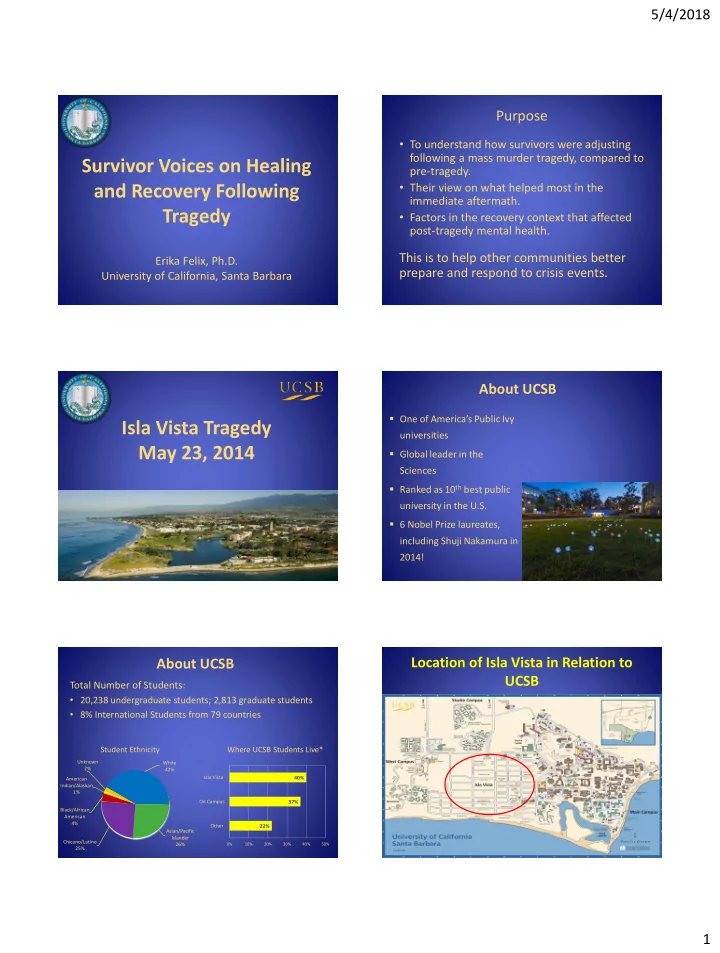
White 42% Asian/Pacific Islander 26% Chicano/Latino 25% Black/African American 4% American Indian/Alaskan 1% Unknown 2%

Student Ethnicity

22% 37% 40%

0% 10% 20% 30% 40% 50%

Other On Campus Isla Vista

Where UCSB Students Live*

Location of Isla Vista in Relation to UCSB

slide-2
SLIDE 2

5/4/2018 2 Details of the Tragedy Crime Scene Locations

Memorial Events after the Tragedy

Paddle – Out Memorial Event IV Deli Memorial

CURRENT STUDY WITH SURVIVORS Background

  • The shared experience of collective traumas

make them differ from individually-based traumas in some substantial ways.

  • Greater exposure is consistently associated

with greater distress (Bonanno et al., 2010).

Review of Research on Mass Shootings*

(Shultz et al., 2014)

  • Degree of Exposure
  • Loss of Someone Close
  • Previous Trauma
  • Previous psychological

functioning

  • Social Support
  • Other Factors (possibly

gender)

Large number of unsuspecting victims from mainstream society not connected to shooter. Factors Associated with Mental Health Problems Following Mass Shootings:

slide-3
SLIDE 3

5/4/2018 3 Northern Illinois University Shooting

(Orcutt et al. 2014)

Four distinct trajectories found:

– Minimum Impact-Resilience (60.9%) – High Impact-Recovery (29.1%) – Moderate Impact-Moderate Symptoms (8.2%) – Chronic Dysfunction (1.8%)

Virginia Tech Mass Shooting

(Littleton et al., 2009)

  • Resource loss predicted posttraumatic

stress symptomatology at both 2 and 6 months post-tragedy.

Current Study

  • Original study was designed to study how

prior experiences of school bullying affected first year students’ adjustment to college.

–Fall 2012 (fall of Freshman year) –Spring 2013 (end of Freshman year) –Tragedy: May 23, 2014 (Sophomore year) –Follow-up Oct-Nov 2014 (Junior year)

We Asked…

  • What changed and what stayed the same after

the tragedy?

  • Psychological Sense of School Membership
  • General Self-Efficacy
  • Social Support
  • Mental Health (Anxiety, Depression, Posttraumatic Stress)
  • What pre- and post-tragedy factors are related

to post-tragedy clinical levels of MH symptoms?

  • What was helpful in the initial aftermath? What

do students say other universities should know to help students recover?

We asked…

  • What do survivors say was the most stressful

part of the tragedy?

  • What do survivors say other people should

know about the psychological effects of this type of tragedy?

Participants

  • 593 took Fall, 2012

survey (18% response rate)

  • 143 took post-tragedy

survey (24% response rate). – 66% Female

  • 77 had all three time

points (pre1, pre2, post-tragedy)

12% 40% 33% 15%

Ethnicity

Latino/a White Asian/Pacific Islander Mixed or Other

slide-4
SLIDE 4

5/4/2018 4 Exposure to the Tragic Events

Exposure Percent Yes Saw police and ambulance responding to injuries 32.3% Knew someone personally who was killed 28.8% Heard gunshots 26.1% Knew someone personally who was injured 24.8% Heard Screams 17.9% Saw someone injured 6.7% Saw the car with the gunman 5.2% Saw someone hit by the car 3.0% Saw someone killed 2.3% Saw the car crash 0.8% Personally injured 0.7%

HOW ARE STUDENTS DOING NOW? AND COMPARED TO BEFORE? How worried are you about your future safety…?

42.60% 17.20% 25.40% 29.50% 18.90% 28.70% 9.00% 14.80% 4.10% 9.80% 0% 10% 20% 30% 40% 50% 60% 70% 80% 90% 100% On Campus In Isla Vista Not at all True A Little Some A lot Extremely

Change in Psychosocial Adjustment from Pre- to Post-Tragedy (N=140)

1 2 3 4 5 6 7 Fall 2012 Post-Tragedy General Self-Efficacy Total Social Support Depression Anxiety Sense of School Membership

Change in Psychosocial Adjustment from Pre- to Post-Tragedy (N=77)

1 2 3 4 5 6 7 Fall 2012 Spring 2013 Post-Tragedy General Self-Efficacy Total Social Support Depression Anxiety

Perceived Resource Loss Influenced Depression

1 2 3 4 5 6 7 Fall 2012 Spring 2013 Post-Tragedy Symptom Levels No Loss Any Loss

slide-5
SLIDE 5

5/4/2018 5 Perceived Resource Loss Influenced Anxiety

1 2 3 4 5 6

Fall 2012 Spring 2013 Post-Tragedy Symptom Levels No Loss Any Loss

Post-Tragedy Clinical Mental Health Concerns

  • 23.2%

posttraumatic stress symptoms

  • 40.0% in

clinical range for any MH concern

– 25.9% one – 9.6% two – 4.4% three

14.4% 20.8% 20.0% 11.5% 11.7% 17.0% 0.0% 5.0% 10.0% 15.0% 20.0% 25.0% Depression Anxiety

Those with clinical levels of post-tragedy mental health symptoms, reported…

  • Higher mean resource loss (1.16 vs. 0.45;

p<.000),

  • Greater objective exposure (2.30 vs. 1.64;

p=.034), and

  • Greater fear for their safety and the safety of

loved ones (6.65 vs. 5.67; p=.026).

Looking back, those with clinical mental health symptoms post-tragedy had:

  • More childhood victimization prior to

college entry

  • Higher depression scores in Fall 2012.
  • Lower social support levels in Spring

2013. WHAT WAS DONE IN THE WEEKS THAT FOLLOWED AND WHAT STUDENTS SAY WAS MOST HELPFUL

What Memorial Events Did Students Attend in the Weeks that Followed?

Most Commonly Attended Events

  • Official campus memorial: 59.5%
  • Class discussions: 52.2%
  • Chalk memorial: 46.7%
  • Activities to build a sense of

community: 42.6%

  • Candlelight vigil: 35.9%

Official Campus Memorial

slide-6
SLIDE 6

5/4/2018 6

What Was Most Helpful in the Weeks that Followed?

  • Candlelight vigil
  • Religious or spiritually-oriented memorial

events

  • Memorial paddle out
  • Supportive & relaxing activities
  • Chalk Memorial

What Was Most Helpful in the Weeks that Followed?

  • “I think UCSB handled it extremely well and did a

great job assisting the community. Especially making as many resources as possible available to students and in being sympathetic to students needs.”

  • “The way to heal comes from the students, not

the school itself. Case in point the paddle out. Also bring puppies onto campus like what's done during hell week. Being reminded of something innocent and good would be better than dwelling

  • n the…depressing.”

Students rated talking individually with professors about the events as more helpful than class discussions about the events. “I appreciated a lot that professors went above and beyond in regards to cutting some slack academically and being willing to mourn with their students. That meant a lot to me, probably more than any organized event. It was just humanity manifesting in the classroom, which is something I wasn't used to seeing or perceiving within a classroom setting.” A minority of students attended drop-in counseling services in the immediate aftermath, and in general it was rated positively.

  • “drop in was very helpful to me, it was a great

quick response.”

  • Another student voiced a different experience,

“At the counseling drop in hours, the questioner gave me so much anxiety that I could not complete it. Please for others effected [sic], make the questioners less intense and direct. I understand it is needed for a diagnosis, but it might be too much for people.”

What to do about academic issues?

  • UCSB offered co-located drop-in academic

advising, financial aide advising, and emergency housing services.

  • Academically, students were given the
  • ption of taking their grade as is before the

event, taking an incomplete, or to stay and finish final exams.

  • There were a variety of student views on

this.

Student Voices on Academic Issues

  • “Finals should have been canceled. It was torture

studying material for finals that I used to study with my friend who was killed in the shooting. Being forced to go through finals while being very depressed was horrible and made me want to leave UCSB for a while.”

  • Another student stated, “I think it was great that

advisors reached out and I was able to understand my options…”

slide-7
SLIDE 7

5/4/2018 7

There were mixed feelings on the official campus memorial…

  • “I think it was great to

emphasize the sense of

  • community. Not only did friends

and people I did not know come to together, but there was the support of faculty…. It was nice to have the memorial service.”

  • “I thought the responses were

perfect …with the exception of the memorial service. I thought some of the speakers delivered shallow, insincere, or inappropriate remarks…and that the whole thing seemed disorganized and strange.”

  • “The memorial itself was a

disservice to those who were lost…I never felt as if anyone was remembered. It was a statistic, a number devoid of any significant meaning. The

  • nly true consolation came

from one on one interactions with professors, discussions among close friends, and hearing the names of those who were lost and what lives they lived; ”

WHAT ABOUT THE RECOVERY CONTEXT?

Background

  • Conceptual models point beyond looking solely at the

influence of individual characteristics, to aspects of the recovery context that influence post-event MH (Silverman &

La Greca, 2002).

– Reactions to media coverage – Negative family reactions – Disappointment in social support received

Survivor Reactions to Media Coverage

  • Negative perceptions of the media coverage

contributed to significantly higher levels of overall anxiety and posttraumatic stress symptoms, with the increases specifically in intrusive re-experiencing and avoidance symptoms.

  • “That the media -- like episodes in Law and Order --

are making money off of my tragedy.”

Since the tragedy, how much has your family…?

39.3% 83.6% 59.8% 82.8% 36.1% 10.7% 23.0% 12.3% 17.2% 3.3% 10.7% 3.3% 7.4% 2.5% 6.6% 1.6% 0% 10% 20% 30% 40% 50% 60% 70% 80% 90% 100% Expressed concern about your future safety at UCSB Urged you not to return to UCSB Been overprotective Been so upset that it interfered with your

  • wn emotional

adjustment Not at all True A Little A Lot Extremely

Family Reactions and Social Support

  • Negative family reactions were related to

higher levels of posttraumatic stress symptoms, including significant relations to all symptom clusters.

  • Negative family reactions were most strongly

related to the avoidance symptom cluster. “…family asking very blunt questions regarding the tragedy made for a fairly stressful time.”

slide-8
SLIDE 8

5/4/2018 8 What do survivors say was the most stressful part of the tragedy?

Theme Valid % (N) Examples Concern for the impact

  • n others or the general

community 28.6% (24) "the aftermath and strain on the community," "not knowing if my friends were okay," "seeing my friends cry" Changes in psychosocial adjustment 23.8% (20) "…I still get waves of anxiety and memories that make it hard or scary to sleep," “I would go into panic attacks and could not stop shaking. …,” "Made me really examine my beliefs and that changed how I view myself and people in general." Media Coverage 22.6% (19) ”…the media. They came in hoards and disturbed everything, made disgusting reports that capitalized on

  • ur tragedy …," "the film crews constantly trying to

get a story from you…," “I did not like the attention it got from the media because UCSB is so much more.” Feeling unsafe or vulnerable 19.0% (16) "feeling unsafe in my own home and community," "knowing that my life or my friends' lives could be taken at any moment"

What do survivors say was the most stressful part of the tragedy?

Theme Valid % (N) Examples Grief or loss of loved

  • ne

14.3% (12) "accepting my friends' death…", "knowing someone who died", "I have never felt any emotion like the grief I felt after the IV tragedy. It was like an intense grief for the victims …" Proximity to the events 8.3% (7) "the fact that I was so close,” "I lived in the same apartment complex as the gunman …,” "seeing the bullets in my apartment" Going back to everyday life 7.1% (6) "living - going about school and day to day life with a constant beat of tragedy in my ears...,” "having to attend class again,” "just having to go back to business as usual so soon" Tragedy exacerbating pre-existing problems

  • r issues

3.6% (3) "The most stressful part of the tragedy was having to deal with it with other personal problems that were already in my life during that time."

SUMMARY AND RECOMMENDATIONS

Summary and Recommendations

  • Those with prior trauma history, greater

depression symptoms, and lower social support pre-tragedy were at great risk for clinical mental health problems post-tragedy.

– Therefore, why wait for students to walk into drop-in counseling services? – Have one counseling center staff dedicated to reaching out to current or former clients to see how they are doing post-tragedy.

Summary and Recommendations

  • Although highly exposed students are more

likely to have mental health issues post- trauma, we need to consider resource loss…how students perceive the tragedy changed them and their assets.

  • It was resource loss that was related to mental

health outcomes post-tragedy.

– This has implications for post-trauma mental health screenings of survivors.

Summary and Recommendations

  • Levels of depression and anxiety increased.
  • General self-efficacy, social support, and

psychological sense of school membership did not change post-tragedy.

– Build on strengths in the immediate aftermath – Community events can build social support and reduce isolation – Students found the student-organized events most helpful.
slide-9
SLIDE 9

5/4/2018 9

Summary and Recommendations

  • Mental health counseling services can be very

helpful in the aftermath.

  • Need to consider:

– Who will be the volunteers? Identify trusted mental health professionals in the community prior to a tragedy. – Training in Psychological First Aide or related crisis counseling model – If not trained, do NOT use that volunteer in initial aftermath, but rather as a referral source for the minority of students who will actually need therapy.

Summary and Recommendations

  • Preparing faculty member to respond to

student distress. What types of class discussions are helpful versus should be avoided?

  • Need to offer academic advising, financial aide

advising, housing for displaced students. Co- locate with mental health counseling.

  • Memorial Service

– Know what the speakers will say and plan an appropriate order.

Summary and Recommendations

  • Media coverage can influence MH of survivors.

– Let it be used for the good of survivors – Prioritize using local media personnel

Summary and Recommendations

  • Public messaging about how family

members and friends can support their loved one who was impacted by tragedy may help make the support being offered the survivor helpful, instead of potentially harmful.

– Listen, then only speak if needed

Thank you to the supportive UCSB Gaucho community, and especially the students that shared their voices with me for this research. In Loving Memory…