Logic and Reasoning R&N 7-9 Room 1 Room 2 Door 1 Door 2 - - PDF document

logic and reasoning
SMART_READER_LITE
LIVE PREVIEW

Logic and Reasoning R&N 7-9 Room 1 Room 2 Door 1 Door 2 - - PDF document

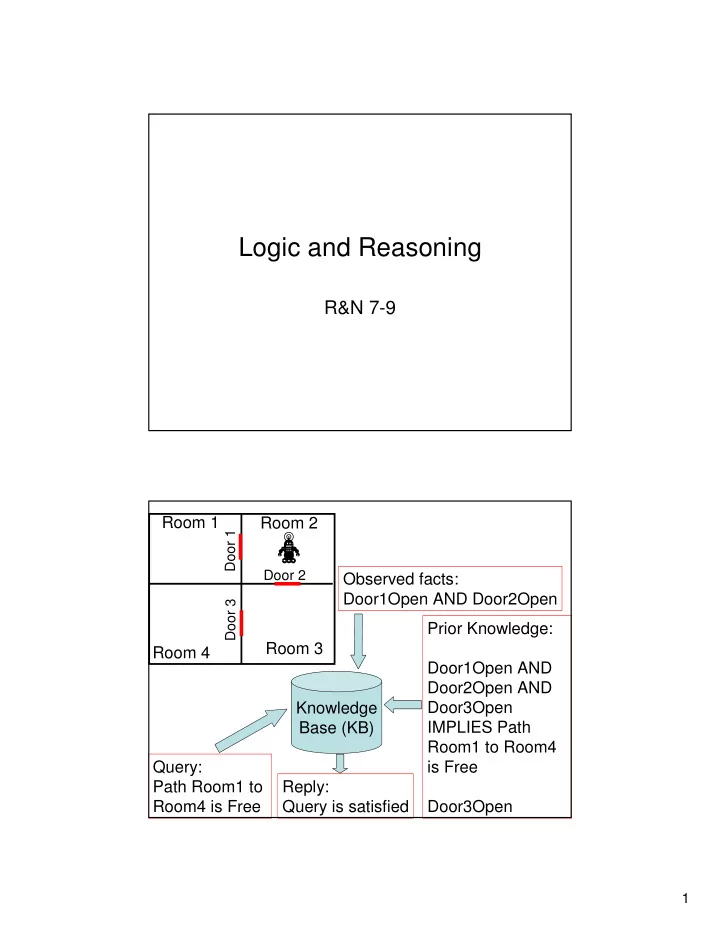
Logic and Reasoning R&N 7-9 Room 1 Room 2 Door 1 Door 2 Observed facts: Door1Open AND Door2Open Door 3 Prior Knowledge: Room 3 Room 4 Door1Open AND Door2Open AND Door3Open Knowledge Base (KB) IMPLIES Path Room1 to Room4 Query:


slide-1
SLIDE 1

1

Logic and Reasoning

R&N 7-9

Observed facts: Door1Open AND Door2Open Prior Knowledge: Door1Open AND Door2Open AND Door3Open IMPLIES Path Room1 to Room4 is Free Door3Open Room 1 Room 2 Room 3 Room 4

Door 2 Door 3 Door 1

Knowledge Base (KB) Query: Path Room1 to Room4 is Free Reply: Query is satisfied

slide-2
SLIDE 2

2

Representing Knowledge: Propositional Logic

  • Symbols
  • True, False
  • Implication: =>
  • Equivalence: <=>
  • And (conjunction): ^
  • Or (disjunction): V
  • Negation: ¬
  • Sentences = combination
  • f the symbols, truth

values, and operators

  • Literals = Symbols and

negated symbols (A and ¬A are both literals)

  • Raining => Wet
  • ¬(Busy ^ Sleeping)
  • (A ^ B) V ¬C

Knowledge Base (KB)

  • Knowledge Base (KB): a collection of sentences.
  • Model: an assignment of (True/False) values to

each of the symbols. If the knowledge base is built from n symbols, there are 2n possible models.

  • Evaluation: A sentence s is evaluated on a

model m by setting each symbol to its corresponding value in m. The result of the evaluation is a value in {True,False}

  • KB Evaluation: The result of the KB evaluation is

the conjunction of the results of the evaluations

  • f all the sentences in KB
slide-3
SLIDE 3

3

Example KB

T T T T T F T T T T F T T F F T F T T F T F T F F T F F F F F F KB C B A KB:

A C B A ∨ ¬ ∨

Logical Entailment

  • “KB logically entails S” if all the models

that evaluate KB to True also evaluate S to True.

  • Denoted by: KB |= S
  • Note: We do not care about those models

that evaluate KB to False. The result of evaluating S for these models is irrelevant.

slide-4
SLIDE 4

4

KB: S:

Example KB

T T T T T F T F T T T T T F T F T F F T F F T T F F T F T F F F T F F F F F F F S KB C B A

A C B A ∨ ¬ ∨ C A∧

KB |= S because KB is true but S is false

KB: S:

Example KB

T T T T T T T F T T T T T F T T T F F T T F T T F T T F T F T F T F F F F F F F S KB C B A

A C B A ∨ ¬ ∨

KB |= S because S is true for all the assignments for which KB is true

C B A ∨ ∨

slide-5
SLIDE 5

5

Logical Entailment KB S KB S KB S KB |= S KB |= S KB |= S

Assignments for which KB is True

Inference

  • An inference algorithm is a procedure for

deriving a sentence from the KB

  • KB |-i S means that S is inferred from KB

using algorithm i.

  • The inference algorithm is sound if it

derives only sentences that are entailed by KB.

  • The inference algorithm is complete if it

can derive any sentence that is entailed by KB.

slide-6
SLIDE 6

6

Examples

  • Examples of sound inference rules

α β α ∧

β α β α

And-Elimination. In words: if two things must be true, then either of them must be true. Modus Ponens. In words: if α implies β and α is in the KB, then β must be entailed.

β α β α ∧ ,

And-Introduction. Premise Conclusion

Inference

  • Basic problem:

– We have a KB – We have a sentence S (the “query”) – We want to check KB |= S

  • Informally, “prove” S from KB
  • Simplest approach: Model checking =

evaluate all possible settings of the symbols

  • Sound and complete (if the space of models

is finite), but 2n

slide-7
SLIDE 7

7

Definitions

  • Valid: A sentence is valid if it is true for all models.
  • Satisfiable: A sentence is satisfiable if it is true for

some models.

  • Unsatisfiable: A sentence is unsatisfiable if it is true for

no models.

  • Proof by contradiction: Given KB and a sentence S,

establishing entailment is equivalent to proving that no model exists that satisfies KB and ¬S. KB |= S equivalent to (KB ^ ¬S) unsatisfiable

α α ¬ ∨ α α ¬ ∧

Proof as Search: Model Checking

  • Enumerate values in the KB’s truth table
  • By default, exponential in the size of the KB
  • All of the CSP techniques described earlier

can be applied, in particular:

– Backtracking search – Local search (hill-climbing, min-conflicts, WalkSAT)

T T T T T F T T T T F T T F F T F T T F T F T F F T F F F F F F KB C B A

KB: A C B A ∨ ¬ ∨

slide-8
SLIDE 8

8

Proof as Search: Inference Rules

  • Proof can be viewed as a search problem

The basic search algorithms that we saw before can be used here

– State: KB – Successor: Apply inference to KB to obtain new sentences – Solution: Sequence of inferences to goal sentence. If the inference algorithm is sound, then this is guaranteed to establish entailment

  • Questions: Is there an inference algorithm that

guarantees efficient search? Will the search be complete?

Resolution

  • A sentence is in Conjunctive Normal Form

(CNF) if it is a conjunction of clauses, each clause being a disjunction of literals

  • Examples:
  • Key fact: It is always possible to convert

any KB to CNF

( ) ( ) ( )

G E J D C B A ∨ ∧ ∨ ∨ ∧ ∨

Clause Clause Clause

slide-9
SLIDE 9

9

CNF Conversion

β α β α ∨ ¬

) ( β α ∧ ¬ β α ¬ ∨ ¬ ) ( β α ∨ ¬ β α ¬ ∧ ¬

( ) ( )

α β β α

  • β

α ⇔

C B A

) (

1. 2. 3. 4.

) ( C B A ∨ ¬ ∨ ¬ C B A ∨ ∧ ¬ ) (

1.

C B A ∨ ¬ ∨ ¬ ) (

3.

To CNF

Resolution

  • In words: If a literal appears in one clause and

its negation in the other one, the two clauses can be merged and that literal can be discarded.

n i i i n i

A A A A A A A A ∨ ∨ ∨ ∨ ∨ ¬ ∨ ∨ ∨ ∨

+ −

  • 1

1 1 1

slide-10
SLIDE 10

10

Resolution

  • In words: If a symbol appears in one clause and

its negation in the other one, the two clause can be merged and that symbol can be discarded.

m l l n i i m i n i

B B B B A A A A B A B A A A ∨ ∨ ∨ ∨ ∨ ∨ ∨ ∨ ∨ ∨ ∨ ∨ ∨ ¬ ∨ ∨ ∨ ∨ ∨ ∨

+ − + −

  • 1

1 1 1 1 1 1 1

Resolution Algorithm (In words)

  • Suppose that KB ^ ¬S is in normal form.
  • If KB entails S, then there should be a sequence
  • f inferences through resolution that will lead to

at least one clause that cannot be satisfied by any model

  • Idea: Keep apply resolution to all the pairs of

clauses in KB ^ ¬S until:

– We can’t find anymore clauses to resolve KB does not entail S – We found an empty clause (which cannot be satisfied by any model) KB does entail S

slide-11
SLIDE 11

11

Door1Open ^ Door2Open => Room2Reachable ¬ Weekend => Door2Open ¬ Weekend ^ Door1Open Query: Room2Reachable ¬ Door1Open V ¬ Door2Open V Room2Reachable Weekend V Door2Open ¬ Weekend ^ Door1Open ¬ Room2Reachable ¬ Door1Open V ¬ Door2Open Door1Open ^ Door2Open ¬ Door2Open ^ Door2Open EMPTY Door1Open ^ Door2Open => Room2Reachable ¬ Weekend => Door2Open ¬ Weekend ^ Door1Open Query: Room2Reachable ¬ Door1Open V ¬ Door2Open V Room2Reachable Weekend V Door2Open ¬ Weekend ^ Door1Open ¬ Room2Reachable ¬ Door1Open V ¬ Door2Open Door1Open ^ Door2Open ¬ Door2Open ^ Door2Open EMPTY

Convert to CNF Add negated query KB |= Room2Reachable because we reach an empty clause

slide-12
SLIDE 12

12

Resolution Algorithm

  • Input: KB and S
  • Output: True if KB entails S, False otherwise
  • Initialize: Clauses  CNF(KB ^ ¬S)

– Repeat:

  • For each pair of clauses Ci and Cj in Clauses

– R  Resolution(Ci, Cj) – If R contains the empty clause: Return True – new  new U R

  • If Clauses contains new: Return False
  • Clauses  Clauses U new

Resolution: Property

  • Resolution is sound: Always produces

sentences that are entailed by their premise

  • Resolution is complete: It is guarantee to

establish entailment of the query in finite time

  • Completeness based on the key theorem: If

a set of clauses is unsatisfiable, then the set

  • f all clauses that can be obtained by

resolution contains the empty clause

  • So, conversely, if we cannot find the empty

clause, the query must be satisfiable

slide-13
SLIDE 13

13

Resolution can be Used to Check Consistency of a KB

  • Repeat: Resolve pairs of sentences from

the KB until

– No more sentences can be produced KB is consistent (satisfiable) – A unsatisfiable sentence is produced KB is inconsistent

Human => Mortal Peter => Human ¬ Human V Mortal ¬ Peter V Human ¬ Peter V Mortal

KB CNF

Resolution Human => Mortal Peter ^ Mortal => False Peter => Human Peter ¬Human V Mortal ¬Peter V Human ¬Peter V ¬ Mortal V False Peter ¬Peter V ¬Human V False ¬Peter V False False

slide-14
SLIDE 14

14

Chaining

  • “Special” case: The KB contains only two types
  • f sentences:

– Symbols – Sentences of the form: (conjunction) => symbol

Sentences of this type are “Horn clauses”

( )

B A A

n

∧ ∧

1

Chaining

  • Basic inference mechanism (“Modus Ponens”):
  • Basic idea: Given KB and a symbol S

– Forward chaining: Repeatedly apply the inference rule to KB until we get to S – Backward chaining: Start from S and find implications whose conclusions are S

Sentences of this type are “Horn clauses”

B A A B A A

n n

∧ ∧

  • 1

1

slide-15
SLIDE 15

15

Forward Chaining

Counter = number of symbols on left hand-side If Counter = 0Infer symbol on right-hand side, B

B A A

n

∧ ∧

1

Forward Chaining

  • Maintain a current list of symbols from KB
  • Initialize a counter for each clause in KB =

number of symbols on the left-hand side

  • Repeat:

– Get the next symbol P from the queue – If P = S

  • We are done, KB |= S

– Else

  • Decrease the counter of each clause in which P

appear in the left-hand side

  • If the counter is 0: Add the right-hand side of the

clause to the list

slide-16
SLIDE 16

16

Forward Chaining P => Q L ^ M => P B ^ L => M A ^ P => L A ^ B => L A B Forward Chaining P => Q L ^ M => P B ^ L => M A ^ P => L A ^ B => L A B

slide-17
SLIDE 17

17

Forward Chaining P => Q L ^ M => P B ^ L => M A ^ P => L A ^ B => L A B Forward Chaining P => Q L ^ M => P B ^ L => M A ^ P => L A ^ B => L A B

slide-18
SLIDE 18

18

Forward Chaining P => Q L ^ M => P B ^ L => M A ^ P => L A ^ B => L A B Forward Chaining P => Q L ^ M => P B ^ L => M A ^ P => L A ^ B => L A B

slide-19
SLIDE 19

19

Forward Chaining P => Q L ^ M => P B ^ L => M A ^ P => L A ^ B => L A B Forward Chaining P => Q L ^ M => P B ^ L => M A ^ P => L A ^ B => L A B

slide-20
SLIDE 20

20

Forward/Backward Chaining

  • Both algorithms are

– Sound (valid inferences) – Complete (every entailed symbol can be derived)

  • Both algorithms are linear in the size of the

knowledge base

  • Forward=data-driven: Start with the data (KB)

and draw conclusions (entailed symbol) through logical inferences

  • Backward=goal-driven: Start with the goal

(entailed symbol) and check backwards if it can be generated by an inference rule

Summary

  • Knowledge base (KB) as list of sentences
  • Entailment verifies that query sentence is

consistent with KB

  • Establishing entailment by direct model checking

is exponential in the size of the KB, but:

– If KB is in CNF form (always possible): Resolution is a sound and complete procedure – If KB is composed of Horn clauses: – Forward and backward checking algorithms are linear, and are sound and complete

  • Shown so far using a restricted representation

(propositional logic)

  • What is the problem with using these tools for

reasoning in real-world scenarios?