Surface Representations Leif Kobbelt RWTH Aachen University 1 - - PowerPoint PPT Presentation
surface representations
SMART_READER_LITE
LIVE PREVIEW

Surface Representations Leif Kobbelt RWTH Aachen University 1 - - PowerPoint PPT Presentation


slide-1
SLIDE 1
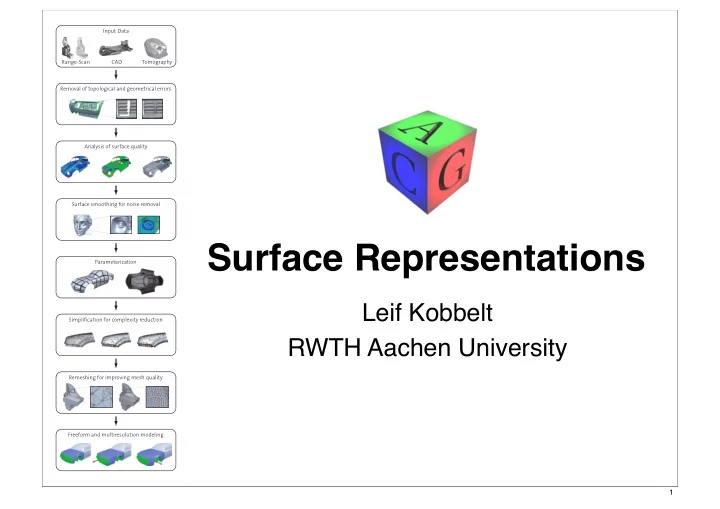
  • Surface Representations

Leif Kobbelt RWTH Aachen University

1

slide-2
SLIDE 2

Leif Kobbelt RWTH Aachen University

Outline

  • (mathematical) geometry representations

– parametric vs. implicit

  • approximation properties
  • types of operations

– distance queries – evaluation – modification / deformation

  • data structures

2

2

slide-3
SLIDE 3

Leif Kobbelt RWTH Aachen University

  • (mathematical) geometry representations

– parametric vs. implicit

  • approximation properties
  • types of operations

– distance queries – evaluation – modification / deformation

  • data structures

Outline

3

3

slide-4
SLIDE 4

Leif Kobbelt RWTH Aachen University

Mathematical Representations

  • parametric

– range of a function – surface patch

  • implicit

– kernel of a function – level set

4

f : R2 → R3, SΩ = f(Ω) F : R3 → R, Sc = {p : F(p) = c}

4

slide-5
SLIDE 5

Leif Kobbelt RWTH Aachen University

2D-Example: Circle

  • parametric
  • implicit

5

f : t → r cos(t) r sin(t)

  • ,

S = f([0, 2π]) F(x, y) = x2 + y2 − r2 S = {(x, y) : F(x, y) = 0}

5

slide-6
SLIDE 6

Leif Kobbelt RWTH Aachen University

  • parametric
  • implicit

2D-Example: Island

6

f : t → r cos(t) r sin(t)

  • ,

S = f([0, 2π]) F(x, y) = x2 + y2 − r2 S = {(x, y) : F(x, y) = 0} ??? ??? ???

6

slide-7
SLIDE 7

Leif Kobbelt RWTH Aachen University

  • piecewise parametric
  • piecewise implicit

Approximation Quality

7

f : t → r cos(t) r sin(t)

  • ,

S = f([0, 2π]) F(x, y) = x2 + y2 − r2 S = {(x, y) : F(x, y) = 0} ??? ??? ???

7

slide-8
SLIDE 8

Leif Kobbelt RWTH Aachen University

  • piecewise parametric
  • piecewise implicit

Approximation Quality

8

f : t → r cos(t) r sin(t)

  • ,

S = f([0, 2π]) F(x, y) = x2 + y2 − r2 S = {(x, y) : F(x, y) = 0} ??? ??? ???

8

slide-9
SLIDE 9

Leif Kobbelt RWTH Aachen University

Requirements / Properties

  • continuity

– interpolation / approximation

  • topological consistency

– manifold-ness

  • smoothness

– C0, C1, C2, ... Ck

  • fairness

– curvature distribution

9

f(ui, vi) ≈ pi

9

slide-10
SLIDE 10

Leif Kobbelt RWTH Aachen University

  • continuity

– interpolation / approximation

  • topological consistency

– manifold-ness

  • smoothness

– C0, C1, C2, ... Ck

  • fairness

– curvature distribution

Requirements / Properties

10

f(ui, vi) ≈ pi

10

slide-11
SLIDE 11

Leif Kobbelt RWTH Aachen University

Requirements / Properties

  • continuity

– interpolation / approximation

  • topological consistency

– manifold-ness

  • smoothness

– C0, C1, C2, ... Ck

  • fairness

– curvature distribution

11

f(ui, vi) ≈ pi

11

slide-12
SLIDE 12

Leif Kobbelt RWTH Aachen University

  • continuity

– interpolation / approximation

  • topological consistency

– manifold-ness

  • smoothness

– C0, C1, C2, ... Ck

  • fairness

– curvature distribution

Requirements / Properties

12

f(ui, vi) ≈ pi

12

slide-13
SLIDE 13

Leif Kobbelt RWTH Aachen University

  • continuity

– interpolation / approximation

  • topological consistency

– manifold-ness

  • smoothness

– C0, C1, C2, ... Ck

  • fairness

– curvature distribution

Requirements / Properties

13

f(ui, vi) ≈ pi

13

slide-14
SLIDE 14

Leif Kobbelt RWTH Aachen University

Topological Consistency

14

14

slide-15
SLIDE 15

Leif Kobbelt RWTH Aachen University

Topological Consistency

14

14

slide-16
SLIDE 16

Leif Kobbelt RWTH Aachen University

Topological Consistency

14

Mesh Repair ...

14

slide-17
SLIDE 17

Leif Kobbelt RWTH Aachen University

Closed 2-Manifolds

  • parametric

– disk-shaped neighborhoods – + injectivity

  • implicit

– surface of a “physical” solid –

15

f(Dε[u, v]) = Dδ[f(u, v)] F(x, y, z) = c, ∇F(x, y, z) = 0

15

slide-18
SLIDE 18

Leif Kobbelt RWTH Aachen University

Closed 2-Manifolds

  • parametric

– disk-shaped neighborhoods – + injectivity

  • implicit

– surface of a “physical” solid –

16

f(Dε[u, v]) = Dδ[f(u, v)] F(x, y, z) = c, ∇F(x, y, z) = 0

16

slide-19
SLIDE 19

Leif Kobbelt RWTH Aachen University

Closed 2-Manifolds

  • parametric

– disk-shaped neighborhoods – + injectivity

  • implicit

– surface of a “physical” solid –

17

f(Dε[u, v]) = Dδ[f(u, v)] F(x, y, z) = c, ∇F(x, y, z) = 0

17

slide-20
SLIDE 20

Leif Kobbelt RWTH Aachen University

Closed 2-Manifolds

  • parametric

– disk-shaped neighborhoods –

  • implicit

– surface of a “physical” solid –

18

f(Dε[u, v]) = Dδ[f(u, v)] F(x, y, z) = c, ∇F(x, y, z) = 0

18

slide-21
SLIDE 21

Leif Kobbelt RWTH Aachen University

Closed 2-Manifolds

  • parametric

– disk-shaped neighborhoods –

  • implicit

– surface of a “physical” solid –

19

f(Dε[u, v]) = Dδ[f(u, v)] F(x, y, z) = c, ∇F(x, y, z) = 0

19

slide-22
SLIDE 22

Leif Kobbelt RWTH Aachen University

Smoothness

  • position continuity : C0
  • tangent continuity : C1
  • curvature continuity : C2

20

20

slide-23
SLIDE 23

Leif Kobbelt RWTH Aachen University

Smoothness

  • position continuity : C0
  • tangent continuity : C1
  • curvature continuity : C2

21

21

slide-24
SLIDE 24

Leif Kobbelt RWTH Aachen University

Smoothness

  • position continuity : C0
  • tangent continuity : C1
  • curvature continuity : C2

22

22

slide-25
SLIDE 25

Leif Kobbelt RWTH Aachen University

Fairness

  • minimum surface area
  • minimum curvature
  • minimum curvature variation

23

23

slide-26
SLIDE 26

Leif Kobbelt RWTH Aachen University

  • (mathematical) geometry representations

– parametric vs. implicit

  • approximation properties
  • types of operations

– distance queries – evaluation – modification / deformation

  • data structures

Outline

24

24

slide-27
SLIDE 27

Leif Kobbelt RWTH Aachen University

Polynomials

  • computable functions
  • Taylor expansion
  • interpolation error (mean value theorem)

25

p(t) =

p

  • i=0

ci ti =

p

  • i=0

c

i Φi(t) p(ti) = f(ti), ti ∈ [0, h] f(h) =

p

  • i=0

1 i! f (i)(0) hi + O(hp+1) f(t) − p(t) = 1 (p + 1)! f (p+1)(t∗)

p

  • i=0

(t − ti) = O(h(p+1))

25

slide-28
SLIDE 28

Leif Kobbelt RWTH Aachen University

  • computable functions
  • Taylor expansion
  • interpolation error (mean value theorem)

Polynomials

26

p(ti) = f(ti), ti ∈ [0, h] p(t) =

p

  • i=0

ci ti =

p

  • i=0

c

i Φi(t)

f(t) − p(t) = 1 (p + 1)! f (p+1)(t∗)

p

  • i=0

(t − ti) = O(h(p+1))

f(h) =

p

  • i=0

1 i! f (i)(0) hi + O(hp+1)

26

slide-29
SLIDE 29

Leif Kobbelt RWTH Aachen University

Polynomials

  • computable functions
  • Taylor expansion
  • interpolation error (mean value theorem)

27

p(ti) = f(ti), ti ∈ [0, h]

p(t) =

p

  • i=0

ci ti =

p

  • i=0

c

i Φi(t)

f(h) =

p

  • i=0

1 i! f (i)(0) hi + O(hp+1)

f(t) − p(t) = 1 (p + 1)! f (p+1)(t∗)

p

  • i=0

(t − ti) = O(h(p+1))

27

slide-30
SLIDE 30

Leif Kobbelt RWTH Aachen University

Implicit Polynomials

  • interpolation error of the function values
  • approximation error of the contour

28

F(p + p) − F(p) p ≈ ∇F(p) p = λ ∇F(p) F(x, y, z) − P(x, y, z) = O(h(p+1))

28

slide-31
SLIDE 31

Leif Kobbelt RWTH Aachen University

Implicit Polynomials

  • interpolation error of the function values
  • approximation error of the contour

29

F(p + p) − F(p) p ≈ ∇F(p) p = λ ∇F(p) F(x, y, z) − P(x, y, z) = O(h(p+1))

p p+Δp

29

slide-32
SLIDE 32

Leif Kobbelt RWTH Aachen University

Implicit Polynomials

  • interpolation error of the function values
  • approximation error of the contour

30

p ≈ F(p + p) − F(p) ∇F(p) p = λ ∇F(p) (gradient bounded from below) F(x, y, z) − P(x, y, z) = O(h(p+1))

p p+Δp

30

slide-33
SLIDE 33

Leif Kobbelt RWTH Aachen University

Implicit Polynomials

31

large gradient small gradient F(x,y,z) F(x,y,z) x,y,z x,y,z

31

slide-34
SLIDE 34

Leif Kobbelt RWTH Aachen University

Polynomial Approximation

  • approximation error is O(hp+1)
  • improve approximation quality by

– increasing p ... higher order polynomials – decreasing h ... smaller / more segments

  • issues

– smoothness of the target data ( maxt f(p+1)(t) ) – handling higher order patches (e.g. boundary conditions)

32

32

slide-35
SLIDE 35

Leif Kobbelt RWTH Aachen University

Polynomial Approximation

  • approximation error is O(hp+1)
  • improve approximation quality by

– increasing p ... higher order polynomials – decreasing h ... smaller / more segments

  • issues

– smoothness of the target data ( maxt f(p+1)(t) ) – handling higher order patches (e.g. boundary conditions)

33

M O T D : p = 1 M O T D : p = 1

33

slide-36
SLIDE 36

Leif Kobbelt RWTH Aachen University

Piecewise Definition

  • parametric

– Euler formula: V - E + F = 2 (1-g) – regular quad meshes

  • F ≈ V
  • E ≈ 2V
  • average valence = 4

– quasi-regular – semi-regular

34

34

slide-37
SLIDE 37

Leif Kobbelt RWTH Aachen University

Piecewise Definition

  • parametric

– Euler formula: V - E + F = 2 (1-g) – regular triangle meshes

  • F ≈ 2V
  • E ≈ 3V
  • average valence = 6

– quasi-regular – semi-regular

35

35

slide-38
SLIDE 38

Leif Kobbelt RWTH Aachen University

Piecewise Definition

  • quasi regular (→ remeshing, Pierre)

36

36

slide-39
SLIDE 39

Leif Kobbelt RWTH Aachen University

Piecewise Definition

  • semi regular

37

37

slide-40
SLIDE 40

Leif Kobbelt RWTH Aachen University

Piecewise Definition

  • semi regular

38

38

slide-41
SLIDE 41

Leif Kobbelt RWTH Aachen University

Piecewise Definition

  • implicit

– regular voxel grids O(h-3) – three color octrees

  • surface-adaptive refinement O(h-2)
  • feature-adaptive refinement O(h-1)

– irregular hierarchies

  • binary space partition O(h-1)

(BSP)

39

39

slide-42
SLIDE 42

Leif Kobbelt RWTH Aachen University

3-Color Octree

40

12040 cells 1048576 cells

40

slide-43
SLIDE 43

Leif Kobbelt RWTH Aachen University

Adaptively Sampled Distance Fields

41

12040 cells 895 cells

41

slide-44
SLIDE 44

Leif Kobbelt RWTH Aachen University

Binary Space Partitions

42

254 cells 895 cells

42

slide-45
SLIDE 45

Leif Kobbelt RWTH Aachen University

Message of the Day ...

  • polygonal meshes are a good compromise

– approximation O(h2) ... error * #faces = const. – arbitrary topology – flexibility for piecewise smooth surfaces – flexibility for adaptive refinement

43

43

slide-46
SLIDE 46

Leif Kobbelt RWTH Aachen University

Message of the Day ...

  • polygonal meshes are a good compromise

– approximation O(h2) ... error * #faces = const. – arbitrary topology – flexibility for piecewise smooth surfaces – flexibility for adaptive refinement

44

44

slide-47
SLIDE 47

Leif Kobbelt RWTH Aachen University

Message of the Day ...

  • polygonal meshes are a good compromise

– approximation O(h2) ... error * #faces = const. – arbitrary topology – flexibility for piecewise smooth surfaces – flexibility for adaptive refinement

45

45

slide-48
SLIDE 48

Leif Kobbelt RWTH Aachen University

Message of the Day ...

  • polygonal meshes are a good compromise

– approximation O(h2) ... error * #faces = const. – arbitrary topology – flexibility for piecewise smooth surfaces – flexibility for adaptive refinement

46

46

slide-49
SLIDE 49

Leif Kobbelt RWTH Aachen University

Message of the Day ...

  • polygonal meshes are a good compromise

– approximation O(h2) ... error * #faces = const. – arbitrary topology – flexibility for piecewise smooth surfaces – flexibility for adaptive refinement – efficient rendering

47

47

slide-50
SLIDE 50

Leif Kobbelt RWTH Aachen University

Message of the Day ...

  • polygonal meshes are a good compromise

– approximation O(h2) ... error * #faces = const. – arbitrary topology – flexibility for piecewise smooth surfaces – flexibility for adaptive refinement – efficient rendering

  • implicit representation can support efficient

access to vertices, faces, ....

48

48

slide-51
SLIDE 51

Leif Kobbelt RWTH Aachen University

  • (mathematical) geometry representations

– parametric vs. implicit

  • approximation properties
  • types of operations

– evaluation – distance queries – modification / deformation

  • data structures

Outline

49

49

slide-52
SLIDE 52

Leif Kobbelt RWTH Aachen University

Evaluation

  • smooth parametric surfaces

– positions – normals – curvatures

50

f(u, v) n(u, v) = fu(u, v) × fv(u, v) c(u, v) = C

  • fuu(u, v), fuv(u, v), fvv(u, v)
  • 50
slide-53
SLIDE 53

Leif Kobbelt RWTH Aachen University

Evaluation

  • smooth parametric surfaces

– positions – normals – curvatures

  • generalization to triangle meshes

– positions (barycentric coordinates)

51

(α, β) → α P1 + β P2 + (1−α−β) P3

f(u, v) n(u, v) = fu(u, v) × fv(u, v) c(u, v) = C

  • fuu(u, v), fuv(u, v), fvv(u, v)
  • 0 ≤ α,

0 ≤ β, α + β ≤ 1

51

slide-54
SLIDE 54

Leif Kobbelt RWTH Aachen University

Evaluation

  • smooth parametric surfaces

– positions – normals – curvatures

  • generalization to triangle meshes

– positions (barycentric coordinates)

52

(α, β, γ) → α P1 + β P2 + γ P3

f(u, v) n(u, v) = fu(u, v) × fv(u, v) c(u, v) = C

  • fuu(u, v), fuv(u, v), fvv(u, v)
  • α + β + γ = 1

52

slide-55
SLIDE 55

Leif Kobbelt RWTH Aachen University

Evaluation

  • smooth parametric surfaces

– positions – normals – curvatures

  • generalization to triangle meshes

– positions (barycentric coordinates)

53

α u + β v + γ w → α P1 + β P2 + γ P3

f(u, v) n(u, v) = fu(u, v) × fv(u, v) c(u, v) = C

  • fuu(u, v), fuv(u, v), fvv(u, v)
  • α + β + γ = 0

53

slide-56
SLIDE 56

Leif Kobbelt RWTH Aachen University

Evaluation

  • smooth parametric surfaces

– positions – normals – curvatures

  • generalization to triangle meshes

– positions (barycentric coordinates)

54

α u + β v + γ w → α P1 + β P2 + γ P3

f(u, v) n(u, v) = fu(u, v) × fv(u, v) c(u, v) = C

  • fuu(u, v), fuv(u, v), fvv(u, v)
  • α + β + γ = 0

→ Parametrization Bruno

54

slide-57
SLIDE 57

Leif Kobbelt RWTH Aachen University

Evaluation

  • smooth parametric surfaces

– positions – normals – curvatures

  • generalization to triangle meshes

– positions (barycentric coordinates) – normals (per face, Phong)

55

f(u, v) n(u, v) = fu(u, v) × fv(u, v) c(u, v) = C

  • fuu(u, v), fuv(u, v), fvv(u, v)
  • N = (P2 − P1) × (P3 − P1)

55

slide-58
SLIDE 58

Leif Kobbelt RWTH Aachen University

Evaluation

  • smooth parametric surfaces

– positions – normals – curvatures

  • generalization to triangle meshes

– positions (barycentric coordinates) – normals (per face, Phong)

56

f(u, v) n(u, v) = fu(u, v) × fv(u, v) c(u, v) = C

  • fuu(u, v), fuv(u, v), fvv(u, v)
  • α u + β v + γ w → α N1 + β N2 + γ N3

56

slide-59
SLIDE 59

Leif Kobbelt RWTH Aachen University

Evaluation

  • smooth parametric surfaces

– positions – normals – curvatures

  • generalization to triangle meshes

– positions (barycentric coordinates) – normals (per face, Phong) – curvatures ... (→ smoothing, Mark)

57

f(u, v) n(u, v) = fu(u, v) × fv(u, v) c(u, v) = C

  • fuu(u, v), fuv(u, v), fvv(u, v)
  • 57
slide-60
SLIDE 60

Leif Kobbelt RWTH Aachen University

Distance Queries

  • parametric

– for smooth surfaces: find orthogonal base point – for triangle meshes

  • use kd-tree or BSP to find closest triangle
  • find base point by Newton iteration

(use Phong normal field)

58

[p − f(u, v)] × n(u, v) = 0

58

slide-61
SLIDE 61

Leif Kobbelt RWTH Aachen University

Modifications

  • parameteric

– control vertices – free-form deformation – boundary constraint modeling

59

f (u, v) =

n

  • i=0

m

  • j=0

cijN n

i (u) N m j (v)

59

slide-62
SLIDE 62

Leif Kobbelt RWTH Aachen University

Modifications

  • parameteric

– control vertices – free-form deformation – boundary constraint modeling

60

f (u, v) =

n

  • i=0

m

  • j=0

cijN n

i (u) N m j (v)

60

slide-63
SLIDE 63

Leif Kobbelt RWTH Aachen University

  • parameteric

– control vertices – free-form deformation – boundary constraint modeling

Modifications

61

→ Remeshing Pierre

61

slide-64
SLIDE 64

Leif Kobbelt RWTH Aachen University

  • parameteric

– control vertices – free-form deformation – boundary constraint modeling

Modifications

62

62

slide-65
SLIDE 65

Leif Kobbelt RWTH Aachen University

  • parameteric

– control vertices – free-form deformation – boundary constraint modeling

Modifications

63

63

slide-66
SLIDE 66

Leif Kobbelt RWTH Aachen University

  • parameteric

– control vertices – free-form deformation – boundary constraint modeling

Modifications

63

63

slide-67
SLIDE 67

Leif Kobbelt RWTH Aachen University

  • parameteric

– control vertices – free-form deformation – boundary constraint modeling

Modifications

64

→ Mesh Editing Mario

64