Surface Ozone Trends at Cape Grim 41 S: producing a homogenous data - - PowerPoint PPT Presentation

surface ozone trends at cape grim 41 s producing a
SMART_READER_LITE
LIVE PREVIEW

Surface Ozone Trends at Cape Grim 41 S: producing a homogenous data - - PowerPoint PPT Presentation

Surface Ozone Trends at Cape Grim 41 S: producing a homogenous data set and interpreting the results Melita Keywood on behalf of Ian Galbally 39 th NOAA ESRL Global Monitoring Annual Conference 17 May 2011 The Centre for Australian Weather and


slide-1
SLIDE 1

The Centre for Australian Weather and Climate Research

A partnership between CSIRO and the Bureau of Meteorology

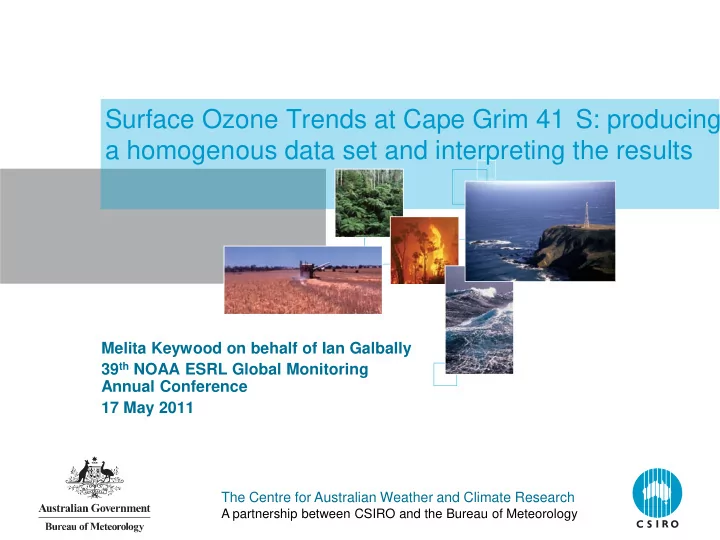
Surface Ozone Trends at Cape Grim 41 S: producing a homogenous data set and interpreting the results

Melita Keywood on behalf of Ian Galbally 39th NOAA ESRL Global Monitoring Annual Conference 17 May 2011

slide-2
SLIDE 2

The Centre for Australian Weather and Climate Research

A partnership between CSIRO and the Bureau of Meteorology NOAA-ASM May 2011

Acknowledgements

The Cape Grim program, established by the Australian Government to monitor and study global atmospheric composition, is a joint responsibility of the Bureau of Meteorology and the CSIRO Staff (past and present) involved on the ozone program include: CSIRO: Ian Galbally, Suzie Molloy Simon Bentley, Mick Meyer, Malcolm Elsworth, Wayne Knight, Michael Douglas, Ian Morrissey, John Osborne, Jason Ward Cape Grim: Laurie Porter, Ross Paterson, Randall Wheaton, Stuart Baly, Jeremy Ward Collaboration: Sam Oltmans NOAA

slide-3
SLIDE 3

The Centre for Australian Weather and Climate Research

A partnership between CSIRO and the Bureau of Meteorology NOAA-ASM May 2011

Do we understand:

  • the distribution of ozone source and sink

regions in the southern hemisphere troposphere?

The scientific challenge: can we

  • bserve, explain and predict:
  • the current distribution of ozone in

the troposphere?

  • the past and future trends in ozone

in the troposphere?

slide-4
SLIDE 4

The Centre for Australian Weather and Climate Research

A partnership between CSIRO and the Bureau of Meteorology NOAA-ASM May 2011

With changing and newly emerging technologies can/did we maintain an atmospheric ozone record

  • ver 30-50 years that:
  • is a representative record of ozone in the

marine boundary layer upwind of Cape Grim

  • has internal consistency such that ozone

variations on timescales from hours to decades are recorded with minimum and unchanging, or quantified, bias over the period of the record

The Technical Challenge

slide-5
SLIDE 5

The Centre for Australian Weather and Climate Research

A partnership between CSIRO and the Bureau of Meteorology

Cape Grim Ozone Equipment 1982 - 2010

  • 3 Ozone monitors
  • 3 Inlets
  • Chart based, magnetic cassette and computer

based analog and digital data acquisition

  • 3 sets of data reduction software
  • 3 Zero and Span units
  • 2 Calibrators
  • 3 International calibrations

NOAA-ASM May 2011

slide-6
SLIDE 6

The Centre for Australian Weather and Climate Research

A partnership between CSIRO and the Bureau of Meteorology NOAA-ASM May 2011

Cape Grim May 1978

slide-7
SLIDE 7

The Centre for Australian Weather and Climate Research

A partnership between CSIRO and the Bureau of Meteorology NOAA-ASM May 2011

Cape Grim Ozone System 2009

slide-8
SLIDE 8

The Centre for Australian Weather and Climate Research

A partnership between CSIRO and the Bureau of Meteorology NOAA-ASM May 2011

slide-9
SLIDE 9

The Centre for Australian Weather and Climate Research

A partnership between CSIRO and the Bureau of Meteorology NOAA-ASM May 2011

The long term trend

slide-10
SLIDE 10

The Centre for Australian Weather and Climate Research

A partnership between CSIRO and the Bureau of Meteorology

Cape Grim Surface Ozone Yearly Trend Analysis based on monthly anomalies. Units: Intercept – ppb. Slope = β1 - ppb/y. CI = 95%

slide-11
SLIDE 11

The Centre for Australian Weather and Climate Research

A partnership between CSIRO and the Bureau of Meteorology

Cape Grim Surface Ozone Seasonal Trend Analysis based on monthly anomalies.

  • Surface ozone in Austral spring (SON) and

summer (DJF) show positive trends in the 1980’s and 1990’s and non-significant trends in the 2000’s and positive trends over the three decades combined

  • Surface ozone in Austral autumn (MAM) and

winter (JJA) show non-significant trends in each

  • f the three decades. Over the three decades

there are ambivalent results concerning an upward trend in these seasons.

slide-12
SLIDE 12

The Centre for Australian Weather and Climate Research

A partnership between CSIRO and the Bureau of Meteorology

slide-13
SLIDE 13

The Centre for Australian Weather and Climate Research

A partnership between CSIRO and the Bureau of Meteorology

Cape Grim Surface Ozone monthly anomalies vs SOI (ENSO) and SAM.

  • Correlation with SOI (ENSO) (r)
  • DJF (Summer) = +0.246 (n = 83)
  • MAM (Autumn) = +0.371 (n = 83)
  • JJA (Winter) = +0.171 (n = 83) n.s.
  • SON (Spring) = +0.384 (n = 83)
  • More intense convection in the Australian region

tropics is associated with positive ozone anomalies at Cape Grim

  • Correlation with SAM = not significant
slide-14
SLIDE 14

The Centre for Australian Weather and Climate Research

A partnership between CSIRO and the Bureau of Meteorology

Possible explanations of southern hemisphere tropospheric ozone trends (1)

  • Increased NOx, VOC and CO emissions from

biomass burning causing the surface ozone increase in the South Atlantic region from 1970’s to present

  • Increased NOx emissions from shipping causing

the surface ozone increase in the Southern Hemisphere from 1970’s to present

NOAA-ASM May 2011

slide-15
SLIDE 15

The Centre for Australian Weather and Climate Research

A partnership between CSIRO and the Bureau of Meteorology

Possible explanations of southern hemisphere tropospheric ozone trends (2)

  • Stratospheric ozone depletion causing increased

tropospheric uv causing downward surface

  • zone trend from 1980’s to present at the South

Pole?

  • Unidentified circulation changes:
  • latitude of high pressure belt,
  • mid latitude vertical overturning,
  • changed strat-trop exchange?

NOAA-ASM May 2011

slide-16
SLIDE 16

Thank you

The Centre for Australian Weather and Climate Research

A partnership between CSIRO and the Bureau of Meteorology

Thank you

www.cawcr.gov.au

The challenge now is to find a key in the ozone record that indicates what has caused the changed concentrations.