Black Carbon Measurements at the Cape Grim Baseline Air Pollution - - PowerPoint PPT Presentation

black carbon measurements at the cape grim baseline air
SMART_READER_LITE
LIVE PREVIEW

Black Carbon Measurements at the Cape Grim Baseline Air Pollution - - PowerPoint PPT Presentation

Black Carbon Measurements at the Cape Grim Baseline Air Pollution Station, Tasmania Fabienne Reisen * , John Gras, Jason Ward, Melita Keywood Global Monitoring Annual Conference, Boulder CO 23 May 2017 OCEANS & ATMOSPHERE Cape Grim Baseline

slide-1
SLIDE 1

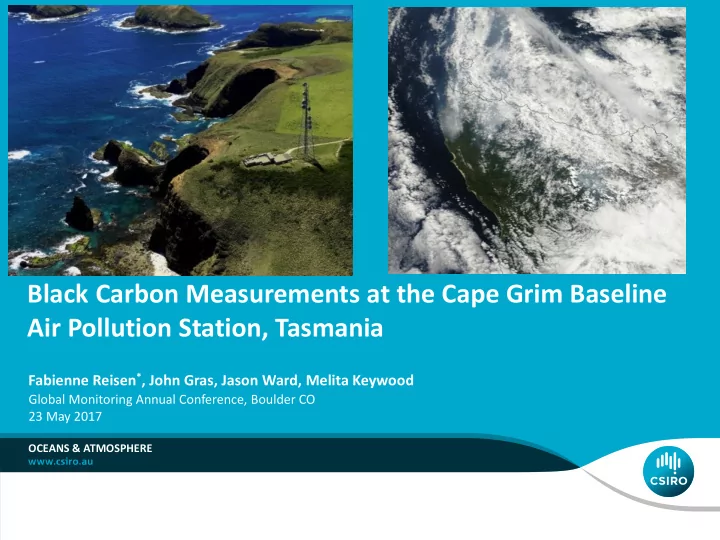
Black Carbon Measurements at the Cape Grim Baseline Air Pollution Station, Tasmania

OCEANS & ATMOSPHERE

Fabienne Reisen*, John Gras, Jason Ward, Melita Keywood

Global Monitoring Annual Conference, Boulder CO 23 May 2017

slide-2
SLIDE 2

Cape Grim Baseline Air Pollution Station Black carbon measurements

Black carbon measurements at Cape Grim| Fabienne Reisen 2 |

Year Instrument 1990-2007 Aethalometer- Magee Scientific AE10 2007 Thermo MAAP 5012 (670nm) Sep 2015 Photoacoustic Extinctiometer DMT PAX – 870nm June 2016 Tricolor Absorption Photometer (TAP-NOAA/Brechtel) 10m mast via 18 mm diameter

  • utlet

RH controlled heater (RH < 40%) BGI 1 μm VSCC

slide-3
SLIDE 3

Initial climatology of BC (1990-1997)

Black carbon measurements at Cape Grim| Fabienne Reisen 3 |

  • Main contributors to BC:

Northern TAS and Melbourne/eastern VIC (peak BC autumn/winter)

  • Baseline conditions:

peak BC in spring attributed to long-range transport of smoke

  • Baseline sector:

potentially wind-related artefacts due to scattering

  • r re-suspended soil
slide-4
SLIDE 4

Origins of air masses at Cape Grim

Black carbon measurements at Cape Grim| Fabienne Reisen 4 |

Baseline sector Continental Australian sector Tasmanian sector

slide-5
SLIDE 5

What are the sources of BC at Cape Grim?

Black carbon measurements at Cape Grim| Fabienne Reisen 5 |

continental sector Long-range transport of smoke Tasmanian sector

slide-6
SLIDE 6

Black carbon concentrations 2011-2017

Black carbon measurements at Cape Grim | Fabienne Reisen 6 |

Baseline Air

slide-7
SLIDE 7

Daily median BC – highlighting few large events

Black carbon measurements at Cape Grim | Fabienne Reisen 7 |

2011 2013 2012 2014 2015 2017 2016 1000 2000 3000

eBC (ng m-3)

20-21 May 7 April 22 March Jan/Feb 2016 7 April

slide-8
SLIDE 8

Tasmanian Fires 2016

Black carbon measurements at Cape Grim | Fabienne Reisen 8 |

At least 70 separate fires that spread quickly burning an area of ~ 100,000 ha over a 6-week period. This was one of the largest and most ecologically damaging fires to

  • ccur in Tasmania in recent history.
slide-9
SLIDE 9

Tasmanian Fires 2016

Black carbon measurements at Cape Grim | Fabienne Reisen 9 |

12 Feb 2016 25 Jan 2016

EFBC=0.3 g/kg fuel

slide-10
SLIDE 10

Potential sources of high BC

Black carbon measurements at Cape Grim | Fabienne Reisen 10 |

slide-11
SLIDE 11

High BC pollution events from continental sector

Black carbon measurements at Cape Grim | Fabienne Reisen 11 |

slide-12
SLIDE 12

High BC pollution events from continental sector

Black carbon measurements at Cape Grim | Fabienne Reisen 12 |

A A B B C C D D

slide-13
SLIDE 13

High BC levels from Tasmanian sector

Black carbon measurements at Cape Grim | Fabienne Reisen 13 |

April 2016

slide-14
SLIDE 14

Seasonal cycles for baseline sector

Black carbon measurements at Cape Grim | Fabienne Reisen 14 |

slide-15
SLIDE 15

Seasonal cycles for baseline sector

Black carbon measurements at Cape Grim | Fabienne Reisen 15 |

Additional criteria for baseline conditions: Radon < 100 mBq m-3

slide-16
SLIDE 16

Seasonal BC concentrations

Black carbon measurements at Cape Grim | Fabienne Reisen 16 |

  • Autumn peak for continental

sector – increased biomass burning from prescribed burns & woodheaters

  • Winter peak for Tasmanian

sector – domestic woodsmoke

  • Slight spring peak for baseline

sector

slide-17
SLIDE 17

Future work

  • Extend analysis of BC measurements to years prior 2011
  • Investigate long-term trend in BC concentrations at Cape Grim
  • Evaluate the TAP and PAX

Black carbon measurements at Cape Grim | Fabienne Reisen 17 |

0.4 0.8 1.2 1.6 2

MAAP eBC (µg m-3)

2 4 6 8 10 12 14

TAP Absorption coefficient

Y = 2.60 * X + 0.081 (r2 = 0.994) Y = 4.05 * X + 0.071 r2 = 0.987 Y = 5.26 * X + 0.058 r2 = 0.976

slide-18
SLIDE 18

Oceans and Atmosphere Fabienne Reisen Senior Research Scientist t +61 3 9239 4435 e fabienne.reisen@csiro.au

OCEANS AND ATMOSPHERE

Thank you