White Paper Runs Name Description baseline2018a Baseline - - PowerPoint PPT Presentation

white paper runs
SMART_READER_LITE
LIVE PREVIEW

White Paper Runs Name Description baseline2018a Baseline - - PowerPoint PPT Presentation

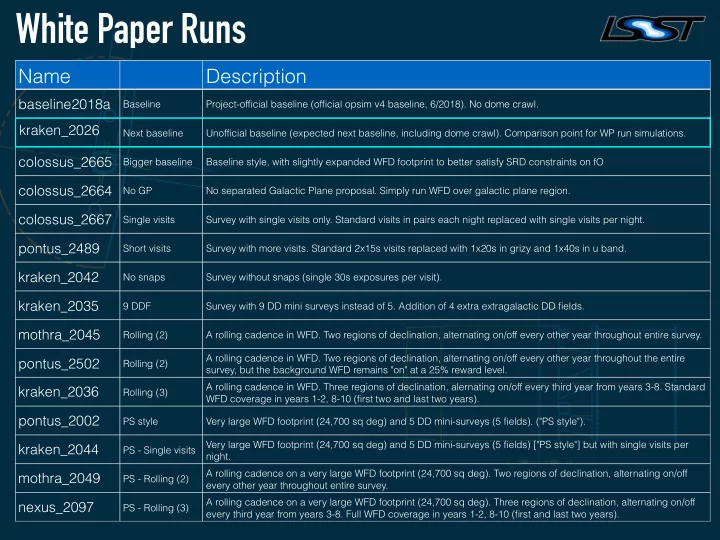
White Paper Runs Name Description baseline2018a Baseline Project-official baseline (official opsim v4 baseline, 6/2018). No dome crawl. kraken_2026 Next baseline Unofficial baseline (expected next baseline, including dome crawl). Comparison


slide-1
SLIDE 1

White Paper Runs

Name Description

baseline2018a

Baseline Project-official baseline (official opsim v4 baseline, 6/2018). No dome crawl.

kraken_2026

Next baseline Unofficial baseline (expected next baseline, including dome crawl). Comparison point for WP run simulations.

colossus_2665

Bigger baseline Baseline style, with slightly expanded WFD footprint to better satisfy SRD constraints on fO

colossus_2664

No GP No separated Galactic Plane proposal. Simply run WFD over galactic plane region.

colossus_2667

Single visits Survey with single visits only. Standard visits in pairs each night replaced with single visits per night.

pontus_2489

Short visits Survey with more visits. Standard 2x15s visits replaced with 1x20s in grizy and 1x40s in u band.

kraken_2042

No snaps Survey without snaps (single 30s exposures per visit).

kraken_2035

9 DDF Survey with 9 DD mini surveys instead of 5. Addition of 4 extra extragalactic DD fields.

mothra_2045

Rolling (2) A rolling cadence in WFD. Two regions of declination, alternating on/off every other year throughout entire survey.

pontus_2502

Rolling (2) A rolling cadence in WFD. Two regions of declination, alternating on/off every other year throughout the entire survey, but the background WFD remains "on" at a 25% reward level.

kraken_2036

Rolling (3) A rolling cadence in WFD. Three regions of declination, alernating on/off every third year from years 3-8. Standard WFD coverage in years 1-2, 8-10 (first two and last two years).

pontus_2002

PS style Very large WFD footprint (24,700 sq deg) and 5 DD mini-surveys (5 fields). ("PS style").

kraken_2044

PS - Single visits Very large WFD footprint (24,700 sq deg) and 5 DD mini-surveys (5 fields) ["PS style"] but with single visits per night.

mothra_2049

PS - Rolling (2) A rolling cadence on a very large WFD footprint (24,700 sq deg). Two regions of declination, alternating on/off every other year throughout entire survey.

nexus_2097

PS - Rolling (3) A rolling cadence on a very large WFD footprint (24,700 sq deg). Three regions of declination, alternating on/off every third year from years 3-8. Full WFD coverage in years 1-2, 8-10 (first and last two years).

slide-2
SLIDE 2

Baseline

Footprint and mini-survey distribution

slide-3
SLIDE 3

SRD Statistics: fO

Requirement to cover 18,000 sq deg with median Nvisits=825

  • 3

MEETING NAME - DATE - LOCATION

fONv - number of visits over 18,000 sq deg area fOArea - amount of area that receives at least 825 visits

rolling cadence + PS style runs rolling cadence + PS style runs

slide-4
SLIDE 4

SRD Statistics: Parallax and proper motion

Requirement: PM error < 1mas/yr, parallax error < 3mas

  • 4

MEETING NAME - DATE - LOCATION

slide-5
SLIDE 5

SRD Statistics: Parallax and proper motion

Requirement: Uniform rapid revisits (40s-20minutes) over 2,000 sq deg

  • 5

MEETING NAME - DATE - LOCATION

slide-6
SLIDE 6

Time in WFD

Time spent in WFD = 1 - time spent in mini surveys

  • 6

MEETING NAME - DATE - LOCATION

PS style runs:

  • nly DD as non-WFD
slide-7
SLIDE 7

White Paper Runs - visit exposure time

Name Description

baseline2018a

Baseline Project-official baseline (official opsim v4 baseline, 6/2018). No dome crawl.

kraken_2026

Next baseline Unofficial baseline (expected next baseline, including dome crawl). Comparison point for WP run simulations.

colossus_2665

Bigger baseline Baseline style, with slightly expanded WFD footprint to better satisfy SRD constraints on fO

colossus_2664

No GP No separated Galactic Plane proposal. Simply run WFD over galactic plane region.

colossus_2667

Single visits Survey with single visits only. Standard visits in pairs each night replaced with single visits per night.

pontus_2489

Short visits Survey with more visits. Standard 2x15s visits replaced with 1x20s in grizy and 1x40s in u band.

kraken_2042

No snaps Survey without snaps (single 30s exposures per visit).

kraken_2035

9 DDF Survey with 9 DD mini surveys instead of 5. Addition of 4 extra extragalactic DD fields.

mothra_2045

Rolling (2) A rolling cadence in WFD. Two regions of declination, alternating on/off every other year throughout entire survey.

pontus_2502

Rolling (2) A rolling cadence in WFD. Two regions of declination, alternating on/off every other year throughout the entire survey, but the background WFD remains "on" at a 25% reward level.

kraken_2036

Rolling (3) A rolling cadence in WFD. Three regions of declination, alernating on/off every third year from years 3-8. Standard WFD coverage in years 1-2, 8-10 (first two and last two years).

pontus_2002

PS style Very large WFD footprint (24,700 sq deg) and 5 DD mini-surveys (5 fields). ("PS style").

kraken_2044

PS - Single visits Very large WFD footprint (24,700 sq deg) and 5 DD mini-surveys (5 fields) ["PS style"] but with single visits per night.

mothra_2049

PS - Rolling (2) A rolling cadence on a very large WFD footprint (24,700 sq deg). Two regions of declination, alternating on/off every other year throughout entire survey.

nexus_2097

PS - Rolling (3) A rolling cadence on a very large WFD footprint (24,700 sq deg). Three regions of declination, alternating on/off every third year from years 3-8. Full WFD coverage in years 1-2, 8-10 (first and last two years).

slide-8
SLIDE 8

Visit exposure time

Why change exposure time?

  • u band (and g band) exposures are read noise limited at 15s
  • can save 8% of time / visit by going to single exposure / visit
  • small changes in exposure time can change number of visits dramatically
  • 8

2x15s visits 1xTs visits u band transitions between read noise & sky limited

slide-9
SLIDE 9

Visit exposure time

  • 9

No snaps (1x30s exp/visit) gains 7% more visits, with no drop (even small increase) in coadded depth

slide-10
SLIDE 10

No snaps: costs

  • 10

Visit exposure time

  • Trailed moving objects lose “direction” information in a single visit
  • TAI midpoint of the exposure (time of visit) is a function of position in the

focal plane (1s shutter open/close) Soliciting (mini) white papers addressing snaps / no snaps issue,

  • r white papers addressing general exposure time questions.
slide-11
SLIDE 11

White Paper Runs - Rolling Cadence Runs

Name Description

baseline2018a

Baseline Project-official baseline (official opsim v4 baseline, 6/2018). No dome crawl.

kraken_2026

Next baseline Unofficial baseline (expected next baseline, including dome crawl). Comparison point for WP run simulations.

colossus_2665

Bigger baseline Baseline style, with slightly expanded WFD footprint to better satisfy SRD constraints on fO

colossus_2664

No GP No separated Galactic Plane proposal. Simply run WFD over galactic plane region.

colossus_2667

Single visits Survey with single visits only. Standard visits in pairs each night replaced with single visits per night.

pontus_2489

Short visits Survey with more visits. Standard 2x15s visits replaced with 1x20s in grizy and 1x40s in u band.

kraken_2042

No snaps Survey without snaps (single 30s exposures per visit).

kraken_2035

9 DDF Survey with 9 DD mini surveys instead of 5. Addition of 4 extra extragalactic DD fields.

mothra_2045

Rolling (2) A rolling cadence in WFD. Two regions of declination, alternating on/off every other year throughout entire survey.

pontus_2502

Rolling (2) A rolling cadence in WFD. Two regions of declination, alternating on/off every other year throughout the entire survey, but the background WFD remains "on" at a 25% reward level.

kraken_2036

Rolling (3) A rolling cadence in WFD. Three regions of declination, alernating on/off every third year from years 3-8. Standard WFD coverage in years 1-2, 8-10 (first two and last two years).

pontus_2002

PS style Very large WFD footprint (24,700 sq deg) and 5 DD mini-surveys (5 fields). ("PS style").

kraken_2044

PS - Single visits Very large WFD footprint (24,700 sq deg) and 5 DD mini-surveys (5 fields) ["PS style"] but with single visits per night.

mothra_2049

PS - Rolling (2) A rolling cadence on a very large WFD footprint (24,700 sq deg). Two regions of declination, alternating on/off every other year throughout entire survey.

nexus_2097

PS - Rolling (3) A rolling cadence on a very large WFD footprint (24,700 sq deg). Three regions of declination, alternating on/off every third year from years 3-8. Full WFD coverage in years 1-2, 8-10 (first and last two years).

slide-12
SLIDE 12

Rolling cadence

  • 12

Scheduling rolling cadence in alternating dec bands inefficient with our current implementation of mini surveys. (decrease in # of visits is due to longer slew times to reach mini survey fields)

slide-13
SLIDE 13

Rolling cadence

  • 13

More visits (either overall or compressed into a short time period) make it easier to revisit fields sooner. Rolling cadence (with ‘background’ observations) can still do a bad job. What are the intervals which really matter? Any filter? Particular pairs?

slide-14
SLIDE 14

Rolling cadence

  • 14

Season length: primarily affected by choices to observe fields near meridian. These rolling cadences affect season length, but this is likely due to cutoffs when switching declination bands from year to year.

slide-15
SLIDE 15

Rolling cadence

  • 15

Season length: primarily affected by choices to observe fields near meridian. (compare against minion_1016). This will also affect inter-night revisit rate.

slide-16
SLIDE 16

White Paper Runs

Name Description

baseline2018a

Baseline Project-official baseline (official opsim v4 baseline, 6/2018). No dome crawl.

kraken_2026

Next baseline Unofficial baseline (expected next baseline, including dome crawl). Comparison point for WP run simulations.

colossus_2665

Bigger baseline Baseline style, with slightly expanded WFD footprint to better satisfy SRD constraints on fO

colossus_2664

No GP No separated Galactic Plane proposal. Simply run WFD over galactic plane region.

colossus_2667

Single visits Survey with single visits only. Standard visits in pairs each night replaced with single visits per night.

pontus_2489

Short visits Survey with more visits. Standard 2x15s visits replaced with 1x20s in grizy and 1x40s in u band.

kraken_2042

No snaps Survey without snaps (single 30s exposures per visit).

kraken_2035

9 DDF Survey with 9 DD mini surveys instead of 5. Addition of 4 extra extragalactic DD fields.

mothra_2045

Rolling (2) A rolling cadence in WFD. Two regions of declination, alternating on/off every other year throughout entire survey.

pontus_2502

Rolling (2) A rolling cadence in WFD. Two regions of declination, alternating on/off every other year throughout the entire survey, but the background WFD remains "on" at a 25% reward level.

kraken_2036

Rolling (3) A rolling cadence in WFD. Three regions of declination, alernating on/off every third year from years 3-8. Standard WFD coverage in years 1-2, 8-10 (first two and last two years).

pontus_2002

PS style Very large WFD footprint (24,700 sq deg) and 5 DD mini-surveys (5 fields). ("PS style").

kraken_2044

PS - Single visits Very large WFD footprint (24,700 sq deg) and 5 DD mini-surveys (5 fields) ["PS style"] but with single visits per night.

mothra_2049

PS - Rolling (2) A rolling cadence on a very large WFD footprint (24,700 sq deg). Two regions of declination, alternating on/off every other year throughout entire survey.

nexus_2097

PS - Rolling (3) A rolling cadence on a very large WFD footprint (24,700 sq deg). Three regions of declination, alternating on/off every third year from years 3-8. Full WFD coverage in years 1-2, 8-10 (first and last two years).

slide-17
SLIDE 17

Dithering example

  • 17

Translational dithers added as an ‘afterburner’.

slide-18
SLIDE 18

Dithering example

  • 18

For SRD metrics, differences between dither patterns are insignificant. Size of dither offsets is significant - primarily because dithering moves some visits outside the 18,000 sq deg WFD footprint. The feature based scheduler dithers inside the scheduler, so avoids ‘mushing’ visits outside the WFD footprint as much. Some spread is inevitable.