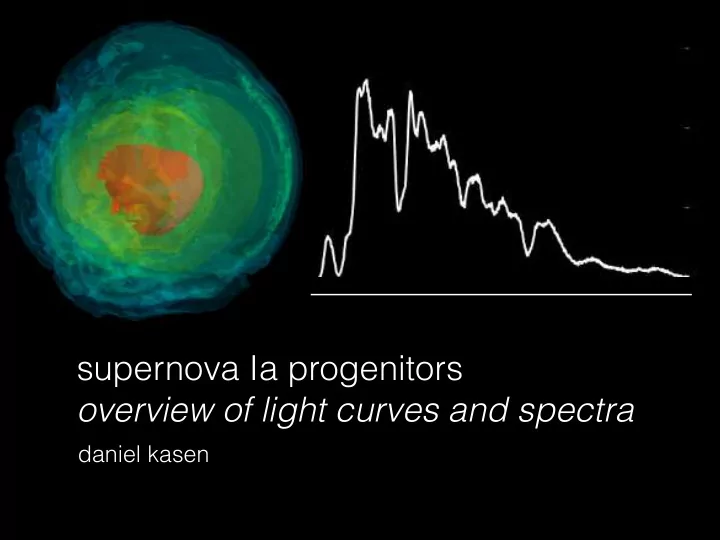
SLIDE 1 supernova Ia progenitors
- verview of light curves and spectra
daniel kasen
SLIDE 2 C/O
IME
C/O
56Ni
IME
explosion
t ~ secs
progenitor ejecta
zeroth order SNIa model
? spectra light curves
need to examine subtleties (line features, asymmetry, CSM) compare to imperfect models, get mixed messages
SLIDE 3 Mch model (central or off-center ignition) C/O WD + H star
merger/collision of two C/O white dwarfs sub-Mch model (double detonation) C/O WD + He star or WD
C/O
He
variety of progenitors/explosions
SLIDE 4 Mch delayed detonation models
central ignition
SLIDE 5 delayed detonation models
kasen+ 2009 roepke+ 2012
hoeflich&Khokhlov 1995.6, nugent 1994, pinto&eastman 2000 kasen+ 2009, roepke+ 2012, sim+2013, dessart+ 2014
SLIDE 6
delayed detonation models good fit to observed spectra/lightcurves
SLIDE 7
(GCD-like model)
kasen & Plewa 2007 foley & kasen (2011)
lopsided ejecta
variations in Fe-group blanketing affect the UV brightness
56Ni IME
SLIDE 8 silicon velocity as a function of viewing angle
Benetti et al (2005)
c.f. maeda+ 2011
SLIDE 9 companion interaction and early light curves
supernova companion
SLIDE 10
SLIDE 11 kutsuna & shigeyama, 2015 RGB companion
different viewing angles
kasen 2010
companion shock signatures
Cao et al (2015) ~20 Rsun Marion et al (2015) ~10 Rsun Shappee (2015) no detection Olling et al (2015) no detection Nugent el al (2015) no detection Bianco et al (2010) no detection Hayden et al (2010) no detection Brown et al (2011) no detection
SLIDE 12
shappee+ 2013
No sign of stripped hydrogen in spectra
but how robust our the theory predictions?
SLIDE 13 Ni/Fe/Cr/Ti/Ca
Si/S/Ca
56Ni
sub-chandrasekhar explosions (double-detonation)
Nomoto+ 1980, Woosley+ 1980, Livne 1990 Woosley&Weaver 1994, Livne&Arnett 1994, Bildsten+ 2007,Fink+ 2007, Sim+ 2010, Kromer+ 2010 Woosley&Kasen 2011
He
C/O
SLIDE 14 double detonation spectra (at maximum)
varying helium shell masses (woosley and kasen 2011)
acc
SLIDE 15
spectral evolution
double detonation
Mcore = 0.90 Msun Mshell = 0.12 Msun
black: with burned shell red: without burned shell
SLIDE 16 broadband light curves
solid (with shell), dashed (no shell), dots (SN2003du)
double detonation
Mcore = 0.90 Msun Mshell = 0.12 Msun
SLIDE 17
sub-chandrasekhar model width luminosity relation
shell only core+shell core + lowmass shell
1D models
c.f. sim+2010
SLIDE 18
0.0 1.2 Residual (1042 erg s−1) 0.0 0.6 1.2 1.8 L (1043 erg s−1)
Us Scalzo+14 MNi (M) 0.55 0.56+0.12
0.12
RNi (M) 0.78 — MIME (M) 0.56 — MCO (M) 0.06 — κ (cm2 g1) 0.10 — MEj (M) 1.17 1.01+0.09
0.07
SNF20060907-000
Best Fit w/Emulator SNFactory Data Emulator 68% CI
fits to observed SNF light curves
physical parameter estimation (danny goldstein, UCB)
SLIDE 19
CaII
blue: M = 1 Msun red: M = 1.26 black : sn201llfe Lack of stable iron group elements in nebular spectra?
Mazzali et al 2015
SLIDE 20 double white dwarf mergers as SNe Ia
“prompt” (violent) detonation
both stars explode
e.g. pakmor et al (2010) raskin+2009, rosswog+2009
“late” detonation
secondary shredded to disk (“tamped” SNe Ia)
e.g., hoeflich and kokhlov (1996) raskin+2014
“double” detonation
He shell explodes during mass transfer; secondary remains intact?
e.g. guillochon et al (2010)
SLIDE 21
moll, raskin, kasen, woosley (2014) raskin, kasen, moll, schwab, woosley (2014)
prompt detonation calculation (CASTRO code)
SLIDE 22
raskin and kasen (2013) moll, raskin, kasen, woosley (2014)
SLIDE 23 ` 28Si 56Ni
white dwarf mergers as SNeIa
compositional structure of prompt explosions
(azimuthal averages)
16O moll, raskin, kasen, woosley (2014)
SLIDE 24 violent white dwarf merger
viewing angle dependence 0.9 x 0.81 max light spectrum
(phi averaged)
SLIDE 25 white dwarf mergers as SNeIa prompt explosion comparison to
moll, raskin, kasen, woosley (2014) raskin, kasen, et al (2014) c.f. roepke et al (2012)
SLIDE 26 prompt explosions of C/O WD mergers
synthetic B-band light curves
moll, raskin, kasen, woosley (2014)
SLIDE 27
carbon features near maximum
CII SiII
1.2 x 1.06 merger (~0.1 Msun of carbon)
SLIDE 28 asymmetry and polarization
normal SNIa show low continuum polarization <~ 0.3% (higher in SN1991bg-like ~ 0.6%) (higher polarization in lines ~1-2%)
violent merger head on collision
SLIDE 29
continuum polarization curves
3-D models: pure e- scattering, inclination = 90o
kasen+ in prep
SLIDE 30
Felicitous agreement with observed light curves/spectra (even the effects of asymmetry), tension with other indicators (e.g., no companion/CSM interaction). Can they contribute at a significant rate?
Mch models
Can we ignite and propagate detonation in low shell masses (< 0.01 Msun) or in a WD merger leadup? Do we need (can we get) stable iron group?
sub-Mch models merger/collision models
Is the high-degree of asymmetry a deal breaker? Are these (just) the “super-Chandrasekhar” events?