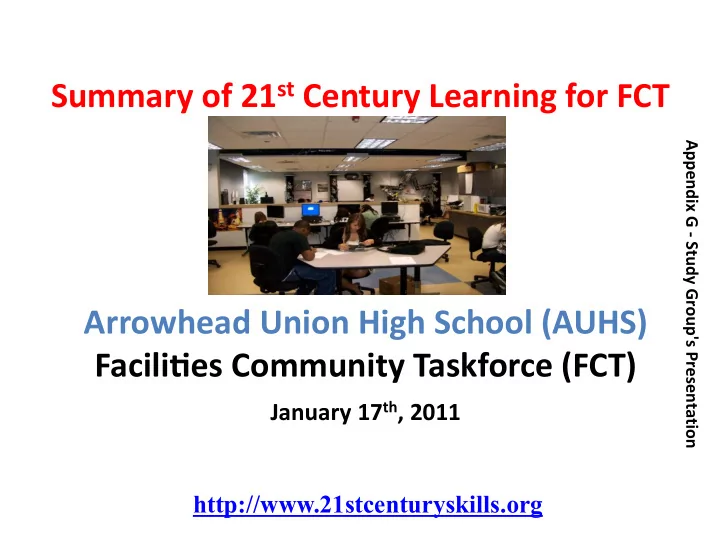
Summaryof21 st CenturyLearningforFCT Appendix G - Study Group's - - PowerPoint PPT Presentation

summary of 21 st century learning for fct
SMART_READER_LITE
LIVE PREVIEW

Summaryof21 st CenturyLearningforFCT Appendix G - Study Group's - - PowerPoint PPT Presentation

Summaryof21 st CenturyLearningforFCT Appendix G - Study Group's Presentation ArrowheadUnionHighSchool(AUHS) Facili@esCommunityTaskforce(FCT) January17 th ,2011


slide-1
SLIDE 1

http://www.21stcenturyskills.org

Summary
of
21st
Century
Learning
for
FCT

 Arrowhead
Union
High
School
(AUHS)
 Facili@es
Community
Taskforce
(FCT)


January
17th,
2011


Appendix G - Study Group's Presentation

slide-2
SLIDE 2


WHY
IS

21st
CENTURY
LEARNING


 SIGNIFICANT

TO
THE
TASKFORCE?


WHAT
IS
21ST
CENTURY
LEARNING?
 WHY
IS
IT
IMPORTANT?


HOW
IS
IT
IMPLEMENTED?
 WHERE
IS
21st
CENTURY
LEARNING
HEADING?
 HOW
WILL
STUDENT’S
21st
CENTURY
LEARNING
TOOLS
 INFLUENCE

EDUCATIONAL
FACILITY
NEEDS?


 WHICH
21st
CENTURY
LEARNING
ISSUES
IMPACT
FCT?


 WHAT
RECOMMENDATIONS
FOR
ALIGNMENT?


slide-3
SLIDE 3

What
is
21st
Century
Learning?

 Key
Skills
Defined


The
Partnership
for
21st
Century
Skills
advocates
for
tools
and
resources
to
help
 the
U.S.
educa<on
system
keep
up
globally
by
fusing
the
three
Rs
and
four
Cs
 (cri<cal
thinking
and
problem
solving,
communica<on,
collabora<on,
and
 crea<vity
and
innova<on).
 LEARNING
&
INNOVATION


  • Crea2vity
&
Innova2on

  • Cri2cal
Thinking
&
Problem‐solving

  • Communica2on
&
Collabora2on


LIFE
&
CAREER


  • Flexibility
&
Adaptability

  • Ini2a2ve
&
Self‐direc2on

  • Social
&
Cross‐cultural
Skills

  • Produc2vity
&
Accountability

  • Leadership
&
Responsibility


INFORMATION
&
TECHNOLOGY


  • Informa2on
Literacy

  • Media
Literacy

  • ICT
Literacy

slide-4
SLIDE 4

Why
is
21st
Century
Learning
Important?


 Partnership
for
21st
Century
Skills


1st Century Skills

slide-5
SLIDE 5
  • To
learn
collabora@on,
work
in
teams.

  • To
learn
cri@cal
thinking,
take
on
complex
problems.

  • To
learn
oral
communica@on,
present.

  • To
learn
wriYen
communica@on,
write.

  • To
learn
technology,
use
technology.

  • To
develop
ci@zenship,
take
on
civic
and
global
issues.

  • To
learn
about
careers,
do
internships.

  • To
learn
content,
research
and
do
all
of
the
above.


How
is
21st
Century
Learning
Implemented?
 Key
Elements
to
21st
Century
Learning


slide-6
SLIDE 6

Where
is
21st
Century
Learning
Heading?
 
Key
Elements
–
In
Prac@cal
Applica@on


  • Project
Based
Collabora@on
mobile
and
global
interac@ve
groups


any
size,
any@me
or
anyplace…Facebook…Tex@ng…TwiYer


  • Communica@on
skills
influenced
by
New
Media
and
Technology

  • Technology
“learn
and
use”
challenged
by
exponen@al
growth


  • Global
Ci@zenship
a
concept
or
real
@me
reality
on
a
mobile
device

  • Careers
how
do
you
prepare
for
a
career
that
may
not
exist
today

  • Research
info
access
&
storage
vs.
data
applica@on
&
manipula@on

  • Needs
facili@es
recommenda@on
influenced
by
the
Future
not
Past

  • Technology
growing
influence
validated
by
corporate
investment


and
historical
trends
in
the
marketplace


slide-7
SLIDE 7

Where
is
21st
Century
Learning
Heading?
 Student
Tech
Trends
Difficult
to
Dismiss


1980’s
FOUNTAIN


  • Network
Infrastructure

  • Content
Challenges

  • Electric
Outlet

  • Personal
Computer

  • Laptop

  • Microsog

  • Outook
e‐mail

  • Systems
Integra@on

  • Applica@on
Developm’t


21st
CENTURY
GROWTH


  • G4
Mobile
Cloud

  • Streaming
On‐Demand

  • BaYery
Life

  • Mobile
Device

  • Tablet

  • Google
Android

  • Facebook

  • Open
Sys
Touch
Screen

  • Create
an
App
for
That

slide-8
SLIDE 8

How
will
Student’s
21st
Century
 Learning
Tools
Influence
Facili@es?


  • Mobile
Devices
on
4G
replace
old
network
infrastructure


  • Open
Campus
mobility
creates
field
learning
for
students

  • Podcast
/Skype
expands
and
complements
the
lecture
hall

  • E‐book
Tablet
impact
on
research,
libraries
and
text
books

  • Modular
Open
Space
dynamic/changeable
over
classroom

  • Adaptability
global
access
to
knowledge
base
diversifies


curriculum,
any
subject
presented
in
real
@me
anyplace


“The
way
we
design
new
schools,
and
 alter
our
exis@ng
spaces,
is
absolutely
 core
to
how
we
are
able
to
harness
 learning
technology
and
introduce
 new
thinking
around
learning.”

 
‐
Ewan
McIntosh
edu.blogs.com


slide-9
SLIDE 9

Which
21st
Century
Learning
Issues
 Impact
FCT?


Physical
Expansion
balanced
with
redesign
and
upgrade

 Educa@on’s
growing
aYen@on
Govt/Public/Corp/Higher
Ed
 Scalability
serve
10
or
100
students
at
the
same
fixed
price
 Remote
Learning
2004
online
educa@on
surpassed
Higher‐Ed
 Learning
Tools
no
longer
too
costly
to
distribute
to
students
 Mobility
changes
the
defini@on
of
a
learning
environment
 Student/Technology
21st
Century’s
least
predictable
variable


slide-10
SLIDE 10

Recommenda@ons
to
Help
FCT
Align
with
 21st
Century
Learning
Ini@a@ves


Assump@ons
 Educators
will
define
and
facilitate
learning
concepts
 Students
create
prac@cal
implementa@on
methods/tools
 Readiness
for
21st
Century
Learning
as
a
FCT
Measurement
 Recommenda@ons


  • Consider
how
the
learning
concept
is
defined
for
AUHS

  • Ensure
facility
changes
won’t
limit
any
future
op@ons

  • Evaluate
specific
learning
facili@es
around
the
world
that


embrace
the
21st
Century
mindset
of
the
next
genera@on


  • Create
a
prac@cal
vision
and
recommenda@ons
based
on


measurable
trends
of
influencing
factors
(social,
economic
 and
technological)
for
the
21st
Century
in
our
community