Subsistence Salmon Fisheries in Alaska: Recent Patterns and Trends - - PowerPoint PPT Presentation

subsistence salmon fisheries in alaska recent patterns
SMART_READER_LITE
LIVE PREVIEW

Subsistence Salmon Fisheries in Alaska: Recent Patterns and Trends - - PowerPoint PPT Presentation

Subsistence Salmon Fisheries in Alaska: Recent Patterns and Trends Presented by: James A. Fall Alaska Department of Fish & Game, Division of Subsistence Long-term Challenges to Alaskas Salmon and Salmon- Dependent Communities


slide-1
SLIDE 1

Subsistence Salmon Fisheries in Alaska: Recent Patterns and Trends

Presented by:

James A. Fall

Alaska Department of Fish & Game, Division of Subsistence

Long-term Challenges to Alaska’s Salmon and Salmon- Dependent Communities Workshop

Anchorage, Alaska November 1, 2016

1

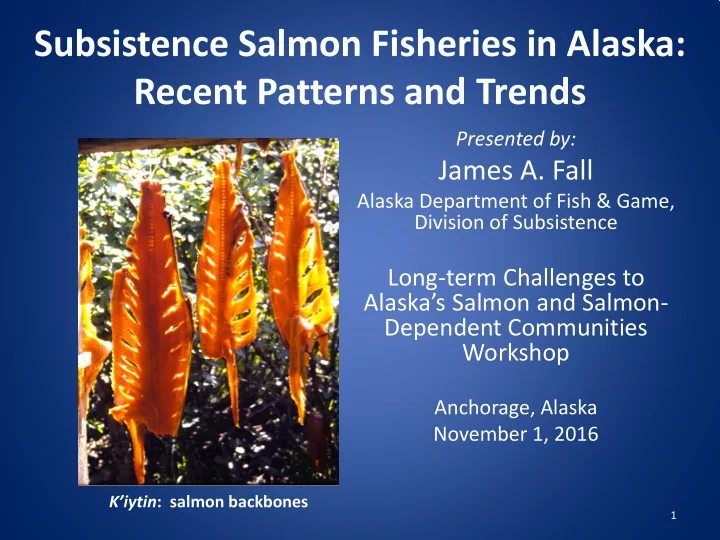
K’iytin: salmon backbones

slide-2
SLIDE 2

Subsistence Salmon Fisheries: Supporting Cultural Traditions

2

Nikolai, upper Kuskokwim River Fish camp, Yukon River near Eagle

slide-3
SLIDE 3

Salmon: Bonding Families and Generations

3

slide-4
SLIDE 4

Subsistence Salmon: Skills, Artistry, and Traditional Knowledge

4

slide-5
SLIDE 5

Salmon: A Large Portion of Alaska’s Food Supply

5

slide-6
SLIDE 6

6

slide-7
SLIDE 7

Salmon’s Contribution: 96 lbs per person/year & 61% of protein requirements in rural Alaska; 25 lb person/year and 16% in Alaska overall

7

slide-8
SLIDE 8

8

http://www.adfg.alaska.gov/sb/CSIS/

slide-9
SLIDE 9

Salmon Harvest Assessment Methods

  • Permits
  • Post-season

household surveys

  • Harvest calendars

9

Tools of the trade

slide-10
SLIDE 10

Alaska Subsistence Salmon Harvests, Composition by Species, Annual Average, 1994 - 2014

10

slide-11
SLIDE 11

11

slide-12
SLIDE 12

12

slide-13
SLIDE 13

13

slide-14
SLIDE 14

Yukon River and Kuskokwim River Chinook Salmon

14

Drifting for Yukon kings, Kaltag Chinook salmon harvest, Kuskokwim River

slide-15
SLIDE 15

15

slide-16
SLIDE 16

16

slide-17
SLIDE 17

Data Gaps and Needs

  • In-season assessments

by fishers

  • Post-season

assessments by fishers

  • Timing and effort data
  • Patterns and trends

analysis

  • TEK and LTK studies

17

slide-18
SLIDE 18

Harvest Assessment: Best Practices

  • Joint ADF&G/AITC

project: 2000 - 2003

  • Working group
  • 10 regional workshops
  • Guiding principles and

recommendations

  • Final reports available

18

Salmon harvest assessment workshop, Kotzebue, November 2002

slide-19
SLIDE 19

TEK: Traditional Ecological Knowledge; LTK: Local and Traditional Knowledge

  • Time depth
  • Local focus
  • Habitat
  • Timing
  • Abundance
  • Condition
  • Also: promotes

collaboration

19

slide-20
SLIDE 20

Some Conclusions About Alaska’s Subsistence Salmon Fisheries

  • Salmon are a critical food throughout Alaska
  • Salmon sustain people, communities, and

cultures

  • Five fisheries – Yukon, Kuskokwim,

Northwest, Bristol Bay, and Copper River – account for 88% of annual subsistence harvests

  • Overall, subsistence salmon harvests have

been relatively stable since mid 1990s

  • But, subsistence harvests are down since

2008 in some key Chinook fisheries

  • Gaps exist in annual assessments of

subsistence fisheries and in documentation of TEK/LTK

  • There are opportunities to work together!

20

slide-21
SLIDE 21

Thank You!

21