Submarine groundwater discharge from tropical islands: Water quality - - PowerPoint PPT Presentation

submarine groundwater discharge from tropical islands
SMART_READER_LITE
LIVE PREVIEW

Submarine groundwater discharge from tropical islands: Water quality - - PowerPoint PPT Presentation

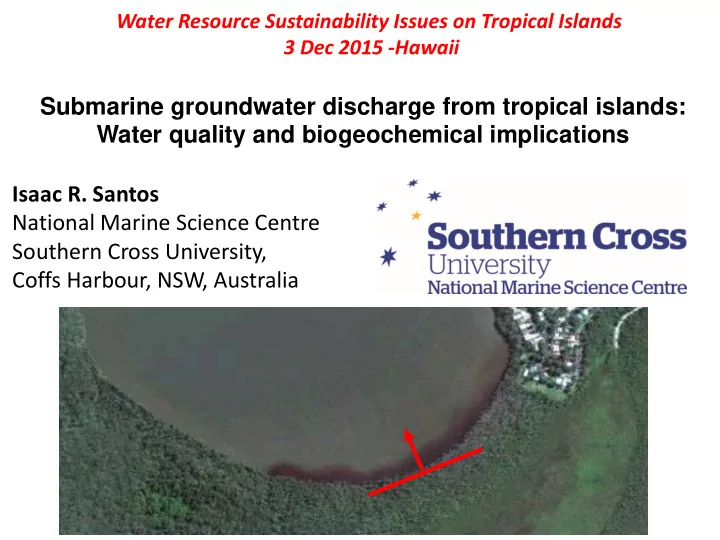
Water Resource Sustainability Issues on Tropical Islands 3 Dec 2015 -Hawaii Submarine groundwater discharge from tropical islands: Water quality and biogeochemical implications Isaac R. Santos National Marine Science Centre Southern Cross


slide-1
SLIDE 1

Submarine groundwater discharge from tropical islands: Water quality and biogeochemical implications Isaac R. Santos National Marine Science Centre Southern Cross University, Coffs Harbour, NSW, Australia

Water Resource Sustainability Issues on Tropical Islands 3 Dec 2015 -Hawaii

slide-2
SLIDE 2

Damien Maher, Douglas Tait, Dirk Erler, Thorsten Dittmar, Hans Brumsack, Melanie Beck, Mahmood Sadat-Noori, Perran Cook, Ling Li, Marnie Atkins, Jackie Gatland, Mitchell Call, Jamers Sippo, Ceyelena Holloway, Justin Gleeson, Uriah Makings, Ashly McMahon, Jason de Weys, et al.

Funding from the Australian Research Council

Acknowledgements

slide-3
SLIDE 3

Tropical islands as global SGD hotspots

Global SGD: ~2,400 km3/y Islands: ~915 km3/y Continents: ~1,485 km3/y (Zekster 2000) Review by Moosdorf et al., 2014

slide-4
SLIDE 4

Tropical islands as global SGD hotspots

Review by Moosdorf et al., 2014

  • High shoreline/area ratio
  • High rainfall
  • High relief
  • Immature permeable soils
slide-5
SLIDE 5

Ocean acidification and eutrophication

Reefs will change to algal-dominated ecosystems

Hoegh Guldberg 2007

5

slide-6
SLIDE 6
slide-7
SLIDE 7

1) Volcanic Island (Cooks Islands) 2) Coral Cay (Heron Island, Great Barrier Reef) 3) Delta Islands (Gold Coast, Australia)

Does SGD drive water quality and the biogeochemistry

  • f nearby coastal ecosystems?
slide-8
SLIDE 8

Natural groundwater tracers

 Particularly valuable in heterogeneous, dynamic systems  Water column integrates the signal coming from multiple groundwater pathways  Quick, precise, and cheap measurements are now possible

1 10 100 1000 GW:SW ratios

222Rn CH4 224Raex 223Ra 226Ra δ18O δ2H

Santos et al. 2008. Journal of Hydrology 353, 275– 293

Mangueira Lagoon, Brazil

slide-9
SLIDE 9

Radon as a groundwater tracer

 Very high in groundwater  Low concentration in surface water  Noble gas (no complicated chemistry)  Radioactive, so dissipates quickly (short memory)  Naturally-ocurring

 Easy to measure!

Continuous, portable 222Rn measurements

Now: Automated measurements Before: Large sample bottles

Burnett et al., 2001

slide-10
SLIDE 10

Experimental setup: Automated, high precision, in situ

Slide from Ashly MacMahon

slide-11
SLIDE 11

Combining radon, CO2, CH4, and δ13C measurements

Slide from Ashly MacMahon

slide-12
SLIDE 12

Combining radon, CO2, CH4, and δ13C measurements

slide-13
SLIDE 13

Combining radon, CO2, CH4, and δ13C measurements

slide-14
SLIDE 14

Combining radon, CO2, CH4, and δ13C measurements

slide-15
SLIDE 15

Apply mass balance models to solve for groundwater + porewater inputs

Perkins et al., 2015

slide-16
SLIDE 16

Apply mass balance models to solve for groundwater + porewater inputs

Sadat-Noori et al., 2015

slide-17
SLIDE 17

Coral reef lagoon (Raratonga, Cook Islands)

Tait et al., (2014)

slide-18
SLIDE 18

Coral reef lagoon (Raratonga, Cook Islands)

Befus et al., (2013)

Resistivity time series across the beach

slide-19
SLIDE 19

Coral reef lagoon (Raratonga, Cook Islands)

  • ~50 years old groundwater account for ~ 29-47% of nitrogen inputs

Tait et al., (2014)

slide-20
SLIDE 20

Coral reef lagoon (Raratonga, Cook Islands)

The Ecotrench – simple and cheap decentralized system

Tait et al., (2014)

slide-21
SLIDE 21

Coral reef lagoon (Raratonga, Cook Islands)

The Ecotrench – simple and cheap decentralized system

  • ~40% Total Nitrogen removal
  • Conversion of ammonium to

nitrate

  • ~46% Total Phosphorus Removal

Tait et al., (2014)

slide-22
SLIDE 22

Coral reef lagoon (Raratonga, Cook Islands)

Cyronak et al., 2014. GBC

slide-23
SLIDE 23

222Rn (dpm m-3)

10000 20000 30000 40000

pCO2 (฀atm)

300 600 900

Coral reef lagoon (Raratonga, Cook Islands)

Cyronak et al., 2014. GBC

  • Groundwater derived free CO2 exceeds evasion to the atmosphere,

and coral uptake

  • Localized groundwater inputs = ocean acidification?
slide-24
SLIDE 24

Coral reef lagoon (Heron Island, Great Barrier Reef)

slide-25
SLIDE 25

Coral reef lagoon (Heron Island, Great Barrier Reef)

Schimidt et al., 2004

slide-26
SLIDE 26

Coral reef lagoon (Heron Island, Great Barrier Reef)

Santos et al., (2010)

slide-27
SLIDE 27
slide-28
SLIDE 28

Coral reef lagoon (Heron Island, Great Barrier Reef)

Groundwater observations: CO2 = 1060% saturation CH4 = 2680% saturation N2O = 1205% saturation

O’Reilly et al., 2015. GRL

slide-29
SLIDE 29

Modified deltas and coastal wetlands (Gold Coast)

slide-30
SLIDE 30

From wetland C sinks to sources of atmospheric CO2?

Modified deltas and coastal wetlands (Gold Coast)

slide-31
SLIDE 31

Groundwater-derived alkalinity release buffers coastal acidification

Natural wetlands prior to drainage

James Sippo in submission

slide-32
SLIDE 32

Gold Coast Canal Estate

  • Canals act as a window to the

coastal aquifer

  • Canals account for >50% of

CO2 evasion from waterways

slide-33
SLIDE 33

Summary and conclusions

2) SGD is major driver of surface water nutrient and carbon budgets near islands. 3) Automated observations allow for links between SGD and water quality to be established. 4) Draining may convert wetlands from carbon sinks to carbon sources due to enhanced SGD. 1) Islands are often SGD hotspots. 5) SGD should be considered when assessing coral reef health.