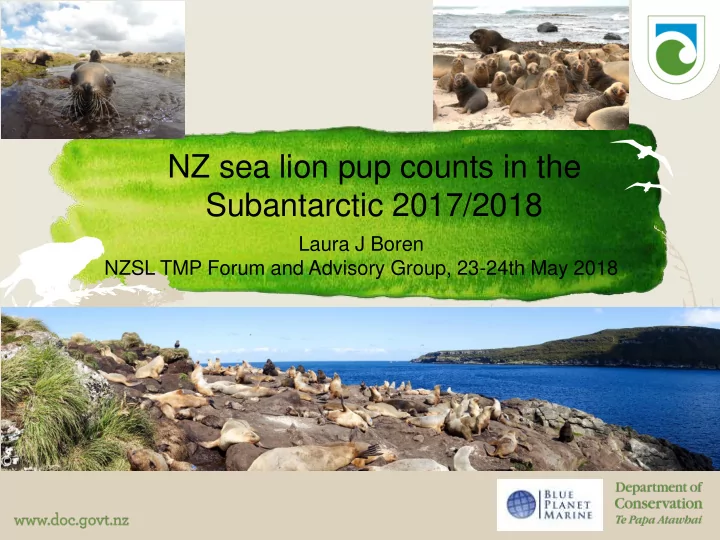
Subantarctic 2017/2018 Laura J Boren NZSL TMP Forum and Advisory - - PowerPoint PPT Presentation

subantarctic 2017 2018
SMART_READER_LITE
LIVE PREVIEW

Subantarctic 2017/2018 Laura J Boren NZSL TMP Forum and Advisory - - PowerPoint PPT Presentation

NZ sea lion pup counts in the Subantarctic 2017/2018 Laura J Boren NZSL TMP Forum and Advisory Group, 23-24th May 2018 New Zealand sea lion TMP Nationally Critical Restricted Breeding Decline 0.5% 1.5% 68% 30% 2 New Zealand sea


slide-1
SLIDE 1

NZ sea lion pup counts in the Subantarctic 2017/2018

Laura J Boren NZSL TMP Forum and Advisory Group, 23-24th May 2018

slide-2
SLIDE 2

2

New Zealand sea lion TMP

  • Nationally Critical
  • Restricted Breeding
  • Decline

68% 30% 0.5% 1.5%

slide-3
SLIDE 3

3

New Zealand sea lion research Auckland Islands 2017/18

Thomas Burns, Sarah Michael, Dan Godoy, Lou McNutt, Chris McCormack, Simon Childerhouse

Blue Planet Marine Nelson, New Zealand www.blueplanetmarine.com

slide-4
SLIDE 4

4

Auckland Islands Project objectives

  • A mark-recapture estimate of pup production at Sandy Bay

(Enderby Island) and Dundas Island.

  • Double flipper tag all pups at Sandy Bay, 400 pups at

Dundas Island and determine sex and weigh and measure (i.e. dorsal straight length and axillary girth) a sample of 100 pups (50 males, 50 females) at each site.

  • PIT (passive inductive transponder) tag all pups at Sandy

Bay.

  • Daily counts of dead and live animals at Sandy Bay.
  • The resighting of marked animals at Enderby Island

(including recording of PIT tags), to be conducted when time allows during the period allotted for the field work.

  • Regular surveys of Enderby Island (including South-east

Point) for signs of pup production and marked animals, to be conducted when time allows during the 8 days allotted for field work.

slide-5
SLIDE 5

5

Changes to methodology

Survey methodologies generally the same as 2016/17 except for:

  • Field season was shorter ending on 22 January 2018 with
  • nly 8 days work in the Auckland Islands funded (e.g. 27

March end in 2015/16 n = 48d field work ; 22 February end 2014/15 n = 59d field work) to coincide with the core CSP funding period

  • Landings on Dundas Island were by vessel rather than

helicopter

  • Separate DOC contract for:

– Figure of Eight Island survey – Autopsy and disease work – Resighting effort

slide-6
SLIDE 6

6

Pup production – Auckland Is

Location Pup production

  • No. live
  • No. dead

Sandy Bay 332 302 23 Dundas Island 1397 1340 57 Figure of Eight Island 63 55 8 South East Point Total Auckland Islands 1792 1697 88

slide-7
SLIDE 7

7

Conclusions

  • CSP field component of the work 13 to 20 January 2018,

significantly shorter than previous CSP projects, but supplemented by additional TMP funded projects

  • Pup production was estimated for New Zealand sea lion

colonies at: – Sandy Bay (n=332), Dundas Island (n=1397), Figure

  • f Eight Island (n=63), South East Point (n=0)

– Total pup production for the Auckland Islands in 2017/18 estimated as 1792 – 173 (9%) pup decrease from 2016/17 – 19% higher than lowest count in 2008/09

slide-8
SLIDE 8

8

Conclusions

  • 763 pups marked: Sandy Bay (n=309 tagged &

chipped), Dundas Island (n=400), Figure of Eight Island (n=54), South-East Point (n=0)

  • Very few tags resights were collected as this

was not a part of the core work for this project

  • Pup length to standard weight measurements

continued

  • Overall, very successful trip
slide-9
SLIDE 9

9

NZSL pup counts at Campbell Island 2017/18

Gareth Hopkins, Mike Morrissey, Micah Jensen, Dahlia Foo Department of Conservation Wild Vet Care University of Tasmania

slide-10
SLIDE 10

10

Objectives

  • Continue monitoring pup numbers and

mortality

  • Improve knowledge of pup mortality

– Starvation – Holes – Klebsiella

  • Improve understanding of factors affecting

pup mortality in holes

  • Develop potential solutions to reduce pup

mortality in holes

slide-11
SLIDE 11

11

Methods

  • Team of 4 (2 DOC, 2 External – vet and tracking

behaviour)

  • ~6 weeks (similar to 2014/15)
  • Locations of colonies and holes
  • Direct counts / mark recapture, live and dead
  • Pup weights / measurements
  • Tagging (up to 700)
  • GSP tracking (up to 40)
  • Caps for camera trap behaviour (up to 100)
  • Post mortems of fresh dead (up to 70)
slide-12
SLIDE 12

12

Differences from 2014/15

Year Departure Return Davis Visits Paradise Visits Whole Island Method 2014/15 16 Dec 29 Jan 4 3 Yes Direct counts 2017/18 16 Dec 3 Feb 1 (3 wks) 2 (1 wk each) No Direct counts, and Mark- Recapture (Bog colony only)

  • Slightly longer season
  • More focus at Davis Point
  • To minimise time lost in transit (5hrs PP-Bm, 8hrs Bm-DP)
  • Feedback from 2014/15 PP v dangerous to access until mid

Jan

slide-13
SLIDE 13

13

Colony location

slide-14
SLIDE 14

14

Pup Numbers

Location # live pups tagged # live pups not tagged # tagged pups later found dead # pups dead and not tagged

2017/18 2014/15 2017/18 2017/18 2014/15 2017/18 2014/15 Davis Point 387 360 3 27 166 113 155 Paradise Combined 196 116 5 2 22 26 57 Paradise East 5 55 3 7 2 12 Paradise West 191 61 2 2 15 24 45 Other locations 4 Totals 583 481 12 29 188 139 215

Location Total est pup production Total dead tagged and untagged Mortality rate

2017/18 2014/15 2009/10 2017/18 2014/15 2017/18 2014/15 2009/10 Davis Point 503 515 503 140 321 28% 62% 63% Paradise Combined 227 173 168 28 79 12% 46% NA Paradise East 10 67 54 2 19 20% 28% 61% Paradise West 217 106 114 26 60 12% 56% 18% Other locations 1 8 10 NA 0% NA Totals 734 696 681 168 403 23% 58% 55%

slide-15
SLIDE 15

15

Pup Mass

Location Date Female n Mean mass (kg) 2017/18 2018 2015 2018 2015 2018 2015 Girth Length Davis Point 13-14/01/2018 13/01/2015 52 50 11.725 +/- 0.2 9.9 +/- 0.2 51.7 +/- 0.4 77.9 +/- 0.5 Paradise Point 20-21/01/2018 15-20/01/15 50 33 13.104 +/- 0.3 10.7 +/- 0.3 53.5 +/- 0.4 82.7 +/- 0.6 Location Date Male n Mean mass (kg) 2018 2015 2018 2015 2018 2015 Girth Length Davis Point 13-14/01/2018 13/01/2015 50 50 12.575 +/- 0.2 11.7 +/- 0.3 53.0 +/- 0.4 80.0 +/- 0.5 Paradise Point 20-21/01/2018 15-20/01/15 50 47 14.684 +/- 0.3 12 +/- 0.3 55.7 +/- 0.5 85.4 +/- 0.6

  • Pups consistently heavier in 2018 than 2015
  • Pups heavier at Paradise Point
  • Difference between the colonies appears greater in

2018

slide-16
SLIDE 16

16

Phase 2

  • 9 Mar – 14 Mar 2018
  • Navy Operation Endurance
  • Team of 3 sea lion, 2 albatross (joint)
  • Sea lion objectives:

– Assess the holes at sea lion colonies to inform potential solutions – Create detailed aerial maps of the colonies, and trial feasibility of monitoring using drone – Collect general footage for Ocean Bounty documentary

slide-17
SLIDE 17

17

Conclusions

  • Pup production higher
  • Pup mortality lower
  • Paradise West = Shoal Point
  • Paradise East decline (movement Shoal Point)
  • Lower mortality due to warmer/drier summer?
  • Or Shoal Point is a better location?
  • Further info on DOC CSP webpage
  • More work to come from all aspects
slide-18
SLIDE 18

18

Acknowledgements

Phase 1: Gareth Hopkins, Mike Morrissey, Micah Jensen, Dahlia Foo Phase 2: Richard Wells, Reuben Saathof, Craig Patterson, Igor Debski And: Joseph Roberts, Sharon Trainor, Rory Hannan, John Peterson, Graeme Sinclair, Sharleen Gargiulo, Mary-Anne Lea, Mark Hindell, Sam Parsons, Susan Waugh, Simon Childerhouse, Wendi Roe