SUAA Graduated Income Tax Presentation Question and Answer Session - - PDF document

suaa graduated income tax presentation
SMART_READER_LITE
LIVE PREVIEW

SUAA Graduated Income Tax Presentation Question and Answer Session - - PDF document

SUAA Graduated Income Tax Presentation Question and Answer Session from the Chat Room from June 17, 2020 1. Are the actual proposed tax rates/structure part of the amendment? Or does the amendment simply authorize a graduated tax structure? The


slide-1
SLIDE 1

SUAA Graduated Income Tax Presentation

Question and Answer Session from the Chat Room

from June 17, 2020

  • 1. Are the actual proposed tax rates/structure part of the amendment? Or does the amendment simply authorize

a graduated tax structure?

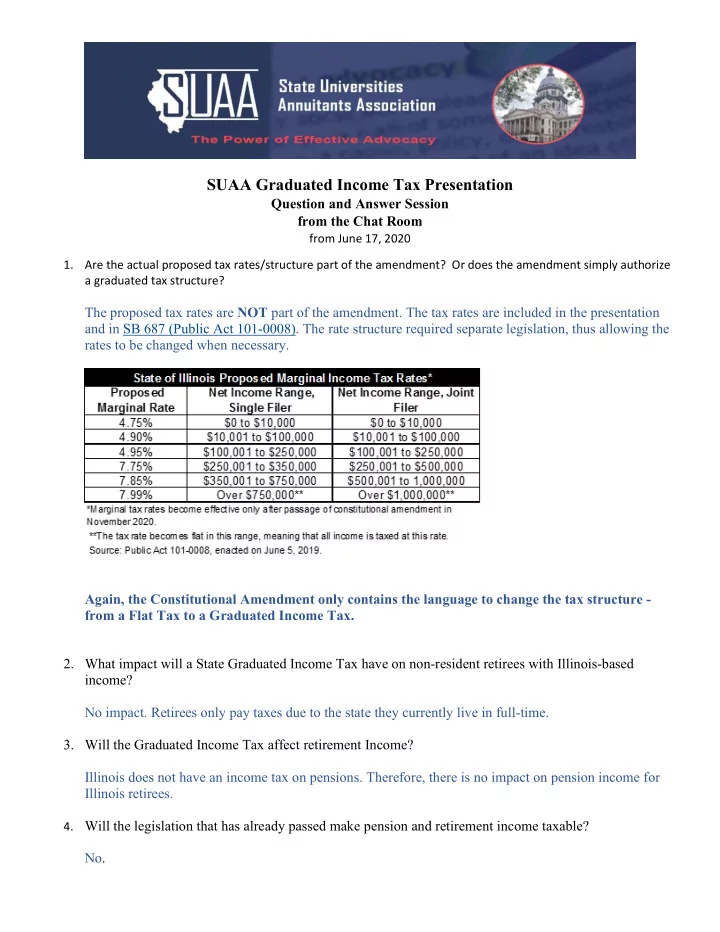
The proposed tax rates are NOT part of the amendment. The tax rates are included in the presentation and in SB 687 (Public Act 101-0008). The rate structure required separate legislation, thus allowing the rates to be changed when necessary. Again, the Constitutional Amendment only contains the language to change the tax structure - from a Flat Tax to a Graduated Income Tax.

  • 2. What impact will a State Graduated Income Tax have on non-resident retirees with Illinois-based

income? No impact. Retirees only pay taxes due to the state they currently live in full-time.

  • 3. Will the Graduated Income Tax affect retirement Income?

Illinois does not have an income tax on pensions. Therefore, there is no impact on pension income for Illinois retirees.

  • 4. Will the legislation that has already passed make pension and retirement income taxable?

No.

slide-2
SLIDE 2
  • 5. Is the Constitutional Amendment required to make pension and retirement money submit to the income

tax?

  • No. Legislation would need to be passed to allow for pension income to be taxed.
  • 6. Comment from audience – pension income will not be taxed, but if the amendment doesn’t pass, it is

something that will definitely be considered to raise revenue. Taxing pensions is not being discussed. However, down the road taxing pensions could be a possibility regardless of the Graduated Income Tax passing or not passing.

  • 7. So the Amendment is only required for graduated rates?

The Constitutional Amendment contains only the language to move from a Flat Tax to a Graduated Income Tax. There are no rates included. Bill number is SJRCA 0001.

  • 8. Will Roth conversions be taxed in 2021?

Off topic but here is a link that might assist you – The 5-Year Rules Every Roth IRA Investor Must Understand

  • 9. What happens with SURS pensions if the state goes bankrupt?

Technically, a State cannot go bankrupt. Higher taxes, reduction in services are possible. Article from The Fiscal Times could be interesting to the audience – Could Illinois Be the First State to Bankrupt? SURS directs employee contributions to the pension system; not the State. The State cannot take money from the pension system. Your membership in SUAA becomes important because as a watchdog

  • rganization, SUAA would make every effort to make sure that the State continues to make its

contributions to SURS. These three reports from SURS will help assure our audience that SURS is fiscally responsible: Defined Benefit Plan Investment Information, Investment Update and SURS in Brief.

  • 10. Has any legislation been brought forward that would make pensions taxable?
  • No. Every so often there are comments that come forward. Such as when Treasurer Michael Frerichs

spoke at the Mid-Year Economic Summit recently, he suggested one argument for the progressive tax is the consideration of taxing retirement income of those who can afford it. The current system doesn’t differentiate between the 6-figure yearly pensions and those retirees who barely get by on their savings

  • r pensions.
  • 11. Comment from audience: My understanding is SURS pension payments are made by SURS until no

money is left. Then, the State makes the payments. True.

  • 12. What percentage of the State Budget goes for pensions?

A whopping 25%. Possibly 26% now.

slide-3
SLIDE 3
  • 13. Do projections of increased revenue from a Graduated Income Tax account for wealthy individuals and

corporations leaving Illinois because of the higher taxes? It would actually be hard to project the number of people who would leave or the number of

  • corporations. Corporations look at the total of taxes paid; not one tax. Individuals should do the same.

Older people tend to stay in one place. It is the younger people who move more often; not because of

  • taxes. In addition, the State now has the aftermath of the pandemic to consider in its fiscal

responsibilities as will all states. Any projections that might have been made are most likely incorrect at this point.

  • 14. Is there a comprehensive cost-benefit analysis of the tax issue?

The talk of moving to a Graduated Income Tax has been around since at least 2012. While an up-to-date report was not found, please take time to look at the Commission on Government Forecasting and Accountability’s “3-Year Budget Forecast FY 2021 – FY 2023”.

  • 15. Where is the term “net income” defined in SB 687 (Public Act 101-0008)?

The term doesn’t seem to be defined in the legislation. There seems to be an assumption that the legislators will be knowledgeable of the term. For our audience, the article “What Is Net Income?” is available.

  • 16. What is a good source to follow on this issue?

Due to the COVID-19, the marketing – pros and cons – has slowed down. However, the newspapers will pick up on this issue soon, as well as other organizations. With Illinois moving into Phase 4, look for the month of July as news articles will begin to pop up – including radio and TV news casts. There will be more political comments. SUAA’s presentation was merely to point out the issue without getting into the politics of it. Passing a Graduated Income Tax is not the nail in the coffin so to say, but it is helpful as the State begins to chip away at the debt. Other taxes will be needed as our speakers referenced.

  • 17. Comment from audience: For 10 years I’ve been suggesting placing a tax on units of caffeine and

refined sugar in Illinois. My representatives were deafening silence. The reasoning behind their inability to hear you is because taxing caffeine, sugar products is deemed as a regressive tax. It would further hurt the lower income people. Even adding a penny to each soft drink purchased at a fast food restaurant or gas station was also considered a regressive tax.

  • 18. Comment for audience: If it took 20 years to get here, can we take 20 years to fix it?

Scott Pattison (speaker) suggested that we need to find a place and begin to chip away at the problem. Doing nothing doesn’t change anything. Additional comment: I would rather have potholes in the roads in lieu of losing my SURS. Potholes can become dangerous. The Graduated Income Tax will most likely not change the lives of 97% of the Illinois taxpayers. Some might see a slight decrease in taxes. Pension income will not be taxed.

  • 19. Is Illinois overall tax system too high?

Illinois is actually considered a low tax state. When determining your actual taxes, you need to compare

slide-4
SLIDE 4

all taxes you pay to like states or all states. Googling State Tax Rates is a great place to start. SUAA will look for sources and post them. The property tax is what causes people to think Illinois is a high tax state.

  • 20. Has Illinois ever been audited to identify graft and corruption spending?

Again, off topic but there are several books available that talks of corruption in Illinois. Other states have corruption too. Possibly even more so than Illinois.

  • 21. Comment from audience: most of the lower income people will not complain to pay more taxes for

essential services – however people that make 6 figure salaries and above do not feel the hurt that we all feel – especially when we are due to retire . . . Lower income people will not be paying more; higher income people will. Remember the chart. It is posted under Question 1.

  • 22. Question regarding Social Security – Windfall Elemination.

Again, off topic. This is a federal issue – Windfall Elimination and Pension Offset. Charts are found at: https://www.ssa.gov/pubs/EN-05-10045.pdf and https://www.ssa.gov/pubs/EN-05-10007.pdf The State guaranteed IRS that it could provide a pension for you that would be better than what Social Security could provide for you. At this time, you are most likely the winner in comparison. SURS average monthly income is $3,390 or $40,680 per year. SURS recipients are also receiving a 3% Automatic Annual Increase which is currently guaranteed each year. Social Security’s average monthly income is $1,303.24 or $15,640.08 per year for 2020. Social Security recipients received a 1.6% Cost of Living Adjustment. In 2021, it is predicted that Social Security recipients will not receive a COLA. The Graduated Income Tax will not harm or cause retirees to pay higher taxes. Retirees do not pay income taxes on pensions in the State of Illinois regardless of the amount. These are the states affected by the Windfall Elimination: California, Colorado, Illinois, Louisiana, Ohio, Texas, Florida, New York, Nevada, Connecticut, Kentucky, Minnesota, Georgia, Missouri, Michigan, Tennessee, Wisconsin, Washington, Indiana, Pennsylvania, Alaska, Maine, Hawaii, Montana, New Mexico and New Hampshire. There have been many attempts to repeal the Windfall Elimination. The most recent legislation calling for the full repeal of the Windfall Elimination Provision (WEP) was introduced in the House in January

  • f 2019, HR 141, "The Social Security Fairness Act". A Senate Bill, S.521, was also introduced in

February of 2019.

  • 23. Comment from audience: It seems to me that it will be almost impossible for the current legislature to

properly handle tax reform when they vote themselves pay raises during this time rather than take cuts. The legislators did not vote themselves a pay raise for FY 2021. There was agreement in both the House and the Senate. It was made very clear during the special legislative session in May that there would be no pay raises or Cost of Living increases. In addition, there is no line item in the FY 2021 Budget for Legislative increases in pay.

slide-5
SLIDE 5
  • 24. What will happen to current retirees who do not get taxed if amendment is passed?
  • Nothing. Pensions are not taxed in the State of Illinois.
  • 25. Comment from audience: But pensions can be taxed now without the amendment.

Pensions cannot be taxed now. There is no legislation to tax pensions. However, it would not take a Constitutional Amendment to tax pensions. Only legislation agreed to by the House and Senate; then signed into law by the governor.

  • 26. Is there talk of raising corporate taxes?

The amendment also modifies the corporate rate limit by requiring that the highest corporate rate not exceed the highest individual rate by more than 60%.

  • 27. What threshold will start for taxable pensions? $35,000 or $50,000?

While the Graduated Income Tax has nothing to do with taxing pensions, the lowest heard when Governor Quinn was in office settled in at $40,000. SUAA was against this low of a threshold. The idea never came forward. Thus far, it stays in the background. One saving grace for those who do not want pensions taxed is that corporate/private sector does not want pensions taxed either. The State would have to tax both public and private pensions if there was legislation to pass. One cannot be taxed without the

  • ther being taxed. At this time, taxing pensions continues to be off the radar, politically.
  • 28. Comment from audience: Since COVID-19 has caused the death of a lot of pensioners, has the unfunded

pension liability now dropped significantly? Who is tracking this? Not everyone’s death is due to COVID-19 nor is a State of Illinois pensioner. The question was asked to SURS if there were many deaths due to COVID-19. SURS did not know. No one is keeping track. It is doubtful that there was a rise in SURS deaths due to COVID-19. SURS does have an aging population

  • f members. Therefore, the deaths are mostly caused by other health issues.
  • 29. What is the data on corporations or wealthy individuals relocating because of changes in taxes or tax

structure? Again, corporations and wealthy individuals will look at taxes as a whole. The move most likely will be

  • slight. As November gets closer, more information will be forthcoming.
  • 30. Suggestion from audience: Pensioners should pay state income taxes on income above a certain level.

SUAA has said “no” to this in the past. Was this a mistake? As explained previously, SUAA did not agree with Governor Quinn’s proposal of the $40,000 threshold. It was too low. We were at the table, but there was no movement to go forward. The amount of revenue the State would receive was not substantial at the time. Therefore, SUAA declined to be supportive.

  • 31. Is retirement income going to be taxed in this new system?

Passing the Graduated Income Tax Constitutional Amendment has nothing to do with taxing pensions. It would require separate legislation. Separate legislation has not been introduced.

slide-6
SLIDE 6
  • 32. To the person who worked 24 years under Social Security before moving to Illinois – You will receive

60% of your substantial earning from Social Security.

  • 33. Am I correct that our pension contribution is deducted before taxes?
  • Yes. Upon retiring you only pay Federal Taxes on your pension because you have not paid federal

income taxes on the amount you contributed. You do not pay income taxes to the State of Illinois. Therefore, you get a pass on State taxes altogether. Also, you do not pay State income taxes on your 3% automatic annual increase every year.

  • 34. Comment from audience: If better revenue basis at the state level, as in broadening the base along with a

graduated income tax structure, then the state has a better funding base for dollars going to local governments, such as cities and school districts. And then as a result of that, less pressure on property taxes. A simple Yes.

  • 35. Comment from audience: Having lived in Wisconsin and Minnesota, I dispute the Illinois Policy

argument based on my experience and that of my friends and family in those states. We pay far less taxes here. Illinois is a high property tax state and a low income tax state.

  • Agreed. WaletHub compares 2020’s Tax Burden by State.
  • 36. Responding to comment about low retirement pension income. Your pension is based on your
  • contribution. Lower wages provide lower pensions, higher wages provide higher pensions. Contributions

to SURS is 8% of your income during your working years for Tier 1 and II. However, there are vesting differences between Tier 1 and II. Retirement Benefit Limitation is 80% of final average salary.

  • 37. Comment from audience: The Illinois Reform Commission – 2009 – made numerous recommendations

to clean up and strengthen Illinois government. These changes in Campaign Finance, Procurement, Enforcement, Government Structure, and Transparency would also markedly reduce the cost of State

  • government. Before increasing taxes, it seems essential to first make the recommended structural

changes that will provide more effective and ethical government. There have been many changes to Illinois government and there continues to be clean-ups so to say. Chipping away at the problems – change does not happen overnight. State government seems to be fairly lean at this time. Increasing taxes? Maybe the approach is better seen as higher income taxpayers paying their fair share; allowing lower income taxpayers to keep more of their money. The Graduated Income Tax will only increase taxes on those with an income of $250,000 and up. It will lower taxes on Income Taxes of $0 - $100,000. Broadening of the Sales Tax Base would be another revenue source to bring additional revenue to the

  • State. Bordering states tax services; no one moved out of these states because of the additional sales tax.
  • 38. Comment from audience: There are studies that show that massive growth in tax exemptions has

seriously eroded federal support of higher education.

  • Agreed. Higher education has taken quite a hit for many years; and, continues to do so.
slide-7
SLIDE 7

Resources – some lean left; some lean right; some are straight shooters.

  • Wall Street Journal
  • The Economist
  • Tax Council Policy Institute
  • American Enterprise Institute
  • NASBO.org (National Association of State Budget Officers)
  • Commission on Government Forecasting and Accountability
  • Illinois State Comptroller
  • Office of Governor JB Pritzker The Governor’s website has a Fair Tax
  • Calculator. Try it if you currently pay State Income Tax. If you don’t, then it

is non-applicable. Reference of Fair Tax is the Graduated Income Tax.

  • Center for Tax and Budget Accountability
  • The Civic Federation
  • Taxpayers’ Federation of Illinois
  • Illinois Chamber (the Chamber refers to Graduated Income Tax as Progressive Tax)
  • Newspapers – Chicago Sun Times, Chicago Tribune, etc.

There are more resources available – the above is a great start.

SUAA will continue to provide information as we move towards the November General Election. Your continued questions or comments are welcome. One main point to remember is – when you hear Fair Tax it is actually referencing the Graduated Income

  • Tax. Fair Tax will not be on the ballot; Graduated Income Tax will.

Every registered voter will receive an explanation of the Graduated Income Tax in the mail from the Illinois Secretary of State’s office. The question on the ballot will be a simple YES or NO. We urge you to vote responsibly on Tuesday, November 3, 2020.