Structure and Function Tissues Organ Systems Homeostasis Return - - PDF document

structure and function
SMART_READER_LITE
LIVE PREVIEW

Structure and Function Tissues Organ Systems Homeostasis Return - - PDF document

Slide 1 / 116 Slide 2 / 116 New Jersey Center for Teaching and Learning Progressive Science Initiative BIOLOGY This material is made freely available at www.njctl.org and is intended for the non-commercial use of students and teachers. These


slide-1
SLIDE 1

Slide 1 / 116

This material is made freely available at www.njctl.org and is intended for the non-commercial use of students and teachers. These materials may not be used for any commercial purpose without the written permission of the owners. NJCTL maintains its website for the convenience of teachers who wish to make their work available to other teachers, participate in a virtual professional learning community, and/or provide access to course materials to parents, students and others.

Click to go to website: www.njctl.org New Jersey Center for Teaching and Learning Progressive Science Initiative

Slide 2 / 116

BIOLOGY Anatomy & Physiology

www.njctl.org April 2014

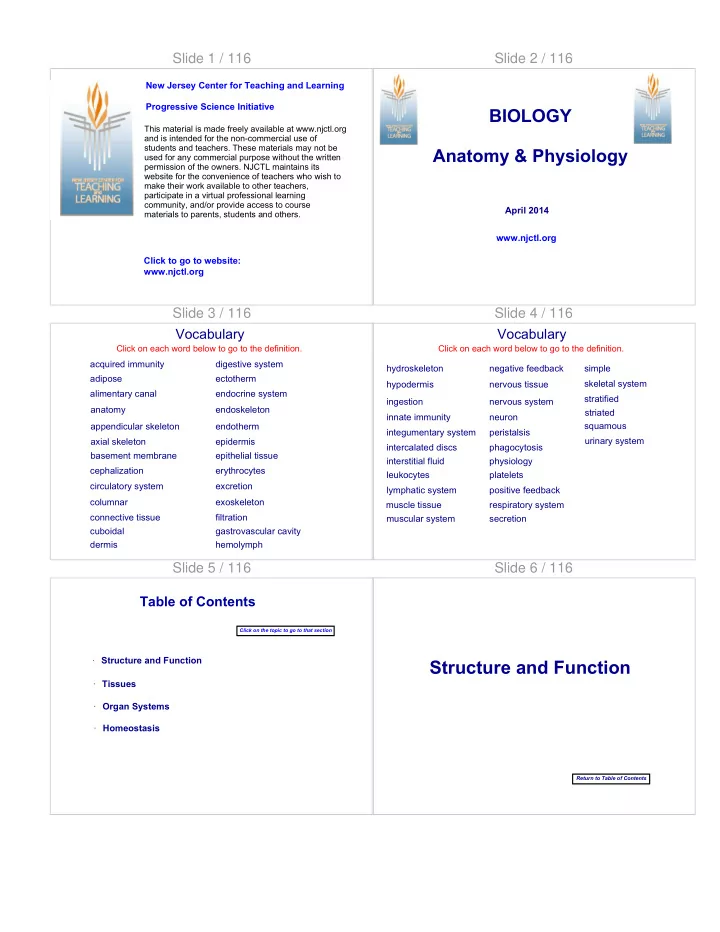
Slide 3 / 116 Vocabulary

Click on each word below to go to the definition. digestive system acquired immunity adipose alimentary canal anatomy basement membrane cephalization circulatory system columnar connective tissue cuboidal dermis ectotherm endocrine system endotherm epidermis epithelial tissue erythrocytes excretion appendicular skeleton axial skeleton endoskeleton exoskeleton filtration gastrovascular cavity hemolymph

Slide 4 / 116 Vocabulary

Click on each word below to go to the definition. nervous system intercalated discs interstitial fluid leukocytes lymphatic system muscle tissue muscular system negative feedback nervous tissue neuron peristalsis phagocytosis physiology platelets positive feedback respiratory system secretion skeletal system stratified striated squamous urinary system simple ingestion innate immunity hypodermis integumentary system hydroskeleton

Slide 5 / 116 Table of Contents

· Structure and Function · Tissues · Organ Systems

Click on the topic to go to that section

· Homeostasis

Slide 6 / 116

Structure and Function

Return to Table of Contents

slide-2
SLIDE 2

Slide 7 / 116

The relationship between structure and function is an important

  • verarching concept in biology and studying this relationship will

help us to understand animals. Structure (anatomy) and function (physiology) are studied together because function is determined by structure.

Structure and Function

The long bill of the sword-billed hummingbird makes it particularly suited to extracting nectar from flowers with deep hypanthium (nectar chamber).

Slide 8 / 116

The adaptations that different animals have to allow them to perform various functions have all been fashioned by natural selection. Natural selection has "fitted" structure to function by selecting,

  • ver many generations, what works

best within a particular population in it's environment.

Structure and Function

What elephant adaptations make it suited for its environment?

Slide 9 / 116 Structure and Function

Ears with large surface area allow efficient heat dissipation. Tusks are used as tools or for protection. Trunk is used for breathing, grasping and lifting. Elephants are suited to their environment:

Slide 10 / 116

tissue

  • rgan
  • rgan system
  • rganism

Structure in living things is

  • rganized in a series of

hierarchical levels. Levels of Organization Slide 11 / 116

tissue

  • rgan
  • rgan system
  • rganism

A group of cells that work together to perform a certain function. Two or more tissues that work together to perform a specific task. Multiple organs that function together to perform a vital body function. All the organ systems functioning together as an integrated unit.

Levels of Organization

Cardiac tissue Heart Circulatory system Human

Slide 12 / 116

1 The study of an organism's structure is known as ____, while the study of its function is ____. A physiology; anatomy B anatomy; physiology C physicality; anonymity D anonymity; physicality

Answer

slide-3
SLIDE 3

Slide 12 (Answer) / 116

1 The study of an organism's structure is known as ____, while the study of its function is ____. A physiology; anatomy B anatomy; physiology C physicality; anonymity D anonymity; physicality

[This object is a pull tab]

Answer B

Slide 13 / 116

2 Two or more tissues that work together to perform a specific task is A a cell. B an organ. C an organ system. D an organism.

Answer

Slide 13 (Answer) / 116

2 Two or more tissues that work together to perform a specific task is A a cell. B an organ. C an organ system. D an organism.

[This object is a pull tab]

Answer B

Slide 14 / 116

3 The digestive system is an organ system that is composed of several organs, including the stomach, small intestine and liver. Each of these organs are composed of A organisms. B bacteria. C organ systems. D tissues.

Answer

Slide 14 (Answer) / 116

3 The digestive system is an organ system that is composed of several organs, including the stomach, small intestine and liver. Each of these organs are composed of A organisms. B bacteria. C organ systems. D tissues.

[This object is a pull tab]

Answer D

Slide 15 / 116

Tissues

Return to Table of Contents

slide-4
SLIDE 4

Slide 16 / 116 Tissues Slide 17 / 116 Epithelial Tissue

Epithelial Tissue consists of many cells tightly packed together with very little extracellular matrix. It covers body surfaces and lines internal organs and body cavities. One side of the tissue is anchored to the underlying tissues by a basement membrane (a dense layer of extracellular matrix consisting of fibrous proteins and polysaccharides.) The other side is the free surface and it faces the outside of an organ or the inside of a tube or passageway.

Source: Davidson College Biology Department

Slide 18 / 116

Epithelial tissues are named according to the number of cell layers they have and to the shape of the cells on the free surface: Simple: A single layer of cells. Stratified: Multiple layers of cells. Squamous: Flat cells Cuboidal: Cube shaped cells Columnar: Taller than they are wide

Epithelial Tissue Slide 19 / 116

The structure of each type of epithelial tissue fits its function. Simple squamous epithelium is very thin and is suitable for exchange of materials via diffusion. It makes up capillaries and alveoli (air sacs in the lungs). Stratified squamous epithelium can be found in areas subject to abrasion, such as the esophagus or our skin.

Epithelial Tissue Slide 20 / 116

4 A dense layer of extracellular matrix that anchors epithelial tissue to underlying tissues is called the A apical surface. B epithelia. C basement membrane. D lymph.

Answer

Slide 20 (Answer) / 116

4 A dense layer of extracellular matrix that anchors epithelial tissue to underlying tissues is called the A apical surface. B epithelia. C basement membrane. D lymph.

[This object is a pull tab]

Answer C

slide-5
SLIDE 5

Slide 21 / 116

5 How would you classify an epithelial tissue that has many layers of cube shaped cells? A simple cuboidal B simple squamous C stratified cuboidal D stratified columnar

Answer

Slide 21 (Answer) / 116

5 How would you classify an epithelial tissue that has many layers of cube shaped cells? A simple cuboidal B simple squamous C stratified cuboidal D stratified columnar

[This object is a pull tab]

Answer C

Slide 22 / 116 Connective Tissue

Connective tissue is opposite of epithelial tissue in that it contains few cells and a lot of extracellular matrix. The extracellular matrix includes certain fibers and other chemicals that are secreted by the cells. There are six major types

  • f connective tissue:

cartilage, bone, adipose (fat), blood, loose connective and fibrous connective.

Slide 23 / 116

Connective Tissue

Type Description Location Loose connective Binds epithelia to underlying tissues and holds organs in place. In the skin and throughout body. Fibrous connective Attaches muscles to bones and connects bones at joints. Tendons and ligaments Bone Hard mineralized tissue that gives structure. Skeleton Blood Liquid extracellular matrix. Functions: defense, carry O2 and clotting. Blood vessels Cartilage Strong but flexible support. Various locations: nose, ears, between vertebrae. Adipose Stores fat for fuel and insulation. Various locations.

Slide 24 / 116

6 The Achille's tendon attaches the calf muscle to the heel

  • bone. Of what type of tissue is this composed?

A fibrous connective B cartilage C loose connective D adipose

Answer

Slide 24 (Answer) / 116

6 The Achille's tendon attaches the calf muscle to the heel

  • bone. Of what type of tissue is this composed?

A fibrous connective B cartilage C loose connective D adipose

[This object is a pull tab]

Answer A

slide-6
SLIDE 6

Slide 25 / 116

7 This is the only liquid tissue. A loose connective B cartilage C bone D blood

Answer

Slide 25 (Answer) / 116

7 This is the only liquid tissue. A loose connective B cartilage C bone D blood

[This object is a pull tab]

Answer D

Slide 26 / 116 Muscle Tissue

Muscle tissue consists of bundles of long cells called muscle fibers. There are many contractile proteins arranged a certain way within the cytoplasm of the muscle cells. Vertebrates have three types of muscle tissue: skeletal, smooth, and cardiac.

Slide 27 / 116

It is attached to bones by tendons and is responsible for voluntary movement. Under the microscope, cells appear striped

  • r striated due to the

arrangement of the contractile units; therefore, it is also called striated muscle.

Skeletal Muscle Tissue Slide 28 / 116

Found in hollow organs and blood vessels. It is "smooth" due to the lack of striations. It is an involuntary muscle, meaning you do not have to think about your stomach digesting food.

Smooth Muscle Tissue Slide 29 / 116

intercalated discs nuclei It forms the contractile tissue of the heart. It is striated, but the cells are branched, not straight as in skeletal muscle. It has specialized junctions, known as intercalated discs, between cells that rapidly conduct the signal to contract from cell to cell.

Cardiac Muscle Tissue

slide-7
SLIDE 7

Slide 30 / 116

8 The iris of the eye is composed of involuntary muscle. What type of tissue is this? A Cardiac B Skeletal C Smooth

Answer

Slide 30 (Answer) / 116

8 The iris of the eye is composed of involuntary muscle. What type of tissue is this? A Cardiac B Skeletal C Smooth

[This object is a pull tab]

Answer C

Slide 31 / 116

9 Striated muscle is also known as A cardiac muscle. B skeletal muscle. C smooth muscle.

Answer

Slide 31 (Answer) / 116

9 Striated muscle is also known as A cardiac muscle. B skeletal muscle. C smooth muscle.

[This object is a pull tab]

Answer B

Slide 32 / 116 Nervous Tissue

Nervous tissue is specialized to sense and respond to stimuli, both internal and external by conducting electrical impulses. The structural and functional unit of nervous tissue is the cell called a neuron.

Nervous Tissue

Slide 33 / 116

Dendrites Cell body Axon

Nervous Tissue

Neurons receive information in the dendrites and transmit that information via the axon.

slide-8
SLIDE 8

Slide 34 / 116

10 The structural and functional unit of the nervous system is the A neuron. B dendrite. C axon. D glial cell.

Answer

Slide 34 (Answer) / 116

10 The structural and functional unit of the nervous system is the A neuron. B dendrite. C axon. D glial cell.

[This object is a pull tab]

Answer A

Slide 35 / 116

11 Information is received and transmitted in a neuron in which direction? A axon to dendrite B dendrite to axon

Answer

Slide 35 (Answer) / 116

11 Information is received and transmitted in a neuron in which direction? A axon to dendrite B dendrite to axon

[This object is a pull tab]

Answer B

Slide 36 / 116

Test your knowledge:

Tissues

Type Composition Function Epithelial Many cells tightly packed together with very little extracellular matrix Covers body surfaces and lines internal

  • rgans and body

cavities Connective Few cells and a lot of extracellular matrix Holds tissues and

  • rgans in place

Muscle Cells with filaments of protein Enables body movement Nervous Nerve cells (neurons) Recieve, process and transmit information

Slide 37 / 116

Organ Systems

Return to Table of Contents

slide-9
SLIDE 9

Slide 38 / 116 Organs

In most animals, tissues are arranged into organs that perform specific functions. Organs are at a higher level of structure than any of the tissues composing them and they perform functions that none of their tissues can do on their own. An example of an organ that consists

  • f different tissues is the heart,

which consists mainly of cardiac muscle but also contains epithelial, connective, and nervous tissue.

Slide 39 / 116 Organ Systems

It takes the integration of several

  • rgans into organ systems to carry out

the major body functions. Vertebrates have 11 major organ systems.

digestive system

Slide 40 / 116 Integumentary System

Includes the skin and hair, nails/claws, sweat glands, and oil glands. Functions of the integumentary system are: · Protection of internal body structures · Body temperature regulation · Sensation · Vitamin D production · Excretion of a limited amount

  • f nitrogenous wastes

through sweat · Reservoir for blood

Slide 41 / 116

Consists of three major regions: Epidermis - outermost region Dermis - middle region Hypodermis - deepest region Note: Soles of the feet and palms of the hands have an extra layer not found anywhere else in the body

(hypodermis)

Integumentary System Slide 42 / 116 Skeletal System

The skeleton of animals functions as: · support · movement · protection of organs There are three main types of skeletons: · hydrostatic skeletons · exoskeletons · endoskeletons

Slide 43 / 116

Hydroskeletons consist of fluid-filled cavities surrounded my

  • muscles. They give the body shape and help protect internal
  • rgans.

Hydroskeletons

slide-10
SLIDE 10

Slide 44 / 116

Many animals, such as insects and arthropods, have a rigid external skeleton called an exoskeleton. In some animals (e.g. arthropods) the exoskeleton must be shed as the animal grows. This is a process called molting and it is replaced by a larger exoskeleton as the animal grows.

Exoskeletons

discarded dragonfly nymph exoskeleton

Slide 45 / 116

Endoskeletons consist of hard or leathery metabolically active support structures surrounding the soft tissues and organs of certain animals. Different types of endoskeletons range from a framework of protein fibers in a sponge up to a complete skeleton made up of bones and cartilage in vertebrates.

Endoskeletons Slide 46 / 116 Human Skeleton

Our skeleton consists of 206 individual bones and is divided into two regions. Axial skeleton: skull, vertebral column, and thorax. Appendicular skeleton: upper and lower limbs and their respective girdles which attach to the axial skeleton

Slide 47 / 116

The muscular system is composed of skeletal, smooth, and cardiac muscle. Functions of the muscular system include · body movement · maintaining posture · circulating blood

Muscular System Slide 48 / 116 Movement of the Human Skeleton

The skeletal system and the muscular system work together as the musculoskeletal system to move the human skeleton. Much of the versatility in movement of our skeleton comes from the various types of articulations (joints) between two or more bones. Bones serve as attachment points for muscles, via their tendons. Bones of moveable joints are held together by ligaments. Muscles and bones interact in movement.

Slide 49 / 116

12 In humans, the visible portion of the skin would be part of which layer? A Dermis B Epidermis C Hypodermis

Answer

slide-11
SLIDE 11

Slide 49 (Answer) / 116

12 In humans, the visible portion of the skin would be part of which layer? A Dermis B Epidermis C Hypodermis

[This object is a pull tab]

Answer B

Slide 50 / 116

13 Which is not a function of the integumentary system? A protection of internal organs B vitamin B synthesis C excretion of nitrogenous wastes D sensation

Answer

Slide 50 (Answer) / 116

13 Which is not a function of the integumentary system? A protection of internal organs B vitamin B synthesis C excretion of nitrogenous wastes D sensation

[This object is a pull tab]

Answer B

Slide 51 / 116

14 The nautilus is a mollusk that lives inside of a shell. What type of skeleton does the nautilus have? A Hydroskeleton B Endoskeleton C Exoskeleton

Answer

Slide 51 (Answer) / 116

14 The nautilus is a mollusk that lives inside of a shell. What type of skeleton does the nautilus have? A Hydroskeleton B Endoskeleton C Exoskeleton

[This object is a pull tab]

Answer C

Slide 52 / 116

15 In vertebrates, the bones of moveable joints are held together by A muscles B tendons C ligaments D dermis

Answer

slide-12
SLIDE 12

Slide 52 (Answer) / 116

15 In vertebrates, the bones of moveable joints are held together by A muscles B tendons C ligaments D dermis

[This object is a pull tab]

Answer C

Slide 53 / 116

16 Which type(s) of muscle are involuntary? A skeletal B smooth C cardiac D B & C

Answer

Slide 53 (Answer) / 116

16 Which type(s) of muscle are involuntary? A skeletal B smooth C cardiac D B & C

[This object is a pull tab]

Answer D

Slide 54 / 116

17 What type of muscle tissue would you find in the walls of a blood vessel? A striated B smooth C cardiac D skeletal

Answer

Slide 54 (Answer) / 116

17 What type of muscle tissue would you find in the walls of a blood vessel? A striated B smooth C cardiac D skeletal

[This object is a pull tab]

Answer B

Slide 55 / 116

There are three main functions of the nervous system: Sensory input: Recieve signals from sensory receptors. Integration: Interpret the sensory signals and form the appropriate responses. Motor output: Conduct signals from the integration center to effector organs (muscles or glands) to carry out the response.

Nervous System

slide-13
SLIDE 13

Slide 56 / 116

Discuss the scenario below in respect to the functions of the nervous system Sensory input? Integration? Motor output?

Nervous System Slide 57 / 116 Nervous System Divisions

Most animals have a nervous system that is divided into two divisions: · Central Nervous System (CNS) - brain and spinal cord which act as the main processing centers · Peripheral Nervous System (PNS) - all other nerves which act as cables that carry information to and away from the CNS. In this depiction of the nervous system, the CNS is colored red and the PNS is colored blue.

Slide 58 / 116

The organization of the nervous system varies throughout the animal kingdom. Some animals, sponges for example, lack a nervous system altogether Hydras have a simple type of nervous system called a nerve net which is a weblike system of neurons extending throughout the body. There is no brain and there are no CNS and PNS divisions. Cephalization refers to the concentration of nerve tissue at the head end of an animal. This is the pattern seen in animals that display bilateral symmetry (having a head end and a tail end)

Nervous System Organization Slide 59 / 116 Endocrine System

The endocrine system is a hormone regulating system. Hormones act as messengers and regulate different body functions. They are produced by a gland in one part of the body, secreted into the blood and carried to another part of the body. Hormones have a wide range of targets. Some, like the sex hormones, affect most tissues of the body whereas others, like glucagon, only act on specific cells.

Endocrine glands and hormones of the digestive system.

Slide 60 / 116

The hypothalamus, which is part of the brain, has a close association with the endocrine

  • system. It secretes many hormones that

regulate the function of other endocrine

  • glands. In fact, the hypothalamus is

sometimes referred to as the "master gland" of the body because of its many functions.

Endocrine System

Slide 61 / 116

18 Which structure(s) make up the PNS? A brain B spinal cord C nerves of the arms and legs D A & B

Answer

slide-14
SLIDE 14

Slide 61 (Answer) / 116

18 Which structure(s) make up the PNS? A brain B spinal cord C nerves of the arms and legs D A & B

[This object is a pull tab]

Answer C

Slide 62 / 116

19 The concentration of nerve tissue in the head of an animal is called A internalization B integration C centralization D cephalization

Answer

Slide 62 (Answer) / 116

19 The concentration of nerve tissue in the head of an animal is called A internalization B integration C centralization D cephalization

[This object is a pull tab]

Answer D

Slide 63 / 116

20 A gland that secretes its products directly into the blood is a(n) ___ gland. A exocrine B circulatory C endocrine D holocrine

Answer

Slide 63 (Answer) / 116

20 A gland that secretes its products directly into the blood is a(n) ___ gland. A exocrine B circulatory C endocrine D holocrine

[This object is a pull tab]

Answer C

Slide 64 / 116

21 Which gland is sometims referred to as the "master gland" of the body? A pancreas B hypothalamus C pituitary gland D pineal gland

Answer

slide-15
SLIDE 15

Slide 64 (Answer) / 116

21 Which gland is sometims referred to as the "master gland" of the body? A pancreas B hypothalamus C pituitary gland D pineal gland

[This object is a pull tab]

Answer B

Slide 65 / 116

The functions of the lymphatic system are: · return interstitial (tissue) fluid to the circulatory system · fight infection The components of the lymphatic system include lymphatic vessels, lymph nodes, tonsils and adenoids, appendix, spleen, bone marrow, and the thymus gland. The bone marrow and thymus is where white blood cells are made.

Lymphatic/Immune System Slide 66 / 116

Innate immunity functions via

  • phagocytosis. In this picture, the

phagocyte (yellow) in engulfing a bacterial cell (orange). After ingesting a pathogen, digestive enzymes will destroy them. Animals have two types of immunity: · Innate immunity - nonspecific immunity against pathogens · Acquired immunity - specific immunity against pathogens; only present in vertebrates

Lymphatic/Immune System Slide 67 / 116

Acquired immunity targets pathogens to which an

  • rganism has previously

been exposed. When a pathogen is recognized by the immune system, specific lymphocytes are triggered that can react to and destroy the pathogen. Describe how vaccines and acquired immunity are related?

Lymphatic/Immune System Slide 68 / 116 Respiratory System

The function of the respiratory system is to exchange oxygen and carbon dioxide in the body. The part of an animal where gases are exchanged with the environment is called the respiratory surface. Respiratory surfaces must be moist in order to function properly because gases are dissolved in water before diffusing across these surfaces. Gas exchange in this newt occur in the feathery gills behind the head.

Slide 69 / 116

Other animals have body parts that are adapted for respiration because their skin surfaces are not extensive enough to provide gas exchange for the entire body. Examples

  • f these include gills in fish, and lungs in

mammals. Some animals, such as earthworms, use their entire outer skin as a respiratory

  • rgan. Gases are exchanged via

diffusion.

Respiratory System

slide-16
SLIDE 16

Slide 70 / 116

Respiratory System

In humans the flow of oxygen is: mouth/nasal cavity, larynx, trachea, bronchial tubes, alveoli. Gas exchange occurs across the mucus membranes of the aveoli into the capillaries that surround them.

Source: National Heart, Lung, and Blood Institute

CO2 exits the body by moving from the capillaries into the aveoli and out through the mouth.

Slide 71 / 116 Urinary System

The urinary system excretes urine and regulates the amount of water and ions in body fluids. In order to survive in any environment, an animal needs to balance its need for water with the disposal of waste. In humans, the main organs of the urinary system are the kidneys.

Slide 72 / 116

Each day, our kidneys filter out about 180 L of fluid as blood filters through them. This is referred to as filtrate and consists of water, urea and many other solutes. Of this,

  • nly about 1.5L of concentrated

waste is excreted from the body. What do you think would happen if we excreted ALL of this filtrate every day?

Urinary System Slide 73 / 116

Filtration: Water and mostly any other molecule small enough to pass through the capillary wall enters the kidney. Reabsorption: Water and valuable solutes are returned to the blood from the filtrate. Secretion: Substances in the blood are transported into the filtrate. This eliminates certain drugs and other toxins. Excretion: The product of the first three processes is urine. This passes from the kidneys into the ureters which lead to the urinary

  • bladder. From the bladder, the urine passes to the outside via the

urethra.

Urinary System Processes Slide 74 / 116

22 A main tool of innate immunity is A exocytosis. B recognition. C phagocytosis. D memory.

Answer

Slide 74 (Answer) / 116

22 A main tool of innate immunity is A exocytosis. B recognition. C phagocytosis. D memory.

[This object is a pull tab]

Answer C

slide-17
SLIDE 17

Slide 75 / 116

23 A toddler contracts chickenpox at the age of 3. As an adult, she is exposed to the disease when she works at a

  • daycare. What type of immunity protects her from getting

sick a second time? A acquired B innate

Answer

Slide 75 (Answer) / 116

23 A toddler contracts chickenpox at the age of 3. As an adult, she is exposed to the disease when she works at a

  • daycare. What type of immunity protects her from getting

sick a second time? A acquired B innate

[This object is a pull tab]

Answer A

Slide 76 / 116

24 There are a variety of respiratory surfaces in animals. What is true of all of them? A They must have access to capillaries. B They must have moist surfaces. C They must have a mouth or nasal cavity. D They must be located inside the body.

Answer

Slide 76 (Answer) / 116

24 There are a variety of respiratory surfaces in animals. What is true of all of them? A They must have access to capillaries. B They must have moist surfaces. C They must have a mouth or nasal cavity. D They must be located inside the body.

[This object is a pull tab]

Answer B

Slide 77 / 116

25 In humans, oxygen travels into the capillaries from what structure? A trachea B pharynx C arteries D aveoli

Answer

Slide 77 (Answer) / 116

25 In humans, oxygen travels into the capillaries from what structure? A trachea B pharynx C arteries D aveoli

[This object is a pull tab]

Answer D

slide-18
SLIDE 18

Slide 78 / 116

26 The main organ of the urinary system is the A ureter B kidney C bladder D liver

Answer

Slide 78 (Answer) / 116

26 The main organ of the urinary system is the A ureter B kidney C bladder D liver

[This object is a pull tab]

Answer B

Slide 79 / 116

27 During which process are certain drugs and other toxins transported from the blood into the filtrate in the kidneys? A Filtration B Reabsorption C Secretion D Excretion

Answer

Slide 79 (Answer) / 116

27 During which process are certain drugs and other toxins transported from the blood into the filtrate in the kidneys? A Filtration B Reabsorption C Secretion D Excretion

[This object is a pull tab]

Answer C

Slide 80 / 116 Digestive System

The functions of the digestive system are: · Ingestion: the act of eating · Digestion: the process of breaking food down into molecules small enough to absorb · Absorption: the uptake of nutrients by body cells · Elimination: the passage of undigested material out of the digestive compartment

Slide 81 / 116

Most other animals have a digestive tube with two openings, a mouth and an anus. The tube is called the alimentary canal.

Simple vs. Complex Digestive Systems

Simple animals, such as cnidarians and flatworms, have a digestive compartment called the gastrovascular cavity with a single opening called the mouth.

slide-19
SLIDE 19

Slide 82 / 116

In the alimentary canal, food moves in one direction and specialized regions of the tube carry out digestion and absorption in sequence. Food is pushed along the canal by peristalsis, rhythmic contractions of smooth muscles in the wall of the canal.

Alimentary Canal

Mouth Pharynx Esophagus Intestine Anus

The alimentary canal is divided into the following regions: · Mouth: Where food enters · Pharynx: The throat region · Esophagus: Channels food to a compartment (such as the stomach) · Intestine: Main site of chemical digestion and nutrient absorption · Anus: Undigested material is expelled through this region

Slide 83 / 116

In addition to the alimentary canal, the digestive system contains accessory glands that secrete digestive juices through ducts.

Accessory Glands

Accessory glands include the: · salivary glands - secretes amylase, an enzyme that breaks down starch · pancreas - secretes digestive enzymes into the small intestine to break down food · liver - produces bile that aids in the digestion

  • f fats

· gallbladder - stores bile

Slide 84 / 116

The structure of the digestive system varies based on the functions necessary in various animals. Dentition, an animal’s assortment of teeth, varies based on diet. Herbivores generally have longer alimentary canals than carnivores, reflecting the longer time needed to digest vegetation. Many herbivores have fermentation chambers, where symbiotic microorganisms digest cellulose.

Structural Variations

Sheep skull Dog skull Explain differences in sheep and dog dentition.

Slide 85 / 116

28 Which stage of food processing is occurring when nutrients diffuse into capillaries in the small intestine? A ingestion B digestion C absorption D elimination

Answer

Slide 85 (Answer) / 116

28 Which stage of food processing is occurring when nutrients diffuse into capillaries in the small intestine? A ingestion B digestion C absorption D elimination

[This object is a pull tab]

Answer C

Slide 86 / 116

29 Cnidarians have a simple digestive system with one

  • pening. This is called a(n)

A alimentary canal. B pharynx. C gastrovascular cavity. D anus.

Answer

slide-20
SLIDE 20

Slide 86 (Answer) / 116

29 Cnidarians have a simple digestive system with one

  • pening. This is called a(n)

A alimentary canal. B pharynx. C gastrovascular cavity. D anus.

[This object is a pull tab]

Answer C

Slide 87 / 116

30 In which part of the alimentary canal does most digestion and absorption take place? A oral cavity B intestine C stomach D liver

Answer

Slide 87 (Answer) / 116

30 In which part of the alimentary canal does most digestion and absorption take place? A oral cavity B intestine C stomach D liver

[This object is a pull tab]

Answer B

Slide 88 / 116

31 Rhythmic contractions of the muscles of the walls of the alimentary canal are called A peristalsis. B spasms. C voluntary contractions. D reflux.

Answer

Slide 88 (Answer) / 116

31 Rhythmic contractions of the muscles of the walls of the alimentary canal are called A peristalsis. B spasms. C voluntary contractions. D reflux.

[This object is a pull tab]

Answer A

Slide 89 / 116

32 Which of the following is not an accessory organ for digestion? A salivary glands B liver C pancreas D spleen

Answer

slide-21
SLIDE 21

Slide 89 (Answer) / 116

32 Which of the following is not an accessory organ for digestion? A salivary glands B liver C pancreas D spleen

[This object is a pull tab]

Answer D

Slide 90 / 116

33 Why do herbivores have longer alimentary canals than carnivores? A Ingestion takes longer in herbivores. B Digestion takes longer in herbivores. C Elimination takes longer in carnivores. D Carnivore dentition allows faster digestion.

Answer

Slide 90 (Answer) / 116

33 Why do herbivores have longer alimentary canals than carnivores? A Ingestion takes longer in herbivores. B Digestion takes longer in herbivores. C Elimination takes longer in carnivores. D Carnivore dentition allows faster digestion.

[This object is a pull tab]

Answer B

Slide 91 / 116 Circulatory System

Every organism must exchange materials with its environment. This exchange ultimately occurs at the cellular level. Small, simple animals exchange materials directly with the environment via diffusion. For large, more complex animals, diffusion is not a sufficient method of exchange. These animals have a circulatory system. These flatworms exchange materials via diffusion.

Slide 92 / 116 Circulatory System

Both open and closed circulatory systems have three components: 1. Circulatory fluid (blood or hemolymph) 2. Tubes (blood vessels) 3. Muscular pump (heart) There are two types of circulatory systems: open or closed.

Closed Circulatory System

Slide 93 / 116 Blood Components

Blood consists of several kinds of cells and cell products suspended in a liquid matrix called plasma: · Erythrocytes (red blood cells): transport oxygen · Leukocytes (white blood cells): defense/immunity · Platelets: involved in blood clotting erythrocyte leukocyte platelet

slide-22
SLIDE 22

Slide 94 / 116 Open Circulatory System

This system is called "open" because blood is pumped through open-ended vessels and flows out among cells. There is no distinction between blood and interstitial fluid, and this general body fluid is more correctly called hemolymph.

Slide 95 / 116 Closed Circulatory System

In a closed circulatory system, blood is confined to vessels and is distinct from the interstitial fluid. Closed systems are more efficient at transporting circulatory fluids to tissues and cells. As a result, this type of system is more commonly referred to in vertebrates as the cardiovascular system.

Closed Circulatory System

Slide 96 / 116

There are three types of blood vessels in a closed circulatory system: · Arteries: Carry blood away from the heart to the body · Veins: Return blood towards the heart from the body · Capillaries: Microscopic blood vessels that carry blood between arteries and veins NOTE: Arteries and veins are distinguished by the direction in which they carry blood.

Blood Vessels

Red blood cells pass single file through a capillary. This ensures that each red blood cell comes in close contact with the surrounding tissue to maximize the exchange of materials.

Slide 97 / 116 Circulatory System

In addition to transporting O2 and nutrients, the circulatory system conveys metabolic waste products to the appropriate

  • rgans for disposal:

CO2 is taken to the lungs and is expelled when you exhale. Nitrogenous waste products are taken to the kidneys where they are expelled in the urine. The circulatory system also functions in immunity via the leukocytes.

Slide 98 / 116

Vertebrate cardiovascular systems range from 2-4 chambers. Fish: two main chambers: one ventricle and one atrium. Amphibians: three-chambered heart: two atria and one ventricle. Turtles, snakes, and lizards : a three-chambered heart in which the ventricle is partially divided. Crocodilians: a three-chambered heart with a completely divided ventricle Mammals and birds: a four chambered heart (two atria and two ventricles). The left side of the heart pumps and receives only

  • xygen-rich blood, while the right side receives and pumps only
  • xygen- poor blood.

Chambered Hearts Slide 99 / 116 Evolution of the Heart

In what animal does mixing of

  • xygenated and deoxygenated

blood occur?

slide-23
SLIDE 23

Slide 100 / 116

34 Which of the following exeriences mixing of blood and interstitial fluid? A three chambered heart of a frog B two chambered heart of a fish C open circuatory system of a grasshopper D three chambered heart of a crocodile

Answer

Slide 100 (Answer) / 116

34 Which of the following exeriences mixing of blood and interstitial fluid? A three chambered heart of a frog B two chambered heart of a fish C open circuatory system of a grasshopper D three chambered heart of a crocodile

[This object is a pull tab]

Answer C

Slide 101 / 116

35 Which type of blood vessels carry blood away from the heart? A arteries B capillaries C veins D venules

Answer

Slide 101 (Answer) / 116

35 Which type of blood vessels carry blood away from the heart? A arteries B capillaries C veins D venules

[This object is a pull tab]

Answer A

Slide 102 / 116

36 Red blood cells, whose main function is to transport

  • xygen, are more properly known as

A leukocytes. B thrombocytes. C platelets. D erythrocytes.

Answer

Slide 102 (Answer) / 116

36 Red blood cells, whose main function is to transport

  • xygen, are more properly known as

A leukocytes. B thrombocytes. C platelets. D erythrocytes.

[This object is a pull tab]

Answer D

slide-24
SLIDE 24

Slide 103 / 116

37 Which of the following is not a function of the circulatory system? A Remove metabolic waste B Transmit nerve responses C Transport oxygen and nutrients D Aid in immunity

Answer

Slide 103 (Answer) / 116

37 Which of the following is not a function of the circulatory system? A Remove metabolic waste B Transmit nerve responses C Transport oxygen and nutrients D Aid in immunity

[This object is a pull tab]

Answer B

Slide 104 / 116 Integration of Organ Systems

Although organ systems each have specific functions, they usually work together to carry out those functions. Think about the following processes and determine which organ systems are involved in each: 1. Kicking a soccer ball 2. Getting oxygen to the cells of your fingers 3. Chewing a saltine cracker

Slide 105 / 116

Homeostasis

Return to Table of Contents

Slide 106 / 116 Homeostasis

Many animals maintain relatively constant conditions in their internal environment through a process known as homeostasis. Even as external conditions fluctuate widely, homeostatic mechanisms regulate internal conditions to keep systems functioning at their optimum. There are two types of feedback systems that regulate homeostasis: · Negative feedback · Positive feedback

Slide 107 / 116

Most of the control mechanisms of homeostasis are based on negative feedback. Negative feedback is when a change in a variable triggers mechanisms that reverse that change.

Negative Feedback System

The thermostat in your house works this way. When it registers that it has gotten too cold, the thermostat sends a signal to the furnace to turn

  • n and raise the temperature in the
  • house. The change (cold

temperature) triggers mechanisms to reverse it (make it warm).

slide-25
SLIDE 25

Slide 108 / 116

Negative Feedback System

On a sunny day, your internal temperature rises above the set point (normal range). This is detected by sensors in the skin. Sensors send this information to the brain, the control center, where it is processed into a response. Blood vessels dilate and your body begins to sweat. This allows your temperature to return to the set

  • point. This is negative feedback because the response reverses the

stimulus.

Slide 109 / 116

Histamines released. Blood vessels dilate. Redness and swelling.

Positive Feedback System

A positive feedback system is one in which homeostasis is regulated by magnifying a change instead of reversing it. The inflammatory response is an example of positive feedback. When injury/infection occurs, histamines are released at the site of

  • damage. Histamines cause local blood vessels to dilate. Blood flow

is increased, which causes redness and swelling. The redness and swelling, in turn, cause more histamines to be released. The cycle restarts and is continually amplified until any pathogens are destroyed and homeostasis is restored.

Slide 110 / 116 Thermoregulation

Animals must regulate how they exchange heat with their environment Different types of animals have different ways of regulating body heat Animals fit into one of two categories: · ectotherms · endotherms

Slide 111 / 116 Ectotherms

Ectotherms are "cold blooded" animals. Most of their heat energy escapes into the environment so their body temperature is close to that of their surroundings. Activity

  • f these animals is drastically affected by temperature changes

in their environment. When outside temperatures rise, they become more active. When outside temperatures drop, they become more sluggish in their activity.

Slide 112 / 116

Endotherms are the "warm blooded" animals, such as mammals and birds. These animals have evolved homeostatic mechanisms that allow them to use the heat they generate.

Endotherms

They have adaptations such as hair, fur, feathers, and fat that help prevent heat loss. They maintain constant body temperatures that are higher than their environment. What are some pros and cons for being endothermic and ectothermic?

Slide 113 / 116

38 Which of the following best illustrates homeostasis? A Most adult humans are between 5 and 6 feet. B The lungs and intestines have large surface areas. C When blood salt concentration rises, the kidney expels more salt. D All the cells of the body are about the same size.

Answer

slide-26
SLIDE 26

Slide 113 (Answer) / 116

38 Which of the following best illustrates homeostasis? A Most adult humans are between 5 and 6 feet. B The lungs and intestines have large surface areas. C When blood salt concentration rises, the kidney expels more salt. D All the cells of the body are about the same size.

[This object is a pull tab]

Answer C

Slide 114 / 116

39 During childbirth, contractions stimulate the release of

  • xytocin, which in turn cause more contractions. The

cycle continues until the baby is born. What type of process is this? A Negative feedback B Positive feedback

Answer

Slide 114 (Answer) / 116

39 During childbirth, contractions stimulate the release of

  • xytocin, which in turn cause more contractions. The

cycle continues until the baby is born. What type of process is this? A Negative feedback B Positive feedback

[This object is a pull tab]

Answer B

Slide 115 / 116

40 When blood sugar levels lower below a set point, glucagon prompts the liver to hydrolyze more glycogen which releases glucose into the blood. What type of process is this? A Negative feedback B Positive feedback

Answer

Slide 115 (Answer) / 116

40 When blood sugar levels lower below a set point, glucagon prompts the liver to hydrolyze more glycogen which releases glucose into the blood. What type of process is this? A Negative feedback B Positive feedback

[This object is a pull tab]

Answer A

Slide 116 / 116

41 A crocodile's activity increases when the outside temperature rises. How would you classify this animal? A Ectotherm B Endotherm

Answer

slide-27
SLIDE 27

Slide 116 (Answer) / 116

41 A crocodile's activity increases when the outside temperature rises. How would you classify this animal? A Ectotherm B Endotherm

[This object is a pull tab]

Answer A