in Material erials s Science ce Mark E. Tuckerman Dept. of - - PowerPoint PPT Presentation

in material erials s science ce
SMART_READER_LITE
LIVE PREVIEW

in Material erials s Science ce Mark E. Tuckerman Dept. of - - PowerPoint PPT Presentation

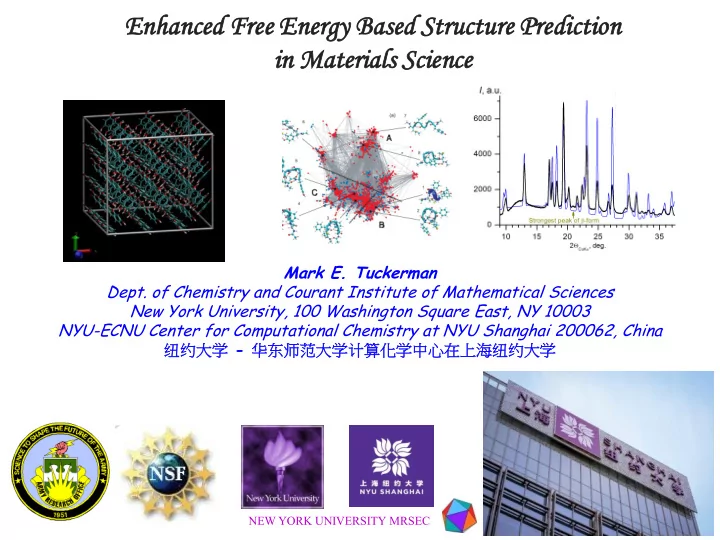
Enhanced En nced Free En Energy Based Structure ture Predicti iction on in Material erials s Science ce Mark E. Tuckerman Dept. of Chemistry and Courant Institute of Mathematical Sciences New York University, 100 Washington Square East,


slide-1
SLIDE 1

Mark E. Tuckerman

  • Dept. of Chemistry and Courant Institute of Mathematical Sciences

New York University, 100 Washington Square East, NY 10003 NYU-ECNU Center for Computational Chemistry at NYU Shanghai 200062, China 纽约大学 - 华东师范大学计算化学中心在上海纽约大学

En Enhanced nced Free En Energy Based Structure ture Predicti iction

  • n

in Material erials s Science ce

NEW YORK UNIVERSITY MRSEC

slide-2
SLIDE 2

Crystallization and the Pharmaceutical Industry: Materials Science? Pharmaceutical Materials Science: An Active New Frontier in Materials Research

  • J. Elliott and B. Hancock

Guest Editors MRS Bulletin 31, Issue 11 (2006)

Pharmaceutical Industry

  • $500 billion global market
  • $250 billion US market
  • Majority of pharmaceuticals are

small molecule crystals “One of the continuing scandals in the physical sciences is that it remains impossible to predict the structure of even the simplest crystalline solids from their chemical composition.”

  • - John Maddox, Nature (1998)
slide-3
SLIDE 3

Targets of the sixth blind structure prediction test

slide-4
SLIDE 4

Accuracy of intermolecular interactions

Empirical potentials fit to SAPT(DFT) calculations

( ) ( ) (1) ( ) 1 bonded 6,8,10

( ) 1 ( , ) ( , ) ( )

ij ij

n r i j ij l l n ij ij ij ij n ij ij n ij l n ij ij

q q C U A r e f r f r U r r

 

 

                  

  

R R

 

( , ) 1 !

m n r n m

r f r e m

 

 

 

Machine-learning (‘mathematical’) potentials Standard force fields

bonded 12 6

( ) ( )

i j ij ij ij ij ij ij

q q a b U U r r r            

R R

Kohn-Sham density functional theory (plus dispersion):

2 { }

1 1 ( ) ( ) ( ) [ ] [ , ] ( ) 2 2 '

min

i i xc ext NN i

n n U d d E n E n U

                   

 

r r R r r R R r r

2

( ) ( )

i i j ij i

n      

r r

slide-5
SLIDE 5

Structure prediction protocol for Target XXII

P212121

Lowest Energy Structures

P21/n P21/n Pbca C2/c Pbca

Optimize monomer geometry using DFT [PBE0 + D3, 6-311G**(d,p) Generate Unit Cells (UPACK)

25,000 generated structures 4,042 unique after clustering 107 within 10 kJ/mol of lowest energy

Run MD at exptl. P,T

slide-6
SLIDE 6

Summary of 50 predicted structures based on MD averaged energies

slide-7
SLIDE 7

I: P21/n II: Pbca, E = 3.46 kJ/mol III: P21/c, E = 5.37 kJ/mol IV: P21/n, E = 5.99 kJ/mol

V: P21/c, E = 6.31 kJ/mol

slide-8
SLIDE 8

Spc grp a b c β Expt. P21/n 11.95 6.70 12.60 108.6 Calc. P21/n 12.02 6.72 12.48 108.7 Prediction of the experimental structure

At 150 K: RMSD20 from experimental structure = 0.15 Å. Rank = 4 on our list Final ranking based on POLY1 SAPT(DFT) potential At 300 K: RMSD20 from experimental structure = 0.18 Å. Rank = 4 on our list Attempted predictions = 21, Times predicted = 12, Times ranked 5 or lower = 7

slide-9
SLIDE 9

Pharmaceutical polymorphism

HIV-1 protease Polymorphism refers to the ability

  • f a compound to form multiple

crystal structures.

Ritonavir: HIV protease inhibitor

  • NIH: $3,500,000 investment
  • Abbott Labs: $200,000,000 investment
  • Originally dispensed in 1996 as ordinary

capsules, no refrigeration required

  • Converted to lower energy (hitherto unknown)

polymorph (form I to form II) on the shelf

  • Form II: Poor solubility, lower bioavailability
  • Required recall (1998) and reformulation as

gel caps (2002).

slide-10
SLIDE 10

Pharmaceutical Polymorphism

Ranitidine hydrochloride (Zantac) C13H22N4O3S

Bond et al. Amer. Pharma. Rev. (2007)

Acetylsalicylic acid

slide-11
SLIDE 11

Rough energy landscapes in proteins and crystals

Dunitz and Scheraga PNAS 101, 14309 (2004)

slide-12
SLIDE 12

Sampling via collective variables in molecular simulation

φ ψ

Peptides: Crystals:

Packing: Orientation:

Cell shape:

x x x y y y z z z

a b c a b c a b c            h

2 1

4 ( ) ( , ) (2 1)

b

N l l b lm b b m l b

Q f r Y l N   

 

 

 

slide-13
SLIDE 13

( , ) 1 1

( ,..., ) d d ( ( ) )

n H n

P s s e q s

   

 

 

 

p r

p r r

Adiabatic free energy (temperature-accelerated molecular) dynamics (AFED/TAMD)

  • L. Rosso, P. Minary, Z. Zhu, MET J. Chem. Phys. 116, 4389 (2002)

Margliano and Vanden-Eijnden, Chem. Phys. Lett. 426, 168 (2006); J. B. Abrams and MET, J. Phys. Chem. B 112, 14752 (2008) For prediction of crystal structures: Yu and MET Phys. Rev. Lett. 107, 015701 (2011); Yu et al. J. Chem. Phys. 150, 214109 (2014)

   

1/2 2 { }

( ) lim exp ( ) 2 2 q s q s

      

   



                r r

Write δ-functions as product of Gaussians: Canonical probability distribution and free energy surface:

 

2 2 1 1

( , , , ) ( , ) ( ) 2 2

n n s s

p s p H q s m

     

 

   

 

p r p r r H

1

( ,..., ) ( ) 1,...,

N

q q q n

 

    r r r

Suppose n collective variables characterize a free energy landscape of interest

1 1

( ,..., ) ln ( ,..., )

n B n

A s s k T P s s  

Dynamically sample Gaussian centers s1,…,sn by introducing a kinetic energy for them And extending the phase space, which gives the following Hamiltonian:

slide-14
SLIDE 14

Adiabatically decoupled equations of motion:

 

( ) heat bath( )

i i i i

q H m s q T

    

         

r r r r

 

( ) heat bath( )

s

m s s q T

    

     r

Introduce high temperature for extended variables and high masses

s i

T T m m

Under adiabatic conditions, we generate a distribution

({ }) adb 1

( ,..., , , )

n s

P s s T T

({ }) adb 1 { } 1 1 { }

lim ln ( ,..., , , ) lim ln ( ,..., , ) ( ,..., , )

s n s s n n s

kT P s s T T T kT P s s T A s s T T

    

             

 

/ ({ }) adb 1 1 { }

lim ( ,..., , , ) ( ,..., , )

s

T T n s n

P s s T T P s s T

 

Adiabatic free energy (temperature-accelerated molecular) dynamics (AFED/TAMD)

slide-15
SLIDE 15

Alanine Decamer (gas phase) Force field: CHARMM22 20 CVs: All (φ,ψ) pairs CV Temperature: Ts = 900 K Physical Temp: T = 300 K CV mass: m(ψ,φ) = 600mH Harmonic coupling: 300.5 kcal/mol/rad2

Other developments: 1. Combining with metadynamics used as a bias:

  • 2. Optimal free energy reconstruction protocols:
  • M. Chen. M. Cuendet, MET J. Chem. Phys. 137, 024102 (2012)
  • M. Cuendet and MET J. Chem. Theor. Comput. 10, 2975 (2014)
slide-16
SLIDE 16
slide-17
SLIDE 17

GROMOS FF, 100 K, 32,000 40,000 K

s

T T   

216 (3 3 3), 2 GPa, Total run time = 500 ps, 5 ns N P    

Constant pressure version with cell matrix as CVs

slide-18
SLIDE 18

II(01)

X-ray powder diffraction patterns Yonetani et al. (2001).

II(98) 98 01

slide-19
SLIDE 19

MURI/ARO

Free energies of benzene polymorphs Six-dimensional free energy surface analyzed using clustering based on a Gaussian mixture model.

II(98) II(01)

Cmca P41212 P21/c C2/c P21/c

(see, also, J. Yang et al. Science 345, 640 (2014))

slide-20
SLIDE 20

Polymorphs of resorcinol

  • Resorcinol (C6H6O2) is a simple benzene derivative.
  • At ambient conditions, forms two stable forms (α and β)

depending on the relative orientations of the OH bonds, both having space group Pna21

1.

  • High pressure phase (δ phase) exists and arises from an

α → δ at pressures above 3 GPa2. Structure unknown.

  • Another high pressure phase (ε phase) can be reached

from β phase above 5.6 GPa. This phase is also thought to be disordered based on Raman scattering2.

  • Another ambient polymorph (γ phase) in the Rb

conformation recently found3. Its exact structure is unknown4.

  • Recent new experimental activity in study of

resorcinol.5

1Robertson and Ubbelohde Proc. Royal Soc. London 167 122 (1938) 2 Rao et al. Phys. Rev. B 65 054108 (2002). 3 Kahr et al. Cryst. Growth Design 11 2070 (2011). 4 Zhu et al. Angew. Chem. Intl. Ed. (submitted) 5 J. Phys. Chem. B (2015); J. Mol. Struct. (2015).

slide-21
SLIDE 21

polymorph 

slide-22
SLIDE 22

1

2 P

slide-23
SLIDE 23

transition at 3 GPa   

slide-24
SLIDE 24

Preliminary free energy estimates for resorcinol

 form δ form a/A b/A c/A a/A b/A c/A Cell length 10.53 9.53 5.60 8.20 11.65 4.88 Cell angle 90 90 90 90 90 90 Space GP Pna21 Pna21

Supercell length A

slide-25
SLIDE 25

Energetic Co-crystals: DADP.TxTNB

DADP TCTNB

β ( iodo- ) α ( chloro- ) ( bromo- )

Experimental Structures

Polarizable system without pre-determined force field parameters = opportunity for ab initio enhanced sampling!

  • Exp. Structures (Maztger Group):
  • J. Am. Chem. Soc. 2015, 137, 5074−5079
  • Angew. Chem. Int. Ed. 2013, 52, 6468-6471

1 3

slide-26
SLIDE 26

CP2K 2.5: PBE+D3/DZVP-MOLOPT-(SR)-GTH

For optimized unit cells within PBE+D3, DZVP, 450 Ry in CP2K Cl α < Cl β ΔE ≈ 1.6 kJ/mol Br α > Br β ΔE ≈ 4.9 kJ/mol I α >> I β ΔE ≈ 15.8 kJ/mol

Energetic Co-crystals: DADP.TxTNB

β ( iodo- ) α ( chloro- ) ( bromo- )

  • Observed DADP.TBTNB co-crystal is a

kinetic product – aggregation promotes co-crystal growth?

  • Can we obtain the actual free energy

difference between the two forms for each co-crystal?

  • Implementation of crystal-AFED in CP2K
slide-27
SLIDE 27

Start with nuclei Compute ,

i n

,

i n

  F

Propagate nuclei a short time Δt with F Add electrons Add electrons

Ab initio molecular dynamics

2

( ) 2 (0) ( ) (0)

I I I I I

t t t M       R R R F

e.g. Verlet:

{ }

min [{ }, ]

I I I

M E

   R R

slide-28
SLIDE 28

11.0 picosecond of ab initio crystal-AFED with CP2K for TCTNB/DADP co-crystal

slide-29
SLIDE 29

Experimental structure: α New Polymorph Alternate polymorph: β

3

14.344 15.272 9.006 91.3 1.549 g/cm a b c       

3

25.797 9.450 12.638 99.6 1.542 g/cm a b c       

3

16.724 9.450 12.638 69.7 1.631 g/cm a b c       

slide-30
SLIDE 30

MURI/ARO

Crystal structures of Xenon at 2700 K and 25 GPa Using Q4 and Q6 only as collective variables Ts = 1.5 x 10⁵ K ms = 108 amu Using Q4, Q6, and the cell matrix hd as collective variables Ts = Th = 105 K, ms = 108 amu

  • T. Q. Yu, P. –Y. Chen, A. Samanta, E. Vanden-Eijnden, MET J. Chem. Phys. (2014)

Experimental evidence mixed fcc-hcp structures in pressure-induced Martensitic transitions from fcc to hcp as intermediates: Jephcoat et al. Phys. Rev. Lett. 59, 2670 (1987) Cynn et al. Phys. Rev. Lett. 86, 4552 (2001)

slide-31
SLIDE 31
slide-32
SLIDE 32

The mechanism of equilibrium melting of a solid

  • A. Samanta, T.-Q. Yu, W. E, MET Science (November, 2014)

Classical nucleation theory:

3 2

4 ( ) 4 , < 0 3

s

G r r r             

3 2

2 16 ( ) 3

s s

r G r      

 

     

r*

slide-33
SLIDE 33

Crystal d-AFED simulations of the melting of Cu

Collective variables: hd, Q4, Q6, T = Tm, Ts=Th = 107 K Potential model: Embedded Atom Model (EAM) of Mishin et al.

  • Phys. Rev. B 63, 224106 (2001).
  • A. Samanta, T.-Q. Yu, W. E, MET Science (November, 2014)
slide-34
SLIDE 34

Free energy surfaces

One-dimensional profiles constructed using string method [Maragliano et al. JCP (2006)]

slide-35
SLIDE 35
slide-36
SLIDE 36

Navigating on a high-dimensional surface From a minimum, we ask for the nearest accessible saddle points. These can be found using gentlest ascent dynamics (GAD) on the FES.

A. Samanta, M. Chen, T. –Q. Yu, W. E, MET J. Chem. Phys. 140, 164109 (2014).

  • M. Chen, T. –Q. Yu, MET PNAS 112, 3235 (2015)

s F

 

Activation: Combine with relaxation to next minimum:

Termed “STochastic Activation-Relaxation Technique” or START

slide-37
SLIDE 37

Example: Alanine tripeptide Landmarks determined using density-based clustering methods. Minima and saddles are assigned as vertices of different colors. An edge connects a saddle vertex to a minimum vertex if a relaxation initiated at the saddle ends up at the corresponding minimum. Graph representation of free energy surfaces

slide-38
SLIDE 38

Full network diagram for met-enkephalin using 10 Ramachandran angles as CVs: 1081 minima, 1431 saddles Graph nodes sorted based on Sketch Map analysis

  • M. Ceriotti, G. A. Tribello, M. Parrinello Proc. Natl. Acad. Sci. 108, 13023 (2011)

2 2

( ) ( )

ij ij i j

F R f r 

     

slide-39
SLIDE 39

If we want to compute free energies, use the minima obtained in a START run to indicate where a set of bins should be placed and use AFED sampling to obtain the populations in those bins. Can be adapted for crystal structure prediction! [M. Chen, T. –Q. Yu, MET (in prep)] Can handle explicit solvent!

slide-40
SLIDE 40
slide-41
SLIDE 41

Spc grp a b c β Expt. P21/c 9.45 6.04 8.56 103.4 Calc. P21/c 9.95 5.90 8.79 106.6

Experimental structure first found in 1 ns using orientational CVs. RMSD4 of carbons = 0.16 Å, full RMSD4 = 0.44 Å using a simple, universal force field

  • M. Chen, T. –Q. Yu,

MET (in prep)

slide-42
SLIDE 42

Conclusions and Perspectives

1. Protocol for crystal structure prediction including specialized force field generation [SAPT(DFT)] combined with molecular dynamics refinement. 2. Enhanced sampling approaches further allow for polymorph prediction and ranking based on free energy, which is the proper figure of merit. 3. Surface navigation combined with enhanced sampling looks to be a promising approach going forward, however, it is important to have a robust set of internal collective variables. 4. Considerable challenges remain including:

  • i. Highly flexible molecules.
  • ii. High-temperature and/or high-pressure polymorphs.
  • iii. Stacking faults, screw axes, mixed phases,….
  • iv. Isotopic polymorphism (requires, e.g., path integrals).

5. From Nature press release based on CCDC 6th blind test, “It is fair to claim that, to a large extent, this blind test has shown that the problem of organic structure prediction has been solved.” – M. Neumann. This claim might be exaggerated, and the field of crystal structure prediction far from dead.

slide-43
SLIDE 43

Acknowledgments

Postdocs

  • Elia Schneider
  • Linas Vilciauskas
  • Leslie Vogt

External

  • Krzysztof Szalewicz (U. Del.)
  • Michael Metz (U. Del.)
  • Andrew Rohl (Curtin U.)
  • Bart Kahr (NYU)
  • Qiang Zhu (Stony Brook)

Students

  • Ming Chen
  • Tang-Qing Yu
  • Manav Kumar
  • Hongxing Song