Struct uctur ural l Axial al, S Shear and and Bend Bending - - PDF document

struct uctur ural l axial al s shear and and bend bending
SMART_READER_LITE
LIVE PREVIEW

Struct uctur ural l Axial al, S Shear and and Bend Bending - - PDF document

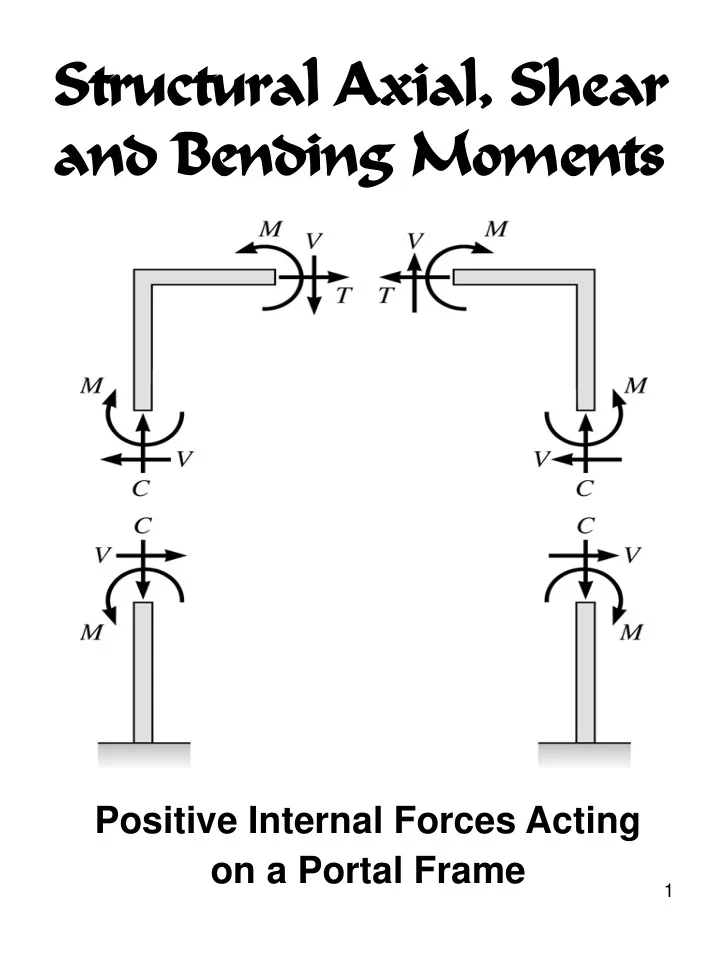
Struct uctur ural l Axial al, S Shear and and Bend Bending ng M Moment oments Positive Internal Forces Acting on a Portal Frame 1 Recall from mechanics of mater- ials that the internal forces P (generic axial), V (shear) and M


slide-1
SLIDE 1

1

Struct uctur ural l Axial al, S Shear and and Bend Bending ng M Moment

  • ments

Positive Internal Forces Acting

  • n a Portal Frame
slide-2
SLIDE 2

2

Recall from mechanics of mater- ials that the internal forces P (generic axial), V (shear) and M (moment) represent resultants of the stress distribution acting on the cross section of the beam. Internal Axial Force (P) ≡ equal in magnitude but opposite in direction to the algebraic sum (resultant) of the components in the direction parallel to the axis of the beam of all external loads and support reactions acting on either side of the section being considered. T ≡ Tension C ≡ Compression

slide-3
SLIDE 3

3

Beam Sign Convention for Shear and Moment

slide-4
SLIDE 4

4

Internal Shear Force (V) ≡ equal in magnitude but opposite in direction to the algebraic sum (resultant) of the components in the direction perpendicular to the axis of the beam of all external loads and support reactions acting

  • n either side of the section being

considered. Internal Bending Moment (M) ≡ equal in magnitude but opposite in direction to the algebraic sum of the moments about (the centroid of the cross section of the beam) the section of all external loads and support reactions acting on either side of the section being considered.

slide-5
SLIDE 5

5

Positive Sign Conventions: Tension axial force on the section Shears that produces clockwise moments Bending moments that produce compression in the top fibers and tension in the bottom fibers of the beam

slide-6
SLIDE 6

6

Shear and bending moment diagrams depict the variation of these quantities along the length

  • f the member.

Proceeding from one end of the member to the other, sections are

  • passed. After each successive

change in loading along the length of the member, a FBD (Free Body Diagram) is drawn to determine the equations express- ing the shear and bending mo- ment in terms of the distance from a convenient origin. Plotting these equations produces the shear and bending moment diagrams.

slide-7
SLIDE 7

7

V and M are in the opposite directions of the positive beam sign convention

slide-8
SLIDE 8

8

Shear and Bending Moment Diagrams

Zero Shear Maximum Positive Bending Moment

slide-9
SLIDE 9

9

Principle of Superposition

slide-10
SLIDE 10

10

Example Problem Shear and Moment Diagrams

Calculate and draw the shear force and bending moment equations for the given structure.

slide-11
SLIDE 11

11

Sketching the Deflected Shape of a Beam or Frame

Qualitative Deflected Shape (elastic curve) ≡ a rough (usually exaggerated) sketch of the neutral surface of the structure in the deformed position under the action

  • f a given loading condition.

Such sketches provide valuable insights into the behavior of struc- tures.

slide-12
SLIDE 12

12

Following our positive beam sign convention, a positive bending moment bends a beam concave upward (or towards the positive y direction), whereas a negative bending moment bends a beam concave downward (or towards the negative y direction).

slide-13
SLIDE 13

13

slide-14
SLIDE 14

14

An accurate sketch must satisfy the following rules:

  • The curvature must be consis-

tent with the moment curve.

  • The deflected shape must

satisfy the boundary constraints.

  • The original angle at a rigid

joint must be preserved.

  • The length of the deformed

member is the same as the

  • riginal length of the unloaded

member.

slide-15
SLIDE 15

15

  • The horizontal projection of a

beam or the vertical projection of a column is equal to the original length of the member.

  • Axial deformations, which are

trivial compared to bending deformations, are neglected.

slide-16
SLIDE 16

16

P.I. Point of Inflection = zero moment location for mechanically loaded structures

slide-17
SLIDE 17

17

BC = zero member bending B C – straight line (linear) since MBC = 0

' '

slide-18
SLIDE 18

18

slide-19
SLIDE 19

19

Enforcing zero displacement at C Ignoring zero displacement at C

slide-20
SLIDE 20

20

Bending displacements without support conditions

slide-21
SLIDE 21

21

Enforcing support conditions NOTE: Members AB’ and C’D” displacements are linear since the bending moment in these members is zero

BB’ = CC’ = ’A from

  • Fig. (a)

DD” = DD’ + A’A from Fig. (a)

slide-22
SLIDE 22

22

Note discontinuity in rotation at C – internal hinge location

slide-23
SLIDE 23

23

Axial Force, Shear Force and Bending Moment Diagrams for Plane Frames

Previous definitions developed for shear forces and bending moments are valid for both beam and frame structures. However, application of these definitions, developed for a horizontal beam, to a frame structure will require some adjustments. Consider the portal frame shown

  • n the next two slides.
slide-24
SLIDE 24

24

P q

A B C D

Figure F.1 (a) Loaded Portal Frame

slide-25
SLIDE 25

25

AB A

V

AB A

T

AB A

M

AB B

T

AB B

V

AB B

M

CD D

T

CD D

V

CD D

M

CD C

M

BC C

M

BC B

M

CD C

T

BC C

T

BC B

T

CD C

V

BC C

V

BC B

V

F.1 (b)

slide-26
SLIDE 26

26

The positive sign convention consistent with beam theory is shown in F.1(b). As seen from F.1 (b), the positive sign convention is (a) tension axial force, (b) shear forces that produce clockwise moments and (c) bending moments that result in tension stresses in the interior frame fibers. The sign convention of F.1(b) can be seen to be equivalent to the beam sign convention rotating columns AB and CD to line up with beam BC.

slide-27
SLIDE 27

27

NOTE: For multi-bay frames, the usual practice is to define tension axial forces and shears that produce clockwise moments as positive for each member. However, the inside fiber for bending is not easily defined. Consequently, engineers choose to draw the bending moments on either the tension (common amongst structural engineers) or compression side of the

  • members. They are not labeled

as either positive or negative. Alternatively, a vector sign convention can be used – usual for computer codes.

slide-28
SLIDE 28

28

Example Frame Problem 1

Calculate and draw the axial force, shear force and bending moment equations for the given frame structure.

slide-29
SLIDE 29

29

Example Frame Problem 2

Calculate and draw the axial force, shear force and bending moment equations for the given frame structure.

slide-30
SLIDE 30

30

Two-Dimensional Force Transformations

x y r

Px Py

θ

Pn Pt FT (b) FT (a) FT = Force Transformation

slide-31
SLIDE 31

31

Suppose you are given the forces in FT (a) and you wish to transform these forces into Pn (normal) and Pt (tangential) as shown in FT (b). This force transformation may be neces- sary so that you can calculate the member axial and shear forces. These force transformations are summarized on the next slide.

slide-32
SLIDE 32

32

Px Py Pn

θ θ

n x y

P P sin P cos = θ − θ

Py Px

θ

Pt t x y

P P cos P sin = θ + θ x y cos ; sin ; r r y tan x θ = θ = θ =

slide-33
SLIDE 33

33

Example Frame with Inclined Member

Calculate and draw the axial force, shear force and bending moment equations.

slide-34
SLIDE 34

34

Degree of Frame Indeterminacy Rigid Frame ≡ composed of straight members connected either by rigid (moment resisting) connections or by hinged connections to form stable configurations. Rigid Joint ≡ prevents relative translations and rotations between connected members.

slide-35
SLIDE 35

35

Statically Determinate ≡ the bending moments, shears, and axial forces in all its members, as well as the external reactions, can be determined by using the equations of equilibrium and condition, otherwise the frame is either unstable or statically indeterminate.

slide-36
SLIDE 36

36

Summary

3m + R < 3j + C ⇒ statically unstable frame 3m + R = 3j + C ⇒ statically determinate frame, if stable 3m + R > 3j + C ⇒ statically indeterminate frame, if stable

I = (3m + R) - (3j + C)

= degree of static indeterminacy Redundants ≡ excess members and reactions

slide-37
SLIDE 37

37

Alternative Approach

An alternative approach for determining the degree of static indeterminacy of a frame is to cut enough members of the frame by passing imaginary sections and/or to remove enough supports to render the structure statically determinate. The total number of internal and external restraints thus removed equals the degree of static indeterminacy.

slide-38
SLIDE 38

38

This alternative approach pro- vides the most convenient means for determining the degree of static indeterminacy of multistory building frames:

I = 3(Ng – Nf) – Nh – 2Nr – C

Ng ≡ Number of Girders in the structure Nf ≡ Number of Free joints in the structure Nh ≡ Number of Hinged supports Nr ≡ Number of Roller supports C ≡ Number of equations of Condition in the structure

slide-39
SLIDE 39

39

Equations of Condition at a Joint Detail w/ Three or More Members

Cj = Nbj – 1 Nbj = Number of Beam (moment resisting) members at joint j

slide-40
SLIDE 40

40

m = 5, R = 8 j = 6, C = 0 I = 5 m = 4, R = 3 j = 4, C = 0 I = 3 m = 6, R = 4 j = 6, C = 0 I = 4 I = (3m + R) – (3j + C)

slide-41
SLIDE 41

41

m = 10, R = 9 j = 9, C = 5 Ng = 4, Nf = 0 Nh = Nr = 0 I = 7 Ng = 4, Nf = 0 Nh = Nr = 0 C = 0 I = 12 I = 3(Ng – Nf) – Nh – 2Nr - C

slide-42
SLIDE 42

42

Ng = 35, Nf = 0 Nh = Nr = 0 C = 0 I = 105