Strabo: A Complete System for Label Recognition in Maps Yao-Yi - - PDF document

strabo a complete system for label recognition in maps
SMART_READER_LITE
LIVE PREVIEW

Strabo: A Complete System for Label Recognition in Maps Yao-Yi - - PDF document

Strabo: A Complete System for Label Recognition in Maps Yao-Yi Chiang and Craig Knoblock Spatial Sciences Institute and Information Sciences Institute University of Southern California Motivation Maps are a rich source of geospatial data:


slide-1
SLIDE 1

Strabo: A Complete System for Label Recognition in Maps

University of Southern California

Yao-Yi Chiang and Craig Knoblock

Spatial Sciences Institute and Information Sciences Institute

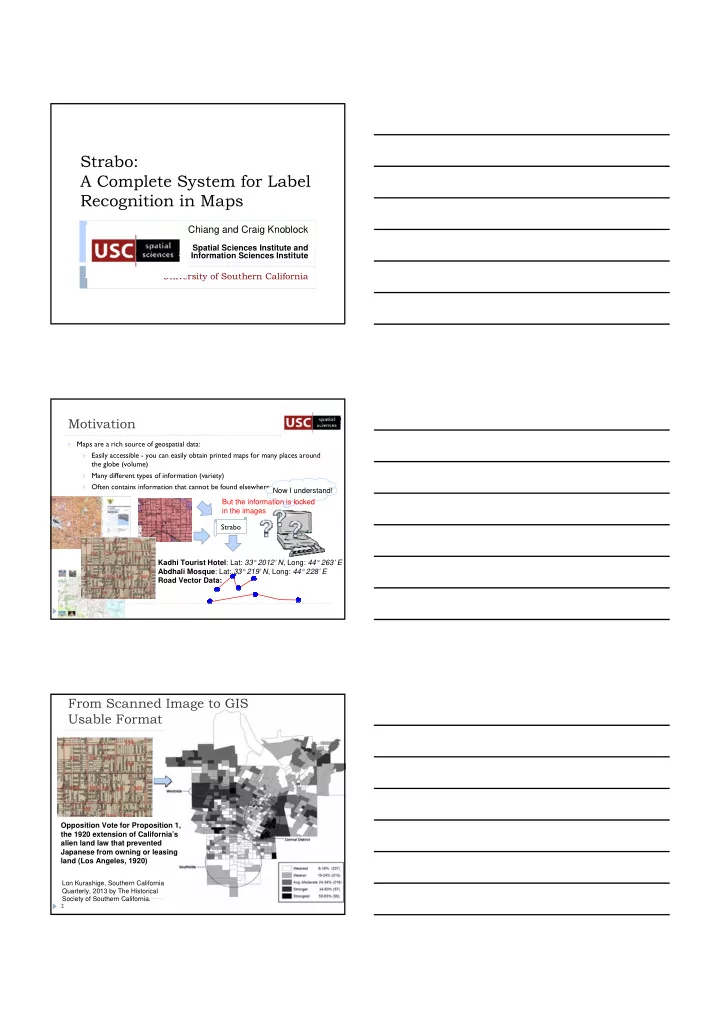
 Maps are a rich source of geospatial data:  Easily accessible - you can easily obtain printed maps for many places around

the globe (volume)

 Many different types of information (variety)  Often contains information that cannot be found elsewhere (historical maps)

Motivation

1

Strabo Kadhi Tourist Hotel: Lat: 33° 2012’ N, Long: 44° 263’ E Abdhali Mosque: Lat: 33° 219’ N, Long: 44° 228’ E Road Vector Data: Now I understand! But the information is locked in the images

2

From Scanned Image to GIS Usable Format

Opposition Vote for Proposition 1, the 1920 extension of California’s alien land law that prevented Japanese from owning or leasing land (Los Angeles, 1920)

Lon Kurashige, Southern California Quarterly, 2013 by The Historical Society of Southern California.

slide-2
SLIDE 2

Harvesting Geographic Features From Heterogeneous Raster Maps

3

Raster Map Road Layer (raster) Text Layer (raster) Map Decomposition

Carter Ave

  • N. Newstead Ave

Rush Pl

  • E. Green Lea Pl

Penrose St Red Bud Ave Fairgrounds Park Pond …

Text Text Recognition Road (vector) Road Vectorization Alignment Road Intersection Extraction Road Intersections

Lat / Long Lat / Long

Road Intersections from a Georeferenced Sources

Various Toponym of the Same Place in Historical Maps of Different Time Periods

4

1921 Japanese 1992 ROC 1945 US Military 1935 Japanese 1986 Scottish Geographical Magazine

Map Processing Challenges

5  It is difficult to unlock the geospatial information in raster maps:  There is limited access to the meta-data  They have overlapping features  They often have poor image quality  Previous work is typically limited to a specific type of map and often relies

  • n intensive manual work
slide-3
SLIDE 3

Scanning and Compression Noise

6

 Raster maps may contain noise from scanning and

compression process

Numerous Colors in Scanned Maps

7

 Manually examining each color for extracting features is

laborious 285,735 colors 285,735 colors

RGB Color Cube RGB Color Cube

 Analyze only color space for color segmentation does not work for feature

extraction purpose

 Colors of individual features do not merge

Color Segmentation by Analyzing Color Space

8

Original image Original image After K-means (16 colors) After K-means (16 colors) After Median-Cut (16 colors) After Median-Cut (16 colors) Each color is represented by a grayscale level Each color is represented by a grayscale level

slide-4
SLIDE 4

Color Segmentation with Spatial Information

9

 The Mean-shift algorithm

 Consider distance in the color space

and in image space

 Preserve object edges  Reduce the colors by 50%

 The K-means algorithm

 Limit the number of colors to K  From 155,299 to 10 colors (K=10)

Supervised Extraction of Text Layers

10  Use color segmentation to reduce the number of colors  User provides examples of text areas for identifying text colors  Decompose a user label into images, each of the images contains one color  Apply Run Length Smoothing algorithm (RLSA) to identify text colors

Determine Text Colors

11

Run Length Smoothing Algorithm (RLSA)

  • >Next slide
slide-5
SLIDE 5

 A RLSA example using a 5x1-pixel window

RLSA Example

12

After Erosion After Erosion After Dilation

 Decompose a user label into images, each of the images contains one color  Apply Run Length Smoothing algorithm (RLSA) to identify text colors

After RLSA

13

1 2 3 1 2 3 1 2 3 1 2 3

After Dilation After Erosion After Erosion

RLSA Extracted Text Layers

Fourth Contribution: Text Recognition

14

User Labels Original map Extracted text layers

slide-6
SLIDE 6

Text Recognition from Identified Text Layers

15

Rotate each string to the horizontal direction Optical character recognition using a commercial product

Fourth Contribution: Text Recognition

Identify individual strings

 Multi-oriented text labels  Characters can have various sizes

Identify Individual Strings

 Conditional Dilation Algorithm:

 Expand the foreground area of the connected components (i.e.,

characters) when certain conditions meet

 To determine the connectivity between the characters 16

Detect String Orientation

 Rotate a string from 0° to 180°  Apply Run Length Smoothing algorithm

17

Rotated Strings After Closing After Erosion

slide-7
SLIDE 7

 Feed the horizontal text strings to a commercial OCR

product

 Use the OCR returned confidence to determine the

correctly oriented horizontal string

 Number of suspicious characters  Number of recognized characters

Recognize Characters in the Horizontal Text Strings

18

OCR

Olympian ueidwblo Experiments

 Tested on 15 maps from 10 sources  Tested the 15 test maps using an OCR product called ABBYY FineReader

alone for comparison

19

Examples of Test Maps

Experiments (Cont’d)

 Strabo extracted 22 text layers using 74 user labels (avg. 3.36)  Strabo extracted 6,708 characters and 1,383 words  ABBYY FineReader extracted 2,956 characters and 655 words 20

slide-8
SLIDE 8

In Practice: Text Recognition on Nautical Charts

21

NOAA nautical chart 12245, edition 67

Extraction Precision/Recall

22 Precision 83.63% Recall 80.35% Total Labels 1,253

Time Requirement

23

Strabo Steps Time (H:MM:SS) User Time Elapse Time

  • 1. Color Segmentation

N/A N/A

  • 2. Providing Text Samples

0:01:04 0:01:04

  • 3. Processing the Text Samples to Extract Text Layers

0:00:00 0:00:11

  • 4. Processing Text Layers to Identify Individual Text Labels

0:00:00 0:16:17

  • 5. Executing ABBYY FineReader to Recognize Text Labels

0:00:00 0:04:47

  • 6. Saving ABBYY FineReader OCR Results

0:00:00 0:18:59

  • 7. Generating Shapefiles

0:00:00 0:09:49 Total Time 0:01:04 0:51:07 Table 1. The required time for using Strabo for text recognition in the test map ArcGIS Steps Time (HH:MM:SS) User Time Elapse Time

  • 1. Post‐editing to Delete Incorrect Results

0:12:46 0:12:46

  • 2. Post‐editing to Add Missing Results

0:20:39 0:20:39

  • 3. Post‐editing to Verify Results

0:23:13 0:23:13 Total Post‐Editing Time 0:56:38 0:56:38 Table 2. The required time for post‐editing in ArcGIS

slide-9
SLIDE 9

Positional Accuracy

24

Label Count Minimum Distance 917 0 (decimal degrees) Maximum Distance 0.002296 (decimal degrees) Distance Sum 0.01332 (decimal degrees) Distance Mean 0.000015 (decimal degrees) Distance Standard Deviation 0.000155 (decimal degrees)

Error Distribution

25

Error Distribution (Cont’d)

26

slide-10
SLIDE 10

Related Work

 Work on one type of map (Fletcher and Kasturi,88; Bixler,

2000; Chen and Wang, 97)

 Require training for each input map (Adam et al., 00;

Deseilligny et al., 95; Pezeshk and Tutwiler, 10)

 Require manual processing to prepare each string for OCR

(Cao and Tan, 02; Li et al., 00; Pouderoux et al., 07; Velazquez and Levachkine, 04, ABBYY FineReader, 10)

 Require additional knowledge of the input map (Gelbukh et al.,

04; Myers et al., 96)

27

Conclusion: Contributions

 A general approach to recognizing text labels in heterogeneous

raster maps

 Not limited to a specific type of map

 Handle raster maps with varying map complexity, color usage, and image

quality

 Require minimal user input  Outperform state-of-art commercial products with considerably

less user input

28

Discussion and Future Work

 Strabo is an open source library  We are working with the TerraGo Technologies to build

commercial package for text recognition on maps

 Current Implementation Limitation and Research

extensions:

 Current user interface takes only 4k-by-4k maps  Recognize languages other than English  Handle monotone, B/W maps  Will incoperate additional knowledge of the map region to

improve text recognition

29

slide-11
SLIDE 11

Questions?

30

Thank You

 Acknowledgement

The U.S. National Committee (USNC) to the International Cartographic Association University of Southern California, Spatial Sciences Institute