STOKING THE FIRE WITHIN: ST FANNING INDIGENOUS FA Neurosciences - - PowerPoint PPT Presentation

stoking the fire within st fanning indigenous fa
SMART_READER_LITE
LIVE PREVIEW

STOKING THE FIRE WITHIN: ST FANNING INDIGENOUS FA Neurosciences - - PowerPoint PPT Presentation

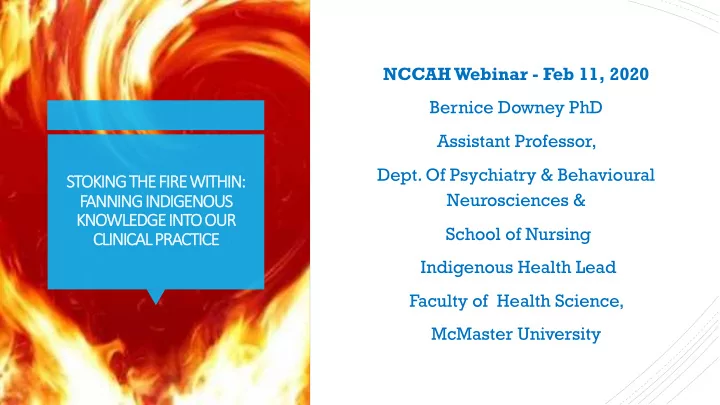
NCCAH Webinar - Feb 11, 2020 Bernice Downey PhD Assistant Professor, Dept. Of Psychiatry & Behavioural STOKING THE FIRE WITHIN: ST FANNING INDIGENOUS FA Neurosciences & KN KNOWLED LEDGE E IN INTO O OU OUR School of Nursing


slide-1
SLIDE 1

ST STOKING THE FIRE WITHIN: FA FANNING INDIGENOUS KN KNOWLED LEDGE E IN INTO O OU OUR CL CLINICA CAL PRACTICE CE

NCCAH Webinar - Feb 11, 2020 Bernice Downey PhD Assistant Professor,

  • Dept. Of Psychiatry & Behavioural

Neurosciences & School of Nursing Indigenous Health Lead Faculty of Health Science, McMaster University

slide-2
SLIDE 2

ST STORY TELLING: “T “Think Indian!”

slide-3
SLIDE 3

DOWNEY

slide-4
SLIDE 4

Objective #2

to understand the challenges and

  • pportunities faced by Indigenous health

practitioners for blending Indigenous and Western knowledges into their health care practices; and

slide-5
SLIDE 5

As Aspiration

  • ns &

& t ten ension

  • ns a

as In Indigen enou

  • us Hea

Healthcare e pr prac actitio titione ners

  • Sense of ‘collective responsibility’ and desire to help our communities
  • Second career after raising families

Aspirations: Why we choose our healthcare professions

  • Clinical practice grounded in bio – medical foundation/theory
  • Little to no room for Indigenous traditional approaches
  • Micro-aggression
  • Isolation

Tensions:

slide-6
SLIDE 6

Historical perspective

slide-7
SLIDE 7

Ar Arti ticle 2 Indigenou

  • us peop
  • ples and

in indiv ivid iduals als ar are fr free an and equal al to all all

  • t
  • ther peop
  • ples and individuals and

ha have e the he right to be be free ee from m any ki kind of discr crimination, in the exerci cise

  • f
  • f their righ

ghts, , in particular that ba based ed on n thei heir indi ndigeno enous us origin n or id identit ity.

slide-8
SLIDE 8

Downey Story

§ EDUCATION § CLINICAL: MENTAL HEALTH § ADMINISTRATION § POLICY § RESEARCH § ADVOCACY § LEADERSHIP

slide-9
SLIDE 9

Window of Opportunity?

§ Recognize that the state of health is directly

related to Canadian policy of assimilation and colonization.

§ Identify measurable goals in consultation with

Indigenous Peoples.

§ Acknowledge distinct needs and diversity of

First Nations, Inuit and Metis Peoples.

§ Sustainable Funding for existing and new

programs that are working.

§ Enhance access to traditional healing

practices.

§ Recruit and Retain more Aboriginal Health

Care providers.

§ Mandatory training in health education.

slide-10
SLIDE 10

§ Increase the number of Aboriginal

professionals working in the health-care field.

§ Ensure the retention of Aboriginal health care

providers in Aboriginal communities.

§ Provide cultural competency training for all

health-care providers.

§ Further, that those who can effect change within

the Canadian health care system to recognize the value of Aboriginal healing practices and use them in the treatment of Aboriginal patients in collaboration with Aboriginal healers and Elders where requested by Aboriginal patients.

Health Related Calls to Action

slide-11
SLIDE 11

Clashing Worldviews

INDIGENOUS

STRESSES INTERACTIONAL RELATIONSHIPS COOPERATION HARMONY IN DIVERSITY CONTEXTUAL FACTORS & ANALYSIS CONSIDERS DIFFERENT VIEWS

WESTERN

HIERARCHAL RELATIONSHIPS, CAUSE AND EFFECT AUTHORITARIANISM & INDIVIDUALISM UNITY BY SIMILARITY & REPITITION CATAGORIZATION & TAXONOMIC METHODS ONE TRUTH

slide-12
SLIDE 12

Objective # 3

To discuss wise practices employed by Indigenous health practitioners in accessing and utilizing Indigenous knowledges and traditional practices to optimize the health

  • utcomes of Indigenous patients.
slide-13
SLIDE 13

Health Practitioner in the post TRC Era

Reconciliation: an ongoing process of establishing & maintaining respectful relationships at all levels of Canadian Society UNDRIP: United Nations Declaration on the Rights

  • f Indigenous Peoples

Cultural Knowledge Distortion Diaspora of Indigenous knowledge Casting out – ‘the tyrant within’ Decolonizing our western educated minds & making space for our own Indigenous ways of knowing and doing

slide-14
SLIDE 14

The right to our

  • wn knowledge

systems

The United Nations Declaration on the Rights of Indigenous Peoples recognizes that respect for indigenous knowledge, cultures and traditional practices contributes to sustainable and equitable development.

slide-15
SLIDE 15

Indigenous Science

§ Way of seeing & knowing that is dynamic, holistic,

intergenerational and time-tested.

§ Indigenous science is place based and therefore,

dependent on a deep connection and relationship to traditional lands and the natural world.

slide-16
SLIDE 16

Article 24.1

Indigenous peoples have the right to their traditional medicines and to maintain their health practices, including the conservation of their vital medicinal plants, animals and

  • minerals. Indigenous individuals also have the

right to access, without any discrimination, to all social and health services. 2. Indigenous individuals have an equal right to the enjoyment of the highest attainable standard of physical and mental health. States shall take the necessary steps with a view to achieving progressively the full realization of this right.

slide-17
SLIDE 17

IK and Traditional Healing

§ medicinal plants § communication with spiritual beings,

dreams & the use of the healing power of water and minerals.

§ Healers: possession of broad

knowledge base passed down between generations

slide-18
SLIDE 18

Article 12.1

§ Right to manifest, practise, develop and teach

their spiritual and religious traditions, customs and ceremonies; the right to maintain, protect, and have access in privacy to their religious and cultural sites; the right to the use and control of their ceremonial objects; and the right to the repatriation

  • f their human remains.
slide-19
SLIDE 19

Making space for Bimaadiziwin

§ Going inward § Situating my work § Owning my identity and merging with my profession § Expressing my spirituality as an Indigenous medical

anthropologist and system change agent

slide-20
SLIDE 20

Article 31.1

§ Indigenous peoples have the right to maintain, control,

protect and develop their cultural heritage, traditional knowledge and traditional cultural expressions, as well as the manifestations of their sciences, technologies and cultures, including human and genetic resources, seeds, medicines, knowledge of the properties of fauna and flora, oral traditions, literatures, designs, sports and traditional games and visual and performing arts. They also have the right to maintain, control, protect and develop their intellectual property over such cultural heritage, traditional knowledge, and traditional cultural expressions.

§

slide-21
SLIDE 21

Ani nishi hina naabe bemowin

“Language is our symbolic code for representing the world that we perceive with our senses. Meaning is not connected solely to intellectual definition but to the life of the body and the spirit of the speaker. At the deeper psychological level, language is sensuous, evocative, filled with emotion, meaning and

  • spirit. In its holistic and natural sense, language is

animate and animating, it expresses our living spirit through sound and the emotion with which we

  • speak. In the Native perspective language exemplifies
  • ur communion with nature.” (Cajete, 2007)
slide-22
SLIDE 22
slide-23
SLIDE 23

In Indig igen enou

  • us Women
  • men’s Hear

Heart Healt Health: Under erstan andin ing & & Me Mending ‘Broken’ Hearts rts

Project Timeline

slide-24
SLIDE 24

Storytelling Methodology

24

§ Indigenizing methods process

§ Research team discussions around adapting

Indigenous research methodologies to be locally and culturally appropriate

§ Maintaining cultural process and balancing

research ethics and mainstream expectations

§ Community and participant guided

methodology § The circle process is relational and equalizes

power inequities

§ Language-fluid concepts

slide-25
SLIDE 25

Authentic Indigenous Partnerships

§ inclusive of values grounded in diverse

Indigenous philosophies

§ centre relationality, respect & reciprocity at

the core of self-determination

§ CINA § Royal College of Physicians & Surgeons –

Indigenous Working Group

§ IPAC § AFMC

slide-26
SLIDE 26

FOR THE FACES TO COME…….