Statistics 300: Elementary Statistics Section 6-5 Central Limit - - PDF document

statistics 300 elementary statistics
SMART_READER_LITE
LIVE PREVIEW

Statistics 300: Elementary Statistics Section 6-5 Central Limit - - PDF document

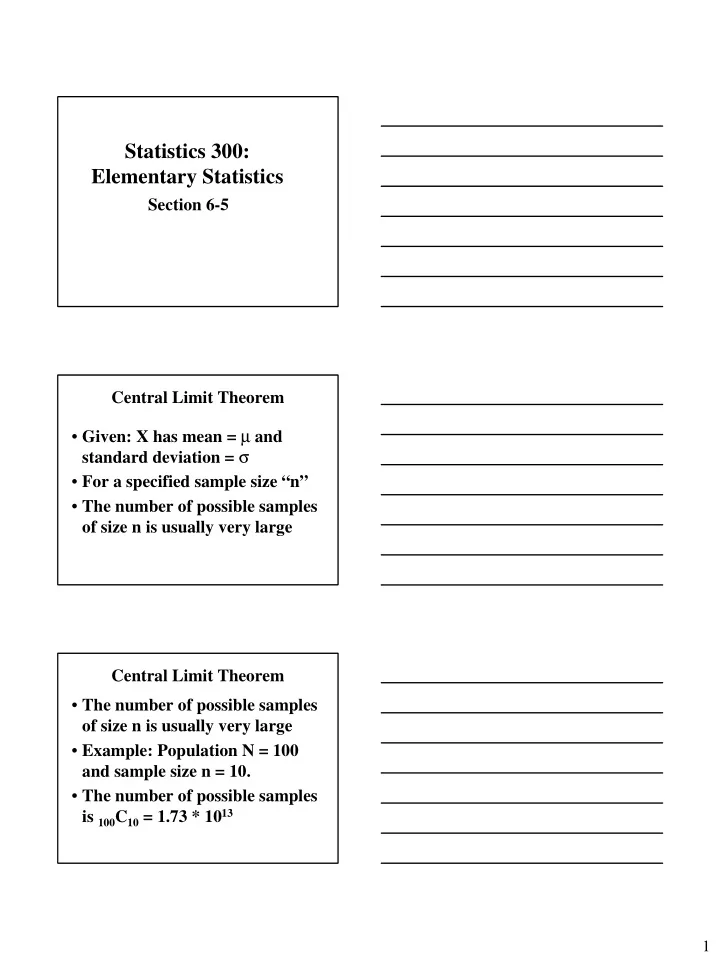
Statistics 300: Elementary Statistics Section 6-5 Central Limit Theorem Given: X has mean = and standard deviation = For a specified sample size n The number of possible samples of size n is usually very large Central


slide-1
SLIDE 1

1

Statistics 300: Elementary Statistics

Section 6-5 Central Limit Theorem

  • Given: X has mean = µ and

standard deviation = σ

  • For a specified sample size “n”
  • The number of possible samples
  • f size n is usually very large

Central Limit Theorem

  • The number of possible samples
  • f size n is usually very large
  • Example: Population N = 100

and sample size n = 10.

  • The number of possible samples

is 100C10 = 1.73 * 1013

slide-2
SLIDE 2

2

Central Limit Theorem

  • Each of the possible samples has

its own sample mean

  • The collection (set or population)
  • f possible sample means has a

mean and standard deviation

  • The mean = µ and the standard

deviation = σ/sqrt(n) Central Limit Theorem

  • Furthermore,
  • If n > 30 or if X~N(µ,σ) then
  • The distribution of all possible

sample means is approximately a normal distribution

      n N X σ µ, ~

The Mean of a Random Sample has the distribution below if n > 30

  • r the “parent population” is “normal”
slide-3
SLIDE 3

3 Weights of oranges have a mean weight of 34.2 grams and a standard deviation of 6.4 grams. If 12 oranges are selected at random, what is the probability the average weight of the 12

  • ranges will be greater than 30 g?