Statistics 300: Elementary Statistics Section 8-2 1 Hypothesis - - PDF document

statistics 300 elementary statistics
SMART_READER_LITE
LIVE PREVIEW

Statistics 300: Elementary Statistics Section 8-2 1 Hypothesis - - PDF document

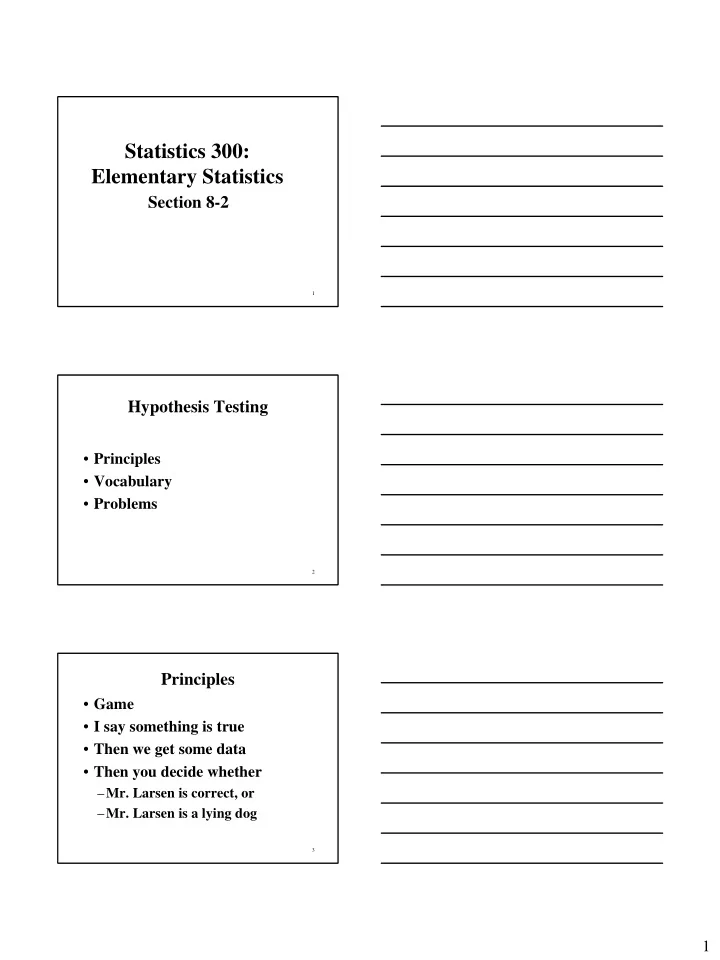
Statistics 300: Elementary Statistics Section 8-2 1 Hypothesis Testing Principles Vocabulary Problems 2 Principles Game I say something is true Then we get some data Then you decide whether Mr. Larsen is


slide-1
SLIDE 1

1

1

Statistics 300: Elementary Statistics

Section 8-2

2

Hypothesis Testing

  • Principles
  • Vocabulary
  • Problems

3

Principles

  • Game
  • I say something is true
  • Then we get some data
  • Then you decide whether

–Mr. Larsen is correct, or –Mr. Larsen is a lying dog

slide-2
SLIDE 2

2

4

Risky Game

  • Situation #1
  • This jar has exactly (no more

and no less than) 100 black marbles

  • You extract a red marble
  • Correct conclusion:

–Mr. Larsen is a lying dog

5

Principles

  • My statement will lead to certain

probability rules and results

  • Probability I told the truth is

“zero”

  • No risk of false accusation

6

Principles

  • Game
  • I say something is true
  • Then we get some data
  • Then you decide whether

–Mr. Larsen is correct, or –Mr. Larsen has inadvertently made a very understandable error

slide-3
SLIDE 3

3

7

Principles

  • My statement will lead to certain

probability rules and results

  • Some risk of false accusation
  • What risk level do you accept?

8

Risky Game

  • Situation #2
  • This jar has exactly (no more

and no less than) 999,999 black marbles and one red marble

  • You extract a red marble
  • Correct conclusion:

–Mr. Larsen is mistaken

9

Risky Game

  • Situation #2 (continued)
  • Mr. Larsen is mistaken because

if he is right, the one red marble was a 1-in-a-million event.

  • Almost certainly, more than red

marbles are in the far than just

  • ne
slide-4
SLIDE 4

4

10

Risky Game

  • Situation #3
  • This jar has 900,000 black

marbles and 100,000 red marbles

  • You extract a red marble
  • Correct conclusion:

–Mr. Larsen’s statement is reasonable

11

Risky Game

  • Situation #3 (continued)
  • Mr. Larsen’s statement is

reasonable because it makes P(one red marble) = 10%.

  • A ten percent chance is not too

far fetched.

12

Principles (reworded)

  • The statement or “hypothesis”

will lead to certain probability rules and results

  • Some risk of false accusation
  • What risk level do you accept?
slide-5
SLIDE 5

5

13

Risky Game

  • Situation #4
  • This jar has 900,000 black

marbles and 100,000 red marbles

  • A random sample of four

marbles has 3 red and 1 black

  • If Mr. Larsen was correct, what

is the probability of this event?

14

Risky Game

  • Situation #4 (continued)
  • Binomial: n=4, x=1, p=0.9
  • Mr. Larsen’s statement is not

reasonable because it makes P(three red marbles) = 0.0036.

  • A less than one percent chance is

too far fetched.

15

Formal Testing Method Structure and Vocabulary

  • The risk you are willing to take
  • f making a false accusation is

called the Significance Level

  • Called “alpha” or α
  • P[Type I error]
slide-6
SLIDE 6

6

16

Conventional α levels ______________________

  • Two-tail

One-tail

  • 0.20

0.10

  • 0.10

0.05

  • 0.05

0.025

  • 0.02

0.01

  • 0.01

0.005

17

Formal Testing Method Structure and Vocabulary

  • Critical Value

–similar to Zα/2 in confidence int. –separates two decision regions

  • Critical Region

–where you say I am incorrect

18

Formal Testing Method Structure and Vocabulary

  • Critical Value and Critical Region

are based on three things:

–the hypothesis –the significance level –the parameter being tested

  • not based on data from a sample
  • Watch how these work together
slide-7
SLIDE 7

7

19

Test Statistic for µ ( )df

n

t n s x

1 0 ~ −

      − µ

20

Test Statistic for p (np0>5 and nq0>5)

( )

1 , ~ ˆ N n q p p p −

21

Test Statistic for σ

( )

( )

2 df 1 n 2 2

? ~ s s 1 n

slide-8
SLIDE 8

8

22

Formal Testing Method Structure and Vocabulary

  • H0: always is = ≤ or ≥
  • H1: always is ≠ > or <

23

Formal Testing Method Structure and Vocabulary

  • In the alternative hypotheses, H1:,

put the parameter on the left and the inequality symbol will point to the “tail” or “tails”

  • H1: µ, p, σ ≠ is “two-tailed”
  • H1: µ, p, σ < is “left-tailed”
  • H1: µ, p, σ > is “right-tailed”

24

Formal Testing Method Structure and Vocabulary

  • Example of Two-tailed Test

–H0: µ = 100 –H1: µ ≠ 100

slide-9
SLIDE 9

9

25

Formal Testing Method Structure and Vocabulary

  • Example of Two-tailed Test

–H0: µ = 100 –H1: µ ≠ 100

  • Significance level, α = 0.05
  • Parameter of interest is µ

26

Formal Testing Method Structure and Vocabulary

  • Example of Two-tailed Test

–H0: µ = 100 –H1: µ ≠ 100

  • Significance level, α = 0.10
  • Parameter of interest is µ

27

Formal Testing Method Structure and Vocabulary

  • Example of Left-tailed Test

–H0: p ≥ 0.35 –H1: p < 0.35

slide-10
SLIDE 10

10

28

Formal Testing Method Structure and Vocabulary

  • Example of Left-tailed Test

–H0: p ≥ 0.35 –H1: p < 0.35

  • Significance level, α = 0.05
  • Parameter of interest is “p”

29

Formal Testing Method Structure and Vocabulary

  • Example of Left-tailed Test

–H0: p ≥ 0.35 –H1: p < 0.35

  • Significance level, α = 0.10
  • Parameter of interest is “p”

30

Formal Testing Method Structure and Vocabulary

  • Example of Right-tailed Test

–H0: σ ≤ 10 –H1: σ > 10

slide-11
SLIDE 11

11

31

Formal Testing Method Structure and Vocabulary

  • Example of Right-tailed Test

–H0: σ ≤ 10 –H1: σ > 10

  • Significance level, α = 0.05
  • Parameter of interest is σ

32

Formal Testing Method Structure and Vocabulary

  • Example of Right-tailed Test

–H0: σ ≤ 10 –H1: σ > 10

  • Significance level, α = 0.10
  • Parameter of interest is σ

33

Claims

  • is, is equal to, equals =
  • less than <
  • greater than >
  • not, no less than $
  • not, no more than #
  • at least $
  • at most #
slide-12
SLIDE 12

12

34

Claims

  • is, is equal to, equals
  • H0: =
  • H1: ≠

35

Claims

  • less than
  • H0: $
  • H1: <

36

Claims

  • greater than
  • H0: #
  • H1: >
slide-13
SLIDE 13

13

37

Claims

  • not, no less than
  • H0: $
  • H1: <

38

Claims

  • not, no more than
  • H0: #
  • H1: >

39

Claims

  • at least
  • H0: $
  • H1: <
slide-14
SLIDE 14

14

40

Claims

  • at most
  • H0: #
  • H1: >

41

Structure and Vocabulary

  • Type I error: Deciding that H0:

is wrong when (in fact) it is correct

  • Type II error: Deciding that H0:

is correct when (in fact) is is wrong

42

Structure and Vocabulary

  • Interpreting the test result

–The hypothesis is not reasonable –The Hypothesis is reasonable

  • Best to define reasonable and

unreasonable before the experiment so all parties agree

slide-15
SLIDE 15

15

43

Traditional Approach to Hypothesis Testing

44

Test Statistic

  • Based on Data from a Sample

and on the Null Hypothesis, H0:

  • For each parameter (µ, p, σ), the

test statistic will be different

  • Each test statistic follows a

probability distribution

45

Traditional Approach

  • Identify parameter and claim
  • Set up H0: and H1:
  • Select significance Level, α
  • Identify test statistic & distribution
  • Determine critical value and region
  • Calculate test statistic
  • Decide: “Reject” or “Do not reject”
slide-16
SLIDE 16

16

46

Next three slides are repeats of slides 19-21

47

Test Statistic for µ (small sample size: n) ( )df

n

t n s x

1 0 ~ −

      − µ

48

Test Statistic for p (np0>5 and nq0>5)

( )

1 , ~ ˆ N n q p p p −

slide-17
SLIDE 17

17

49

Test Statistic for σ

( )

( )

2 df 1 n 2 2

? ~ s s 1 n