More Definitions Parameter a numerical characteristic of a - - PDF document

more definitions
SMART_READER_LITE
LIVE PREVIEW

More Definitions Parameter a numerical characteristic of a - - PDF document

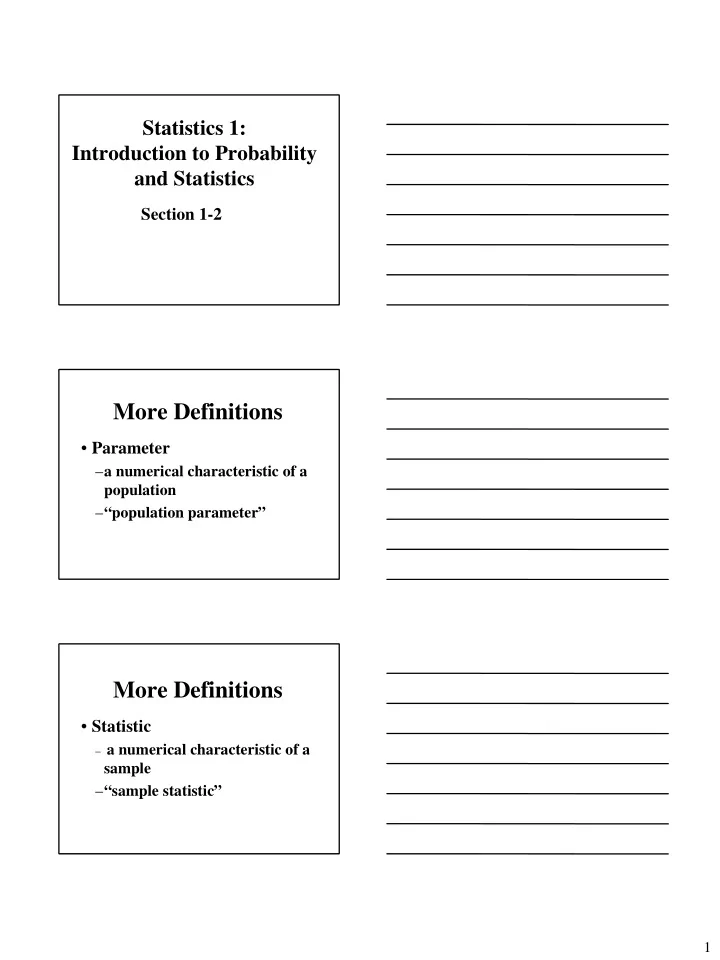
Statistics 1: Introduction to Probability and Statistics Section 1-2 More Definitions Parameter a numerical characteristic of a population population parameter More Definitions Statistic a numerical characteristic of


slide-1
SLIDE 1

1

Statistics 1: Introduction to Probability and Statistics

Section 1-2

More Definitions

  • Parameter

–a numerical characteristic of a population –“population parameter”

More Definitions

  • Statistic

– a numerical characteristic of a

sample –“sample statistic”

slide-2
SLIDE 2

2

  • 1. Average or Mean
  • 2. Biggest (maximum) value
  • 3. Smallest (minimum) value
  • 4. Range :

maximum - minimum

Examples of “numerical characteristics” A Statistic is:

  • A function of data
  • Function : y = f(x)

– the value of “x” determines the value of “y”

  • The average is a function of a set
  • f “x” values; the average of 4, 6,

and 8 = 6.

Start with the sample

  • r the population?
  • Sometimes we have a sample

and we need to consider the population or populations that the sample represents

slide-3
SLIDE 3

3

Start with the sample

  • r the population?
  • A sample is likely to be

“representative” (it looks like the population) if it is collected in a well-planned and well-executed manner

The Nature of Data Definitions

  • Quantitative vs. Qualitative
  • Discrete vs. Continuous
  • Four “levels” of measurement
slide-4
SLIDE 4

4

Definitions

  • Quantitative vs. Qualitative
  • Quantitative Data are

numbers that represent counts or measurements

  • Qualitative Data may

represent categories based

  • n a non-numerical

characteristic

  • Sometimes called categorical
  • r attribute data
slide-5
SLIDE 5

5

Definitions

  • Discrete vs. Continuous

Definitions

  • Discrete
  • The set of possible values can

be counted (possibly infinite)

  • Main example: “Counts”

Definitions

  • Continuous
  • The possible values cannot be
  • counted. Even in a small range,

the possibilities are infinite.

  • Main example:

“Measurements”

slide-6
SLIDE 6

6

Definitions

  • Four “levels” of measurement

–Nominal –Ordinal –Interval –Ratio

Definitions

  • Four “levels” of measurement

–Nominal

  • “name”
  • not quantitative
  • cannot compare magnitudes

Definitions

  • Four “levels” of measurement

–Nominal

  • New York, San Francisco,

Sacramento, Lodi

  • Other attributes of these

cities can be compared as quantities, but not the names

slide-7
SLIDE 7

7

Definitions

  • Four “levels” of measurement

–Ordinal

  • “names” or categories
  • not quantitative
  • can be compared in

magnitude as “less than” or “greater than” only

Definitions

  • Four “levels” of measurement

–Ordinal

  • small, medium, large
  • can be put in order according

to magnitude, but other comparisons cannot be done

Definitions

  • Four “levels” of measurement

–Interval

  • values represent magnitude

explicitly

  • can be put in order, and
  • intervals can be compared, but
  • ratios cannot be compared
slide-8
SLIDE 8

8

Definitions

  • Four “levels” of measurement

–Interval

  • Temperatures
  • 0oC, 10oC, 20oC
  • can be put in order
  • interval from 0 to 10 is the

same as 10 to 20

Definitions

  • Four “levels” of measurement

–Interval

  • Temperatures
  • 0oC, 10oC, 20oC
  • 20 is not “twice as hot” as 10

Definitions

  • Four “levels” of measurement

–Interval

  • These temperatures are the same
  • 0oC, 10oC, 20oC; 20 ÷ 10 = 2
  • 32oF, 50oF, 68oF; 68 ÷ 50 = 1.36
  • 273oK, 283oK, 293oK

293 ÷ 283 = 1.04

slide-9
SLIDE 9

9

Definitions

  • Four “levels” of measurement

–Ratio

  • Values represent magnitude

explicitly

  • Can be put in order
  • Intervals can be compared
  • Ratios can be compared

Definitions

  • Four “levels” of measurement

–Ratio

  • Natural not arbitrary “zero”
  • Speed, weight, elapsed time,

voltage, distance

  • 60 miles per hour is twice as

fast as 30 miles per hour