State Oil Company of the Republic of Azerbaijan 23 September, Sofia - - PowerPoint PPT Presentation

state oil company of the republic of azerbaijan
SMART_READER_LITE
LIVE PREVIEW

State Oil Company of the Republic of Azerbaijan 23 September, Sofia - - PowerPoint PPT Presentation

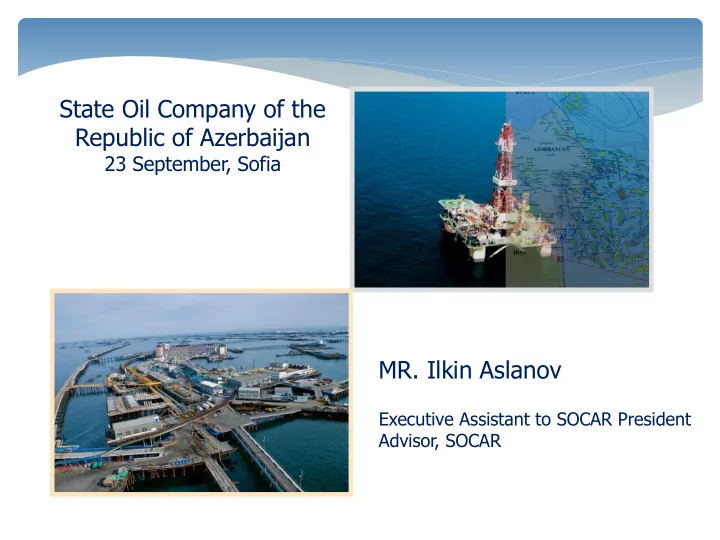
State Oil Company of the Republic of Azerbaijan 23 September, Sofia MR. Ilkin Aslanov Executive Assistant to SOCAR President Advisor, SOCAR The Role of Southern Gas Corridor for Energy Security of Europe Gas Sales Proven total


slide-1
SLIDE 1
  • MR. Ilkin Aslanov

Executive Assistant to SOCAR President Advisor, SOCAR

State Oil Company of the Republic of Azerbaijan

23 September, Sofia
slide-2
SLIDE 2

“The Role of Southern Gas Corridor for Energy Security of Europe” Gas Sales

slide-3
SLIDE 3
  • Proven total hydrocarbon reserves -- 4,6 billion tons
  • Forecasted total hydrocarbon reserves -- 10 billion tons
  • Prospective onshore and offshore structures – 40
slide-4
SLIDE 4
  • Secure energy stability and sustainability
  • Strategic cooperation with leading energy

companies

  • New infrastructure development and

upgrade, modernization and efficient use of existing infrastructure

  • Optimization of management
  • Oil/Gas revenues management
  • Expansion of SOCAR’s investment portfolio

and geography of operations

  • Diversification of consumer markets and

export transportation routes

  • Contribution to the development of

Southern Energy Corridor

Azerbaijan’s Gas Strategy: Views and Perspectives

slide-5
SLIDE 5

Azerbaijan’s Gas Production

1,2 trillion cubic meters gas 240 million tons condensate Annual production from Stage 2 will start by the beginning of 2018 and reach more than 16 bcm at plateau

Shah Deniz Field

5 bcm

2013 2004

30 bcm x6

slide-6
SLIDE 6

*Main natural gas volumes come from Shahdeniz and ACG fields Gas from Shah Deniz field has been exported via the SCP gas pipeline since 2006 (Azerbaijan and Georgia) and now reaches 1.9 bcm per annum Signed agreement to supply Turkey with 89.2 of gas from Shahdeniz over a 15-year period starting 2007 (Shahdeniz stage 1 volume) To satisfy the gas demand of Nakhchivan AR, SOCAR swaps gas with National Iranian Gas Export Company In 2013,-1.4 bcm of natural gas was exported to Russia

Azerbaijan Gas Exports

slide-7
SLIDE 7

Total 16bcma Stage 2 future sales volumes were negotiated and agreed; BOTAS GSA was signed in 2011 for 6bcma. For remaining 10bcma GSAs were signed with 9 European buyers in September 19, 2013; Axpo Trading AG, Bulgargaz EAD, DEPA Public Gas Corporation of Greece S.A., Enel Trade SpA, E.ON Global Commodities SE, Gas Natural Aprovisionamientos SDG SA, GDF SUEZ S.A., Hera Trading srl and Shell Energy Europe Limited

Shahdeniz Stage 2 Gas Sales

slide-8
SLIDE 8
  • Absheron

Total/GdF PSA 340 bcm gas 45 mln tons of condensate

  • Nakhchivan

HoA RWE

  • Shafag-Asiman

BP PSA

  • ACG Deep

ACG Consortium

  • Umid

SOCAR 200 bcm gas 40 mln tons condensate

  • Babek

400 bcm gas 80 mln tons condensate

Prospective Fields and Structures

slide-9
SLIDE 9

Gas Export Potential

slide-10
SLIDE 10

Southern Gas Corridor Projects

Trans Anatolian Pipeline (TANAP) Trans Adriatic Pipeline (TAP) South Caucasus Pipeline expansion (SCPx)

Shah Deniz Full Field developme nt (SD2)

  • The EU initiative is to enhance energy security by connecting

to new natural gas sources in the Caspian basin

  • One gas field development, one pipeline expansion and two

new pipeline construction, one of which is TANAP

  • Projects will be able to supply 7 million households in South

Eastern and Western Europe with natural gas

slide-11
SLIDE 11

Diversity and security of energy supply for Europe

Shah Deniz SCP TANAP TAP

Expansion of Southern Caucasus Pipeline System (SCPx) Trans Anatolian Pipeline (TANAP) Trans Adriatic Pipeline (TAP) Shah Deniz 2 project («Upstream»)

 Proposed Southern Gas Corridor Pipelines

slide-12
SLIDE 12

Southern Gas Corridor – Key Information about Project Costs

slide-13
SLIDE 13

 The 692km South Caucasus Pipeline has been designed to transport gas from the Shah Deniz field in the Azerbaijan sector of the Caspian Sea, through Georgia and on to the Georgia-Turkey border. The SCP Project was sanctioned on 27 February 2003.   The physical construction of SCP pipeline commenced in 2004 and the pipeline was ready for commercial

  • peration in September 2006. This is a 42-inch

diameter pipeline. The SCP pipeline is capable of carrying up to 7,4 billion cubic meters of gas annually.

South Caucasus Pipeline(SCP)

slide-14
SLIDE 14

 The expansion of the South Caucasus Pipeline is part of the Shah Deniz Full Field Development project. The construction has started in 2014 and is planned to be completed by 4Q 2018.  SCPX is one of the major projects within the Shah Deniz (SD) Stage 2 (SD2) Program. SCPX is also a component of the Southern Gas Corridor, which will allow for the transportation of gas from Azerbaijan, through Turkey and into Europe.

South Caucasus Pipeline Expansion (SPCX)

slide-15
SLIDE 15

 SCPX will expand the existing SCP system with a new 48-inch pipeline loop with the capacity to export an additional 16bcma of gas sales to the Georgia-Turkey

  • border. This is to be accomplished by building a

new pipeline loop in parallel with the existing SCP. In Georgia two new intermediate compressor stations will be constructed.

Project Details

slide-16
SLIDE 16

 The project has four phases: Study, Select, Define and Execution.  “Select” stage started on January 1, 2010 and has been completed on April 1, 2012.  The “Define” stage followed right after, and the transition from Define to Execution Stage has been achieved on December 17, 2013. Currently project is on “Execution” Stage and after completion of construction it will enter to “Operation” Stage.  The Final Investment Decision with respect to SCPX Project was taken on December 17, 2013 and SCPX Project was sanctioned.

Project Status

slide-17
SLIDE 17

Shareholders of SCP/SCPX

 SOCAR/AzSCP – 10%  • SGCM – 6,67%  • BP – 28,83%  • TPAO – 19%  • STATOIL –15,5%  • LUKOIL – 10%  • NICO – 10%

slide-18
SLIDE 18
slide-19
SLIDE 19

Present status of TANAP and its potential role in the European gas transit route

slide-20
SLIDE 20

Gas Arrangements with Turkey

 October 25, 2011  Landmark gas sales and transportation between Azerbaijan and Turkey  IGA on gas sales to Turkey  June 26, 2012  TANAP IGA and HGA  October 15, 2012  TANAP Shareholders Agreement signed by SOCAR, BOTAS and TPAO  January 2013  TANAP IGA and HGA ratified by Azerbaijan and Turkey Parliaments

Azerbaijan EU Joint Declaration

  • Signed in January 2011 during the

visit

  • f

President Barroso to Azerbaijan

  • Framework document
  • Strategic principles for the supply
  • f Azerbaijan and Caspian gas to

Europe

slide-21
SLIDE 21

Growing demand for gas

slide-22
SLIDE 22

Energy security

 Europe needs reliable suppliers  Azerbaijan has proved to be a trusted partner;  SGC appears prominently in the European Commission's latest “Energy Security Strategy” report  TANAP constitutes an integral part of the Southern Gas Corridor  TANAP section of SGC will bring gas from a massive field off the coast of Azerbaijan called Shah Deniz 2 into the heart of Europe

slide-23
SLIDE 23

Project Details

 Shareholders:

 SOCAR (Azerbaijan) - 58% (operator), BOTAŞ (Turkey) - 30%, BP (UK) – 12%

 Project cost: $11.8 billion USD  Total pipeline length and width:

 Georgia-Turkey – 1,333km – 56”;  Turkey-Greece – 477 km – 48”;

 Total length: 1,810

 Connecting directly to TAP on the Turkish-Greek border

slide-24
SLIDE 24

Project Details

 Initial capacity: 16 bcm/a:

 6 bcm to Turkey  10 bcm to Europe;

 Potential capacity: 31 bcm/a by 2026.  Buyers: contracts with 9 European countries have already been signed

Supply Contracts Signed

Axpo (Switzerland) Hera (Italy) Enel (Italy) E.ON Gas Natural (Germany) GDF (Spain) Shell (England/Netherlands) Bulgargaz (Bulgaria) DEPA (Greece)

10 bcm/a

slide-25
SLIDE 25

Project Status

 A Memorandum of Understanding has been signed between Azerbaijan and Turkey  Gas Transportation Agreement has been signed between BOTAŞ and TANAP to transport the gas along Turkey territories  The use of funds allocated for TANAP project has already been started

 Note: the project is 100% equity-financed

slide-26
SLIDE 26

Project Status

 A significant five year contract for the supply of Engineering, Procurement and Construction Management (EPCM) is awarded to WorleyParsons on May, 2014  EIA Positive Decision was taken from the competent authority Turkish Ministry of the Environment & Urbanization (MoEU) to be effective as of 24th of July  Land Acquisition process is ongoing

slide-27
SLIDE 27

Project Potential

 A second wave of gas from Azerbaijan can be anticipated with several additional gas opportunities in Azerbaijan including Shah Deniz Deep, Shafag-Asiman and ACG Deep that are being evaluated by BP and its co-venturers. With continued progress these projects can follow on after Shah Deniz, and therefore provide additional gas to Europe  Absheron field could be exporting gas in the early 2020s.  The Middle East and East Mediterranean have the potential to supply the Southern Corridor through the Trans-Anatolian Pipeline in the future.

slide-28
SLIDE 28

The role of TAP in the energy security of the Balkans

Baku 2014

slide-29
SLIDE 29

Europe – Dependance on gas imports

slide-30
SLIDE 30

What is TAP?

  • Tap is an integral part of the Southern Gas Corridor.
  • Trans Adriatic Pipeline (TAP) is a pipeline project to

transport natural gas from the Caspian sea (Azerbaijan) to the European buyers.

slide-31
SLIDE 31

TAP's Key Features

 Start of operation: 2019  Length – 867km (Greece - 547km, Albania - 211km, Adriatic Sea - 104km and Italy - 5km)  Diameter: 48 inch (subsea– 36 inch)  Project cost:≈ $ 5.2 billion USD  Initial throughput capacity: 10 bcma (expandable to 20 bcma)

TANAP TAP

The shareholders are: BP (UK) (20%), SOCAR (20%), Statoil (Norway) (20%), Fluxys (Belgium) (16%), Total (France) (10%), E.ON (Germany ) (9%) and Axpo (Switzerland) (5%)

slide-32
SLIDE 32

TAP's Key Features (2)

 Aligned with EU’s energy policy objectives  Designed to expand from 10 to 20 bcm (plus) per year  Up to 80% of physical reverse flow and potential gas storage  Connecting directly to TANAP on the Turkish-Greek border  Interconnection with various existing and proposed pipelines providing energy security in South Eastern Europe  Providing Bulgaria with a new source of gas through IGB or Kula-Sidirokastro Interconnector  Although TAP will be initially designed to transport available volumes of Shah Deniz gas to Europe, TAP is scaleable.

slide-33
SLIDE 33

TAP is a PCI and PECI

 TAP has been designated as a Project of Common Interest (PCI) and Europe’s Energy Community has named it a Project of Energy Community Interest (PECI).  TAP is just the beginning for the opening of the Caspian basin producing countries into the EU, which would constitute a great step ahead in terms of diversification and gas security supply.  TAP continues to develop the framework that will enable increased security of supply and diversification of gas resources in the SEE region.

slide-34
SLIDE 34

TAP will be connected to European Network

 The EC is already prioritizing support for interconnecting pipelines to assist in the development of the gas networks in Southern and South Eastern Europe.  Connection to Bulgaria  Connection to Ionian Adriatic Pipeline

FYROM Albani a Turke y Bosnia- Herzegovi na Bulgari a Monteneg ro Ital y Serbi a Croati a Austri a Sloveni a Romani a Hungar y Greece

Budapes t Vienn a Belgrad e Buchare st Sofi a Skopje Zagre b Ljubljana Podgoric a Sarajevo Tirana Rome Fier Brindisi Ploc e

LN G

Thessalonik i Komotin i

slide-35
SLIDE 35

Connection to Bulgaria

 Caspian gas could also be transported to Bulgaria through interconnection with planned and existing gas networks. TAP is currently exploring options of cooperation with developers - Interconnector Greece-Bulgaria (IGB) and Kula-Sidirokastro Interconnector.  Developers of the planned Interconnector Greece-Bulgaria (IGB) signed a technical MoUC with TAP in January 2014. The IGB could enable Caspian gas to flow into the Bulgarian gas network and further into South East Europe.

Reverse flow on Kula/Sidirokastro Interconnection point exporting Russian gas from Bulgaria into Greece. Existing capacity (Bulgaria-to-Greece direction): 4.3 bcm/y at a minimum pressure at Sidirokastro MS of 47,74 barg. Reverse Flow capacity: up to 4.3 bcm/y IGB IGB – is designed to connect Greece (Komotini) to Bulgaria (Stara Zagora). Planned Capacity: up to 3 bcm/y (option for capacity increase to 5 bcm/y)

slide-36
SLIDE 36

Connection to Ionian Adriatic Pipeline

 TAP has entered into multiple Memorandum of Understanding and Cooperation (MoUC) with the Ionian Adriatic Pipeline (IAP) which can be connected to TAP, so that such countries as Albania, Croatia, Bosnia and Herzegovina, Montenegro, Slovenia, can all benefit from Shah Deniz gas.

Bilateral Agreements on IAP with TAP:

  • Plinacro (Croatia) Feb 2011
  • BH-Gas (Bosnia-Herzegovina) April 2011
  • MoE Montenegro May 2011
  • METE Albania July 2011
  • Plinovodi (Slovenia) Sept 2011

Cooperation goals:

  • Align project schedules
  • Understand technical requirements
  • Identify and manage technical interfaces
  • Exchange views on best practice
  • Enhance regional visibility
  • Gain political support within the host

governments, the EU and the region Seven TAP-IAP Joint Working Group meetings have been held to date IAP throughput scenarios:

  • 1 bcm to Albania
  • 0.5 bcm to Montenegro
  • 1 bcm to Bosnia and Herzegovina
  • 2.5 bcm to Northern Croatia or 0.2 bcm to

Southern Croatia

slide-37
SLIDE 37

Securing Supply for SEE region

 TAP will contribute to Market Integration and Diversification of Gas Supply to South Eastern Europe

  • Physical reverse flow:

up to 80 % of capacity

  • Secures supply in

emergency situations and flexibility: connects SEE to North African and

  • ther gas resources (i.e.

LNG in Greece and Turkey)

  • Cross-border

interconnector between the Italian and South East Europe

  • Market development and

integration through

  • ther planned pipelines

(IAP, WBR, IGB)

IAP: Ionic Adriatic Pipeline IGB: Interconnector Greece-Bulgaria WBR: Western Balkan Ring

slide-38
SLIDE 38

Securing Supply for SEE region (2)

E.ON Ruhrgas emergency supplies during the Ukraine Gas Crisis 2009

Switzerlan d Rumania Austria Czech Republic Ital y German y Poland Slowakia Croatia Hungary Sloveni a Bulgaria FYROM Greece Turkey Bosnia- Herzegovin a

Potential additional emergency supplies via Reverse Flow on TAP

Serbia Monteneg ro Albani a

TAP reverse flow significantly contributes to security of supply in SEE region

slide-39
SLIDE 39

TAP - strategic partnership

During the past few years, TAP has successfully established several strategic partnerships with various governments and companies:  TAP has entered into multiple Memoranda of Understanding and Cooperation (MoUC) with the developers of the proposed Ionian Adriatic Pipeline (IAP).  The Croatian gas system operator Plinacro, Bosnian-Herzegovinian gas company BH-Gas, Slovenian Geoplin Plinovodi and the energy ministries of Albania and Montenegro are working with TAP on the interconnection and alignment of the two projects.  Further support for the TAP-IAP connection came in May 2013 when the governments of Albania, Bosnia and Herzegovina, Croatia and Montenegro signed an MoU in support of both pipelines, as well as a declaration of support in facilitating the supply of gas from Azerbaijan in South Eastern Europe..  Additionally, in June 2013 the foreign ministers of six countries – Albania, Bosnia and Herzegovina, Croatia, Greece, Italy and Montenegro – met in Dubrovnik, Croatia, to once again confirm high level political support for TAP.  In Bulgaria, the developers of the planned Interconnector Greece-Bulgaria (IGB) signed a technical MoUC with TAP in January 2014. The IGB could enable Caspian gas to flow into the Bulgarian gas network and further into South East Europe.  In Greece, the natural gas transmission system operator DESFA entered into a Cooperation Agreement with TAP in July 2013 on the operation and maintenance of TAP’s Greek section (the pipeline’s longest).  In Turkey, following the signing of an MoUC in November 2012, TAP continues to cooperate closely on technical and commercial matters with the Trans Anatolian Gas Pipeline (TANAP), which will connect with TAP on the border with Greece.  In Italy, TAP holds regular meetings with Snam Rete Gas (SRG), the Italian gas transmission system operator, on technical and commercial issues. Planned expansion of the system will ensure that Shah Deniz gas can be transported further into Central and Western Europe.

slide-40
SLIDE 40

Additional Supply Sources of Gas

 A second wave of gas from Azerbaijan can be anticipated with several additional gas opportunities in Azerbaijan including Shah Deniz Deep, Shafag-Asiman and ACG Deep that are being evaluated by BP and its co-

  • venturers. With continued progress these projects can follow on after

Shah Deniz, and therefore provide additional gas to Europe  Absheron field could be exporting gas in the early 2020s.

  • The Middle East and East

Mediterranean have the potential to supply the Southern Corridor through the Trans-Anatolian Pipeline in the future.

slide-41
SLIDE 41

Natural Gas Reserves (figures in tcm)

Source: BP World Energy Statistical Review

slide-42
SLIDE 42

Connecting Europe to new gas reserves (figures in tcm)

slide-43
SLIDE 43

Conclusion

 TAP’s capacity is expandable to 20 bcm/yr  Additional suply sources of gas: second wave of gas from Azerbaijan (Azerbaijan including Shah Deniz Deep, Shafag-Asiman and ACG Deep) + potential to supply from Middle East and East Mediterranean  TAP will in its initial setup have significant physical reverse flow capacity to provide Security of Supply for Greece and the SEE countries in cases of supply disruptions  TAP will offer commercial reverse flow products if this is requested by the

  • market. This will connect SEE to new gas sources previously not accessible such

as northern Africa or the partially liquid gas market in Italy

TAP contributes to diversification of gas supplies and Security of Supply in SEE!

slide-44
SLIDE 44

Thank you for your attention