
SLIDE 1
- 1-
State of Washington Department of Health Public Health Laboratories - - PowerPoint PPT Presentation
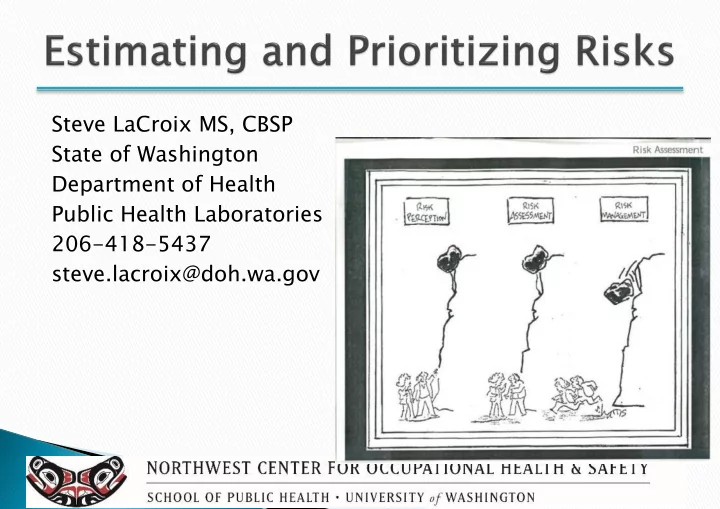
Steve LaCroix MS, CBSP State of Washington Department of Health Public Health Laboratories 206-418-5437 steve.lacroix@doh.wa.gov -1- Rely on past experiences Systematic Applicable across work activities Develop strategy
Rely on past experiences Systematic Applicable across work activities Develop strategy Gather resources & utilize expertise
Likelihood of adverse effect Consequences of adverse effect Very high High Medium Low
Risk sk Asses Assessment M sment Matrix atrix Ha Hazard ard Conseq sequenc uence Insignificant Minor Moderate Major Cri ritica tical Ha Hazard ard Li Likelih kelihood
Highly Likely
Medium Medium High Extreme Extrem treme
Likely
Low Medium High High Extrem treme
Possible
Low Medium High High Hi High gh
Unlikely
Low Low Medium Medium Hi High gh
Rare are Lo Low Lo Low Lo Low Med ediu ium Med ediu ium
Descri scripti tion
Risk sk Leve vel Acti tions
Low
If an incident were to occur, there would be little likelihood that an injury would result Und nderta ertake ke th the e acti tivi vity ty wi with th th the e existing isting con
trol
s in n place Mo Moderate te If an incident were to occur, there would be some chance that an injury requiring First Aid would result Additi tiona
trol
s are advi vised ed Hi High gh If an incident were to occur, it would be likely that an injury requiring medical treatment would result Con
trol
s wi will need need to to be in in pl place e befo fore e acti tivi vity ty is un undert dertaken aken Extreme treme If If an i n inc ncid iden ent t we were e to to o
ur, it t wo woul uld be li like kely ly th that t a perma manen nent, t, debilit itating ting inj njury ury or
death th wo woul uld resu sult Con
sider der alte tern rnati tives ves to to doi
ng th the acti tivi vity
gnific ficant ant con
trol
me measures sures wi will ne need ed to to be imp mplemented mented to to ensure nsure safety fety
Risk Score Risk Level Acceptability
Recommended Actions <3 Low Risk Acceptable No additional risk control measures required. To continue to monitor to ensure risk do not escalate to higher level. 3 – 4 Medium Risk Moderately Acceptable Acceptable to carry out the work activity; however, task need to be reviewed to bring risk level to As Low As Reasonably Practicable. Interim control measures such as administrative controls can be implemented. Supervisory oversight required. >4 High Risk Not Acceptable Job must not be carried out until risk level is brought to at least medium risk level. Risk controls should not be overly dependant on personal protective equipment. Controls measures should focus on Elimination, substitution and engineering controls. Immediate Management intervention required to ensure risk being brought down to at least medium level before work can be commenced.
Likelihood Severity Remote (1) Occasional (2) Frequent (3) Minor (1) 1 2 3 Moderate (2) 2 4 6 Major (3) 3 6 9
Yo You are re in in the e zoo,
erving ving a c caged ged adult ult tig iger er, wh , which ich is is well ll f fed ed and and has as a mi mild ld tempe mperament. rament.
Yo You are re in in an o n ope pen n fi field ld next xt to a ve very ry hu hungr ngry, , aggre ressive sive adult ult tig iger
. The he tig iger er is is un unre restrained trained and and sees you u as fo food
Yo You are re holding
tig iger er cub wit ith a h a pla layful ful tempe mperamen rament t in in your ar r arms ms.
Gaudioso & Salerno Consequence Likelihood Likelihood Consequence Consequence Likelihood
RISK Likelihood Consequences
CEN CWA 15793