SLIDE 1
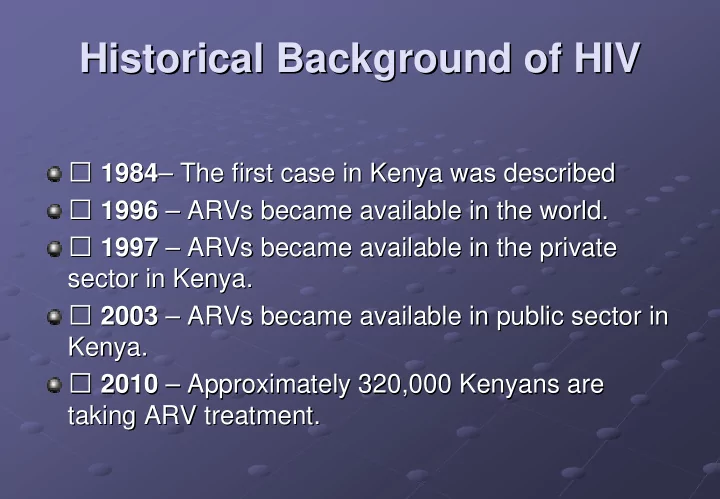
Historical Background of HIV Historical Background of HIV
1984 1984– – The first case in Kenya was described The first case in Kenya was described 1996 1996 – – ARVs became available in the world. ARVs became available in the world. 1997 1997 – – ARVs became available in the private ARVs became available in the private sector in Kenya. sector in Kenya. 2003 2003 – – ARVs became available in public sector in ARVs became available in public sector in Kenya. Kenya. 2010 2010 – – Approximately 320,000 Kenyans are Approximately 320,000 Kenyans are taking ARV treatment. taking ARV treatment.
SLIDE 2 HIV Prevalence by Gender HIV Prevalence by Gender (age 15 (age 15-
64)
% HIV Infected % HIV Infected TOTAL TOTAL FEMALES FEMALES MALES MALES 7.1 7.1 8.4 8.4 5.4 5.4
7.1% (1.4 million) Kenyans age 15-64 are infected with HIV.
SLIDE 3 E a st e r n 4 . 6 % N o r t h Ea st e r n 0 . 8 % R i f t Va ll e y 6 . 3 % W e st e r n 5 . 4 % N y a n z a 1 4 . 9 % N a i r o b i 8 . 8 % Co a st 8 . 1 % Ce n t r a l 3 . 6 %
HIV prevalence in Kenya by province, KAIS 2007
SLIDE 4
4 in 5 of HIV infected do not know their status Aprox.390,000 need ART 37% who need ART know their status 18.0% have CD4<250 & are not on ART
SLIDE 5 4 8 12 16 15-19 20-24 25-29 30-34 35-39 40-44 45-49 50-54 55-59 60-64
HIV Prevalence (% ) KAIS Females KAIS Males
Young women between ages 15 and 34 are disproportionately infected compared to young men.
SLIDE 6 MODES OF TRANSMISSION
Transmission route % Sexual intercourse 80-90 Mother-to-child-transmission 5-10 Blood transfusion 3-5 Injecting drug use <5 Health care – e.g.: needle stick injury <0.01
SLIDE 7
Modes of transmission Modes of transmission
SLIDE 8 NATIONAL HIV PREVALENCE –KAIS 2007
Adults 15 Adults 15-
64 year old year old URBAN URBAN RURAL RURAL Male Male 6.2 6.2 5.5 5.5 Female Female 10.8 10.8 8.2 8.2 TOTAL TOTAL 400,000 400,000 1 MILLION 1 MILLION TOTAL% TOTAL% 30% 30% 70% 70%
SLIDE 9
Epidemiology/Impact of HIV/AIDS in Epidemiology/Impact of HIV/AIDS in Kenya Kenya
60% medical beds 60% medical beds 40% 40% Paediatric Paediatric beds beds >50% TB patients >50% TB patients – – HIV + HIV + >25% STI patients >25% STI patients – – HIV+ HIV+ Health workers face both the medical and Health workers face both the medical and social challenges of HIV/AIDS on a daily basis social challenges of HIV/AIDS on a daily basis
SLIDE 10 Accurate Knowledge of HIV Status Accurate Knowledge of HIV Status among KAIS HIV among KAIS HIV-
Infected Participants
57% never tested for HIV
2% missing
16% accurate knowledge of HIV status 26% believe themselves uninfected based on last HIV test
Denominator: All HIV infected participants
83%
infected participants do not know their status.
SLIDE 11
Magnitude of HIV in Pregnant women in Kenya
. Estimated population 2010: 38 million . Estimated births per year: 1.5-1.7M million . Estimated HIV prevalence: 6.7% . Estimated HIV exposed births per year: 100,500- 113,900 . MTCT with no interventions: 40% or 40,200- 45,560