State and Local Implications for Connected and Automated Vehicles - - PowerPoint PPT Presentation
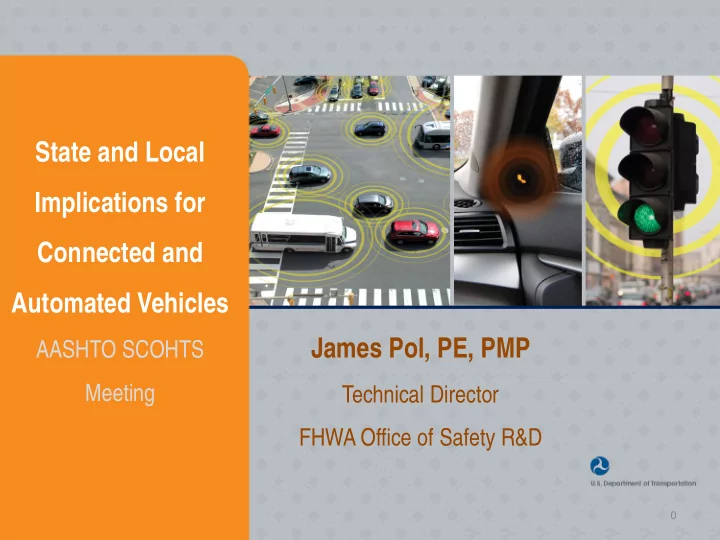
State and Local Implications for Connected and Automated Vehicles James Pol, PE, PMP AASHTO SCOHTS Meeting Technical Director FHWA Office of Safety R&D 0 Agenda USDOT ITS Strategic Plan 2015-2019 Connected Vehicles & Safety
Agenda
- USDOT ITS Strategic Plan 2015-2019
- Connected Vehicles & Safety Benefits
- Automated Vehicles
- Community Response to Connected Vehicles
- FHWA Connected Vehicle Deployment
Guidance
- Connected Vehicle Applications & Pilots
1
2
Congestion Today
3
Congestion Tomorrow
4
Limits on Creating New Capacity
Source: http://www.dot.gov/BeyondTraffic
5
Kate Hartman
ITS Strategic Plan 2015-2019
U.S. Department of Transportation ITS Joint Program Office
6
Vision and Mission
VISION Transform the Way Society Moves MISSION
Conduct research, development, and education activities to facilitate the adoption of information and communication technology to enable society to move more safely and efficiently.
7
Innovation Through Connectivity: Connected Vehicles
Connected vehicles are the future of transportation:
- Connected vehicles can save lives by significantly
reducing traffic accidents
- Connected vehicles can make travel easier, more
efficient, and more enjoyable
- Connected vehicles can help curb pollution
- Connected vehicles include all modes of transportation
as well as pedestrians
- Connected vehicle research is a partnership between
the USDOT, the auto industry, and other public and private researchers
- Connected vehicles are not a threat to your privacy
8
Program Category: Connected Vehicles
9
Safety Benefits of Connected Vehicles
- NHTSA studied the safety benefits of two V2V applications: Intersection Movement Assist (IMA) and
Left Turn Assist (LTA).
- NHTSA estimates that IMA and LTA would potentially prevent up to 592,000 crashes and save up to
1,083 lives annually.
IMA: Warns the driver when it is not safe to enter an intersection— for example, when something is blocking the driver’s view of
- pposing or
crossing traffic LTA: Notifies a driver who is attempting to make a left turn with oncoming traffic that it is not safe to proceed
10
Innovation Through Automation: Automated Vehicles
The path toward connected vehicles will ultimately lead to automated vehicles.
11
- Full automation has the potential to
revolutionize the transportation system but requires careful study
- Partial automation will likely provide
significant transportation system benefits
- Connectivity is critical to safe and efficient
- perations
Automation In Transportation
12
Community Responses to Connected Vehicles
- “The focus for connected vehicles should be in
making a dramatic improvement in road safety…by the application of systems engineering to the four contributing domains:
– road design and traffic control systems; – vehicle design and networking; – information and communications technology applied to road traffic safety; and – human systems integration optimization.
Source: IdeaScale Response to ITS Strategic Plan 2015-2019 13
Deployment is Coming
- V2V auto industry deployments moving
forward
- NHTSA announcement about regulatory
proposal that would require V2V in new vehicles
- V2I prototype deployment testing nearing
completion
- Ongoing supporting research such as AASHTO
Footprint Analysis and Pooled Fund Studies
Source: http://www.its.dot.gov/presentations/worldcongress2014/PDF/V2I_Deployment_Guidance_Arnold.pdf
14
How Do You Prepare?
- Infrastructure will be deployed and operated
by State and local DOT’s
– Not a “shall” – Use of V2I is not mandated – But, you need to know about planning, funding, deployment, etc.
- What investments could be made to leverage
a nationwide fleet of equipped vehicles in support of state and local policy and
- perational objectives?
Source: http://www.its.dot.gov/presentations/worldcongress2014/PDF/V2I_Deployment_Guidance_Arnold.pdf
15
2015 FHWA V2I Deployment Guidance
http://www.its.dot.gov/meetings/pdf/V2I_Depl
- ymentGuidanceDraftv9.pdf
16
Topics Covered in the Draft Guidance
- Planning
- Federal-aid Eligibility
- V2I Deployments and NEPA
- Interoperability
- Evaluation
- ITS Equipment Capability and
Compatibility
- Hardware/Software Certification
- Reliability
- Use of Right of Way
- Allowance of Private Sector Use
- Design consideration for facilities
- Use of existing infrastructure
- Use on public sector fleets
- Procurement processes
- Legacy systems/devices
- Communication technology
- DSRC Service Licensing
- Data Connection and Latency
- Connected Vehicle Privacy
Principles
- Connected Vehicle Security
- Data Access
- Manual on Uniform Traffic
Control Devices
- Using Public-Private Partnerships
Source: http://www.its.dot.gov/presentations/worldcongress2014/PDF/V2I_Deployment_Guidance_Arnold.pdf
17
Connected Vehicle: Applications
- Connected vehicles will generate robust data about how, when, and
where our vehicles travel—information that could be used to develop new and innovative apps, leading to less congested and safer roads.
18
Connected Vehicle Pilots: Help Shape the Future
- Proposed Program Schedule
□
Early 2015 - Solicitation for Wave 1 Pilot Deployment Concepts
□
Early 2017 - Solicitation for Wave 2 Pilot Deployment Concepts
□
September 2020 - Pilot Deployments Complete
- Resources
□
ITS JPO Website: http://www.its.dot.gov/
□
CV Pilots Program Website: http://www.its.dot.gov/pilots
- CV Pilot Program Goals
19
How Connected Vehicle Resonates
20
Contact Info
James Pol, PE, PMP Technical Director, FHWA Office of Safety R&D (202) 493-3371 James.Pol@dot.gov James Pol ITS Strategic Plan 2015-2019 http://www.its.dot.gov/landing/strategicplan2015.htm NHTSA V2V Readiness Report http://www.nhtsa.gov/About+NHTSA/Press+Releases/2 014/NHTSA-issues-advanced-notice-of-proposed- rulemaking-on-V2V-communications “DOT HS 812 014” USDOT Beyond Traffic http://www.dot.gov/BeyondTraffic
Photos courtesy of: Thinkstock and USDOT 21