Automated Design of Digital Automated Design of Digital Automated - - PowerPoint PPT Presentation

automated design of digital automated design of digital
SMART_READER_LITE
LIVE PREVIEW

Automated Design of Digital Automated Design of Digital Automated - - PowerPoint PPT Presentation

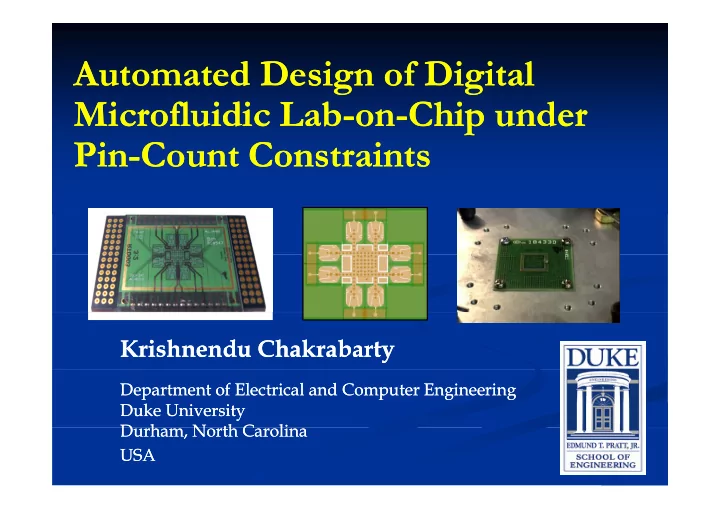
Automated Design of Digital Automated Design of Digital Automated Design of Digital Automated Design of Digital Microfluidic Lab Microfluidic Lab- -on on- -Chip under Chip under Pin Pin- -Count Constraints Count Constraints Krishnendu


slide-1
SLIDE 1

Automated Design of Digital Automated Design of Digital Automated Design of Digital Automated Design of Digital Microfluidic Lab Microfluidic Lab-

  • on
  • n-
  • Chip under

Chip under Pin Pin-

  • Count Constraints

Count Constraints

Krishnendu Chakrabarty Krishnendu Chakrabarty

Department of Electrical and Computer Engineering Department of Electrical and Computer Engineering Duke University Duke University D h N th C li D h N th C li Durham, North Carolina Durham, North Carolina USA USA

slide-2
SLIDE 2

Acknowledgments Acknowledgments

Students: Tianhao Zhang, Fei Su, William Hwang, Phil Paik, Tao Xu,

Students: Tianhao Zhang, Fei Su, William Hwang, Phil Paik, Tao Xu, Vijay Srinivasan, Yang Zhao Vijay Srinivasan, Yang Zhao

Post

Post-

  • docs, colleagues, and collaborators: Dr. Vamsee Pamula, Dr.

docs, colleagues, and collaborators: Dr. Vamsee Pamula, Dr. Michael Pollock, Prof. Richard Fair, Dr. Jun Zeng (Coventor, HP) Michael Pollock, Prof. Richard Fair, Dr. Jun Zeng (Coventor, HP)

Duke University

Duke University’ ’s Microfluidics Research Lab s Microfluidics Research Lab (http://www.ee.duke.edu/research/microfluidics/) (http://www.ee.duke.edu/research/microfluidics/)

Advanced Liquid Logic (

Advanced Liquid Logic (http://www.liquid http://www.liquid-

  • logic.com/

logic.com/): Start ): Start-up up company spun out off Duke University company spun out off Duke University’ ’s microfluidics research s microfluidics research project project project project

slide-3
SLIDE 3

Talk Outline Talk Outline Talk Outline Talk Outline

Motivation

Motivation

Motivation

Motivation

Technology overview

Technology overview gy gy

Design of high

Design of high-

  • throughput pin

throughput pin-

  • constrained lab

constrained lab on

  • n chip

chip constrained lab constrained lab-on

  • n-chip

chip

Array partitioning

Array partitioning

Cross

Cross-

  • referencing

referencing-

  • based biochip

based biochip

High

High-

  • throughput droplet manipulation

throughput droplet manipulation g g p p p g p p p

Conclusions

Conclusions

slide-4
SLIDE 4

Applications and Advantages Applications and Advantages

  • f Lab
  • f Lab on
  • n Chip

Chip

  • f Lab
  • f Lab-on
  • n-Chip

Chip

Applications Applications

Point

Point-

  • of
  • f-
  • care clinical diagnostics,

care clinical diagnostics, newborn screening newborn screening E i t l it i E i t l it i

Environmental monitoring

Environmental monitoring

Massively

Massively-

  • parallel DNA

parallel DNA sequencing sequencing q g q g

Automated drug discovery

Automated drug discovery

Conventional Biochemical Analyzer

Shrink

Advantages Advantages

Automated

Automated

Microfluidic Lab-

  • n-Chip

uto ated uto ated

Small sample/reagent cost

Small sample/reagent cost

High sensitivity

High sensitivity

20nl sample

High sensitivity

High sensitivity

slide-5
SLIDE 5

Why Do We Care? Why Do We Care?

System Driver for 2009: “Medical”

Final Draft 2007 Intel Research Day 2007: Biochip prototype demonstrated for point-of-care diagnostics and lab testing

slide-6
SLIDE 6

Motivation for Microfluidics Motivation for Microfluidics

Test tubes

Automation Integration

Test tubes

Integration Miniaturization

Robotics

Automation Integration Integration Miniaturization Automation

Microfluidics

Integration Miniaturization

slide-7
SLIDE 7

Microfluidics Microfluidics

Continuous

Continuous-

  • flow lab

flow lab-

  • on
  • n-
  • chip: Permanently

chip: Permanently-

  • etched microchannels,

etched microchannels, micropumps and microvalves, electrokinetics, etc. micropumps and microvalves, electrokinetics, etc.

Digital microfluidic lab

Digital microfluidic lab-

  • on
  • n-
  • chip: Manipulation of liquids as discrete

chip: Manipulation of liquids as discrete droplets droplets

Multiplexing Multiplexing

Mixing: Static, Diffusion Limited Biosensors: Diffusion Limited

Optical: SPR, Fluorescence etc. Electrochemical: Amperometric, Potentiometric etc.

slide-8
SLIDE 8

What is Digital Microfluidics? What is Digital Microfluidics? g

Droplet actuation is

Droplet actuation is hi d th h hi d th h achieved through achieved through an an effect called effect called electrowetting electrowetting electrowetting electrowetting

⎯ Electrical modulation

Electrical modulation

  • f the solid
  • f the solid-
  • liquid

liquid interfacial tension interfacial tension

No Potential Applied Potential

slide-9
SLIDE 9

Demonstrations Demonstrations Demonstrations Demonstrations

Video source: www.ee.duke.edu/research/microfluidics

slide-10
SLIDE 10

Some Basic Operations Some Basic Operations Some Basic Operations Some Basic Operations

Transport Transport Splitting/Merging Splitting/Merging p

25 cm/s flow rates, order of magnitude higher than continuous-flow methods

p g g g p g g g

slide-11
SLIDE 11

Current Capabilities Current Capabilities

Digital microfluidic lab

Digital microfluidic lab-

  • on
  • n-
  • chip

chip

MIXERS TRANSPORT DISPENSING REACTORS DETECTION

INTEGRATE

  • Basic microfluidic functions (transport, splitting,

merging, and mixing) have already been demonstrated on a 2-D array

Di it l Mi fl idi

y

  • Highly reconfigurable system

Digital Microfluidic Lab-on-Chip

Protein crystallization chip (under development) (under development)

slide-12
SLIDE 12

Emerging Trends and Needs for Emerging Trends and Needs for L b L b Chi Chi Lab Lab-on

  • n-
  • Chip

Chip

High throughput

High throughput

High throughput

High throughput

DNA sequencing, 10

DNA sequencing, 106 base pairs base pairs

Protein crystallization, 10

Protein crystallization, 103

3 candidate conditions

candidate conditions

Protein crystallization, 10

Protein crystallization, 10 candidate conditions candidate conditions Low cost

Low cost

Disposable low

Disposable low-cost less than $1/chip cost less than $1/chip

Disposable, low

Disposable, low cost, less than $1/chip cost, less than $1/chip

PCB design

PCB design

Rapid prototyping and inexpensive mass

Rapid prototyping and inexpensive mass-

  • fabrication

fabrication

Copper layer for electrodes (coplanar grounding rails)

Copper layer for electrodes (coplanar grounding rails)

Solder mask for insulator

Solder mask for insulator T fl AF i f h d h bi i T fl AF i f h d h bi i

Teflon AF coating for hydrophobicity

Teflon AF coating for hydrophobicity

Disposable PCB device plugged into controller circuit board,

Disposable PCB device plugged into controller circuit board, programmed and powered with USB port programmed and powered with USB port p g p p p g p p

slide-13
SLIDE 13

Electrode Electrode-

  • Addressing Problem

Addressing Problem

Direct Addressing: Direct Addressing:

Each electrode connected to an independent pin

Each electrode connected to an independent pin F l ( 100 100 l d ) F l ( 100 100 l d )

For larger arrays (e.g., > 100 x 100 electrodes)

For larger arrays (e.g., > 100 x 100 electrodes)

Too many control pins

Too many control pins high fabrication cost high fabrication cost

Complicated wiring, too many PCB layers, high cost

Complicated wiring, too many PCB layers, high cost

PCB design 250 m ia hole 500 m 500 m electrode PCB design 250 m ia hole 500 m 500 m electrode PCB design: 250 um via hole, 500 um x 500 um electrode PCB design: 250 um via hole, 500 um x 500 um electrode

Via Holes Via Holes Wires Wires

slide-14
SLIDE 14

Solution Based on Array Partitioning y g

Pin

Pin-

  • constrained array design

constrained array design

Ad Ad R d b f i d d i f R d b f i d d i f

Advantage

Advantage: Reduce number of independent pins for : Reduce number of independent pins for n x x m m array array from from n x m n x m to to k ≤ n x m k ≤ n x m

k = 5 is fewest # of control pins to control single droplet

= 5 is fewest # of control pins to control single droplet

k = 5 is fewest # of control pins to control single droplet

= 5 is fewest # of control pins to control single droplet

Disadvantage

Disadvantage: Potential for unintentional interference between : Potential for unintentional interference between multiple droplets: no way to concurrently move multiple droplets: no way to concurrently move Di to position to position multiple droplets: no way to concurrently move multiple droplets: no way to concurrently move Di to position to position (1,2) and (1,2) and Dj

j to position (4,4)

to position (4,4)

Solution

Solution Solution Solution

Single droplet:

Single droplet: Addressing each electrode

Addressing each electrode and its neighbors with distinct pins and its neighbors with distinct pins g p g p

Multiple droplets:

Multiple droplets: Partition the chip

Partition the chip Need for stall cycles?

Need for stall cycles?

Need for stall cycles?

Need for stall cycles?

slide-15
SLIDE 15

Partitioning for Pin Partitioning for Pin-

  • Constrained

Constrained Designs Designs

Droplet Trace

Droplet Trace

all the cells traversed by a

all the cells traversed by a droplet in its lifetime droplet in its lifetime droplet in its lifetime droplet in its lifetime

Scheduling and placement

Scheduling and placement information needed information needed

Partitioning rules

Partitioning rules

non

non-

  • overlapping partitions
  • verlapping partitions

spatially overlapping partitions

spatially overlapping partitions

temporally overlapping

temporally overlapping partitions partitions partitions partitions

slide-16
SLIDE 16

Pin Assignment in Each Partition Pin Assignment in Each Partition g

Goal

Goal

Addressing each electrode and

Addressing each electrode and its neighbors with distinct pins its neighbors with distinct pins Problem formulation

Problem formulation

Vertex coloring problem from

Vertex coloring problem from graph theory graph theory

5 pins (colors) are sufficient for 5 pins (colors) are sufficient for h i i ! h i i ! each partition! each partition!

Connect

Connect-

  • 5

5 algorithm algorithm

Bagua structure

Bagua structure

Tiling the Bagua structure

Tiling the Bagua structure

slide-17
SLIDE 17

An Example An Example

Schedule for a multiplexed bioassay Schedule for a multiplexed bioassay

A 15×15 array used for multiplexed bioassays

Partition and pin assignment results for the multiplexed bioassay

slide-18
SLIDE 18

Cross Cross-

  • Referencing

Referencing-

  • Based

Based D i D i Design Design

  • Orthogonally placed pins on top and bottom plates

Orthogonally placed pins on top and bottom plates

  • Orthogonally placed pins on top and bottom plates

Orthogonally placed pins on top and bottom plates

Advantage Advantage

k = n x m k = n x m n + m for a n by m microfluidic array n + m for a n by m microfluidic array

Disadvantage Disadvantage Disadvantage Disadvantage

Suffers from Suffers from electrode interference electrode interference

slide-19
SLIDE 19

Electrode Interference Electrode Interference

Unintentional Electrode Actuation

Unintentional Electrode Actuation

Selected column and row pins may intersect at multiple Selected column and row pins may intersect at multiple electrodes electrodes

Unintentional Droplet Manipulation

Unintentional Droplet Manipulation

1 2 3

1

4 5 6

3 1 Unintentional Unintentional destination cells destination cells

7 8 9

2 destination cells destination cells

1 2 3 4 5 6 7 8 9 10 10

slide-20
SLIDE 20

Efficient Droplet Manipulation Efficient Droplet Manipulation Method Method

G l G l

Goal

Goal

Improve droplet manipulation concurrency on cross

Improve droplet manipulation concurrency on cross-

  • f

i f i b d bi hi b d bi hi referencing referencing-

  • based biochips.

based biochips. 9 steps needed if 9 steps needed if moving one droplet moving one droplet moving one droplet moving one droplet at a time (Too slow) at a time (Too slow)

slide-21
SLIDE 21

Efficient Droplet Manipulation Efficient Droplet Manipulation Method Method

Observation

Observation

Observation

Observation

  • Droplet manipulations whose

Droplet manipulations whose destination cells destination cells belongs belongs to the same column/row can be carried out without to the same column/row can be carried out without to the same column/row can be carried out without to the same column/row can be carried out without electrode interferences. electrode interferences. 9 4 destination cells destination cells

slide-22
SLIDE 22

Efficient Droplet Manipulation Efficient Droplet Manipulation Method Method

Methodology

Methodology

Group droplet manipulations according to their

Group droplet manipulations according to their p p p g p p p g destination cells destination cells

All manipulations in a group can be executed

All manipulations in a group can be executed simultaneously simultaneously The goal is to find the optimal grouping plan which The goal is to find the optimal grouping plan which results in the minimum number of groups. results in the minimum number of groups.

slide-23
SLIDE 23

Efficient Droplet Manipulation Efficient Droplet Manipulation p p p p Method Method

Problem formulation

Problem formulation

Problem formulation

Problem formulation

Destination cells Destination cells Nodes Nodes D ti ti ll i l / D ti ti ll i l /

  • Cli

Cli Destination cells in one column/row Destination cells in one column/row a Clique a Clique Grouping Grouping Clique partitioning Clique partitioning Optimal g Optimal grouping rouping Minimal clique Minimal clique-partitioning partitioning Optimal g Optimal grouping rouping Minimal clique Minimal clique-partitioning partitioning

slide-24
SLIDE 24

Broadcast Electrode Broadcast Electrode-

  • Addressing

Addressing

Observation

Observation

“Don’t “Don’t-

  • Cares” in Electrode

Cares” in Electrode-

  • Actuation Sequences

Actuation Sequences Electrode control inputs: 3 values Electrode control inputs: 3 values “1” “1” activated activated 1 1 –- activated activated “0” “0” – –-

  • deactivated

deactivated “x” “x” –- can be either “1” or “0” can be either “1” or “0” Therefore, activation sequences Therefore, activation sequences can be combined by interpreting “x” can be combined by interpreting “x”

Floating electrode Floating electrode

Example: A droplet routed counterclockwise on a loop of electrodes Corresponding electrode activation sequences

slide-25
SLIDE 25

Electrode Addressing Based on Electrode Addressing Based on Clique Partitioning in Graphs Clique Partitioning in Graphs

Idea

Idea

Idea

Idea

Combining compatible sequences to reduce # of control pins

Combining compatible sequences to reduce # of control pins

Clique

Clique-

  • partitioning

partitioning-

  • based method

based method

Electrodes Electrodes Nodes Nodes Electrodes Electrodes Nodes Nodes Electrodes with compatible activation sequences Electrodes with compatible activation sequences a clique a clique Optimal combination Optimal combination Minimal clique Minimal clique-partitioning partitioning p q p g p g

slide-26
SLIDE 26

Addressing Results Addressing Results g

A biochip target execution of a Comparison of bioassay l ti ti i diff t multiplexed assay completion time using different addressing methods Addressing Addressing methods methods Broadcast Broadcast addressing addressing Array Array-

  • partitioning

partitioning-

  • based method

based method Cross Cross-

  • referencing

referencing-

  • based method

based method # of control pins # of control pins 25 25 35 35 30 30 p

slide-27
SLIDE 27

Conclusions Conclusions

  • High

High concurrency concurrency can can be be achieved achieved on

  • n pin

pin-

  • constrained

constrained lab lab-

  • on
  • n-
  • chip

chip using using a a number number of

  • f methods

methods

Partitioning Partitioning of

  • f the

the arra arra based based on

  • n droplet

droplet mo ement mo ement patterns patterns

Partitioning

Partitioning of

  • f the

the array array based based on

  • n droplet

droplet-movement movement patterns patterns

Grouping

Grouping of

  • f droplet

droplet movements movements based based on

  • n clique

clique partitioning partitioning

Exploiting

Exploiting flexibility flexibility in in electrode electrode-

  • actuation

actuation sequences sequences

  • Array

Array partitioning partitioning: :

Specific

Specific to to target target application, application, number number of

  • f pins

pins determined determined such such that that there there is is no no impact impact on

  • n assay

assay completion completion time time

  • Clique

Clique partitioning partitioning in in cross cross referencing referencing: :

Independent

Independent of

  • f target

target application, application, number number of

  • f pins

pins is is fixed, fixed, and and goal goal is is to to minimize minimize impact impact on

  • n assay

assay completion completion time time

  • Broadcast

Broadcast addressing addressing: :

Specific

Specific to to target target application, application, number number of

  • f pins

pins determined determined such such that that there there is is no no impact impact on

  • n assay

assay completion completion time time

  • Growing

Growing interest interest and and ongoing

  • ngoing work

work in in CAD CAD for for digital digital microfluidic microfluidic lab lab-

  • n
  • n-
  • chip

chip: : University University of

  • f Texas

Texas (Austin), (Austin), National National Taiwan Taiwan University, University, Penn Penn State State University, University, Rennsselaer Rennsselaer Polytechnic Polytechnic University, University, etc etc. . y, y, y y, y,