RAIN Clinicopathologic ID: 74 year old Chinese woman with past - - PowerPoint PPT Presentation

rain clinicopathologic
SMART_READER_LITE
LIVE PREVIEW

RAIN Clinicopathologic ID: 74 year old Chinese woman with past - - PowerPoint PPT Presentation

2/16/2018 Case RAIN Clinicopathologic ID: 74 year old Chinese woman with past medical history of rheumatoid arthritis, who presents with fevers and altered mental status. HPI. Conference 2018 2 weeks prior to presentation had L


slide-1
SLIDE 1

2/16/2018 1

RAIN Clinicopathologic Conference 2018

  • Dr. Chris McGraw, MD, PhD

Department of Neurology

  • Dr. Melike Pekmezci, MD

Department of Pathology

  • Dr. Felicia Chow, MD

Department of Neurology University of California San Francisco 2/16/2018

Case

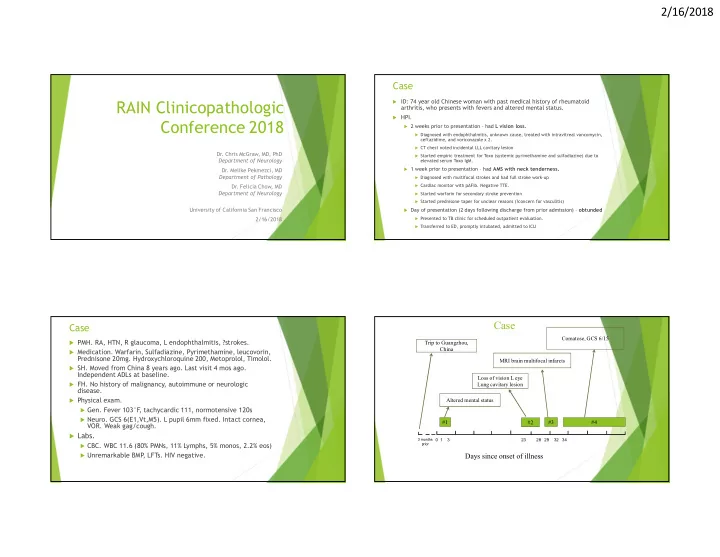
 ID: 74 year old Chinese woman with past medical history of rheumatoid

arthritis, who presents with fevers and altered mental status.

 HPI.

 2 weeks prior to presentation – had L vision loss.  Diagnosed with endophthalmitis, unknown cause, treated with intravitreal vancomycin, ceftazidime, and voriconazole x 2.  CT chest noted incidental LLL cavitary lesion  Started empiric treatment for Toxo (systemic pyrimethamine and sulfadiazine) due to elevated serum Toxo IgM.  1 week prior to presentation – had AMS with neck tenderness.  Diagnosed with multifocal strokes and had full stroke work-up  Cardiac monitor with pAFib. Negative TTE.  Started warfarin for secondary stroke prevention  Started prednisone taper for unclear reasons (?concern for vasculitis)  Day of presentation (2 days following discharge from prior admission) – obtunded  Presented to TB clinic for scheduled outpatient evaluation.  Transferred to ED, promptly intubated, admitted to ICU

Case

 PMH. RA, HTN, R glaucoma, L endophthalmitis, ?strokes.  Medication. Warfarin, Sulfadiazine, Pyrimethamine, leucovorin,

Prednisone 20mg. Hydroxychloroquine 200, Metoprolol, Timolol.

 SH. Moved from China 8 years ago. Last visit 4 mos ago.

Independent ADLs at baseline.

 FH. No history of malignancy, autoimmune or neurologic

disease.

 Physical exam.  Gen. Fever 103°F

, tachycardic 111, normotensive 120s

 Neuro. GCS 6(E1,Vt,M5). L pupil 6mm fixed. Intact cornea,

  • VOR. Weak gag/cough.

 Labs.  CBC. WBC 11.6 (80% PMNs, 11% Lymphs, 5% monos, 2.2% eos)  Unremarkable BMP

, LFTs. HIV negative.

Case

Days since onset of illness

0 1 3 23 28 29 32 34

#1 #2 #3 #4 Altered mental status Loss of vision L eye Lung cavitary lesion MRI brain multifocal infarcts Comatose, GCS 6/15

3 months prior

Trip to Guangzhou, China

slide-2
SLIDE 2

2/16/2018 2

Initial thoughts?

Dr. Felicia Chow

1/28 2/28 3/28 4/28 5/28 6/28 7/28 8/28 9/28 10/28 11/28 12/28 13/28 14/28 15/28 16/28 17/28 18/28 19/28 20/28 21/28 22/28 23/28 24/28 25/28 26/28 27/28 28/28

T2 FLAIR

MRI Brain on admission

1/69 2/69 3/69 4/69 5/69 6/69 7/69 8/69 9/69 10/69 11/69 12/69 13/69 14/69 15/69 16/69 17/69 18/69 19/69 20/69 21/69 22/69 23/69 24/69 25/69 26/69 27/69 28/69 29/69 30/69 31/69 32/69 33/69 34/69 35/69 36/69 37/69 38/69 39/69 40/69 41/69 42/69 43/69 44/69 45/69 46/69 47/69 48/69 49/69 50/69 51/69 52/69 53/69 54/69 55/69 56/69 57/69 58/69 59/69 60/69 61/69 62/69 63/69 64/69 65/69 66/69 67/69 68/69 69/69

T2 TRACE

MRI Brain on admission

1/25 2/25 3/25 4/25 5/25 6/25 7/25 8/25 9/25 10/25 11/25 12/25 13/25 14/25 15/25 16/25 17/25 18/25 19/25 20/25 21/25 22/25 23/25 24/25 25/25

T1 PRE + POST

MRI Brain on admission

slide-3
SLIDE 3

2/16/2018 3

Hospital course – initial treatment

 Initial work-up concerning for toxoplasmosis vs

nocardia abscesses > TB meningoencephalitis

Empiric antibiotics covering toxo + nocardia:

 Ampicillin 2g q6  Cefepime 2g Q12  Metronidazole 500 q8  Vancomycin  Sulfadiazine/Pyrimethamine

Steroids tapered off

Routine Labs Basic metabolic panel

Na 146, K 4.8, CL 118, CO2 22, BUN 40, Creat 0.99, EGFR 55

Complete blood count

WBC 17.0 (90% neut, 5% lymph, 2.5% monos, 0.3% eos). Hb 9.2, MCV 89.5, Plts 165.

Ammonia

72 H

TSH

0.08 (uU/mL) L

Free T4

0.30 (ng/dL) L

Microbiology Cerebrospinal fluid (CSF) #1 Appearance, cell count, diff, glucose, protein Clear, WBC 347H (57% PMN, 11%Mono, 31% Lympho, 3% eos), RBC 13, glc 30L, protein 71H. Gram stain. Many PMNs, no organisms. Bacterial/fungal/AFB Negative Cryptococcal Ag (CrAg) Negative Toxo PCR Negative CSF VDRL Non reactive CSF VZV PCR/IgG/IgM Negative #2 (HD#9) Appearance, cell count, diff, glucose, protein Clear, WBC 123H (50% PMN, 17% mono, 30% lympho, 3% eos). RBC

  • 2. Glc 36L, protein 210H

Cytology Mixed inflammatory infiltrate, no malignant cells #3 (HD#13) Appearance, cell count, diff, glucose, protein Xanthochromic, WBC 123 (50% PMN, 17% mono, 30% lympho, 3% eos). RBC 2, glc 36L, prot 210H. Microbiology Serum Blood cultures (multiple) No growth HIV Ab Negative Toxo PCR/IgM/IgG Negative Coccidioides IgM/IgG Negative AFB smear Negative x 3 RPR Non reactive Trach aspirate Gram stain/Culture No organisms, no growth. MTB PCR Negative Urine Histoplasma Ag Negative Diagnostic imaging Chest CT (OSH) LLL cavitary lesion Transthoracic Echocardiogram No e/o valvular disease CT Angio No flow limiting stenoses Rheumatological ANA

1:640 H

Rheumatoid Factor

429 H

CRP

151.2 H

Hospital course – response to treatment

 Patient continued to decline rapidly over the 1st

10 days of hospitalization

 Intermittently febrile despite antibiotics  GCS declining. Initially 6  4 (E1, VT

, M3)  2 (E1, VT , M1). Unreactive pupils. Breathing spontaneously.

 Brain biopsy #1 was obtained on HD#4 – unimpressive.  Repeat MRI brain on HD#10.

Repeat MRI Brain on Day 10 of hospitalization T2 FLAIR HD#1 HD#10

slide-4
SLIDE 4

2/16/2018 4

1/27 2/27 3/27 4/27 5/27 6/27 7/27 8/27 9/27 10/27 11/27 12/27 13/27 14/27 15/27 16/27 17/27 18/27 19/27 20/27 21/27 22/27 23/27 24/27 25/27 26/27 27/27

Repeat MRI Brain on Day 10 of hospitalization T1 POST

Additional thoughts?

Dr. Felicia Chow

Hospital course – treatment change

 Given clinical and radiographic deterioration,

empiric treatment for toxo was discontinued, and empiric treatment for TB / cocci was started on HD#10-11.

 Rifampin, Isoniazid, Pyrazinamide, Ethambutol  Moxifloxacin  Amphotericin

 Repeat brain biopsy was obtained on HD#11

Hospital course – response to treatment change

 Worsening hemodynamic stability  Worsening mass effect of lesions causing

communicating hydrocephalus

 Extraventricular drain (EVD) is placed for CSF diversion

HD#13, with elevated ICPs noted

 Methylprednisone to reduce swelling

 Worsening exam.

 No cough/gag.

 Patient transitioned to comfort care and expires

HD#17.

slide-5
SLIDE 5

2/16/2018 5

Additional thoughts?

Dr. Felicia Chow

Additional diagnostic studies

 Two brain biopsies were obtained  CSF was sent for next generation sequencing

Pathology

Dr. Melike Pekmezci

Biopsy #1 (day 4)

  • Clinical
  • Klebsiella (urine)
  • Toxoplasmosis IgM+
  • Cavitary lung lesion (TB?)
  • Embolism per initial imaging (? Bacterial source)
  • Imaging (multiple lesions with reduced diffusion and central

enhancement)

  • Toxoplasmosis
  • Nocardia
  • Cryptococcus
  • PML
  • Lymphoma/metastasis
slide-6
SLIDE 6

2/16/2018 6

Diagnosis: Mild white matter gliosis

  • No inflammatory component or other features to suggest

an infectious process

  • The findings are mild and nonspecific
  • Unclear whether the biopsy material is representative of

the radiographic abnormality

slide-7
SLIDE 7

2/16/2018 7

Biopsy #2 (day 11)

  • Clinical
  • Klebsiella (urine)
  • Toxoplasmosis IgM+
  • Cavitary lung lesion (TB?)
  • Embolism per initial imaging (? Bacterial source)
  • Imaging (multiple lesions with reduced diffusion and central

enhancement)

  • Toxoplasmosis
  • Nocardia
  • Cryptococcus
  • PML
  • Lymphoma/metastasis
slide-8
SLIDE 8

2/16/2018 8

CD20 CD3

Prebiopsy differential diagnosis

  • Clinical
  • Klebsiella (urine)
  • Toxoplasmosis IgM+
  • Cavitary lung lesion (TB?)
  • Embolism per initial imaging (? Bacterial source)
  • Imaging (multiple lesions with reduced diffusion and central

enhancement)

  • Toxoplasmosis
  • Nocardia
  • Cryptococcus
  • PML
  • Lymphoma/metastasis
slide-9
SLIDE 9

2/16/2018 9 Vasculitis – Fibrinoid necrosis Lymphocytes, eosinophils, neutrophils

  • Primary CNS vasculitis
  • Primary angiitis of CNS
  • Aβ-related angiitis

Vasculitis – Fibrinoid necrosis Lymphocytes, eosinophils, neutrophils

  • Primary CNS vasculitis
  • Systemic diseases
  • PAN, eosinophilic granulomatous polyangiitis
  • Systemic Lupus Erythematosis
  • Rheumatoid arthritis

Necrotizing vasculitis- SLE

Vasculitis – Fibrinoid necrosis Lymphocytes, eosinophils, neutrophils

  • Primary CNS vasculitis
  • Systemic diseases
  • Infectious
  • Bacterial: Treponema (syphilis), Borrelia (lyme)
  • Viral: VZV, HCV, HIV
  • Fungal: Aspergillus, Mucor, Candida, Coccidioides
slide-10
SLIDE 10

2/16/2018 10

Aspergillus

Vasculitis – Fibrinoid necrosis Lymphocytes, eosinophils, neutrophils

  • Primary CNS vasculitis
  • Systemic diseases
  • Infectious
  • Bacterial: Treponema (syphilis), Borrelia (lyme)
  • Viral: VZV, HCV, HIV
  • Fungal: Aspergillus, Mucor, Candida, Coccidioides
  • Protozoal: Toxoplasmosis, Trypanosomiasis, Amebiasis

Toxoplasmosis Vasculitis – Fibrinoid necrosis Lymphocytes, eosinophils, neutrophils

  • Primary CNS vasculitis
  • Systemic diseases
  • Infectious
  • Bacterial: Treponema (syphilis), Borrelia (lyme)
  • Viral: VZV, HCV, HIV
  • Fungal: Aspergillus, Mucor, Candida, Coccidioides
  • Protozoal: Toxoplasmosis, Trypanosomiasis, Amebiasis
  • Nematodes: Toxocariasis
  • Trematodes: Schistosomiasis
  • Cestodes: Neurocysticercosis- cerebrovascular form
slide-11
SLIDE 11

2/16/2018 11

Infectious disease stains

  • PAS and GMS stains are negative for fungal organisms
  • Gram stain is negative for gram-positive bacteria
  • Steiner stain is negative for spirochete organisms
  • Immunohistochemistry for toxoplasmosis is negative

Diagnosis: Necrotizing vasculitis

  • Stains for infectious organisms are negative
  • There is no evidence of lymphoma
  • Correlation with serologic / rheumatologic findings

Now what?

Metagenomic Deep Sequencing (CSF from day 9)

BIOINFORMATICS Wilson MR, et al. Ann Neurol. 2015;78(5):722-30. PMID: 26290222

Nextgendiagnostics.ucsf.edu

slide-12
SLIDE 12

2/16/2018 12

Bioinformatics of MDS

19,642,946 reads 5.2 gigabases 33,093 candidate non- human reads 81 reads map to Balamuthia mandrillaris

Align to reference human genome Additional filtering for human sequences and known contaminants Align with known pathogen genes in library

15,021 non-human reads

0.000412% of all reads 0.54% of non-human reads

Re-review of pathology Diagnosis: Amebic encephalitis Confirming the diagnosis- Multiplex PCR

Qvarnstrom Y, J Clin Microbiol. 2006;44(10):3589-95.

slide-13
SLIDE 13

2/16/2018 13

Classifying the Organism -DPH

Section of brain with cluster of Balamuthia amebas (green) and few red blood cells.

Classifying the Organism - DPH Classifying the Organism - CDC Amebic CNS infections

Cerebral Amebiasis Primary amebic Meningo- encephalitis “Granulomatous” amebic encephalitis “Sappina” encephalitis

  • Local meningitis
  • Cerebral abscess
  • Rapid

progression

  • Fatal in 72 hours
  • Fulminant acute

meningo-encephalitis

  • neutrophils
  • Predominantly

meninges

  • Frontal lobe orbital

surface

  • 95% fatal in 1-14 days
  • Vasculitis
  • Focal necrosis
  • Mixed inflammation
  • Delayed CNS

infection (few months)

  • Fatal within 1wk-

6mo (1mo)

  • Necrotic

hemorrhagic brain lesion

  • Large trophozoites

with two nuclei attached to each

  • ther
  • No eosinophils or

granulomas

Entamoeba histolytica Naegleria fowleri

  • A. castellani
  • A. polyphaga
  • B. mandrillaris

Sappina diploidea

slide-14
SLIDE 14

2/16/2018 14

Amebic meningoencephalitis

Guarner J, et al. Mod Pathol. 2007;20(12):1230-7. PMID: 17932496

Balamuthia mandrillaris

 free-living ameba (single-celled living organism) found naturally in the

environment

 Unclear environmental niche

 Isolated from soil and dust, possibly also water-borne  Exposure may be common, but disease caused by Balamuthia is rare

 Infection occurs by inhalation of airborne cysts or direct skin

inoculation

 Causes granulomatous amebic encephalitis (GAE) when organisms travel from

lower respiratory tract/sinuses or skin via hematogenous route to the meninges and brain.

 First described in 1989 – since then 200 cases have been reported

worldwide

 During 1974-2014 in the US, 94 Balamuthia cases reported to CDC  More deaths from Balamuthia than Rabies since 1990  Both immunocompentent and immunocompromised hosts  Disproportionate involvement of patients with Hispanic ethnicitity among US

cases (33%, n= 29/88)

Clinical features of Balamuthia GAE

Incubation period – unknown

 In disseminated infections with preceding cutaneous involvement, few weeks to ~2

years may elapse between initial skin lesions  CNS involvement

 Exposure via solid organ transplant more quickly – few days to weeks (range 12-24 days) 

Symptoms

 Gradual, progress over weeks to months  Early symptoms of GAE

 Personality and mental status changes (can occur in isolation)  Meningitic symptoms (headache, stiff neck, photophobia)  Nausea, vomiting, lethargy, fever.  Diplopia, impaired speech, ataxia, or other focal neurologic deficits  Seizures

 Most often fatal as multifocal brain lesions compromise brain function 

Antecedent findings

 rhinitis with sinus infections, otitis media,  skin lesions

 Single >> multiple. Location = face (nose, cheeks), oral cavity (soft palate) > torso or limbs  Chronic, granulomatous, erythematous plate-like areas enlarging over time  Painless, but can ulcerate Lorenzo-Morales et al 2013 Trends in Parasitol

Diagnosis of Balamuthia GAE

 Imaging

 MRI. Early. One or a few ring-enhancing lesions with mass effect +/-

hemorrhage.

  • Late. Increasing size (up to 3-4cm) and number, involving

cerebral hemispheres, cerebellum, brainstem, and thalamus.  Laboratory testing

 CSF

. Elevated WBC (usually <500, lymphocytic predominant), Glucose normal to low, elevated protein (may be mild in early disease, but later >1000 mg/dL).

 Organisms only rarely seen.

 Organism-specific testing – if concerned, call CDC.

 Real-time PCR testing (CDC only)  IHC/IIF on tissue sections with antibody specific for B. mandrillaris  Serology – not routine (seropositivity observed in healthy persons)  Culture. Axenic cultures with eukaryotic cells (specific for B.

mandrillaris)

 Experimental – next generation sequencing.

slide-15
SLIDE 15

2/16/2018 15

Treatment of Balamuthia GAE

 Only ~10 of 200 reported cases have survived

 In some cases, survivors had complete return to normal

function without reported sequelae

 Early diagnosis and treatment may increase odds of survival

 CDC recommends combination therapy with:

  • 1. Pentamidine 4mg/kg qD
  • 2. Sulfadiazine 1.5g q6h (adults), 200mg/kg/day (peds)
  • 3. Flucytosine 37.5 mg/kg q6h
  • 4. Fluconazole 12 mg/kg/day
  • 5. Azithromycin 20 mg/kg/day
  • 6. Miltefosine 150mg daily (in US, only available through IND

filed by CDC)  Duration of treatment. Several weeks to several

months/years.

Conclusions

 Balamuthia mandrillaris is a free-living ameba

associated with granulomatous amebic encephalitis (GAE)

 Affects immunocompetent patients  more cases than rabies in the last 10 years!  Diagnosis requires specialized testing  Should contact CDC if suspicion is high (multifocal

encephalitis with negative studies)

 Usually fatal, but 5% of patients have survived  Treatment requires aggressive combination therapy

Thank you to all involved in this very challenging case

 Dr. Barbara Haller – SFGH Microbiology  Dr. Andrew Bollen – UCSF Neuropath  Dr. Matt Wood – UCSF Neuropath  Dr. Mike Reid – UCSF Infectious Disease  Dr. Niraj Shanbhag – UCSF Neurology  Dr. Mike Wilson – Derisi Lab  Dr. Carole Glaser – DPH  Many many others

For more information related to metagenomic deep sequencing, please visit: http://nextgendiagnostics.ucsf.edu

References

 Baig AM. Pathogenesis of amoebic encephalitis:

Are the amoebae being credited to an 'inside job' done by the host immune response? Acta Trop. 2015;148:72-6. PMID: 25930186

 CDC. Investigational drug available directly from CDC for the treatment of

infections with free-living amebae. MMWR (2013) 62;33:666

 Detering H, et al. First Draft Genome Sequence of Balamuthia mandrillaris,

the Causative Agent of Amoebic Encephalitis. Genome Announc. 2015 24;3(5). PMID: 26404594

 GreningerAL, et al. Clinical metagenomic identification of Balamuthia

mandrillaris encephalitis and assembly of the draft genome: the continuing case for reference genome sequencing. Genome Med. 2015;7:113. PMID: 26620704

 Guarner J, et al. Histopathologic spectrum and immunohistochemical

diagnosis of amebic meningoencephalitis. Mod Pathol. 2007;20(12):1230-7. PMID: 17932496

 Itoh K, et al. An autopsy case of Balamuthia mandrillaris amoebic

encephalitis, a rare emerging infectious disease, with a brief review of the cases reported in Japan. Neuropathology. 2015;35(1):64-9. PMID: 25186798

 Khurana S, et al. Emergence of Balamuthia mandrillaris

meningoencephalitis in India. Indian J Med Microbiol. 2015;33(2):298-300. PMID: 25865989

 Kiderlen AF

, et al. Assessment of Balamuthia mandrillaris-specific serum antibody concentrations by flow cytometry. Parasitol Res. 2009;104(3):663-

  • 70. PMID: 19039606

 Kodet R, et al. Amebic encephalitis caused by Balamuthia mandrillaris in a

Czech child: description of the first case from Europe. Pathol Res Pract. 1998;194(6):423-9. PMID: 9689651

 Latifi AR, et al. Presence of Balamuthia mandrillaris in hot springs from

Mazandaran province, northern Iran. Epidemiol Infect. 2016;144(11):2456-

  • 61. PMID: 27086943

 Martínez AJ. Granulomatous amebic encephalitis: a review and report of a

spontaneous case from Venezuela. Acta Neuropathol. 1994;87(4):430-4. PMID: 8017178.

  • Onyango CO, et al. Evaluation of a TaqMan Array Card for Detection of Central

Nervous System Infections. J Clin Microbiol. 2017;55(7):2035-2044. PMID: 28404679

  • Qvarnstrom Y, et al. Multiplex real-time PCR assay for simultaneous detection of

Acanthamoeba spp., Balamuthia mandrillaris, and Naegleria fowleri. J Clin

  • Microbiol. 2006;44(10):3589-95. PMID: 17021087
  • Schuster FL. Cultivation of pathogenic and opportunistic free-living amebas. Clin

Microbiol Rev. 2002;15(3):342-54. Review. PMID: 12097243

  • Schuster FL, et al. Balamuthia amebic encephalitis risk, Hispanic Americans.

Emerg Infect Dis. 2004;10(8):1510-2. PMID: 15503402

  • Schuster FL, et al. Under the radar: balamuthia amebic encephalitis. Clin Infect
  • Dis. 2009;48(7):879-87. PMID: 19236272
  • Schuster FL, et al. Balamuthia mandrillaris, agent of amebic encephalitis:

detection of serum antibodies and antigenic similarity of isolates by enzyme

  • immunoassay. J Eukaryot Microbiol. 2008;55(4):313-20. PMID: 18681845
  • Tavares M, et al. Diagnosis of first case of Balamuthia amoebic encephalitis in

Portugal by immunofluorescence and PCR. J Clin Microbiol. 2006;44(7):2660-3. PMID: 16825409

  • van der Beek NA, et al. Fatal Balamuthia mandrillaris Meningoencephalitis in the

Netherlands after Travel to The Gambia. Emerg Infect Dis. 2015;21(5):896-8. PMID: 25897644

  • Visvesvara GS, et al. Leptomyxid ameba, a new agent of amebic

meningoencephalitis in humans and animals. J Clin Microbiol. 1990 28(12):2750-

  • 6. Review. PMID: 2280005
  • Wilson MR, et al. Diagnosing Balamuthia mandrillaris Encephalitis With

Metagenomic Deep Sequencing. Ann Neurol. 2015;78(5):722-30. PMID: 26290222.

  • Yagi S, et al. Detection of Balamuthia mitochondrial 16S rRNA gene DNA in

clinical specimens by PCR. J Clin Microbiol. 2005;43(7):3192-7. PMID: 16000434
slide-16
SLIDE 16

2/16/2018 16

Infectious Workup

 Toxoplasma IgM: positive

Confirmation at Palo Alto Toxoplasma Serology Lab:

  • Vitreous fluid Toxo PCR
  • Serum Toxo IgM Elisa
  • Serum Toxo IgG Avidity
  • Serum Toxo IgG Dye test

 Neurocysticercosis  Bacteria cultures (?septic emboli from endocarditis)  Disseminated drug-resistant Klebsiella  TB meningitis  Nocardial abscess  HIV  Cryptococcus  Coccidioidomycosis  Histoplasma

Negative Negative

Parasites Protozoa

Flagellates

Giardia

Ciliates

Balantidum coli

Amebas

Balamuthia Entameba histolytica

Coccidia

Toxoplasma gondii

Metazoa

Nematodes Platyhelmin ths

MRI Brain on admission

 Innumerable (>20) contrast-

enhancing reduced diffusion lesions throughout the supra and infratentorial brain

 Many lesions demonstrate

central nodular enhancement

 Minimal vasogenic edema

associated with these lesions

slide-17
SLIDE 17

2/16/2018 17

Repeat MRI Brain Day 10 of hospitalization

  • Marked interval progression
  • f enhancing and non-

enhancing supra and infra tentotorial intraparenchymal lesions.

  • majority of lesions

demonstrate central nodular and rim-enhancement with associated reduced diffusion.

  • Development of extensive

basal meningoencephalitis and leptomeningeal enhancement

Protozoa Metazoa (helminths)

Ciliates

  • Eg. Balantidium coli

Platyhelminths (flatworms) Nematodes (roundworms)

  • Eg. Ascaris lumbricoides

Trematodes (flukes)

  • Eg. Schistosoma spp

Cestodes (tapeworms)

  • Eg. Taenia solium

(cysticercosis)

Flagellates

  • Eg. Giardia lamblia

Coccidia

  • Eg. Toxoplasma gondii

Parasites

Amebas

  • Eg. Entamoeba histolytica,

Balamuthia mandrillaris

Amebas

  • Eg. Entamoeba histolytica,

Balamuthia mandrillaris

Background: Free-Living Amebas

 Ameba = “to change”  2 forms:

  • Cyst = nonmotile, resting stage,

resistant to environment

 Four genera known to infect humans:

1) Naegleria fowleri – acute primary amebic meningoencephalitis (PAM) 2) Acanthamoeba – lung/skin infections, ulcerative keratitis, subacute-to- chronic granulomatous amebic encephalitis (GAE) 3) Balamuthia mandrillaris – skin infections, BAE 4) Sappinia

Trabelsi H et al 2012 Pathol Biol Parija SC et al 2015 Trop Parasitol Visvesvara 2013 Handbook Clin Neurol

  • Trophozoite = motile, feeding

stage, “to nourish”

References

1.

Lobo SA, Patil K, Jain S et al. Diagnostic challenges in Balamuthia mandrillaris infections. Parasitol Res (2013) 112:4015- 4019

2.

Centers for Disease Control and Prevention, www.cdc.gov

3.

  • CDC. Investigational drug available directly from CDC for the treatment of infections with free-living amebae. MMWR

(2013) 62;33:666

4.

  • CDC. Transplant-transmitted Balamuthia mandrillaris. Arizona, 2010. MMWR (2010) 59:1182

5.

Jayasekera S, Matin A, Sissons J et al. Balamuthia mandrillaris stimulates interleukin-6 release in primary human brain microvascular endothelial cells via a phosphatidylinositol 3-kinase-dependent pathway. Micr and Infect (2005) 7:1345- 1351

6.

Kiderlen AF, Tata PS, Ozel M et al. Cytopathogenicity of Balamuthia mandrillaris , an opprtunistic causative agent of granulomatous amebic encephalitis. J Euk Micro (2006) 53;6: 456-463

7.

LaFleur M, Joyner D, Schlakman B et al. Balamuthia mandrillaris meningoencephalitis associated with solid organ transplantation – review of cases. Radiology Case (2013) 7;9:9-18

8.

Lorenzo-Morales J, Cabello-Vilchez AM, Martin-Navarro CM et al. Is Balamuthia mandrillaris a public health concern worldwide? Trends in Parasitol (2013) 29;10:483-488

9.

Parija SC, Dinoop KP, Venugopal H. Management of granulomatous amebic encephalitis: laboratory diagnosis and

  • treatment. Trop Parasitol (2015) 5;1:23-28

10.

Siddiqui R and Khan NA. Balamuthia amoebic encephalitis: An emerging disease with fatal consequences. Microbial Pathogen (2008) 44: 89-97

11.

Siddiqui R and Khan NA. Balamuthia mandrillaris: Morphology, biology, and virulence. Trop Parasitol (2015) 5;1:15-22

12.

Trabelsi H, Dendana F, Sellami A et al. Pathogenic free-living amoebae: epidemiology and clinical review. Pathol Biol (2012) 60:399-405

13.

Visvesvara GS. Infections with free-living amebae. Handbook Clin Neurol (2013) 114, chp 10

slide-18
SLIDE 18

2/16/2018 18

1 / 2 8 2 / 2 8 3 / 2 8 4 / 2 8 5 / 2 8 6 / 2 8 7 / 2 8 8 / 2 8 9 / 2 8 1 / 2 8 1 1 / 2 8 1 2 / 2 8 1 3 / 2 8 1 4 / 2 8 1 5 / 2 8 1 6 / 2 8 1 7 / 2 8 1 8 / 2 8 1 9 / 2 8 2 / 2 8 2 1 / 2 8 2 2 / 2 8 2 3 / 2 8 2 4 / 2 8 2 5 / 2 8 2 6 / 2 8 2 7 / 2 8 2 8 / 2 8

Repeat MRI Brain on Day 10 of hospitalization T2 FLAIR

1/30 2/30 3/30 4/30 5/30 6/30 7/30 8/30 9/30 10/30 11/30 12/30 13/30 14/30 15/30 16/30 17/30 18/30 19/30 20/30 21/30 22/30 23/30 24/30 25/30 26/30 27/30 28/30 29/30 30/30

Repeat MRI Brain on Day 10 of hospitalization T2 FLAIR

1/30 2/30 3/30 4/30 5/30 6/30 7/30 8/30 9/30 10/30 11/30 12/30 13/30 14/30 15/30 16/30 17/30 18/30 19/30 20/30 21/30 22/30 23/30 24/30 25/30 26/30 27/30 28/30 29/30 30/30

Repeat MRI Brain on Day 10 of hospitalization T2 TRACE

slide-19
SLIDE 19

2/16/2018 19

1/25 2/25 3/25 4/25 5/25 6/25 7/25 8/25 9/25 10/25 11/25 12/25 13/25 14/25 15/25 16/25 17/25 18/25 19/25 20/25 21/25 22/25 23/25 24/25 25/25

Repeat MRI Brain on Day 10 of hospitalization T1

1/97 2/97 3/97 4/97 5/97 6/97 7/97 8/97 9/97 10/97 11/97 12/97 13/97 14/97 15/97 16/97 17/97 18/97 19/97 20/97 21/97 22/97 23/97 24/97 25/97 26/97 27/97 28/97 29/97 30/97 31/97 32/97 33/97 34/97 35/97 36/97 37/97 38/97 39/97 40/97 41/97 42/97 43/97 44/97 45/97 46/97 47/97 48/97 49/97 50/97 51/97 52/97 53/97 54/97 55/97 56/97 57/97 58/97 59/97 60/97 61/97 62/97 63/97 64/97 65/97 66/97 67/97 68/97 69/97 70/97 71/97 72/97 73/97 74/97 75/97 76/97 77/97 78/97 79/97 80/97 81/97 82/97 83/97 84/97 85/97 86/97 87/97 88/97 89/97 90/97 91/97 92/97 93/97 94/97 95/97 96/97 97/97

Repeat MRI Brain on Day 10 of hospitalization T1 POST

Clinical Presentation1

Sex Age # days beore hospit al

Ethnicity

Presenting symptoms

Risk factors

CSF WCC CSF Protein

M 1.5 30 Hispanic Ataxia NA 153 122 M 3 10 Hispanic Seizures, emesis fever Contact with flowerpots 540 122 M 7 Na Hispanic Headache, seizures NA M 7 2 Hispanic Headache, seizures, lethargy Steroid therapy 78 nml M 12 7 Hispanic Headache, emesis, AMS ATV in desert 230 305 M 19 14 Hispanic AMS, weight loss, fever IVDU 11 64 M 35 NA Hispanic Seziures Occ soil exposure 300 647 M 43 14 Caucasian Fever , headache CN palsy Contact with soil 128 643 M 72 1 Pacific Islander Headache, fever , behavior changes Gardening, yard work 188 114 M 64 4 Hispanic Headache, nausea, AMS Landscape gardener , alcoholism 188 114

Presentation

  • 70% lethargy
  • 60% headache
  • 40% generalized seizures
  • 40% cranial nerve palsies
  • 1. Schuster, CID, 2009

N=10