Outline Case Presentation 1. History and Exam Clinicopathologic - - PowerPoint PPT Presentation

outline
SMART_READER_LITE
LIVE PREVIEW

Outline Case Presentation 1. History and Exam Clinicopathologic - - PowerPoint PPT Presentation

2/10/2017 Outline Case Presentation 1. History and Exam Clinicopathologic Conference 2. Expert Opinion RAIN 2017 3. Ancillary Testing 4. Final Diagnosis? Case Presenter: Scott Caganap, MD Clinical Discussant: Gil Rabinovici, MD


slide-1
SLIDE 1

2/10/2017 1

Clinicopathologic Conference RAIN 2017

Case Presenter: Scott Caganap, MD Clinical Discussant: Gil Rabinovici, MD Pathology Discussant: Lea Grinberg, MD, PhD

Outline

  • Case Presentation
  • 1. History and Exam
  • 2. Expert Opinion
  • 3. Ancillary Testing
  • 4. Final Diagnosis?
  • Pathology Presentation
  • Closing Remarks

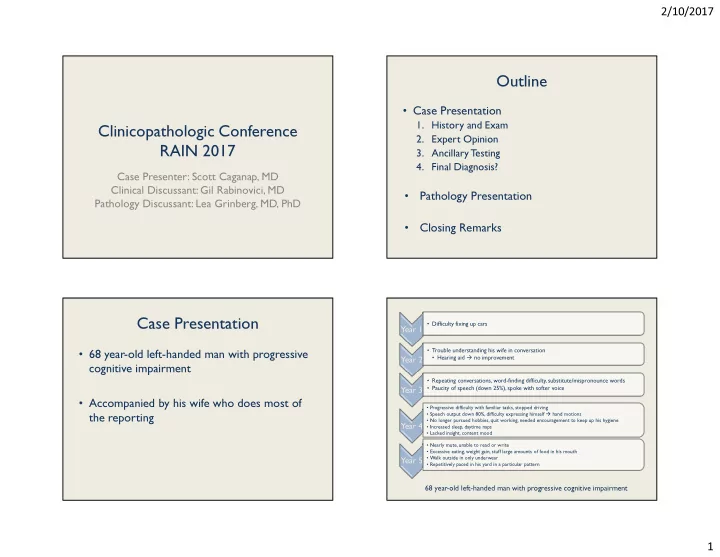
Case Presentation

  • 68 year-old left-handed man with progressive

cognitive impairment

  • Accompanied by his wife who does most of

the reporting

Year 1

  • Difficulty fixing up cars

Year 2

  • Trouble understanding his wife in conversation
  • Hearing aid no improvement

Year 3

  • Repeating conversations, word-finding difficulty, substitute/mispronounce words
  • Paucity of speech (down 25%), spoke with softer voice

Year 4

  • Progressive difficulty with familiar tasks, stopped driving
  • Speech output down 80%, difficulty expressing himself hand motions
  • No longer pursued hobbies, quit working, needed encouragement to keep up his hygiene
  • Increased sleep, daytime naps
  • Lacked insight, content mood

Year 5

  • Nearly mute, unable to read or write
  • Excessive eating, weight gain, stuff large amounts of food in his mouth
  • Walk outside in only underwear
  • Repetitively paced in his yard in a particular pattern

68 year-old left-handed man with progressive cognitive impairment

slide-2
SLIDE 2

2/10/2017 2

Review of Systems

  • Cognition:

– No fluctuations in cognition or level of arousal – Unclear if memory is an issue because he speaks so rarely – Does not get lost in familiar environments – No issues recognizing his family, but may not recognize former co-workers occasionally

Review of Systems

  • Psychiatric:

– Approximately 10 years ago, he had a recurrent delusion in which he suspected his wife of infidelity, but this resolved with marriage counseling – No illusions, misperceptions, or hallucinations

Review of Systems

  • Neurologic:

– No changes in vision – Difficulty swallowing (pills, large solids); coughs during meals – Intermittently kicked his legs while sleeping – Generally slower movements – No tremor, weakness, incoordination, or recurrent falls – Occasional urinary incontinence

Personal History

  • PMH: BPH s/p laser surgery
  • MEDS: tamsulosin, NKDA
  • FH: two healthy sons; biological family not known
  • Social History:

– Raised in foster care. Lost foster parents at a young age. – Grew up in central California. Completed the twelfth grade without difficulty. – Most recently worked a part-time job as a dishwasher. Previously employed as a mechanic at an auto shop. – Rare alcohol consumption. No tobacco or illicit drug use.

slide-3
SLIDE 3

2/10/2017 3

Examination

  • General:

– Normal vital signs, 137 lbs., 5’7” – Cooperative, well-groomed

Mental Status Exam

  • Alert, DSF 4
  • Flat affect, slow to respond
  • Unable to spell WORLD backward, DSB 0
  • Oriented to self, city, month, and date, but not

season, year, or place

  • Word registration 3/3, recall 0/3

Mental Status Exam

  • Sparse speech, up to 4-word sentences,

grammatically correct

  • Used hand gestures when attempting to speak
  • Named only a few simple objects
  • Can repeat a simple sentence
  • Unable to perform multi-step tasks

Mental Status Exam

  • Unable to copy intersecting pentagons
  • Could not pantomime blow-a-kiss or whistle
  • Unable to perform 3-step hand movement

task (Luria test) on both sides

  • MMSE 8/30
slide-4
SLIDE 4

2/10/2017 4

Cranial Nerve Exam

  • VFF, no extinction to DSS
  • PERRLA
  • EOMI except for limitation in up-gaze, gaze

impersistence

  • Normal saccades, no nystagmus

Cranial Nerve Exam

  • Mild hypophonia and guttural dysarthria
  • Moderate hypomimia, full facial strength
  • Mildly diminished hearing bilaterally
  • Symmetric palate elevation
  • Normal tongue movements, no fasciculation

Motor Exam

  • Occasional BUE fasciculation
  • Paratonia in all extremities
  • Slowing of movements in all extremities (R>L)
  • Reduced amplitude finger/foot tapping
  • No postural or rest tremor
  • Full strength

Coordination Exam

  • Intention tremor during FNF testing on R
  • No dysmetria
  • Unable to perform RAMs
slide-5
SLIDE 5

2/10/2017 5

Reflex Exam Reflex Exam

  • R palmar grasp
  • R palmomental & rooting reflex
  • Snout reflex

Sensory Exam

  • Normal sensation to all modalities
  • No extinction to DSS
  • Normal stereognosis
  • No instability during Romberg testing

Gait Exam

  • Slow, cautious
  • Short-stride length
  • Decreased arm-swing bilaterally
  • One step backwards during retropulsion

testing

slide-6
SLIDE 6

2/10/2017 6

Expert Opinion

  • What are your thoughts Dr. Rabinovici?

– Differential Diagnosis? – Further Workup? – Leading Diagnosis? – Expected Underlying Pathology?

Clinicopathological Conference:

68 year-old with 5 years of cognitive and behavioral decline

Gil Rabinovici, M.D.

Associate Professor of Neurology, UCSF 50th Annual Recent Advances in Neurology February 10, 2017

Disclosures

  • Research support

– Avid Radiopharmaceuticals/Eli Lilly, GE Healthcare, Piramal Imaging – NIH (NIA, NINDS, NCATS), American College of Radiology, Alzheimer’s Association, Tau Consortium, Association for Frontotemporal Degeneration, Michael J Fox Foundation

  • Consulting/honoraria

– Eisai, Genentech, Lundbeck, Merck, Putnam, Roche

Approach to Patient with Cognitive Complaints

  • HPI probes cognitive domains

– Memory: misplacing items, repetitive questions, missing appointments or bills, remote memory – Visuospatial: navigation, spatial relationships, object and face recognition – Language: production and comprehension, motor speech, reading and writing – Executive: decision-making, judgment, multi-tasking, concentration/focus – Behavior: personality changes, depression, anxiety, apathy, disinhibition, psychosis – Motor

  • First or early symptoms particularly helpful
  • PMH, Meds, FH, SH may offer valuable clues
slide-7
SLIDE 7

2/10/2017 7

Approach to Patient with Cognitive Complaints

  • Mental Status exam and neuro-

psychological testing

– Better define cognitive domains

  • Physical neurological exam

– Cranial nerves – Motor: UMN/LMN, parkinsonism – Sensory loss – Ataxia – Gait

Approach to Patient with Cognitive Complaints

  • Labs: exclude “treatable” metabolic or

infectious causes

– Mandatory

  • Chem 20, CBC, B12, TSH

– Discretionary

  • RPR/FTA-ABS, HIV, homocysteine/methylmalonic acid,

LP, rheumatologic, paraneoplastic, heavy metals, etc.

– Imaging (MRI preferred)

– Exclude tumor, SDH, NPH, etc. – Evaluate for vascular lesions – Pattern of atrophy

From Clinical Syndrome to Pathology

Aβ Tau α-synuclein TDP-43 Common Causes of Neurodegenerative Dementia

Disease Protein Anatomy Early Sxs Neuropsych

AD

Aβ, tau

Medial temporal Posterior temporoparietal Memory loss, spatial disorientation Behavior spared Episodic memory Visuospatial Dysexecutive

DLB

α-synuclein Aβ

Frontal Occipital/temporal Basal ganglia Brainstem Parkinsonism, RBD, Psychosis, fluctuations Visuospatial Dysexecutive Memory relatively spared

FTD

Tau TDP-43 FUS

Frontal Anterior temporal Disinihibition, apathy, personality changes Aphasia, executive dysfunction Motor-neuron disease Dysexecutive Memory may be spared Visuospatial usually spared

VascD

N/A

Often frontal predominant (but variable) Often dysexecutive, memory, visuospatial, behavioral Often executive functions worst, though variable

slide-8
SLIDE 8

2/10/2017 8

History: Cognitive Symptoms

  • First symptom: “difficulty performing skilled tasks”

(e.g. car repairs)

– Executive, motor planning or output, procedural memory

  • Language decline

– “Difficulty understanding his wife” – comprehension, attention – Decreased speech output, short sentences – Mispronouncing words, soft voice, mutism - motor speech – Repeating previous conversations

  • Episodic memory, perseveration

– Unable to read or write: pervasive language deficits

History: Behavioral Symptoms

  • Apathetic!

– Loss of initiative, interest in hobbies, personal hygiene, hyper-somnolence

  • Blissfully unaware

– Poor insight, not perturbed by deficits

  • Repetitive motor behaviors, pacing
  • Disinhibition

– Walking around in underwear

  • Overeating

Frontal Circuits: Cognition & Behavior

Seeley et al. J Neurosci. 2007 Rosen et al. Brain 2005

Aberrant Motor Behavior Apathy Disinhibition

T-score T-score T-score

Executive Control Network – Lateral, fronto-parietal Cognitive Salience Network – Medial, fronto-insular Social-emotional behavior

Speech Production Networks

Key nodes: inferior frontal gyrus (BA 44), supplementary motor area (SMA), caudate Key tracts: aslan tract (AT), superior longitudinal fasciculus (SLF), fronto-striatal

Gorno-Tempini et al. Neurology 2006 Mandelli et al. Brain 2016

slide-9
SLIDE 9

2/10/2017 9

Additional History

  • Dysphagia
  • Occasional urinary incontinence
  • Delusion of marital infidelity 10 years ago, no

hallucinations

  • No sleep disturbance
  • No major medical co-morbidities, Rx
  • Family history unknown

Exam: Pertinent Positives and Negatives

  • Thin (5’7”, 137 lbs.) despite over-eating
  • Cognitively globally impaired (but knows exact date)
  • Slow, apathetic, little speech output, orobuccal

apraxia

  • Digits forwards 4, backwards 0; working memory

disproportionately affected vs. repetition

  • Saccades intact; hypophonic, guttaral dysarthria
  • UE fasciculations; mild hyper-reflexia, R Babinski
  • Hypomimia, bradykinesia R>L, slow gait with

decreased arm swing

  • Intention tremor on R, no truncal or limb ataxia

Rabinovici et al., Continuum 2015

Case Summary

  • Chronic, progressive course and absence of

co-morbidities consistent with primary neurodegenerative disease

  • Cognitive: Early and disproportionate

executive dysfunction and motor speech

  • Behavior: Apathy > disinhibition, overeating
  • Motor: UMN/LMN; mild extra-pyramidal
  • Localization:

– Dorsolateral and dorsomedial prefrontal cortex, L>R – UMN and C-spine LMN, basal ganglia

slide-10
SLIDE 10

2/10/2017 10

Common Causes of Neurodegenerative Dementia

Disease Protein Anatomy Early Sxs Neuropsych

AD

Aβ, tau

Medial temporal Parietal Frontal Memory loss, spatial disorientation, social graces preserved Episodic memory Visuospatial Dysexecutive

DLB

α-synuclein Aβ

Frontal Occipital/temporal Brainstem Parkinsonism, RBD, Psychosis, fluctuations Visuospatial Dysexecutive Memory relatively spared

FTD

Tau TDP-43 FUS

Frontal Anterior temporal Disinihibition, apathy, personality changes, Aphasia, executive dysfunction Motor-neuron disease Dysexecutive Memory usually spared Visuospatial always spared

VascD

N/A

Often frontal predominant (but variable) Often dysexecutive, memory, behavioral Often executive functions worst, though variable

Frontotemporal Dementia

  • Family of clinicopathologic syndromes

– Progressive changes in behavior or language – Neurodegeneration of frontal or anterior temporal lobes

  • Common cause of pre-senile dementia

– 5% of all dementia, most common cause of early-onset dementia (<65 years) – Incidence 3-4/105, prevalence 15-22/105 – Even more common when include associated disorders ALS, HS, CBD, PSP, CTE PSP CBD nfvPPA bvFTD svPPA FTLD-ALS

FTLD-TAU FTLD-TDP

MAPT PGRN Clinical Syndromes: FTD Pathology: FTLD Genes FTLD-FUS C9ORF72

Rabinovici and Miller. CNS Drugs 2010

Behavioral-Variant FTD: Clinical Criteria (3 of 6 for “Possible bvFTD”)

  • Early behavioral disinhibition
  • Early apathy or inertia -
  • Early loss of emotional reactivity/sympathy and

empathy

  • Perseverative, stereotyped or compulsive/ritualistic

behavior

  • Hyper-orality and dietary changes -
  • Executive-predominant cognitive dysfunction

Rascovsky et al. Brain 2011

slide-11
SLIDE 11

2/10/2017 11 Behavioral-Variant FTD: Clinical Criteria (3 of 6 for “Possible bvFTD”)

  • Early behavioral disinhibition - +/-
  • Early apathy or inertia -
  • Early loss of emotional reactivity/sympathy and

empathy - No

  • Perseverative, stereotyped or compulsive/ritualistic

behavior -

  • Hyper-orality and dietary changes -
  • Executive-predominant cognitive dysfunction –

perhaps early on, now too impaired to judge

Rascovsky et al. Brain 2011

Atrophy Patterns in FTLD vs. AD

Pathology-proven AD/FTLD vs. NC Common atrophy in AD and FTLD Distinct atrophy in AD and FTLD

Rabinovici et al. AJADOD 2007

Amyloid vs. FDG-PET in Differential Diagnosis of AD vs. FTD

Rabinovici et al. Neurology 2011

AD (N=62, age 65, MMSE 22) FTD (N=45, age 65, MMSE 22) Amyloid (PIB) PET visual reads 90% sensitivity, 83% specificity Inter-rater agreement κ=0.96 FDG-PET visual reads 78% sensitivity*, 84% specificity Inter-rater agreement κ=0.72* 70 autopsy-proven cases

PIB: Sensitivity 96%, Specificity 88% FDG: Sensitivity 88%, Specificity 89%

* - p<0.05 vs. PIB

bvFTD – Probable or Definite

  • Probable bvFTD

– Meets criteria for possible bvFTD – Significant functional decline – Frontal/anterior temporal pattern on MRI/FDG

  • bvFTD with definite FTLD pathology

– Histopathological evidence on bx/autopsy – Presence of a known pathogenic mutation

  • Exclusions

– Deficits better accounted for by other medical, neurological or psychiatric disorder – Biomarkers strongly indicative of AD or other process

Rascovsky et al. Brain 2011

slide-12
SLIDE 12

2/10/2017 12

Primary Progressive Aphasia

  • Non-fluent/agrammatic variant

(nfvPPA)

– Effortful speech, agrammatism, motor speech deficits – Pathology: FTLD-Tau > FTLD-TDP

  • Semantic variant (svPPA)

– Fluent, grammatically correct speech with loss of word and

  • bject meaning

– Pathology: FTLD-TDP

  • Logopenic variant (lvPPA)

– Hesitant speech with word finding difficulty, poor repetition – Pathology: AD Mesulam, Ann Neurol 1982 Gorno-Tempini et al. Neurology 2011

Progressive loss of language with relative preservation of other cognitive functions

Progressive Supranuclear Palsy

  • Richardson’s Syndrome

– Vertical gaze palsies, postural instability with early falls, axial-predominant parkinsonism – Highly specific but not sensitive at early stages

  • Cognitive decline

– Executive dysfunction, slowed processing speed, impaired working memory

  • Behavioral symptoms

– Apathy, depression, impulsivity

  • Atypical phenotypes

– PSP-parkinsonism, pure akinesia with gait freezing (PAGF), nonfluent PPA, bvFTD

Clinical Phenotypes of Corticobasal Degeneration

  • Corticobasal syndrome (CBS)

– Asymmetric limb rigidity/akinesia, dystonia, myoclonus – Orobuccal/limb apraxia, cortical sensory loss, alien limb

  • Frontal behavioral-spatial syndrome

– Executive dysfunction, behavior/personality changes, visuospatial deficits

  • Nonfluent primary progressive aphasia

– Effortful speech, agrammatism, apraxia of speech

  • PSP syndrome

– Symmetric, supranuclear gaze palsies, early falls

Armstrong et al. Neurol 2013

bvFTD FTLD-ALS

FTLD-TAU FTLD-TDP

MAPT PGRN Clinical Syndromes: FTD Pathology: FTLD Genes FTLD-FUS C9ORF72

Rabinovici and Miller. CNS Drugs 2010

slide-13
SLIDE 13

2/10/2017 13

Pick’s PSP CBD TDP-A TDP-B TDP-C FTLD-TDP FTLD-tau DPR (C9ORF72) FTLD-FUS

Neuropathological Dx in Clinical bvFTD

UCSF Neurodegenerative Brain Bank, N=117

Courtesy of David Perry, Lea Grinberg & Bill Seeley

None Delusions more common (and more severe on NPI) More signs of MND None with visual misperception

FTLD-tau: FTLD-TDP

Younger age at onset, presentation, and death More oral exploration More severe NPI anxiety, euphoria, apathy, disinhibition, aberrant motor, sleep disturbance, eating behavior Worse verbal memory and more design fluency repetitions

FTLD-FUS

FTDC criteria

  • No difference in 6 core FTDC features at presentation or throughout follow-up
  • Frequency of meeting possible or probable FTDC criteria

Parkinsonism

Not helpful

Predicting Pathology in bvFTD: Clinical Pearls

FTD Autosomal Dominant Mutations

Mutation C9orf72 MAPT GRN Age of DX 56 52 62 Clinical bvFTD, ALS FTD-ALS, (AD) bvFTD, PSP. CBS, (AD) bvFTD, nfvPPA, CBS, (AD) MRI Diffuse cortical, can be mild, thalamus, cerebellum Frontotemporal temporal > frontal Asymmetric frontotemporal, parietal Unique clinical ALS, psychiatric prodrome with slow progression Symmetry, addiction Asymmetric syndromes Neuropath FTLD-TDP B FTLD-TDP A FTLD-TDP (U) FTLD-Tau (usually 4R) FTLD-TDP A

slide-14
SLIDE 14

2/10/2017 14

Genetic vs. Sporadic FTD

Whitwell et al. Brain 2012

Tau PET in FTD: [18F]AV1451

Spina et al. Neurology 2017

Final Conclusions

  • Clinical dx: behavioral-variant FTD (with

prominent language disturbance)

  • Predicted pathology (in order of

likelihood):

  • 1. FTLD-TDP, type B; sporadic or C9ORF72
  • 2. FTLD-TDP, type A/U
  • 3. FTLD-Tau (Pick, PSP, CBD) less likely
  • 4. AD unlikely to be primary pathology

Year 1

  • Difficulty fixing up cars

Year 2

  • Trouble understanding his wife in conversation
  • Hearing aid no improvement

Year 3

  • Repeating conversations, word-finding difficulty, substitute/mispronounce words
  • Paucity of speech (down 25%), spoke with softer voice

Year 4

  • Progressive difficulty with familiar tasks, stopped driving
  • Speech output down 80%, difficulty expressing himself hand motions
  • No longer pursued hobbies, quit working, needed encouragement to keep up his hygiene
  • Increased sleep, daytime naps
  • Lacked insight, content mood

Year 5

  • Nearly mute, unable to read or write
  • Excessive eating, weight gain, stuff large amounts of food in his mouth
  • Walk outside in only underwear
  • Repetitively paced in his yard in a particular pattern

68 year-old left-handed man with progressive cognitive impairment

ROS ROS

  • Dysphagia
  • Bradykinesia
  • Incontinence
slide-15
SLIDE 15

2/10/2017 15

Ancillary T esting

  • Basic serum studies including B12 and TFTs were

unremarkable

  • MRI Brain:

– No mass lesions or ischemic changes – Subtle generalized atrophy, ? anterior predominance, no lateralization

  • FDG-PET: global hypometabolism with sparing of

bilateral occipital cortices and posterior cingulate

Year 1

  • Difficulty fixing up cars

Year 2

  • Trouble understanding his wife in conversation
  • Hearing aid no improvement

Year 3

  • Repeating conversations, word-finding difficulty, substitute/mispronounce words
  • Paucity of speech (down 25%), spoke with softer voice

Year 4

  • Progressive difficulty with familiar tasks, stopped driving
  • Speech output down 80%, difficulty expressing himself hand motions
  • No longer pursued hobbies, quit working, needed encouragement to keep up his hygiene
  • Increased sleep, daytime naps
  • Lacked insight, content mood

Year 5

  • Nearly mute, unable to read or write
  • Excessive eating, weight gain, stuff large amounts of food in his mouth
  • Walk outside in only underwear
  • Repetitively paced in his yard in a particular pattern

68 year-old left-handed man with progressive cognitive impairment

ROS ROS

  • Dysphagia
  • Bradykinesia
  • Incontinence

MRI T1-Weighted Sequences

slide-16
SLIDE 16

2/10/2017 16

Ancillary T esting

  • MRI Brain: severe L>R atrophy

– Lateral and medial frontal lobes – Anterior and medial temporal lobes

  • PIB-PET: negative

Expert Opinion

  • Interpretation of Imaging?
  • Final Diagnosis and Pathology? Change your mind?

Year 1

  • Difficulty fixing up cars

Year 2

  • Trouble understanding his wife in conversation
  • Hearing aid no improvement

Year 3

  • Repeating conversations, word-finding difficulty, substitute/mispronounce words
  • Paucity of speech (down 25%), spoke with softer voice

Year 4

  • Progressive difficulty with familiar tasks, stopped driving
  • Speech output down 80%, difficulty expressing himself hand motions
  • No longer pursued hobbies, quit working, needed encouragement to keep up his hygiene
  • Increased sleep, daytime naps
  • Lacked insight, content mood

Year 5

  • Nearly mute, unable to read or write
  • Excessive eating, weight gain, stuff large amounts of food in his mouth
  • Walk outside in only underwear
  • Repetitively paced in his yard in a particular pattern

68 year-old left-handed man with progressive cognitive impairment

slide-17
SLIDE 17

2/10/2017 17

Year 6

  • Marked progression of apathy
  • Decline in mobility and functional independence
  • No longer following commands

Year 7

  • No longer responding to voice
  • Significant weight loss, feeding tube placement
  • Bedridden
  • Hospice

68 year-old left-handed man with progressive cognitive impairment

Pathology Discussion

  • Dr. Grinberg, what are the range of

pathological findings that can be seen in a patient presenting with these signs and symptoms?

  • What did the autopsy show?

RAIN 2017 CPC Pathology

Lea T. Grinberg, M.D Ph.D Associate Professor of Neurology and Pathology UCSF

Frontotemporal lobar degeneration (FTLD) SD FTD-MND bvFTD PSPS CBS PNFA

slide-18
SLIDE 18

2/10/2017 18

Frontotemporal lobar degeneration (FTLD) SD FTD-MND FTLD-tau FTLD-TDP* Pick’s 3R tau CBD 4R tau PSP 4R tau FTDP-17

(MAPT)

Tau NOS MST/AGD FTLD-FUS FTLD-3

(CHMP2b)

bvFTD PSPS CBS Alzheimer’s Disease PNFA Type C Type D

(VCP)

Type B

(C9orf72) (TARDP?)

*Harmonized scheme aFTLD-U NIFID ???

(FUS)

BIBD Type A

(PGRN) (C9orf72)

Courtesy W. Seeley, UCSF

Frontotemporal lobar degeneration (FTLD) SD FTD-MND FTLD-tau FTLD-TDP* Pick’s 3R tau CBD 4R tau PSP 4R tau FTDP-17

(MAPT)

Tau NOS MST/AGD FTLD-FUS FTLD-3

(CHMP2b)

bvFTD PSPS CBS Alzheimer’s Disease PNFA Type C Type D

(VCP)

Type B

(C9orf72) (TARDP?)

*Harmonized scheme aFTLD-U NIFID ???

(FUS)

BIBD Type A

(PGRN) (C9orf72)

Courtesy W. Seeley, UCSF

Weight: 1066 g

R

UCSF/MAC Neurodegenerative Disease Brain Bank

slide-19
SLIDE 19

2/10/2017 19

  • 1. Moderate dorsolateral frontal and insula atrophy
  • 2. Mild ventral frontal and temporal atrophy
  • 3. Caudate is flat
  • 4. Hippocampus is relatively spared

Example of negative immunohistochemical assay

100 µm

slide-20
SLIDE 20

2/10/2017 20

Beta-amyloid

Scarce number of diffuse and neuritic plaques in the primary visual area (occipital cortex)

TDP-43

*

ITG

Scale bars: 10 µm

unclassifiable: neuronal cytoplasmatic and nuclear inclusions, threads, glial inclusions in all cortical layers

SN ITG IFG

3R- and 4 Repeat-tau

RD4 RD3

Entorhinal cortex

Scale bars: 10 µm

Atypical neuronal/glial 4R-tauopathy (limbic and peri-limbic

Ubiquitin IHC, cerebellar granule cells

The signature pathology

Immunohistochemistry for p62 - cerebellum

pathognomonic of C9orf72 expansions

slide-21
SLIDE 21

2/10/2017 21 Final Neuropathological Diagnoses

Primary diagnosis: Frontotemporal lobar degeneration with TDP-43 immunoreactive inclusions FTLD-TDP, unclassifiable

Contributing diagnosis : 4-repeat tauopathy, not otherwise specified Incidental diagnosis: Alzheimer’s disease neuropathological change (ADNC)2 Low ADNC, NIA-AA Criteria (A1, B1, C0) Thal Amyloid Plaque Phase 1 Braak Neurofibrillary Degeneration Stage 1 CERAD Neuritic Plaque Score none,

Case Summary

  • Our patient developed cognitive impairment in his mid-

60’s that progressed over 7 years

– Cognitive domains:

1. Executive 2. Behavior + Language

– Brain Imaging:

1. Anterior-predominant hypometabolism 2. Severe L>R frontal & anterior temporal lobe atrophy

  • Clinical Dx: behavioral-variant Frontotemporal

Dementia

  • Pathological Dx: FTLD-TDP associated with mutation

in C9ORF72

behavioral-variant Frontotemporal Dementia Epidemiology

  • FTD is 2nd most common cause of early-onset

neurodegenerative dementia (after AD)

  • Prevalence:

– 15-22 per 100K persons 45-64 yo – 10% occurs in patients <45 yo – 30% occurs in patients >65 yo

  • bvFTD accounts for >50% of autopsy-

confirmed FTLD

Knopman et al, J Mol Neurosci 2011 Snowden et al, Brain 2011

slide-22
SLIDE 22

2/10/2017 22

Genetics

  • 40% of FTD is associated with autosomal

dominant inheritance

  • bvFTD & agrammatic PPA are most common

phenotypes

  • Mutations in 8 genes account for 50% of

familial FTD

  • C9ORF72 mutation is most common genetic

abnormality in familial FTD (12%) and familial ALS (23%)

Rohrer et al, Neurology 2009 Le Ber, Rev Neurol 2013 DeJesus-Hernandez et al, Neuron 2011

Criteria for bvFTD

  • Gradual onset and progressive deterioration
  • f behavior and/or cognition

– Disinhibition – Apathy – Ritualistic behavior – Hyperorality

  • Frontal and/or anterior temporal pattern on

MRI or PET

Rascovsky et al, Brain 2011

Management

  • No approved therapies for FTD
  • Supportive care

– Power of attorney – Swallow evaluation – Physical therapy

  • Genetic counseling

Finger, Continuum 2016

slide-23
SLIDE 23

2/10/2017 23

Acknowledgements

  • The patient and his family
  • UCSF Memory and Aging Center
  • Discussants:

– Dr. Gil Rabinovici – Dr. Lea Grinberg

  • RAIN 2017 Co-Chairs:

– Dr. Stephen Hauser – Dr. Andy Josephson