
SLIDE 1
STAR FORMATION HISTORIES FROM Z=0 TO Z=8
Peter Behroozi, Stanford University Santa Cruz Galaxy W
- rkshop 2011
Risa W echsler, Stanford University Charlie Conroy, Harvard / UCSC
Wednesday, August 10, 11
STAR FORMATION HISTORIES FROM Z=0 TO Z=8 Peter Behroozi, Stanford - - PowerPoint PPT Presentation
STAR FORMATION HISTORIES FROM Z=0 TO Z=8 Peter Behroozi, Stanford University Risa W echsler, Stanford University Charlie Conroy, Harvard / UCSC Santa Cruz Galaxy W orkshop 2011 Wednesday, August 10, 11 Major Questions When did galaxies
Peter Behroozi, Stanford University Santa Cruz Galaxy W
Risa W echsler, Stanford University Charlie Conroy, Harvard / UCSC
Wednesday, August 10, 11
When did galaxies form their stars, as a function of their mass today? (Or their mass at an earlier redshift?)
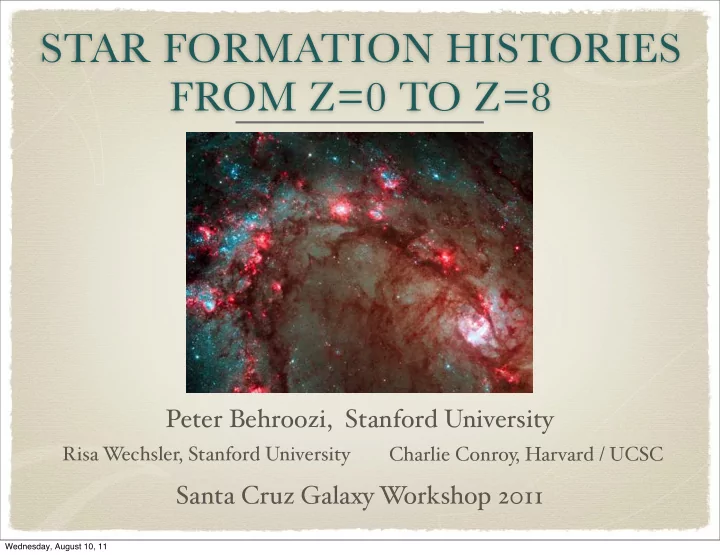
LMC; Hubble Heritage Team
Wednesday, August 10, 11
What’s the solution to the discrepancy between the cosmic SFR and the cosmic SM density? 0 1 2 3 4 z
Wilkins et al. 2008
Wednesday, August 10, 11
Parametrize the evolution of the stellar mass function; Constrain using ALL available data, currently including observations of the stellar mass function, specific star formation rates, and the cosmic star formation rate (all from z=0-8). Include nuisance parameters for all conceivable systematic effects.*
*see Behroozi, Conroy, & W echsler 2010
Wednesday, August 10, 11
(∆t) · SFRmd(tnow) = SMmd(tnow) −
(new stars) (expected stellar mass) (number of contributing progenitors, corrected for ICL losses) (stellar population of progenitors, corrected for stellar death)
In equations:
Talk to me about details!
Wednesday, August 10, 11
Include parametrized models for all conceivable systematic effects: Many have suggested that high-redshift galaxies have bursty/dusty star formation,* but no-one’s done a self-consistent check. Let’s try out a simple model! *Stark et al. 2009, K.S. Lee et al. 2009, Schaerer & Barros 2010
Wednesday, August 10, 11
λ(z) = A 1 + exp(B − z) Incompleteness/burstiness:
1 2 3 4 5 z 0.4 0.5 0.6 0.7 0.8 0.9 Completeness
Wednesday, August 10, 11
1 2 3 4 5 6 Redshift 0.001 0.01 0.1 Cosmic SFR [MO
Without including CSFR constraint Face Value Bursty/Dust Obscured Bursty/Dust Obscured w/o SSFR scaling
W e can immediately better match the cosmic SFR.
Wednesday, August 10, 11
1 2 3 4 5 z 0.4 0.5 0.6 0.7 0.8 0.9 1 Completeness
And we can constrain the incompleteness (in this model):
Wednesday, August 10, 11
Burstiness / dust obscuration helps, but does not completely explain the cosmic SFR / SM tension at z>4. Result: W e have an extremely powerful framework for testing models to resolve the cosmic SFR / SM tension.
Wednesday, August 10, 11
W e’ve run our models to z=0, and found the same trends: strongly decreasing SFRs at fixed halo mass with redshift:
Preliminary
Wednesday, August 10, 11
But, if we ask the complementary question about galaxy star formation histories, there’s no single trend!
Preliminary
Wednesday, August 10, 11
The rate at which the stellar population grew in low-mass galaxies has always been increasing; whereas for high-mass galaxies, the rate peaked at an early redshift and then declined.
Preliminary
0.1 0.2 0.3 0.4 0.5 0.6 0.7 0.8 0.9 Scale Factor 0.2 0.4 0.6 0.8 1 SF History [MO
Mh = 10
11.0 MO
0.1 0.2 0.3 0.4 0.5 0.6 0.7 0.8 0.9 Scale Factor 10 20 30 40 50 60 70 80 SF History [MO
Mh = 10
13.0 MO
Wednesday, August 10, 11
Best-fit model: Even better in detail: V alid across a wide range of redshifts (0<z<4 at least).
0.1 0.2 0.3 0.4 0.5 0.6 0.7 0.8 0.9 Scale Factor 0.2 0.4 0.6 0.8 1 SF History [MO
Mh = 10
11.0 MO
0.1 0.2 0.3 0.4 0.5 0.6 0.7 0.8 0.9 Scale Factor 10 20 30 40 50 60 70 80 SF History [MO
Mh = 10
13.0 MO
SFH(a) = AaB exp[C(1 − a)] SFH(a) = AaB exp[C(1 −
3
√a)]
Wednesday, August 10, 11
Still preliminary work, but: Our approach combines constraints from the observed stellar mass function at all times, as well as the observed clustering of galaxies (through the galaxy-halo connection), as well as the cosmic SFR and specific SFRs.
Wednesday, August 10, 11
Still preliminary work, but: W e can also start to constrain models for resolving the discrepancy between cosmic SFRs and SMs. Our approach combines constraints from the observed stellar mass function at all times, as well as the observed clustering of galaxies (through the galaxy-halo connection), as well as the cosmic SFR and specific SFRs.
Wednesday, August 10, 11
Still preliminary work, but: W e can also start to constrain models for resolving the discrepancy between cosmic SFRs and SMs. Our approach combines constraints from the observed stellar mass function at all times, as well as the observed clustering of galaxies (through the galaxy-halo connection), as well as the cosmic SFR and specific SFRs. W e’ve already obtained constraints on the functional form of both the star formation history and the star formation rate for galaxies.
Wednesday, August 10, 11
http://spacefellowship.com/news/ art15504/picture-of-the-day-the- birth-of-stars.html http://www.williamsclass.com/ EighthScienceW
ImagesEighth/ SuperNovaReminant.jpg
Wednesday, August 10, 11