Concepts, Science, Communities: Writing histories of African - - PowerPoint PPT Presentation

concepts science communities
SMART_READER_LITE
LIVE PREVIEW

Concepts, Science, Communities: Writing histories of African - - PowerPoint PPT Presentation

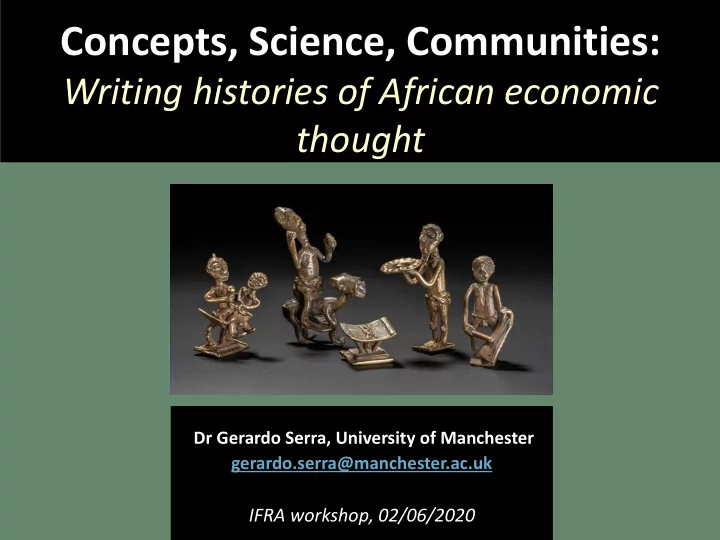
Concepts, Science, Communities: Writing histories of African economic thought Dr Gerardo Serra, University of Manchester gerardo.serra@manchester.ac.uk IFRA workshop, 02/06/2020 Outline Histories of economic thought Writing histories

slide-1
SLIDE 1

Concepts, Science, Communities:

Writing histories of African economic thought

Dr Gerardo Serra, University of Manchester gerardo.serra@manchester.ac.uk

IFRA workshop, 02/06/2020

slide-2
SLIDE 2

Outline

  • Histories of economic

thought

  • Writing histories of

African economic thought: 3 paths

  • Conclusions
slide-3
SLIDE 3

Histories of economic thought

  • Political economy, economics

and their history

  • ‘Rational reconstruction’ vs.

‘historical reconstruction’

  • What is the history of economic

thought for?

  • J. Schumpeter

(1883-1950)

slide-4
SLIDE 4

HI HIST STORIES ORIES OF OF AFRICA AFRICAN N EC ECONOMIC ONOMIC TH THOUG OUGHT HT: : Th Three ee pos

  • ssible

sible pat aths hs

slide-5
SLIDE 5
  • I. Concepts
slide-6
SLIDE 6

What is conceptual history?

  • Not all history of ideas is ‘conceptual

history’

  • Beyond ‘intellectual elites’
  • Same form, different meanings
  • Concepts construct the horizon within

which historical actors make sense of the world and operate in it

  • R. Koselleck

(1923-2006)

slide-7
SLIDE 7

Where do we look for concepts?

Gold weight, Funtunfunefu- Denkyemfunefu

slide-8
SLIDE 8

‘Wealth’ in Asante history

  • Sika
  • Golden Stool (sika dwa kofi) and

Golden elephant tail (sika mena)

  • Degrees of complementarity
  • 19th century: collapse of the

intellectual order

slide-9
SLIDE 9

Poverty in words and proverbs

  • Umphawi (Chewa)  lack of kin and friends
  • ‘The poor man has no friend’ (Twi proverb)
  • ‘The common people make their soup without meat,

and the destitute make it without salt’ (Hausa proverb)

  • ‘When are you are a poor man, you stay at home and

do not mix with public affairs’ (Twi proverb)

  • ‘The person who has been poor since long ago

speaks thus: What did the Muganda leave me with?’ (Lusoga proverb)

  • ‘I grew up dancing: says the one dressed in an old

barkcloth’ (Luganda proverb)

slide-10
SLIDE 10

Poverty in Uganda: a longue durée view

  • 14 languages, 2 main linguistic groups (Great

Lakes Bantu - with focus on North Nyanza), Eastern Nilotic)

  • Typicality
  • ‘Roots’  semantic spheres
slide-11
SLIDE 11

EASTERN NILOTIC language group ROOT LANGUAGE WORD MEANING

  • can-

Ngakarimojong acanaanu poverty ngican trouble, affliction, suffering Turkana akicanut poverty akican to annoy, to disturb, to trouble

  • kuly-

Ngakarimojong akulyako abject poverty akulyakanut poverty due to lack of cattle Turkana ekulikit destitute

  • R. Stephens, ‘ “Wealth”, “Poverty” and the Question of Conceptual

History in Oral Contexts: Uganda from c. 1000 CE’

slide-12
SLIDE 12

NORTH NYANZA language group ROOT LANGUAGE WORD MEANING

  • ták-

Lugwere

  • butáki

poverty Lusoga

  • butáki

misery, degradation butaki deficiency in conducts, manners, money, etiquette physical, social and spiritual ineptitude

  • naku-

Lusoga

  • búnakú

destitution, misery, suffering

  • lúnakú

day Luganda nakù poor, distressed òlùnakù day

  • R. Stephens, ‘ “Wealth”, “Poverty” and the Question of Conceptual

History in Oral Contexts: Uganda from c. 1000 CE’

slide-13
SLIDE 13

Neo-colonialism

‘The greatest danger facing Africa is neo-colonialism and its major instrument, balkanisation’ AFRICA MUST UNITE (1963) ‘The essence of neo-colonialism is that the State which is subject to it is, in theory, independent {…} In reality its economic system, and thus its political policy is directed from outside’ NEO-COLONIALISM (1965)

slide-14
SLIDE 14

Neo-colonialism

Jean Paul Sartre

slide-15
SLIDE 15

The National Archives (London), DO/35/9424

slide-16
SLIDE 16

Public Records Archives and Administration Department (Accra), RG17/1/366

slide-17
SLIDE 17

Summary

  • Koselleck and beyond
  • It can facilitate historical reconstructions in

the longue duree

  • It can result in a very selective understanding
  • f ‘context’ surrounding the concept chosen
  • It invites the incorporation of a wide range of

sources

  • Draws on interdisciplinary skills that are

consolidated in African studies (ethnography, linguistics, archaeology)

slide-18
SLIDE 18
  • II. Science
slide-19
SLIDE 19

Africa and Western science: from ‘anthropology’ to ‘economics’

E.B. Worthington (1938) Science in Africa Reprinted in H. Tilley, Africa as a Living Laboratory: Empire, Development and the Problem of Scientific Knowledge, 1870-1950

slide-20
SLIDE 20

The National Archives (London), CO 96/688/11 (1929, Anthropological Research)

From the desk to the field: anthropology as science and administration

slide-21
SLIDE 21

Colonial anthropology as anti-colonial discourse

‘To {…} all the dispossessed youth of Africa: for perpetuation

  • f communion with ancestral

spirits through the fight for African freedom, and in the firm faith that the dead, the living and the unborn will unite to rebuild the destroyed shrines’

1938

slide-22
SLIDE 22

Theory and observation

  • From ‘Af

African ican eco conomic nomic thought’ to ‘ec economics

  • nomics

in Africa’

  • Na

Nati tional

  • nal income

come ac accoun counts ts

Phyllis Deane Wolfgang Stolper

Polly Hill

LLK/7/8, King’s College, Cambridge

slide-23
SLIDE 23

Theory and observation

  • ‘Global division of labour’?

grand-narratives and theorising vs. empirical observation

  • From national income accounts to

‘Okparanomics’

Pius Okigbo 1924-2000

slide-24
SLIDE 24

Scientific communities: Ibadan vs. Zaria

  • Federal finance vs.

Marxian political economy

  • Communities:

1) Bibliometrics 2) Prosopography 3) Social network analysis 4) Witness seminar

slide-25
SLIDE 25

Summary

  • History of science: from ‘great discoveries’

and diffusionism to emphasis on practice and communities

  • Re-think colonial encounter and its aftermath
  • Epistemologies and disciplinary identities
  • Theory and observation
  • Sociology of a profession and the politics of

expertise

  • From biography to bibliometrics and

prosopography

slide-26
SLIDE 26
  • III. Communities:

from ‘economics’ to ‘oeconomia’

slide-27
SLIDE 27

Development as state-building

‘The picture depicts life in Africa in the

  • 1960s. […]. It portrays the uncanny ability of

the African to derive joy from traditional cultural activities, and to master the techniques directly needed in the solution of the development problems of Africa. It reveals the secret

  • f

effective African nationhood, namely a sense of oneness between the rural and the city African, between the educated and the uneducated, and between the rich and the poor’.

David M. Rubenstein Rare Books & Manuscript Library (Duke University). Gerald Meier papers, box S1.

slide-28
SLIDE 28

Pan-Africanism as economic thought

  • The African system as ‘socialistic

and cooperative’, ‘widest concentration of land and well- being’  but advocacy of British colonialism (Blyden, 1908, African Life and Customs)

  • Winfried Tete-Ansah, 1930, Africa

Works

Edward Blyden (1832-1912)

slide-29
SLIDE 29

Pan-Africanism in 1960s Ghana

CONCEPT – SCIENCE – COMMUNITY

slide-30
SLIDE 30

CON ONCL CLUSIONS USIONS

slide-31
SLIDE 31

Conclusions

  • ‘Development’ and beyond
  • Methodological pluralism

and publication

  • pportunities
  • Decolonising knowledge
  • Towards ‘Afrotopia’
slide-32
SLIDE 32

Thank you for your attention. gerardo.serra@manchester.ac.uk