Concepts and principles of IT Aim Identify the IT concepts and - - PDF document

concepts and principles of it
SMART_READER_LITE
LIVE PREVIEW

Concepts and principles of IT Aim Identify the IT concepts and - - PDF document

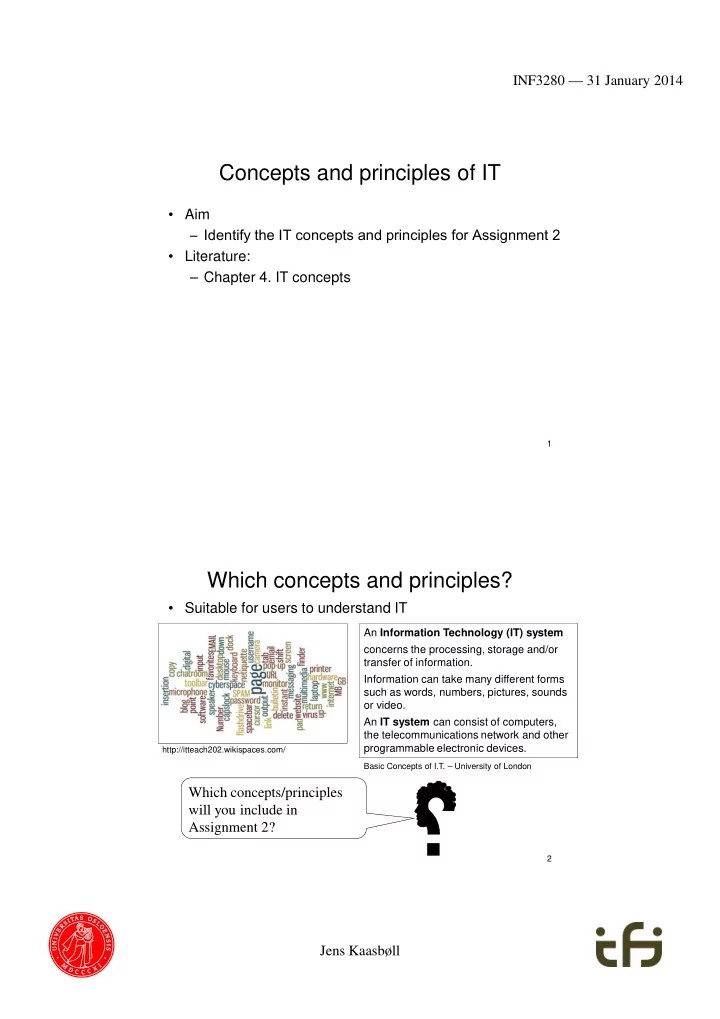
INF3280 31 January 2014 Concepts and principles of IT Aim Identify the IT concepts and principles for Assignment 2 Literature: Chapter 4. IT concepts 1 Which concepts and principles? Suitable for users to understand


slide-1
SLIDE 1

INF3280 — 31 January 2014 Jens Kaasbøll

Concepts and principles of IT

  • Aim

– Identify the IT concepts and principles for Assignment 2

  • Literature:

– Chapter 4. IT concepts

1

Which concepts and principles?

  • Suitable for users to understand IT

2 http://itteach202.wikispaces.com/

An Information Technology (IT) system concerns the processing, storage and/or transfer of information. Information can take many different forms such as words, numbers, pictures, sounds

  • r video.

An IT system can consist of computers, the telecommunications network and other programmable electronic devices.

Basic Concepts of I.T. – University of London

c Which concepts/principles will you include in Assignment 2?

slide-2
SLIDE 2

INF3280 — 31 January 2014 Jens Kaasbøll

Computers – Sequence

  • Manipulating symbols
  • Automatic
  • Computationally universal

– All finite calculations – Replace all special IT

  • Turing completeness

3

Alan Turing

ENIAC 1946

  • Automatic and universal
  • Programs stored by

plugging cables

U.S. Army Photo 4

Structure: the von Neumann architecture

  • Programs stored in the same

way as data

  • von Neumann architecture

János Lajos Margittai Neumann

Photo: Los Alamos National Laboratory

Computers

slide-3
SLIDE 3

INF3280 — 31 January 2014 Jens Kaasbøll

5

The first von Neuman computer

Manchester Mark 1, 1948 – Programs and data

stored in 6000 vacuum tubes

von Neumann architecture enables

  • Download, install and run new software

– The app market

  • Programs can change themselves and other programs

– Compilers generating executable code

  • Data files can contain programs

– Macros – Virus

  • Layers

– Data can be processed by different programs – Each program addresses certain aspects of the data

6

slide-4
SLIDE 4

INF3280 — 31 January 2014 Jens Kaasbøll

Structure: The layered architecture of IT

  • Layers can be changed independently of each other

– Internet can work on

  • Data transmission cables
  • Phone lines
  • Mobile phone network

– Layout separated from contents and structure

7

c What is the difference between tables and columns in a document? Do they determine

  • Layout?
  • Structure?

Layered network model

8

Applications Browser with URL, … Web server Transport software IP address, network key, … User connection Internet gateway Hardware Antenna, signal, cable, … User’s computer Local Area Network Internet Service Provider Internet Remote web host

slide-5
SLIDE 5

INF3280 — 31 January 2014 Jens Kaasbøll

Structures of sequences of operations

Mode Synch

Point-to- point Mass Synchronous Chat TV Asynchronous E-mail Web

9

Communication modes and synchronization

Types and Instances

  • Type

– Description of a common set of properties and operations

  • Instance

– A unit of data adhering to the type Integer

Number without decimals Calculation operators

10

Account Balance Owner Deposit Withdraw :Account 18 473.32 Kari :Account 3 292.00 Ola

Class Objects

234 -2 1 000 000

slide-6
SLIDE 6

INF3280 — 31 January 2014 Jens Kaasbøll jpg file type – Compresses image – Enables editing Heading 2 paragraph style – Determines layout – Enables ToC entry

11

2.1. Learning IT skills 2.2. Instruction sheets

Selecting the type influences

  • Information

– Complete tiff – Loss, compression jpeg

  • Business fit

– Manipulate picture jpeg or tiff – Search through text pdf

12

c Types in word processors? Presentation programs? Relational databases?

slide-7
SLIDE 7

INF3280 — 31 January 2014 Jens Kaasbøll c What is the structure

  • f the file system?

13

Data structures

Sequence Part followed by part Grid (array, matrix) Multi-dimensional sequences Addressed by coordinates (indexes) Hierarchy Units inside each other Aggregation: Whole-parts Network Linked parts without any strict topology

Functional dependency

  • Data structures enable consistency

– Data stored one place only – If the value of one component changes when the value of another component changes, the former is functionally dependent on the latter

14

c Which mechanisms for achieving functional dependency are found in

  • Office applications
  • The web
  • The operating system?
slide-8
SLIDE 8

INF3280 — 31 January 2014 Jens Kaasbøll

Structure: metadata – data about about data

 Descriptive data – Derived from a file

  • Constraining data

– Specification of structures

  • Data Type Definitions – DTD
  • XML schema

– Specification of format

  • Cascading Style Sheets – CSS

– Catalogues in databases

  • Table of all tables

15

c What is the metadata

  • f a picture?