Trademark Law Prof. Madison Key concepts from Class 3: Legal rules - - PowerPoint PPT Presentation

trademark law
SMART_READER_LITE
LIVE PREVIEW

Trademark Law Prof. Madison Key concepts from Class 3: Legal rules - - PowerPoint PPT Presentation

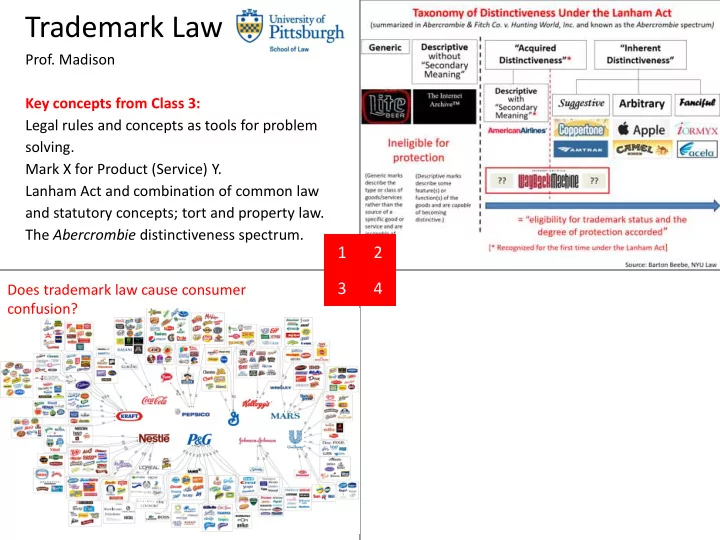
Trademark Law Prof. Madison Key concepts from Class 3: Legal rules and concepts as tools for problem solving. Mark X for Product (Service) Y. Lanham Act and combination of common law and statutory concepts; tort and property law. The


slide-1
SLIDE 1

2 1 4 3

Trademark Law

  • Prof. Madison

Key concepts from Class 3: Legal rules and concepts as tools for problem solving. Mark X for Product (Service) Y. Lanham Act and combination of common law and statutory concepts; tort and property law. The Abercrombie distinctiveness spectrum. Does trademark law cause consumer confusion?

slide-2
SLIDE 2

The line between descriptive marks (not valid or protected unless secondary meaning / acquired distinctiveness is shown; consumer goodwill must be built) and suggestive marks (automatically valid because inherently distinctive; consumer goodwill is assumed): 1.Dictionary definition 2.Imagination test 3.Competitive need 4.Third-party uses

2 1 4 3 Result of the “choose a mark” exercise: In the language of trademark law, is this mark distinctive (i.e., valid)? If not – yet – how can the owner ensure that trademark rights attach to the mark?

The line between descriptive marks that lack secondary meaning (not valid or protected) and descriptive marks that have developed secondary meaning (valid and protected because they have acquired distinctiveness).

Frosty Treats Inc. v. Sony Computer Entertainment America (8th Cir. 2005)

slide-3
SLIDE 3

Board of Supervisors for Louisiana State University Agricultural & Mechanical College v. Smack Apparel Co. (5th Cir. 2008)

Factors and evidence:

  • Producer

investment (time, $$, sales success)?

  • Consumer/comp-

etitor reliance/

  • pportunity?

2 1 4 3

(An illustration: does it matter who caused the distinctiveness to arise?) “Red for staplers”: created as film prop (1999), produced by fans (1999-2002), manufactured by Swingline in

  • 2002. What is the first date of

Swingline’s trademark?

Problems

Generic marks: Ask “what do consumers believe the product / service is? Is the mark source indicating to them?” (Note in this case: Right outcome, wrong reasoning.)

slide-4
SLIDE 4