Business and Technical Concepts of Business and Technical Concepts of - - PowerPoint PPT Presentation

business and technical concepts of business and technical
SMART_READER_LITE
LIVE PREVIEW

Business and Technical Concepts of Business and Technical Concepts of - - PowerPoint PPT Presentation

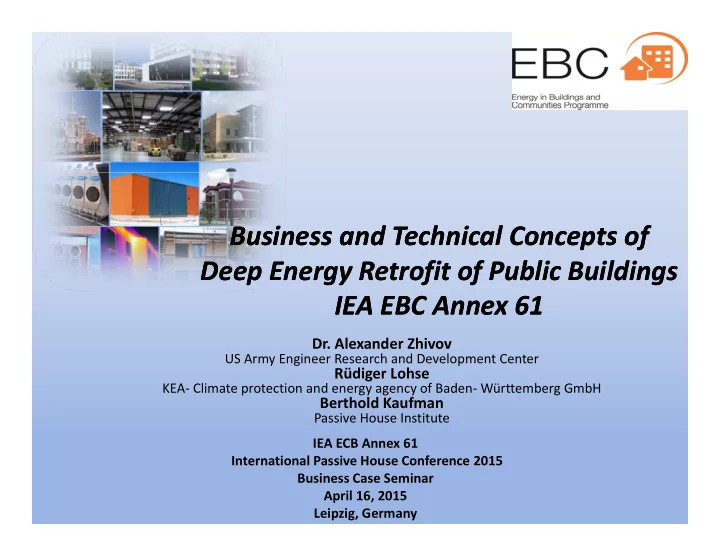
Business and Technical Concepts of Business and Technical Concepts of Business and Technical Concepts of Business and Technical Concepts of Deep Energy Retrofit of Public Buildings Deep Energy Retrofit of Public Buildings IEA EBC Annex 61 IEA EBC


slide-1
SLIDE 1

Business and Technical Concepts of Business and Technical Concepts of Business and Technical Concepts of Business and Technical Concepts of Deep Energy Retrofit of Public Buildings Deep Energy Retrofit of Public Buildings IEA EBC Annex 61 IEA EBC Annex 61 IEA EBC Annex 61 IEA EBC Annex 61

  • Dr. Alexander Zhivov

US Army Engineer Research and Development Center

Rüdiger Lohse

l d f d b b IEA ECB Annex 61 KEA‐ Climate protection and energy agency of Baden‐ Württemberg GmbH

Berthold Kaufman

Passive House Institute International Passive House Conference 2015 Business Case Seminar April 16, 2015 Leipzig, Germany

slide-2
SLIDE 2

Introduction

  • Governments worldwide are setting more stringent

targets for energy use reductions in their building targets for energy use reductions in their building stocks

  • To achieve these goals, there must be a significant

To achieve these goals, there must be a significant increase in both the annual rates of building stock refurbishment and energy use reduction, for each project (EU: refurbishment rate of 3% p.a., USA: 3% p.a. site energy reduction compared to CBECS 2003 h h 2015 d 2 5% b 2015 d 2025) through 2015 and 2.5% between 2015 and 2025)

2

slide-3
SLIDE 3

EU Energy Performance of Buildings Directive (EPBD 2010)

  • Member States shall develop policies and take measures such as

setting targets to stimulate the transformation of buildings to be refurbished to a nearly zero‐energy condition refurbished to a nearly zero energy condition.

  • A Member State shall not be required to set minimum energy

performance requirements that are not cost‐effective over a building’s estimated economic lifecycle.

  • A nearly zero‐energy building is defined as “a building that has a very

high energy performance The nearly zero or very low amount of high energy performance. The nearly zero or very low amount of energy required should be covered to a very significant extent by energy from renewable sources, including energy from renewable d d i b ” sources produced on‐site or nearby.”

  • The term “high performance building” (as used in Austria, Germany,

the Czech Republic, and Denmark) was developed by the Passivhaus the Czech Republic, and Denmark) was developed by the Passivhaus Institute (PHI) for the German building market, and has the same definition as “nearly zero‐energy.”

slide-4
SLIDE 4

IEA‐EBC Annex 61: Business and Technical Concepts f D E R fi f P bli B ildi for Deep Energy Retrofit of Public Buildings

Annex 61

Deep Energy Retrofit (IT‐Tool)

4

slide-5
SLIDE 5

T id f k d l t d t l d id li t

Objectives

  • To provide a framework and selected tools and guidelines to

significantly reduce energy use (by more than 50%) in government and public buildings and building communities undergoing renovation

  • To gather, research, develop, and demonstrate innovative and highly

effective bundled packages of ECMs for selected building types and climatic conditions

  • To develop and demonstrate innovative, highly resource‐efficient

business models for retrofitting/refurbishing buildings and community systems using appropriate combinations of public and y y g pp p p private funding

  • To support decision makers in evaluating the efficiency, risks,

financial attractiveness and contractual and tendering options financial attractiveness, and contractual and tendering options conforming to existing national legal frameworks

  • To engage end users, mainly building owners and other market

t i th di d k f th A S bt k partners, in the proceedings and work of the Annex Subtasks.

5

slide-6
SLIDE 6

Receptors

  • Executive decision‐makers and energy managers of

public and governmental administrations p g

  • ESCOs
  • Financing industries

g

  • Energy utility companies
  • Designer‐, architect‐ and engineer‐companies
  • Manufacturers of insulation, roofing materials,

lighting, controls, appliances, and HVAC and energy generation equipment including those using generation equipment, including those using renewable sources.

6

slide-7
SLIDE 7

Major deliverables

  • Subtask A:

– Case studies of completed DER – “How‐to” Guide with financially attractive core technologies bundles and How to Guide with financially attractive core technologies bundles and their characteristics by clime zones

  • Subtask B:

i d i i l d l f d fi / f bi h f – Business and Financial models for deep energy retrofit/refurbishment of buildings and building groups using combined government/public and private funding

  • Subtask C:

– Case studies of DER project implemented using combined funding

7

slide-8
SLIDE 8

Definition of Deep Energy Retrofit Deep Energy Retrofit (DER) is a major building renovation project in which site energy use intensity has been reduced by at least 50% from the pre‐renovation baseline.

slide-9
SLIDE 9

Some Examples of Deep Energy Retrofit Projects

  • Forststr. 7

(retrofitted) Heilbronner Str. 19 (retrofitted)

Residential buildings renovation: 75% energy use reduction Karlsruhe (Germany) Residential building renovation: 78% energy use reduction

9

Barracks renovation: 45% energy use reduction, Ft Polk (USA) 78% energy use reduction Freiburg (Germany)

slide-10
SLIDE 10

More Examples of Deep Energy Retrofit Projects

Renovation of the medieval Franciscan monastery in Graz, Austria to Zero Energy building Renovation of a residential building in Kapfenberg (Austria) – renovated to 85% site energy use reduction building Renovation of a kindergarten in Denmark Primary energy used reduced from 224 kWh/m²/year to 103 kWh/m²/year Renovation of a school campus in Aachen. Primary energy use reduced from 240 kWh/m²year to 78 kWh /m² year

slide-11
SLIDE 11

COUNTRY SITE BUILDING TYPE PICTURES

Annex 61 DER Case Studies (26+)

COUNTRY SITE BUILDING TYPE PICTURES

1.Austria Kapfenberg Social housing L d i h f M lti t i 2.Germany Ludwigshafen‐ Mundenheim Multi‐stories apartment 3 Germany Nürnberg Bavaria Multi‐stories 3.Germany Nürnberg, Bavaria apartment 4.Germany Ostfildern Gymnasium 5.Germany Baden‐Württemberg School 6.Germany Osnabrueck School 7.Germany Olbersdorf School

11

slide-12
SLIDE 12

COUNTRY SITE BUILDING TYPE PICTURES

8.Germany Darmstadt Office building 9.Denmark Egedal, Copenhagen School 10.USA Grand Junction, Colorado Office Building / Courthouse Silver Spring and Federal Building/

  • 11. USA

Silver Spring and Lanham, Maryland Federal Building/ Office

Intelligence Community

Ad i i t ti

  • 12. USA

Intelligence Community Campus, Bethesda , MD

Administrative buildings

  • 13. USA
  • St. Croix. Virgin Islands

Office/Courthouse

  • 14. Estonia

Kindergarten in Valga Kindergarten

  • 14. Estonia

Kindergarten in Valga Kindergarten

  • 15. Latvia

Riga Multi‐family building

12

slide-13
SLIDE 13

“Core Technology” Bundle for DER

13

slide-14
SLIDE 14

Core Technology Bundles

  • Passive House Institute
  • Energy Target: heating < 25kWh/a (site

) t t l 120kWh/ ( i

  • DER
  • Site energy Target: 50% from the

b li b t b tt th th i i energy), total < 120kWh/a (primary energy),

  • Insulation levels for BE components <

0.15 W/(m2 K) – walls and roofs baseline, but better then the minimum national standard

  • Insulation levels for BE components by

climate zone

  • Window characteristics < 0.85 W/(m2 K)
  • BE air tightness < 0.6ACH @50Pa
  • Thermal bridges mitigation
  • Window characteristics by climate zone
  • BE air tightness (e.g., 0.15 cfm/ft2

@75Pa – USA) Th l b id iti ti

  • HR from return air Eff > 75%
  • Project component s certification
  • Building post occupancy certification
  • Thermal bridges mitigation
  • DOAS
  • HR from return air
  • Duct air tightness and insulation levels

Duct air tightness and insulation levels (current national standards)

  • Hot and cold water pipe insulation
  • Lighting levels and LPD
  • Project Delivery Quality Assurance
slide-15
SLIDE 15

I t d ti

Subtask A: DER Guide ‐ Outline

  • Introduction
  • What is Deep Energy Retrofit
  • Energy efficiency technologies and strategies
  • Core technologies for DER
  • Building Envelope

– Wall and roof cross‐sections Wall and roof cross sections – Insulation types and levels for different climate conditions – Thermal Bridges Wi d t d h t i ti f diff t li t diti – Window types and characteristics for different climate conditions – Air barrier requirements – Water and Vapor control for different climate conditions

  • Lighting systems
  • HVAC systems : core requirements to energy efficiency of equipment, HR, ducts

and pipes

slide-16
SLIDE 16

DER Guide – Outline (Cont)

  • Attachments

– Insulation Materials – Catalogue of thermal bridges – Air barrier examples of good and bad practices Windows good practices and installation recommendations – Windows –good practices and installation recommendations – Water and Vapor control: examples of good and bad practices – Lighting Design Guide Lighting Design Guide – HVAC : examples of energy efficient technologies

  • Quality Assurance
  • Conclusions
  • References
slide-17
SLIDE 17

Wall Insulation

Country U‐value W/(m2*K) (Btu/(hr*ft2*°F) R‐value (m2*K)/W (hr*ft2*°F)/Btu Austria (c.z. 5A) c.z.7 0.135 (0.024) 0.24 (0.043) 7.4. (42) 4.17 (23) c.z.7 0.24 (0.043) 4.17 (23) China c.z. 7 c.z. 4A c.z. 3A c.z. 2A 0.31(0.054) 0.48(0.084) 0.60(0.106) 0.96(0.169) 3.2(19) 2.1(12) 1.7(9) 1.0(6) c.z. 2A c.z. 3C 0.96(0.169) 0.96(0.169) 1.0(6) 1.0(6) Denmark (c.z. 5A) 0.15 (0.026) 6.7 (38) Estonia (c.z. 6A) 0.17 (0.03) 5.9 (33) Germany (c.z. 5A) 0.17‐0.24 (0.03‐0.04) 4.2‐5.9 (24‐33) y ( ) ( ) ( ) Latvia (c.z. 6A) 0.19 (0.033) 5.3 (30) UK (c.z. 4A) 5A 0.22(0.039) 0.22(0.039) 4.5(26) 4.5(26) USA c.z. 1 0.76 (0.133) 1.3 (8) c.z. 2 c.z. 3 c.z. 4 c.z. 5 ( ) 0.38 (0.067) 0.28 (0.050) 0.23 ( 0.040) 0.19 (0.033) ( ) 2.6. (15) 3.6 (20) 4.3 (25) 5.3. (30)

17

c.z. 6 c.z. 7 c.z. 8 ( ) 0.14 (0.025) 0.11 (0.020) 0.11 (0.020) ( ) 7.1. (40) 9.1 (50) 9.1 (50)

slide-18
SLIDE 18

Wall Insulation Levels by Country

Country U‐value (SI/IP) W/m²K (BTU/h oF ft2) R‐value (IP) (h oF ft2)/BTU /BTUAustria (c.z. 5A) 0.12 (0.021) 47.3 China c.z. 7 c.z. 4A c.z. 3A c.z. 2A 0.124 (0.022) 0.268(0.047) 0.327(0.057) 0.370 (0.065) 46 21.3 17.5 15.4 c.z. 3C ( ) 0.446(0.079) 12.6 Denmark (c.z. 5A) 0.15 (0.026) 37.9 Estonia (c.z. 6A) 0.17 (0.03) 33 Germany (c.z. 5A) 0.2 (0.035) 29 UK (c.z. 4A) 0.22(0.039) 26 USA c z 1 0 76 (0 133) 7 5 USA c.z. 1 c.z. 2 c.z. 3 c.z. 4 c z 5 0.76 (0.133) 0.38 (0.067) 0.28 (0.050) 0.23 ( 0.040) 0 19 (0 033) 7.5 15 20 25 30 c.z. 5 c.z. 6 c.z. 7 c.z. 8 0.19 (0.033) 0.14 (0.025) 0.11 (0.020) 0.11 (0.020) 30 40 50 50

slide-19
SLIDE 19

Guidance for Insulation Values

Item Component Recommendation

Assem bly Max (2) Min R‐Value (2)

Based on modeling results, ranges for insulation levels

5

a

(2)

Roof

Insulation Entirely Above Deck U‐0.020 R‐50ci Metal Building R‐13 + R‐13 + R‐34ci Vented Attic and Other R‐60 M R 30 i

and windows was developed for various climate

limate Zone 5

Walls

Mass U‐0.033 R‐30ci Metal Building R‐19 + R‐17ci Steel Framed R‐19 + R‐20ci Wood Framed and Other R‐19 + R‐14ci

zones

DOE C

Below Grade/Basement U‐0.067 R‐15ci

Floors Over Unconditioned Space

Mass U‐0.033 R‐16 Spray Foam + R‐11ci. Steel Joist R‐16 Spray Foam + R‐13ci. Wood Framed and Other R 19 + R 10ci Wood Framed and Other R‐19 + R‐10ci.

Slab‐on‐Grade

Unheated F‐0.54 R‐10 for 24 in. Heated F‐0.44 R‐15 for 36 in. + R‐5ci below

Doors

Swinging U‐0.60 Insulated

Doors

Non‐Swinging U‐0.40 Insulated

slide-20
SLIDE 20

Roof Insulation

U value R value Country Climate zone U‐value W/(m2*K) (Btu/(hr*ft2*°F) R‐value (m2*K)/W (hr*ft2*°F)/Btu Austria 4a 7 0.159 (0.028) 0.23 (0.041) 6.3 (36) 4.4 (25) 0 3 (0 0 ) ( 5) China 2a 3a 3c 4a 0.53 (0.093) 0.53 (0.093) 0.53 (0.093) 0.38(0.067) 1.9(11) 1.9(11) 1.9(11) 2.6(15) 7 0.30 (0.053) 3.3(19) Denmark 5a 0.10 (0.018) 1 (57) Estonia 6a 0.11 (0.02) 9.1 (52) Germany 5a 0.14 (0.025) 7.1 (40) Latvia 6a 0.16 (0.029) 6.3 (35) UK 4a 5a 0.13(0.023) 0.13(0.023) 7.7 (44) 7.7 (44) 1 0.16 (0.029) 6.3 (35) USA 1 2 3 4 5 6 0.16 (0.029) 0.14 (0.025) 0.12 (0.022) 0.12 ( 0.022) 0.11 (0.020) 0 09 (0 0167) 6.3 (35) 7.1 (40) 8.3 (45) 8.3 (45) 9.1 (50) 11 1 (60)

20

6 7 8 0.09 (0.0167) 0.09 (0.0154) 0.08 (0.0133) 11.1 (60) 11.1 (65) 12.5 (75)

slide-21
SLIDE 21

Windows

Country U‐value W/(m2*K) (Btu/(hr*ft2*°F) R‐value (m2*K)/W (hr*ft2*°F)/Btu SHGC Austria (c.z. 5A) c z 7 1.09 (0.19) 1 09 (0 19) 0.92 (5.3) 0 92 (5 3) 0.60 0 60 c.z.7 1.09 (0.19) 0.92 (5.3) 0.60 China c.z. 2A c.z. 3a c z 3C 2.55(0.45) 2.55(0.45) 2 70(0 48) 0.39 (2.2) 0.39 (2.2) 0 37 (2 1) 0.48 0.48 0 48 c.z. 3C c.z. 4A c.z. 7 2.70(0.48) 1.79(0.32) 1.79(0.32) 0.37 (2.1) 0.56 (3.1) 0.56 (3.1) 0.48 0.68 0.68 Denmark (c.z. 5A) 1.2 (0.21) 0.83 (4.8) 0.63 Estonia (c z 6A) 1 1 (0 19) 0 91 (5 3) 0 56 Estonia (c.z. 6A) 1.1 (0.19) 0.91 (5.3) 0.56 Germany (c.z. 5A) 1.3 (0.23) 1.0 (5.7) 0.55 Latvia (c.z. 6A) 1.2 (0.21) 0.83 (4.8) 0.43 UK (c z 4A) 1 32 (0 23) 0 76 (4 3) 0 48 UK (c.z. 4A) c.z. 5A 1.32 (0.23) 1.79 (0.32) 0.76 (4.3) 0.56 (3.1) 0.48 0.68 USA c.z. 1&2 c.z. 3&4 c.z. 5 1.98 (< 0.35) 1.70 (< 0.30) 1.53 (< 0.27) > 0.51 (2.9) > 0.59 (3.3) > 0.65 (3.7) < 0.25 0.30‐ 0.35 0.35‐ 0.40

21

c.z. 6 c.z. 7 c.z. 8 ( ) 1.36 (< 0.24) 1.25 (< 0.22) 1.02 (< 0.18) ( ) > 0.74 (4.2) > 0.80 (4.5) > 0.98 (5.6) >50 >50 >50

slide-22
SLIDE 22

Thermal Bridges

slide-23
SLIDE 23

Example of Window Replacement Sequencing (with improved insulation, air and thermal barriers)

slide-24
SLIDE 24

Thermal Bridge Remediation

Typical detail poor Insert thermal Wrap the thermal bridge break parapet

slide-25
SLIDE 25

Example

slide-26
SLIDE 26

Building Air Tightness

Country Source Requirement* cfm/ ft2 at 75Pa Austria OIB RL 6, 2011 for buildings with 1.5 1/h at 50 Pa 0.28 Austria OIB RL 6, 2011 for buildings with mechanical ventilation 1.5 1/h at 50 Pa 0.28 Germany DIN 4108‐2 1.5 1/h at 50 Pa 0.28 ASHRAE Standard 90 1 ‐ 2013 USA ASHRAE Standard 90.1 ‐ 2013 USACE ECB for all buildings [21] 0.25 USA USACE HP Buildings and DER proposed requirement 0.15 UK TS‐1Commercial Tight 2 m3/h/m2 at 50 Pa 0.14 CAN R‐2000 1 sq in EqLA @10 Pa /100 sq ft 0.13 Germany Passive House Std 0.6 1/h at 50 Pa 0.11 y /

Based on four‐story building, 120 x 110 ft, n=0.65.

slide-27
SLIDE 27

Advanced HVAC Systems

  • Dedicated outdoor air system (DOAS)

Dedicated outdoor air system (DOAS)

  • Heating and Cooling equipment per current national standard

(e.g., ASHRAE 90.1‐2013)

  • Heat recovery (sensible and latent) > 80% efficiency
  • Duct air tightness – class C

d h ll d l l

  • Hot and chilled water pipes insulation per current national

standard

  • Low exergy heating and
  • Low exergy heating and

cooling systems: indirect evaporative cooling (e.g., C l d ) di h i Coolerado), radiant heating and cooling, energy flow cascading, etc.

slide-28
SLIDE 28

Lighting – Improved Design and Technology

Improved Design Reduced illuminance Reduced electrical power

slide-29
SLIDE 29

Lighting Controls

  • Use daylight responsive controls in frequently
  • ccupied spaces with daylight access
  • Use vacancy sensors in spaces with daylight access
  • Use occupancy sensors in spaces without daylight

access

  • Control lighting with time‐clocks for building‐wide

energy conservation

6W Desk Lamp

slide-30
SLIDE 30

Quality Assurance Includes Quality Assurance Includes

  • Detailed technical specification, against which

Detailed technical specification, against which tenders will be made, and verification of understanding of these specifications by potential contractors,

  • Specification in SOW/OPR of areas of major concern

to be addressed and checked during the bid selection, design, construction, commissioning and post occupancy phases; post‐occupancy phases;

  • Clear delineation of the responsibilities and

qualifications of stakeholders in this process qualifications of stakeholders in this process.

slide-31
SLIDE 31

QA Process Phases

  • RFP and SOW provides clear and concise documentation of the Owner’s

goals, expectations and requirements to the renovated building and shall be utilized throughout the project delivery, provides an informed baseline and focus for design development and for validating building’ energy and environmental performance. Based on this document, bidders will be able to offer a matching perspective;

  • Procurement phase, which includes analysis of bidders qualifications,

their understanding of the statement of work and its requirements; previous experience and ability to coordinate different trades and d li th t d b ildi hi h ill t ifi ti deliver the renovated building which will meet specifications;

  • Design Phase with Design Reviews;
  • Construction and whole building commissioning, and
  • Post occupancy evaluation
  • Post occupancy evaluation
slide-32
SLIDE 32

Statement of Work and Bidding Process

  • Contractually binding specific energy targets (i.e., EUI for site and primary

energy, kWh/m2 per year, energy security and system redundancy requirements) to be achieved through the building renovation, parameters and qualities of materials; components and building systems to be used; installation methods; testing and commissioning methods which will be used for verification throughout the design, construction and post occupancy phases.

  • During the bidding and design phases the contractor will provide results of

energy modeling to demonstrate theoretical feasibility of meeting energy targets

  • Pre‐renovation building model shall be calibrated against the utility data.
  • Contractor presents a review of the energy requirements for the project to

include site and source energy targets; energy calculation and modeling methodologies; and discusses and resolves any conflicts or questions to the SOW/OPR.

slide-33
SLIDE 33

DER Implementation Strategies

∆Budget with financing ∆Budget without financing BAU Major Renovation Non-energy BAU Major renovation Energy related SOW DER Energy Enhance ment Cost of Funding Non energy related SOW SOW ment SOW

33

slide-34
SLIDE 34

Allowable (Cost Effective) Budget Increase for DER

∆ Budget max = NPV [∆ Energy ($)] + NPV [∆Maintenance ($)] + NPV [∆Replacement Cost ($)] + NPV [∆Lease Revenues ($)]

∆ Budget max = SRE [∆ Energy ($)] + SM [∆Maintenance] + SL [∆Lease Revenues]

SM and SL scalars can be calculated and are the uniform present worth factor

NPV [∆G x CG] = [∆G]t=1 x CG(t=1) x (1+e)/d-e) x [1- (1+e)/1+d)]N = [∆G]t=1 x CG(t=1) SE

NPV Net Present Val e f nction

M L

p Series that use the discount rate, the same way as SRE with the escalation rate e=0%. NPV = Net Present Value function N = study life in years d = discount rate e –escalation rate e escalation rate

slide-35
SLIDE 35

Examples of SR or selected economic project life interest discount and escalation rates life, interest, discount and escalation rates.

No.* Economic Life (yrs) 5 10 15 20 25 30 35 40 45 50 Discount Escalation 1 0% 0% 5.0 10.0 15.0 20.0 25.0 30.0 35.0 40.0 45.0 50.0 2 0% 1% 4 9 9 5 13 9 18 0 22 0 25 8 29 4 32 8 36 0 39 1 2 0% ‐1% 4.9 9.5 13.9 18.0 22.0 25.8 29.4 32.8 36.0 39.1 3 0% 1% 5.2 10.6 16.3 22.2 28.5 35.1 42.1 49.4 57.0 65.1 4 0% 3% 5.5 11.8 19.2 27.7 37.6 49.0 62.3 77.7 95.5 116.2 5 2% ‐1% 4.9 9.5 13.9 18.1 22.2 26.2 30.0 33.6 37.2 40.7 6 2% 1% 5.1 10.5 16.2 22.1 28.2 34.6 41.2 48.1 55.2 62.5 7 2% 3% 5 5 11 8 18 9 27 1 36 4 46 9 58 7 71 9 86 6 103 0 7 2% 3% 5.5 11.8 18.9 27.1 36.4 46.9 58.7 71.9 86.6 103.0 8 4% ‐1% 4.9 9.5 14.0 18.3 22.4 26.5 30.5 34.4 38.3 42.2 9 4% 1% 5.1 10.5 16.1 22.0 28.0 34.1 40.5 46.9 53.5 60.2 10 4% 3% 5.5 11.7 18.7 26.6 35.4 45.0 55.4 66.7 78.9 91.8 11 6% ‐1% 4.9 9.5 14.0 18.4 22.6 26.9 31.0 35.2 39.3 43.4 12 6% 1% 5.1 10.5 16.1 21.8 27.7 33.7 39.8 45.9 52.1 58.4 13 6% 3% 5.4 11.6 18.6 26.2 34.4 43.2 52.5 62.3 72.5 83.0

*These data (indicated by “No.”) relate to the curves in Figure 2a.

Scalars for Maintenance and Leases below, Escalation = 0% 1 0% 0% 5.0 10.0 15.0 20.0 25.0 30.0 35.0 40.0 45.0 50.0 2 1% 0% 4.9 9.5 13.9 18.0 22.0 25.8 29.4 32.8 36.1 39.2 3 2% 0% 4.7 9.0 12.8 16.4 19.5 22.4 25.0 27.4 29.5 31.4 4 3% 0% 4.6 8.5 11.9 14.9 17.4 19.6 21.5 23.1 24.5 25.7 5 4% 0% 4.5 8.1 11.1 13.6 15.6 17.3 18.7 19.8 20.7 21.5 6 5% 0% 4.3 7.7 10.4 12.5 14.1 15.4 16.4 17.2 17.8 18.3 6 5% 4.3 7.7 10.4 12.5 14.1 15.4 16.4 17.2 17.8 18.3 7 6% 0% 4.2 7.4 9.7 11.5 12.8 13.8 14.5 15.0 15.5 15.8 8 7% 0% 4.1 7.0 9.1 10.6 11.7 12.4 12.9 13.3 13.6 13.8

slide-36
SLIDE 36

Scalar Ratio for Fuels at varying Discount and Fuel Escalations Rates SRe and Scalars for Maintenance and Lease S.

e

36

slide-37
SLIDE 37

SRM‐ESPC Deep Retrofit Project Model #1

SRM funds

Funding Management

Design/build contract

ESPC ESCO ESPC funding

Contract

  • ESCO is awarded design/build

contract for non-energy-related building renovation, and ESPC

General Contractor

for energy-related measures

  • ESCO hires a GC, but provides

single point of contact for Army

Building renovation

  • Interior/Exterior
  • Structural/finishes

Building renovation

  • Interior/Exterior
  • Structural/finishes

Energy Saving Measures

  • HVAC
  • Envelope

Energy Saving Measures

  • HVAC
  • Envelope

Envelope (Insulation/Windows)

  • Cool Roof

Envelope (Insulation/Windows)

  • Cool Roof
slide-38
SLIDE 38

Questions Comments Want to be a part Questions, Comments, Want to be a part

  • f the TEAM?

Contact the Co‐Operating Agents:

  • Dr. Alexander Zhivov (US Army ERDC)

Email: Alexander.M.Zhivov@usace.army.mil Ph 1 217 417 6928 Phone: +1 217 417 6928

  • Mr. Rüdiger Lohse(KEA)

Email: ruediger lohse@kea bw de Email: ruediger.lohse@kea‐bw.de Phone: + 49 721 9 84 7115