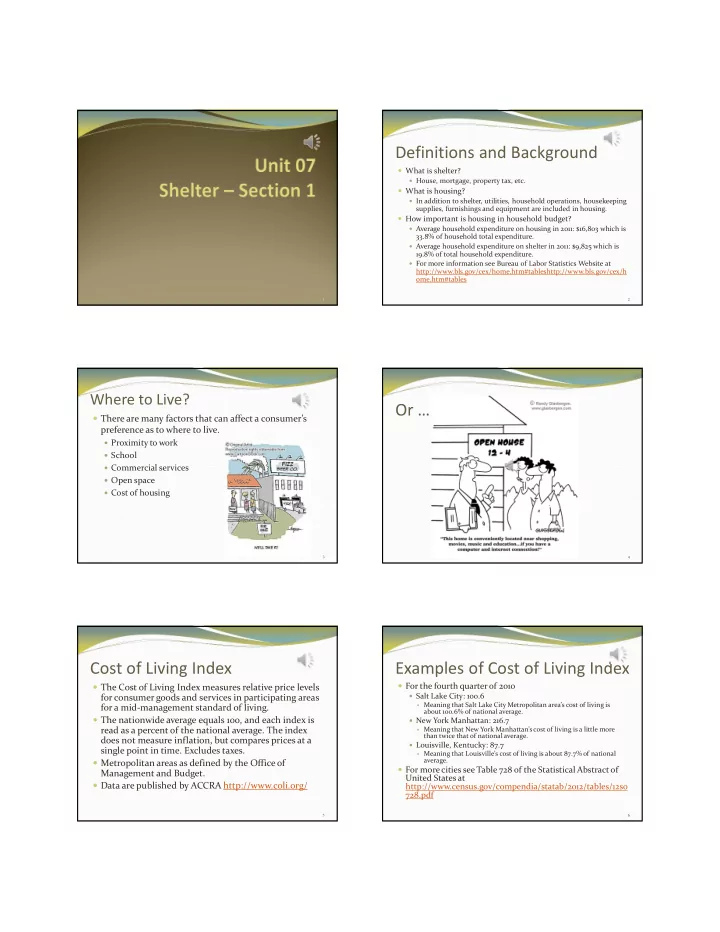
Definitions and Background What is shelter? House, mortgage, - - PDF document

definitions and background
SMART_READER_LITE
LIVE PREVIEW

Definitions and Background What is shelter? House, mortgage, - - PDF document

Definitions and Background What is shelter? House, mortgage, property tax, etc. What is housing? In addition to shelter, utilities, household operations, housekeeping supplies, furnishings and equipment are included in housing.


slide-1
SLIDE 1

1

Definitions and Background

What is shelter?

House, mortgage, property tax, etc.

What is housing?

In addition to shelter, utilities, household operations, housekeeping

supplies, furnishings and equipment are included in housing. How important is housing in household budget?

Average household expenditure on housing in 2011: $16,803 which is

33.8% of household total expenditure.

Average household expenditure on shelter in 2011: $9,825 which is

19.8% of total household expenditure.

For more information see Bureau of Labor Statistics Website at

http://www.bls.gov/cex/home.htm#tableshttp://www.bls.gov/cex/h

  • me.htm#tables

2

Where to Live?

There are many factors that can affect a consumer’s preference as to where to live.

Proximity to work School Commercial services Open space Cost of housing

3

Or …

4

Cost of Living Index

The Cost of Living Index measures relative price levels for consumer goods and services in participating areas for a mid-management standard of living. The nationwide average equals 100, and each index is read as a percent of the national average. The index does not measure inflation, but compares prices at a single point in time. Excludes taxes. Metropolitan areas as defined by the Office of Management and Budget. Data are published by ACCRA http://www.coli.org/

5

Examples of Cost of Living Index

For the fourth quarter of 2010

Salt Lake City: 100.6

Meaning that Salt Lake City Metropolitan area’s cost of living is

about 100.6% of national average. New York Manhattan: 216.7

Meaning that New York Manhattan’s cost of living is a little more

than twice that of national average. Louisville, Kentucky: 87.7

Meaning that Louisville’s cost of living is about 87.7% of national

average.

For more cities see Table 728 of the Statistical Abstract of United States at http://www.census.gov/compendia/statab/2012/tables/12s0 728.pdf

6

slide-2
SLIDE 2

What Determines the Price of Shelter?

Amenities of the house – size, etc. Location premium

Good schools Nice neighborhoods Low crime rate Proximity to work

Housing price is ultimately determined by demand and supply.

The higher the demand, and the lower the supply, the higher

the price. New York Manhattan prices are so high because a lot of people want to live there.

Demand and supply are partly determined by amenities and location.

7

What Are the Costs of Owning a Home?

The cost of renting is just rent. The cost of home ownership is much more complicated. The cost includes

One time costs:

Closing cost, down payment, selling cost

Periodic costs:

Opportunity cost: lost investment returns on closing costs and down

payment

Mortgage principal and interest payment Property taxes Hazard insurance Operating and maintenance costs

Factors reducing homeownership costs

Tax deductions Appreciation 8

One-Time Costs of Home Ownership

Closing costs: include such expenditures as loan

  • rigination fees, survey fees, lawyer fees, and advance tax

and insurance payments. They are generally in the neighborhood of 3-4% of the loan amount. It can be much less if you choose a no-cost loan, but then the interest rate will be higher. Down payment: 20% of the housing price is usually a good idea as that will allow you to not have to pay private mortgage insurance, which often can cost $100 a month. Zero down may be available, but one pays a much higher interest rate. Selling costs: Fees you will have to pay to a real estate agent. Usually it is 6% of the selling price, although you might be able to negotiate a lower fee.

9 10

Periodical Costs – Opportunity Cost

Opportunity cost is the lost investment returns on closing costs and down payment. Example:

If you buy a house of $200,000, with $5,000 of closing

costs and 20% down, then your upfront one-time cost is 5,000+40,000=45,000.

If interest rate is 6% per year, then opportunity cost per

year is 45,000*6%=2,700.

11

Periodical Costs - Mortgage Payment

Notations

Monthly payment = M Loan amount = L Principal payment = P Interest payment = I Mortgage term = n (months) Annual interest rate = r

Mortgage payment is just an installment payment situation we studied in Unit04. It is a present value factor sum (PVFS) application. Typically the EOM formula is used for mortgage computation.

12

slide-3
SLIDE 3

An example

House price = $200,000 Down payment (20%)=$40,000 Mortgage Loan L=$160,000 r=9%, n=30 years=360 months, rm=9%/12=0.75%=0.0075 What is the monthly payment? What are the interest portion, the principal portion, and the remaining balance after each payment?

13

Monthly Payment

Monthly payment (M) 40 . 1287 281866 . 124 000 , 160 % 75 . %) 75 . 1 ( 1 1 000 , 160 ) , 360 %, 75 . ( 000 , 160 ), , 360 %, 75 . ( 000 , 160

360

= = + − = = = = = = × = EOM n rm PVFS M EOM n rm PVFS M

14

Interest, Principal, and Balance

Interest payment (I), principal payment (P), and monthly balance (L) vary each month

Month 1

I1 = =160,000*0.75%=160,000 * 0.0075 = $1,200.00 P1= 1,287.40-1,200=87.40 L1= 160,000-87.40=159,912.60

Month 2

I2=159,912.60*0.0075=$1,199.34 P2=1287.40-1,199.34=88.06 L2=159,912.60-88.06=159,824.54

Month 3 … Next page is a table showing a break down of interest

payment, principal payment, and monthly balance for various months.

15

Month 1

  • f year

Inter- est Princi- pal Balance Month 1

  • f year

Inter- est Princi- pal Balance 1 1,200.00 87.40 159,912.60 17 920.50 366.90 122,366.46 2 1,191.80 95.59 158,811.29 18 886.08 401.31 117,743.06 3 1,182.83 104.56 157,606.67 19 848.44 438.96 112,685.95 4 1,173.03 114.37 156,289.04 20 807.26 480.14 107,154.45 5 1,162.30 125.10 154,847.81 21 762.22 525.18 101,104.06 6 1,150.56 136.83 153,271.38 22 712.95 574.44 94,486.10 7 1,137.73 149.67 151,547.08 23 659.07 628.33 87,247.32 8 1,124.90 162.49 149,824.73 24 600.13 687.27 79,329.51 9 1,108.33 179.07 147,598.04 25 535.66 751.74 70,668.94 10 1,091.53 195.87 145,341.53 26 465.14 822.26 61,195.96 11 1,073.16 214.24 142,873.35 27 388.00 899.39 50,834.34 12 1,053.06 234.34 140,173.64 28 303.63 983.76 39,500.73 13 1,031.08 256.32 137,220.67 29 211.35 1,076.05 27,103.96 14 1,007.03 280.36 133,990.70 30 110.41 1,176.99 13,544.28 15 980.73 306.66 130,457.73 Month 360 9.58 1,277.81 0.00 16 951.97 335.43 126,593.35

16

After Paying 18 Years of a 30-Year Mortgage …

17

Periodical Costs – Property Taxes, Insurance, and Operating and Maintenance Costs

Property taxes: Property taxes are paid to the local

  • government. Usually monthly payments are paid to

the mortgage company so the mortgage company can hold the money in an escrow account to pay property tax. Hazard insurance: Homeowners insurance often is also paid as monthly payment to the mortgage company in an escrow account. Operating and maintenance costs: heating, cooling, electricity, repairs, etc.

18

slide-4
SLIDE 4

Factors Reducing Homeownership Costs - Tax Deductions

What expenses are tax-deductible?

The interest paid on a mortgage loan Property taxes

To claim tax benefits one must use itemized deduction instead of standard deduction.

Two tax concepts we need to know

Standard deduction vs. itemized deduction Marginal tax rate

19

Standard Deduction vs. Itemized Deduction

Every American taxpayer must choose to either itemize

  • r take a standard deduction when filing tax return.

Itemizing will allow the homeowner to deduct several expenses from his adjusted gross income before calculating the income tax owed. The most significant itemized deductions are mortgage interest, property tax, state income taxes, and charitable contributions. If a taxpayer chooses not to itemize, s/he receives a standard deduction. In 2012, the standard deduction for a single person was $5,950. The standard deduction for a married couple filing jointly was $11,900.

20

2012Federal Marginal Tax Rate

21

Single Married - Joint Head of Household Married - Separate 10% 0 - 8,700 0 - 17,400 0 - 12,400 0 - 8,700 15% 8,700 - 35,350 17,400 - 70,700 12,400 - 47,350 8,700 - 35,350 25% 35,350 - 85,650 70,700 - 142,700 47,350- 122,300 35,350 - 71,350 28% 85,650 - 178,650 142,700 - 217,450 122,300 - 198,050 71,350 - 108,725 33% 178,650 - 388,350 217,450 - 388,350 198,050 - 388,350 108,725 - 194,175 35% 388,350 and Up 388,350 and Up 388,350 and Up 194,175 and Up

Annual Value of Homeownership Tax Deduction

Homeowner tax benefit = marginal tax rate * (annual interest paid on mortgage loan + annual property taxes

  • standard deduction)

However, in many cases the tax benefit is larger than the above formula shows. The above formula provides a conservative estimate of homeownership tax benefit.

22

Example of Computing Tax Benefit

Example:

First year mortgage interest payment = 14,356 Property tax = $2,700 Federal marginal tax rate = 25% State marginal tax rate = 10% Standard deduction for both federal and state taxes = 5,700 Total marginal tax rate =federal marginal tax rate + state

marginal tax rate = 25%+10%=35% Answer:

Total tax saving

  • = 35% * (14,356 + 2,700 - 5,700) = 3,974.60

23

Appreciation

Appreciation is an investment return to the homeowner when a house increases in value

  • ver time.

Housing prices can rise, fall, or remain constant over time.

24

slide-5
SLIDE 5

Annual Rate of Appreciation

Below is an example of how to compute the rate of appreciation

An example

Initial house price = $200,000 Selling price after 5 years = $230,000

200,000*(1+appreciation rate)^5=230,000 Annual appreciation rate = (230000/200000)^(1/5) -1 =

2.8347% General formula for home appreciation=

  • (selling price/purchasing price)^(1/n) -1
  • where n=number of years one has the house.

25

How Good of an Investment Is a Home?

One needs to be very careful about what statistics are

  • used. The news media often quotes statistics on home

appreciation rates that are mostly comparisons of prices of houses that were sold this year compared to last year. These statistics are like comparing apples to

  • ranges because the houses sold are quite different

from one year to another. For an example of such statistics see http://extras.sltrib.com/homeprices/

26

The Better Way – Housing Price Index (HPI)

The HPI is published by the Office of Federal Housing Enterprise Oversight (OFHEO). The HPI is a broad measure of the movement of single-family house

  • prices. It serves as a timely, accurate indicator of house

price trends at various geographic levels. The HPI includes house price figures for the nine Census Bureau divisions, 50 states and the District of Columbia, and many Metropolitan Statistical Areas (MSAs) and Divisions. A weighted average index figure for the United States as a whole is also included.

27

Historical HPI for the U.S.

Housing Price Index (HPI) Q1 Year HPI Year HPI 1991 100 2002 156.44 1992 102.20 2003 168.58 1993 103.92 2004 182.68 1994 107.76 2005 201.68 1995 110.61 2006 220.35 1996 113.92 2007 225.22 1997 116.84 2008 213.77 1998 121.47 2009 197.03 1999 128.70 2010 191.51 2000 137.05 2011 181.02 2001 146.78 2012 182.20

The base is set to be 1991 at

  • 100. For 2012 Q1, the index

was 182.20. This means, housing prices in the U.S. in 2012 Q1 is about 1.822 times the prices in 1991. The interpretation of HPI is the same as the interpretation of Consumer Price Index (CPI) For more information see http://www.fhfa.gov/Defa ult.aspx?Page=87

28

What is the Annual Housing Appreciation Rate in the U.S. from 1991 to 2012?

From the Table on the previous page we know

1991 HPI = 100, 2012 HPI=182.20

Denote

a=annual appreciation rate n=number of years, in this case 21 years

Answer:

a=(182.20/100)^(1/n)-1= (182.20/100)^(1/21)-1=2.898%

29

Housing Price Index for Utah

Housing Price Index (HPI) for Utah Year HPI Year HPI 1991 100 2006 266.45 1992 106.02 2007 310.64 1993 117.74 2008 316.03 1994 138.02 2009 282.94 1995 155.18 2010 257.84 1996 168.05 2011 238.04 1997 175.55 2012 248.00 1998 182.18 1999 187.64 2000 191.81 2001 195.81 2002 198.95 2003 202.29 2004 211.10 2005 229.20

In this table 1991 was used as the base year.

30

slide-6
SLIDE 6

What is the Annual Housing Appreciation Rate in Utah from 1991 to 2012?

From the Table on the previous page we know

1991 HPI = 100, 2012 HPI= 248

Denote

a=annual appreciation rate n=number of years, in this case 21 years

Answer:

a=(248/100)^(1/n)-1= (248/100)^(1/21)-1=4.42%

31 32