
SLIDE 1
Standard 10.8.4 Describe the political, diplomatic, and military - - PowerPoint PPT Presentation
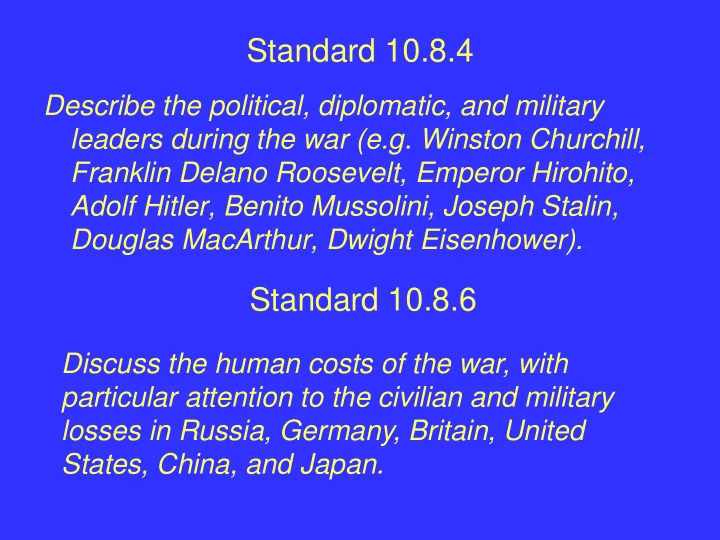
Standard 10.8.4 Describe the political, diplomatic, and military leaders during the war (e.g. Winston Churchill, Franklin Delano Roosevelt, Emperor Hirohito, Adolf Hitler, Benito Mussolini, Joseph Stalin, Douglas MacArthur, Dwight Eisenhower).
WWI left Europe physically and psychologically devastated Every European nation’s economy was in turmoil Adolf Hitler Used the bitterness toward the failed government to gain support Blamed Jews and socialists for Germany’s loss in WWI Nazis gained control of the German government in the early 1930’s Nazi party was militant and ultra-nationalistic Germany Italy Leader of Italy’s Fascist Party Benito Mussolini Italy and Germany were totalitarian states They controlled their people through fear, violence, and extreme patriotism They suppressed minorities and political opposition through violence and propaganda Il Duce (The Leader) Dissatisfied war veterans, nationalists and those afraid
the Fascist party Fascism-The idea that people should glorify their nation and their race through an aggressive show of force Japan Nationalists and Militarists increased their power in the 20’s and 30’s They persuaded the emperor the best way to ensure access to basic raw materials was to invade China and Southeast Asia Germany, Italy and Japan formed the Axis Powers The poor economy combined with nationalist resentments after WWI gave rise to military dictatorships
1935-Italy took over Ethiopia 1937-Japan overran more of China 1938-Germany took over Austria and parts of Czechoslovakia European response to the annexation of Austria by Hitler with a policy of appeasement Europeans were fearful of another war, so they supported Hitler’s actions in return for his promise that he would not invade any more countries Hitler did not keep his promise and invaded Poland in 1939 By 1940, Germany had invaded most of Western Europe, and in 1941 Hitler violated a secret alliance with the Soviet Union and invaded the USSR This led to England and France to declare war on Germany U.S. remained neutral but did start to build up its military, thinking that it would only be used to protect against a possible invasion of the Western Hemisphere And were also at war with Germany’s Axis allies Japan and Italy Appeasement-giving aggressor nations what they wanted to avoid war
Axis
Allies Causes of WWII Rise of totalitarian, militaristic regimes in Germany, Italy and Japan Great depression allowed these totalitarian dictators to take hold of their respective countries. Countries were too worried about their own country to worry about another country Germany, Italy, and Japan were anxious to regain or increase their power These three countries also set themselves up as champions against Communism Democratic countries had a desire for peace, which led to their military unprepared ness League of Nations, weakened from the start by the defection of the US was unable to promote disarmament Economic depression sharpened national rivalries, increased fear and distrust, and made the masses susceptible to the promises of demagogues Germany, Italy, and Japan Great Britain, France, Soviet Union, and later the United States Policy of appeasement toward the Axis powers by Britain and France Began September 1, 1939 when Germany, without a declaration
The United States, as it did in WWI, practiced isolationism. They did not want to fight another European war. German-Soviet nonaggression pact removed German fear of a possible two-front war All three eventually adopted forms of dictatorship that made the state supreme and called for expansion at the expense of neighboring countries
European Theater
Major Battles of WWII
Pacific Theater Battle of Britain Battle of the Bulge Battle of Stalingrad Battle of Midway Battle of Guadalcanal Series of air battles between Great Britain and Germany, fought over Britain Germans gradually gave up hope of invading England first major failure of the Germans in World War II, and it thwarted Hitler's plan to force Britain to accept peace or face invasion U.S. forces began their first large-scale invasion of a Japanese-held island; after bitter fighting, it was conquered Fought mostly with aircraft, resulted in the destruction of four Japanese aircraft carriers, crippling the Japanese navy D-Day (Operation Overlord) Allied invasion of the European continent through Normandy Supreme command over its execution was entrusted to Gen. Dwight D. Eisenhower The Germans penetrated deep into Belgium, creating a dent, or bulge, in the Allied lines and threatening to break
force held out, even though surrounded and
German forces were destroyed, but not without some 77,000 Allied casualties German army exceeding 500,000 men (including Italians, Hungarians, and Romanians), began an all-out attack on Stalingrad Hitler reaffirmed his intention to take Stalingrad, despite great losses and lack of reserves. He refused to withdraw The combined German and Soviet losses during the battle were staggering-the Germans alone suffered approximately 300,000
generally remained on the offensive for the remainder of the war.
FDR died in May 1945
End of the War
Harry S. Truman became president US captured Okinawa, an important island south of Japan Okinawa gave the U.S. a base from which it could launch bombing raids on Japan Once the US captured Okinawa, it began fire bombing Japanese cities August 1945, US dropped atomic bombs on Japan Hiroshima and Nagasaki Killing over 250,000 people Truman stated that an invasion of Japan would have cost hundred of thousands
therefore saved lives and resources Yalta Conference In early 1945, Stalin, Churchill and FDR met at the Yalta Conference It was to redraw the world map Known as the “Big Three” Germany would be divided into occupation zones There would be free elections in the liberated countries of Eastern Europe A new world peace
(the future United Nations) August 6th and August 9th respectively Potsdam Conference Truman met with Stalin and the new British Prime Minister Clement Atlee to devise a plan for implementation of the Yalta conference It became clear to both the US and USSR that the two had incompatible ideologies and post-war goals. These raids killed tens of thousands of civilians in each city and devastated cities by creating massive fires
Japanese Internment
Japanese Internment Fearing that Japan might attack the West Coast and to alleviate the possibility of Japanese- Americans spying for Japan Placed more than 110,000 Japanese Americans to prison camps (known as internment camps) Korematsu v. United States (1944) the Supreme Court ruled that the internment was constitutional Most Japanese left voluntarily to their new residences They were just doing what they needed to do to be a good American