What do we do in GCSE History? YEAR 10 YEAR 11 Superpower - - PowerPoint PPT Presentation

what do we do in gcse history
SMART_READER_LITE
LIVE PREVIEW

What do we do in GCSE History? YEAR 10 YEAR 11 Superpower - - PowerPoint PPT Presentation

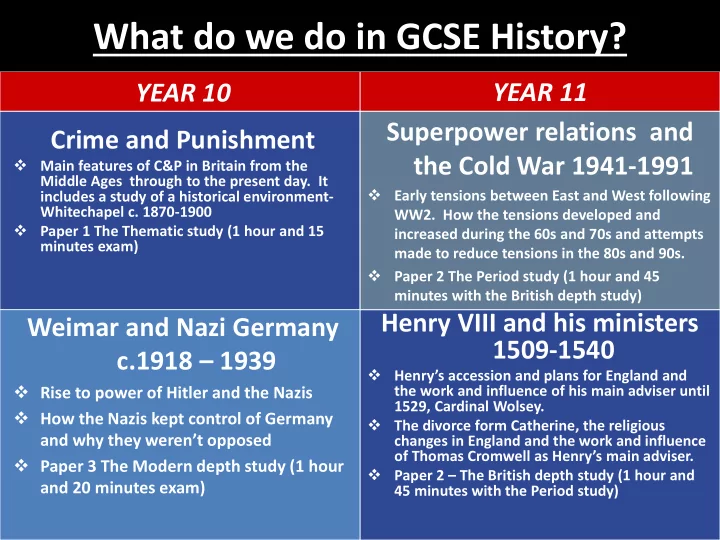
What do we do in GCSE History? YEAR 10 YEAR 11 Superpower relations and Crime and Punishment the Cold War 1941-1991 Main features of C&P in Britain from the Middle Ages through to the present day. It Early tensions between


slide-1
SLIDE 1

What do we do in GCSE History?

YEAR 11 Superpower relations and the Cold War 1941-1991

 Early tensions between East and West following

  • WW2. How the tensions developed and

increased during the 60s and 70s and attempts made to reduce tensions in the 80s and 90s.  Paper 2 The Period study (1 hour and 45 minutes with the British depth study)

Henry VIII and his ministers 1509-1540

 Henry’s accession and plans for England and the work and influence of his main adviser until 1529, Cardinal Wolsey.  The divorce form Catherine, the religious changes in England and the work and influence

  • f Thomas Cromwell as Henry’s main adviser.

 Paper 2 – The British depth study (1 hour and 45 minutes with the Period study)

YEAR 10 Crime and Punishment

 Main features of C&P in Britain from the Middle Ages through to the present day. It includes a study of a historical environment- Whitechapel c. 1870-1900  Paper 1 The Thematic study (1 hour and 15 minutes exam)

Weimar and Nazi Germany c.1918 – 1939

 Rise to power of Hitler and the Nazis  How the Nazis kept control of Germany and why they weren’t opposed  Paper 3 The Modern depth study (1 hour and 20 minutes exam)

slide-2
SLIDE 2

What do we do in GCSE History?

YEAR 11

Crime and Punishment  Main features of C&P in Britain from the Middle Ages through to the present day. It includes a study of a historical environment- Whitechapel c. 1870-1900

Paper 1 - The Thematic study (1 hour and 15 minutes exam)

REVISION AND EXAM PRACTICE

YEAR 10

Weimar and Nazi Germany c.1918 – 1939  Rise to power of Hitler and the Nazis  How the Nazis kept control of Germany and why they weren’t opposed. Paper 3 - The Modern depth study (1 hour and 20 minutes exam) Superpower relations and the Cold War 1941-1991

 Early tensions between East and West following WW2.  How the tensions developed and increased during the 60s and 70s and attempts made to reduce tensions in the 80s and 90s.

Henry VIII and his ministers 1509-1540

 Henry’s accession and plans for England and the work and influence

  • f his main adviser until 1529, Cardinal Wolsey.

 The divorce form Catherine, the religious changes in England and the work and influence of Thomas Cromwell as Henry’s main adviser.

Paper 2 – The British depth study (1 hour and 45 minutes with the Period study)

slide-3
SLIDE 3

How can parents support their child through the GCSE course?

  • Take an interest in what your child is learning, it doesn’t matter if you haven’t studied the

history we’ll be studying before. Ask if you can help in any way and ask your child if they can teach you what they have been learning!

  • Ask your child to teach you some of the vocabulary, key people and key dates that have been

covered in recent lessons.

  • Encourage them to read through their notes and prepare questions to ask their teacher for

clarification of concepts not understood. Also make sure they catch up on any work missed.

  • Encourage your child to ‘revise’ as they learn. There are revision books available for all three

exams and BBC Bitesize covers the topics on Germany and Superpower relations. Looking

  • ver work studied recently (3-4 weeks before) and testing themselves or getting you to test

them is a good way to retain information and detail. We regularly do ‘quick quizzes’ in lessons, do some at home too! Get your child to write down 10 key questions about a topic they are currently studying and come back to it a few weeks later to ‘quiz’ them.

  • Encourage them to create timelines and mind maps to aid their revision and retention of
  • information. Use post it notes to test themselves or for you to test them on dates and

sequencing.

  • Encourage them to complete all exercises from their revision books, even if they have already

done them, they can rub them out and have another go.

slide-4
SLIDE 4

What do students need to support their revision?

  • A quiet space to work. Recognising that most people can’t concentrate for

more than 40 minutes at a time. So break down work or topics into smaller chunks or blocks.

  • Help to create a timetable (make it realistic and try to stick to it, include

treats, rewards, family events, think about the best time for them to study, think about those 40 minute blocks of revision time and then have a 5-10 minute break.)

  • They need to organise themselves; gather together some equipment (pens

and paper), plan out what they need to revise, keep all revision materials, books, cards practice questions together in the same folder/part of a shelf so it’s easy to access.

  • Develop the best ways to support their understanding and learning of

subject content. This often come about through trail and error, some ways work better than others (e.g. creating mind maps or making flashcards).

  • Answering practice questions.
slide-5
SLIDE 5

How to revise for GCSE History

Revision tips…. Post it notes Past questions Come to revision sessions Memorise facts Timelines Create mind maps

Put a key date/event on a post-it and stick it around the house. Get family/friends to test you. Booklets have been provided to guide you through each exam. Each week there will be a different focus. Dates and times to follow. Use your subject checklists to break down each topic into manageable chunks . Put together timelines from a series of dates e.g. 1924-29, 1930-1933, 1933-1934, 1934-1939 Sheets are available to help you get started.

slide-6
SLIDE 6

What resources do you need?

Titles and ISBNs can be emailed to you and your parents/carers.

These are all books. They cost approximately £5.99 each but you may be able to find them for less. Revise Edexcel GCSE (9-1) History. Weimar and Nazi Germany. Revision Guide and Workbook. Revise Edexcel GCSE (9-1)

  • History. Crime and

Punishment in Britain. Revision Guide and Workbook. Revise Edexcel GCSE (9-1)

  • History. Henry VIII and his
  • ministers. Revision Guide

and Workbook. Revise Edexcel GCSE History (9-1). Superpower relations and the cold war. Revision Guide and work book.

slide-7
SLIDE 7

What resources do you need?

Titles and ISBNs can be emailed to you and your parents/carers.

A B C D

These are ready made sets of

  • flashcards. They cost

approximately £5.00 each but you may be able to find them for less. Revise Edexcel GCSE (9-1) History. Weimar and Nazi Germany. Revision cards Revise Edexcel GCSE (9-1)

  • History. Crime and

Punishment in Britain. Revision Cards. Revise Edexcel GCSE History (9-1). Superpower relations and the cold war. Revision Cards.