Standalone Unmanned Flexible Reusable Offshore Oil Production - - PowerPoint PPT Presentation

standalone unmanned flexible reusable
SMART_READER_LITE
LIVE PREVIEW

Standalone Unmanned Flexible Reusable Offshore Oil Production - - PowerPoint PPT Presentation

Standalone Facilities Back to the future SeaCaptaur Unlocking small pools and extending old pools Standalone Unmanned Flexible Reusable Offshore Oil Production System www.seacaptaur.com.au 1 History Tank storage


slide-1
SLIDE 1

www.seacaptaur.com.au

1
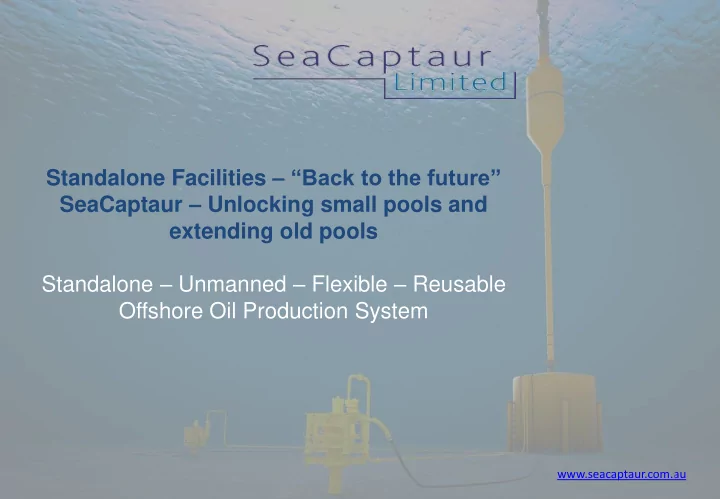
Standalone Facilities – “Back to the future” SeaCaptaur – Unlocking small pools and extending old pools Standalone – Unmanned – Flexible – Reusable Offshore Oil Production System

slide-2
SLIDE 2

History

  • Tank storage and spars are not new ideas
  • SeaCaptaur was formed to create a cost effective solution to stranded
  • ilfields
  • SeaCaptaur headquarters in Perth WA and has invested around $6 million

to take the idea through proof of concept to the FEED stage

  • Proof of concept validated and patents awarded for each system

component

  • Seeking funding and partners to complete the FEED and embark on the

first opportunity

  • Working with a number of partners to jointly arrive at a solution

2

slide-3
SLIDE 3

How Big Is The Market?

  • The UK regulator (OGA) published a study in 2016 which identified 347 undeveloped discoveries in the UK.
  • More than 130 of the undeveloped discoveries in the study were greater than 6 mmbbo
  • More than 1,000 fields worldwide make this a global opportunity

The Oil and Gas Authority (OGA) Unsanctioned Discoveries Information Pack October 2016.

SeaCaptaur Target Market 155 of the small pools identified by the OGA are in unlicensed waters

3

slide-4
SLIDE 4

Business Sector Flexibility

Discovered Small Pools

  • Unmanned standalone facility
  • For use in up to 300m water

depth

  • Sea bed storage
  • Offtake by shuttle tanker
  • Suitable for development of

undeveloped discoveries

  • Rates up to 10,000bopd
  • No need for any other facilities

in vicinity

Tie-Back

  • The processing spar can be

deployed to tie back into existing facilities without the need for seabed storage.

  • This can offer improved

efficiency over conventional tie-back facilities

Field Life Extension

  • Deployed in the late stages of

field development

  • Can replace FPSO’s
  • Can extend production profile

where FPSO OPEX is greater than production revenue 4

slide-5
SLIDE 5

Why this design?

  • Optimised hydrodynamics to minimise movement and maximise access time
  • Normally unmanned
  • Smaller structure to reduce costs
  • Simplified marine architecture
  • Re-usable
  • Ease of deployment
  • Tank design, improvements from previous deployments
  • Correct scale to match opportunities, 15% small FPSO
  • Built in redundancy to maximise up time

5

slide-6
SLIDE 6

Subsea 65,000 barrels TANK Production SPAR Shuttle TANKER

Proven technologies in a new application, all equipment is re-usable on future projects at significantly reduced cost

System overview

slide-7
SLIDE 7

SeaCaptaur Tank

slide-8
SLIDE 8

SeaCaptaur Tank

  • World’s first double walled MARPOL compliant tank
  • Seabed location simplifies architecture and reduces metocean forces
  • Secured to seabed via one of three piling options
  • Leak monitoring through double wall
  • Multiple thermal management options
  • Can function as a second stage oil/water separator
  • Scalable: 65k-750k bbls.
  • Connected to SPAR base via riser flex joint
  • Integrated production manifold
  • Capacity to recover and dry dock on a slipway
  • Reusable tank drives superior economics
  • Diver and ROV accessible if required
  • Approximate CAPEX $28m
slide-9
SLIDE 9

Spar

slide-10
SLIDE 10

Spar

  • Hosts a SCADA controlled, fully automated conventional process system
  • Very low acceleration and motion range for all but extreme metocean events
  • Self installable with DSV assistance
  • Plug and play connection to subsea architecture
  • Equipment and machinery can be pre-commissioned before fitting into hull
  • Top to bottom access - manway, hoist, lift system
  • MTBF redundancy philosophy
  • Critical spares and tools preinstalled
  • Triple fuel operation - diesel start and crude/gas fuelled
  • Comprehensive remote monitoring
  • Approximate CAPEX $65m
slide-11
SLIDE 11

In tank processing

  • A potential supplementary technology to allow gas to be processed directly

in the tank system rather than in the spar

  • Three peer reviews carried out on the system
  • A batch process with two phase separators
  • Patent applied for and working with a Scottish University to validate the

process

  • One of a suite of applications being developed by the SeaCaptaur team
  • Potential to develop sour gas fields at lower risk without gas entry to the

spar

11

slide-12
SLIDE 12

Standalone Analysis

The UK National Subsea Research Initiative (NSRI) commissioned a study from the University of Aberdeen to determine how best to exploit the large number of undeveloped hydrocarbon pools in the North Sea. The study modelled the development of three hypothetical pools using three different development technologies to determine the minimum pool sizes that could be developed at current oil prices. “Economic Study of Novel Standalone Facilities to Exploit Stranded Small Pools in the UKCS”, David Graham, August 2016

The production buoy with subsea storage system i.e. SeaCaptaur was the most economic solution in this study

12 US$55/bbl

slide-13
SLIDE 13

Field size and recoverable economics

10 Million BBLS 20 Million BBLS 30 Million BBLS Initial deployment $46.83 $38.24 $32.16 First re-use $38.14 $33.90 $29.36

13

  • UTC in dollars presented for each scenario
  • Assumes all costs associated with each field size
  • Well numbers and production times vary with differing production volumes
  • Volumes are recoverable reserves
  • Lower volume numbers are conservative as CAPEX is life of field only
  • Small developments in series will bring UTC below $30
slide-14
SLIDE 14

Progress report

14

  • Four month Hydrodynamics study carried out by INTECSEA in

UK/USA/India. Study validated SeaCaptaur proof of concept

  • Four large service company groupings have expressed interest in

collaborative studies

  • Working with ITF-OGIC on specific technical studies
  • Entered a joint submission to the OGTC for the Small Pools design

competition for “tie-back of the future”

  • Seeking investor funding and partners for the full feed study
slide-15
SLIDE 15

Conclusions

  • There is a large market for stranded oilfield technology
  • SeaCaptaur may be one of a number of potential solutions
  • There are a variety of applications for SeaCaptaur
  • Small pools
  • Enhanced tie backs
  • FPSO replacement
  • Sour gas
  • SeaCaptaur is a more robust solution in the current low oil price environment
  • The first deployment is the most difficult and expensive, is better oil industry

collaboration the solution?

15