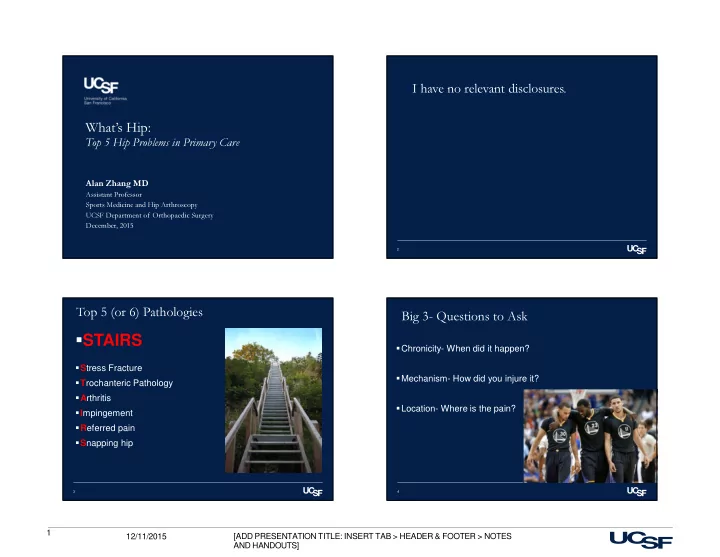
STAIRS Chronicity- When did it happen? S tress Fracture - - PowerPoint PPT Presentation

stairs
SMART_READER_LITE
LIVE PREVIEW

STAIRS Chronicity- When did it happen? S tress Fracture - - PowerPoint PPT Presentation

I have no relevant disclosures. Whats Hip: Top 5 Hip Problems in Primary Care Alan Zhang MD Assistant Professor Sports Medicine and Hip Arthroscopy UCSF Department of Orthopaedic Surgery December, 2015 2 Top 5 (or 6) Pathologies Big 3-


slide-1
SLIDE 1

[ADD PRESENTATION TITLE: INSERT TAB > HEADER & FOOTER > NOTES AND HANDOUTS] 12/11/2015 1

What’s Hip:

Top 5 Hip Problems in Primary Care

Alan Zhang MD

Assistant Professor Sports Medicine and Hip Arthroscopy UCSF Department of Orthopaedic Surgery December, 2015

I have no relevant disclosures.

2

Top 5 (or 6) Pathologies

STAIRS

Stress Fracture Trochanteric Pathology Arthritis Impingement Referred pain Snapping hip

3

Big 3- Questions to Ask

Chronicity- When did it happen? Mechanism- How did you injure it? Location- Where is the pain?

4

slide-2
SLIDE 2

[ADD PRESENTATION TITLE: INSERT TAB > HEADER & FOOTER > NOTES AND HANDOUTS] 12/11/2015 2

Chronicity

Acute Chronic

  • Overuse
  • Repetitive

microtrauma

  • Degenerative
  • No specific injury

5

Mechanism of Injury

Contact Non-contact

  • Twisting
  • Squatting
  • Flexion/extension
  • “Pop”

6

Location, Location, Location

Buttock/posterior

  • Low back/sciatic nerve
  • Referred pain

Lateral/thigh

  • Trochanteric pathology
  • Snapping hip

Anterior/groin

  • Arthritis
  • Impingement (FAI)
  • Stress fracture

7

Anatomy

8

Intra-articular Anatomy

slide-3
SLIDE 3

[ADD PRESENTATION TITLE: INSERT TAB > HEADER & FOOTER > NOTES AND HANDOUTS] 12/11/2015 3

Stress Fracture

Acute on chronic injury Age group 18-60 (more commonly >40 years old) Pain in groin, anterior thigh, deep in joint, worse with weightbearing PE- painful hop test Females >males Female athletic triad

  • Stress fracture
  • amenorrhea
  • eating disorder

9

Stress Fracture (Proximal Femur)

Sports- Track and field most common MRI or bone scan for diagnosis Treatment

  • Rest, counseling,

protected weight bearing RTP: 3-4 months

10

Trochanteric Pathologies

Trochanteric bursitis Gluteus tear All have lateral sided hip pain

11

Trochanteric Bursitis

Chronic pain from inflamed trochanteric bursa Pain over lateral hip Pain with direct palpation of greater trochanter More common in females age 40-70 Treatment

  • PT, CSI
  • If refractory >3 months then endoscopic bursectomy is option

12

slide-4
SLIDE 4

[ADD PRESENTATION TITLE: INSERT TAB > HEADER & FOOTER > NOTES AND HANDOUTS] 12/11/2015 4

Gluteus Tears

Chronic trochanteric bursitis can cause gluteus medius and minimus tearing Chronic but can be from acute fall Females 50-70 Lateral pain and WEAKNESS with abduction on exam Tredelenburg sign Treatment

  • PT, CSI
  • If no improvement then endoscopic gluteus repair is an option

13

Physical Exam

14

Hip Abduction Testing

Arthritis of the Hip

Osteoarthritis most common

  • Chronic pain, no specific injury
  • Pain in groin, anterior thigh, deep
  • Age >55

Rheumatoid Arthritis

  • Family history
  • Multiple joints involved
  • Age >35

15

Clinical Presentation

Physical Exam

  • Decreased range of motion
  • Pain in groin, lateral and posterior
  • Crepitus with ROM
  • Altered gait

16

slide-5
SLIDE 5

[ADD PRESENTATION TITLE: INSERT TAB > HEADER & FOOTER > NOTES AND HANDOUTS] 12/11/2015 5

Radiographic Findings

AP Pelvis

  • Joint space

narrowing

  • Subchondral

sclerosis

  • Osteophytes

17

Treatment

Conservative

  • Physical Therapy

‒ Gluteal and core strengthening

  • Cortisone injection

‒ Ultrasound or fluoroscopic guidance Operative treatment

  • Total hip arthroplasty

‒ Anterior, anterolateral, posterior approach

18

Impingement

Femoroacetabular Impingement (FAI) More commonly chronic injury (can be acute) Age group 15 to 55 years old Pain- groin/anterior or C-shaped band over the hip Worse with prolonged sitting

19

FAI

Abnormal bony anatomy that forms during development

  • Intense sports during childhood may be associated
  • Can lead to intra-articular injury to labrum and cartilage
  • Can lead to early arthritis

20

slide-6
SLIDE 6

[ADD PRESENTATION TITLE: INSERT TAB > HEADER & FOOTER > NOTES AND HANDOUTS] 12/11/2015 6

FAI

21

  • Cam-Type- femoral head neck asphericity
  • Pincer Type- acetabulum overcoverage
  • Mixed Type- both Cam and Pincer

Hip Labral Tear- can be acute event

22

Physical Exam

23

  • Flexion, adduction, internal rotation of hip causes pain

Xrays

24

slide-7
SLIDE 7

[ADD PRESENTATION TITLE: INSERT TAB > HEADER & FOOTER > NOTES AND HANDOUTS] 12/11/2015 7

Radiographic Measurements

25

Alpha angle and head-neck offset Lateral Center Edge Angle and Cross-over sign

MRI- can show labral/cartilage injury

26

Prevalence of FAI in Athletes

Football- 90% of players at NFL Combine (2009-2010) had at least 1 sign of FAI on xrays Hockey- 75% of Elite Youth Hockey players in Colorado had Cam lesion on MRI Soccer- 72% of male and 50% of female elite soccer players (MLS, US national team) had radiographic FAI

27

FAI Acquired During Skeletal Maturation in Athletes

Agricola et al AJSM 2014

  • 63 pre-professional

soccer players in Netherlands

  • Baseline Xray at age 12

showed 2% with Cam

  • F/u xrays 2 years later

showed 18% with Cam

28

slide-8
SLIDE 8

[ADD PRESENTATION TITLE: INSERT TAB > HEADER & FOOTER > NOTES AND HANDOUTS] 12/11/2015 8

FAI and Arthritis

29

  • For patients <50 years old with hip arthritis
  • 45% due to FAI, 45% hip dysplasia, 10% trauma/other

Treatment

Conservative treatment is 1st line Rest PT- core strengthening, gluteal strengthening

30

Surgical Treatment- Hip Arthroscopy

31

Cam Decompression

32

slide-9
SLIDE 9

[ADD PRESENTATION TITLE: INSERT TAB > HEADER & FOOTER > NOTES AND HANDOUTS] 12/11/2015 9

Labral Repair

33

Labral Repair

34

Incidence of Hip Arthroscopy

36

Zhang et al 2015

Outcomes

Byrd et al 2011 200 athletes with 2 year follow up after hip arthroscopy 90% returned to sport (95% pro, 85% collegiate)

37

slide-10
SLIDE 10

[ADD PRESENTATION TITLE: INSERT TAB > HEADER & FOOTER > NOTES AND HANDOUTS] 12/11/2015 10

Does FAI Surgery Prevent Arthritis?

Quantitative MRI to assess for early cartilage injury in hip NIH funded study at UCSF- actively recruiting patients

38

Referred Pain

Hip pain can be referred from the lumbar spine or the knee Can be acute (lumbar disk herniation) Usually located posterior in buttock region and radiates down the leg Age group- >40

39

Referred pain

Lumbar radiculopathy

  • Ask about radiating or shooting pain, numbness or tingling
  • Pain that shoots from the hip down past the knee is usually from

the spine and not the hip

  • Obtain L-spine films if needed

Knee pain

  • Femoral nerve can cause referred hip pain when source is from

the knee (and vice versa)

  • Check radiographic and knee exam if hip films and exam is

normal

40

Snapping Hip

External snapping hip (lateral)

  • More common
  • IT band catching on greater trochanter
  • Dancers, runners, soccer players

Internal snapping hip (groin)

  • Iliopsoas snaps over the lesser trochanter or AIIS

Treatment

  • PT- Rest, stretching, foam roll
  • Rarely- surgery for endoscopic IT band or iliopsoas release

41

slide-11
SLIDE 11

[ADD PRESENTATION TITLE: INSERT TAB > HEADER & FOOTER > NOTES AND HANDOUTS] 12/11/2015 11

IT Band Syndrome

Chronic pain over lateral thigh/hip pain from overuse Age group 20-40 Can cause contracture/tightness- External snapping hip Common in runners and bikers Treatment

  • Rest, icing, stretching,
  • PT, foam roll
  • Endoscopic IT band release

RTP: 2-4 weeks

42

Iliopsoas Snapping/tendinopathy

43

  • Low pitched snap on

flexion to extension of hip (Thomas test)

  • Tender on deep palpation
  • f anterior groin
  • Sore with hyperflexion of

hip

Stress Fracture

  • Female athlete triad

Trochanteric Pathology

  • Bursitis, gluteus tear

Arthritis

  • Osteoarthritis, rheumatoid

Impingement

  • FAI, Labral tears

Referred pain

  • Lumbar spine/knee

Snapping hip

  • IT band, Iliopsoas

44

STAIRS

Thank you

Alan Zhang, MD alan.zhang@ucsf.edu 415-885-3832

12/11/2015 Pediatric Hip Injuries 45

slide-12
SLIDE 12

[ADD PRESENTATION TITLE: INSERT TAB > HEADER & FOOTER > NOTES AND HANDOUTS] 12/11/2015 12

References

1. Kocher MS, Tucker R. Pediatric athlete hip disorders. Clin Sports Med. 2006 Apr;25(2):241-53, viii. 2. Jayakumar P, Ramachandran M, Youm T, Achan P. Arthroscopy of the hip for paediatric and adolescent disorders: current concepts. J Bone Joint Surg Br. 2012 Mar;94(3):290-6. doi: 10.1302/0301-620X.94B3.26957. 3. Kovacevic D, Mariscalco M, Goodwin RC. Injuries about the hip in the adolescent

  • athlete. ports Med Arthrosc. 2011 Mar;19(1):64-74. doi:

10.1097/JSA.0b013e31820d5534. 4. Frank JS, Gambacorta PL, Eisner EA. Hip pathology in the adolescent athlete. J Am Acad Orthop Surg. 2013 Nov;21(11):665-74. doi: 10.5435/JAAOS-21-11-665. 5. Byrd JW. Femoroacetabular impingement in athletes: current concepts. Am J Sports

  • Med. 2014 Mar;42(3):737-51. doi: 10.1177/0363546513499136. Epub 2013 Aug 27.

6. Draovitch P, Edelstein J, Kelly BT. The layer concept: utilization in determining the pain generators, pathology and how structure determines treatment. Curr Rev Musculoskelet Med. 2012 Mar;5(1):1-8. doi: 10.1007/s12178-011-9105-8. 7. Byrd JW, Jones KS. Arthroscopic management of femoroacetabular impingement in

  • athletes. Am J Sports Med. 2011 Jul;39 Suppl:7S-13S. doi:

10.1177/0363546511404144.

12/11/2015 Pediatric Hip Injuries 46