Outline Office Procedures in Orthopaedics Knee exam Knee - - PowerPoint PPT Presentation

outline
SMART_READER_LITE
LIVE PREVIEW

Outline Office Procedures in Orthopaedics Knee exam Knee - - PowerPoint PPT Presentation

8/7/2013 Physical Exam Skills and Outline Office Procedures in Orthopaedics Knee exam Knee aspiration and injection Shoulder exam Subacromial bursa injection UCSF Essentials of Primary Care August 14, 2012 Carlin Senter, M.D.


slide-1
SLIDE 1

8/7/2013 1

Physical Exam Skills and Office Procedures in Orthopaedics

UCSF Essentials of Primary Care August 14, 2012 Carlin Senter, M.D.

Outline

  • Knee exam
  • Knee aspiration and injection
  • Shoulder exam
  • Subacromial bursa injection

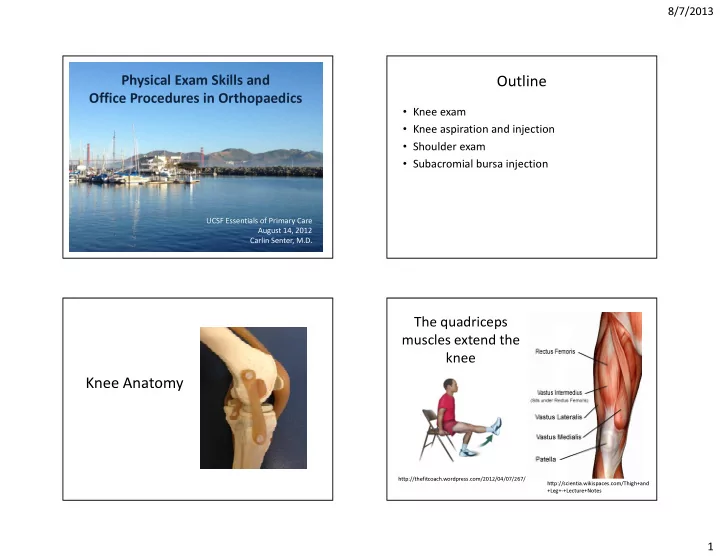
Knee Anatomy

The quadriceps muscles extend the knee

http://thefitcoach.wordpress.com/2012/04/07/267/ http://scientia.wikispaces.com/Thigh+and +Leg+-+Lecture+Notes

slide-2
SLIDE 2

8/7/2013 2

The quadriceps muscles merge to form the quadriceps tendon… patellar tendon

The hamstrings flex the knee

www.hep2go.com

Pes anserine bursa

http://meded.ucsd.edu/clinicalmed/joints.htm

There are 4 main ligaments in the knee

slide-3
SLIDE 3

8/7/2013 3

Meniscus Knee exam Musculoskeletal work-up

  • History
  • Inspection
  • Palpation
  • Range of motion
  • Other Tests

Common Causes of Knee Pain by Location of Symptoms

  • Anterior:
  • Patellofemoral syndrome
  • Quadriceps tendinitis
  • Patellar tendinitis
  • Lateral:
  • Lateral jointline: meniscus tear
  • r OA
  • IT band syndrome
  • LCL sprain (rare)
  • Fibular head: fracture (rare)
  • Medial
  • Medial joint-line: meniscus

tear or OA

  • MCL sprain
  • Pes anserine bursitis
  • Posterior
  • Hamstring tendinitis
  • Gastrocnemius strain
  • OA, meniscus tears,

effusion, popliteal cyst….

slide-4
SLIDE 4

8/7/2013 4

Inspection

http://doctorhoang.wordpress.com/20 10/09/06/valgus-knee-and-bunion/ http://meded.ucsd.edu/cl inicalmed/joints.htm

Palpation of joint line seated or supine

http://www.rheumors.com/kneeexam/palpation.html

Palpation of patella - supine Ballottement Palpation of patellar facet

slide-5
SLIDE 5

8/7/2013 5

Knee range of motion

  • ROM: normal 0-135

– Determine if knee is locking or if ROM is limited due to effusion – Locking: think bucket handle meniscus.

  • Urgent xrays, MRI
  • Urgent referral to sports surgeon for arthroscopy

Permission for use provided by

  • Dr. Charles Goldberg, UCSD

Other Tests: Lachman to evaluate ACL

Sensitivity 75-100% Specificity 95-100%

Magee, DJ. Orthopaedic Physical Assessment, 5th ed. 2008.

PCL: Posterior Drawer MCL and LCL

slide-6
SLIDE 6

8/7/2013 6

Meniscus: McMurray

Sensitivity medial 65%, Specificity medial 93%

Magee, DJ. Orthopaedic Physical Assessment, 5th ed. 2008.

Meniscus: Thessaly Meniscus: Squat Knee exam practice

  • Standing: inspection

– Varus or valgus

  • Sitting: palpation

– Joint line – Femoral condyles – Tibial plateau – Fibular head

  • Supine

– Patellar facets – Patellar grind – ROM – Special tests

  • Lachman
  • Posterior drawer
  • Varus 0 and 30
  • Valgus 0 and 30
  • McMurray medial and

lateral

  • Thessaly
  • Squat
slide-7
SLIDE 7

8/7/2013 7

Knee aspiration and injection

Intra-articular corticosteroid injections: do they work for knee OA?

  • Good short-term pain relief

– Effect size 0.72 at 2 and 3 weeks

  • No significant effect on function

– Effect size 0.06

  • No evidence for long-term pain relief
  • Clinical effect independent of degree of inflammation

present

– Don’t need to restrict injection just to those with effusion

  • Frequency: general practice once every 3 months max

– Concern for cartilage toxicity with more than 4/year

  • AAOS: recommends for short-term pain relief (level II)

Zhang W et al. OARSI recommendations for the management of hip and knee osteoarthritis: Osteoarthritis Cartilage. 2010 Apr;18(4):476-99.

Superolateral approach

  • Patient supine
  • Extend knee
  • Bump under knee so

flexed 10-20 degrees

  • Superior border patella
  • Lateral border patella
  • 1cm below
  • Mark with syringe cover
  • r tip of pen

Injection set-up bucket

  • Betadine
  • Ethyl chloride
  • Alcohol swabs
  • 4x4 guaze
  • Bandaids
slide-8
SLIDE 8

8/7/2013 8

Injection prep Needles, syringes, meds Corticosteroids

Why use local anesthetic with steroid injection?

  • Dilute the steroid

– Decrease likelihood of steroid atrophy – Decrease irritant nature of steroid crystals causing post-injection flare

  • Pain relief

– Diagnostic and therapeutic (subacromial more than knee)

  • Floculation: combining steroid and local

anesthetic can precipitate crystals. Carefully inspect for precipitate before injection.

slide-9
SLIDE 9

8/7/2013 9

Aspiration

Why aspirate the effusion before injection?

  • Clinically

– Decreased pain and stiffness because effusion gone – More effect of steroid because not diluted by effusion – Inspect fluid for inflammation/infection, send to lab if question – Confirms that injxn was intra-articular

  • Significantly greater improvement in VAS for patients

who had joint aspirated at time of injection in knee OA patients (Gaffney K et al, Ann Rheum Dis, 1995.)

  • Reduction in relapse for 6 months after injection in RA

patients (Weitoft T et al, Ann Rheum Dis, 2000.)

Post-injection patient instructions

  • Rest: no definitive evidence-based

recommendation

– Recommendations in literature vary

  • No restrictions
  • Bed rest x 24 hours
  • Light activity x 7 days, no weight bearing exercise
  • Avoid swimming, hot tub, bath x 24 hours

– Let injection site heal

Contraindications to steroid injection

  • Joint infection
  • Fracture
  • Prosthetic joint
  • Hemarthrosis (theoretically higher risk of

infection)

  • Soft tissue infection overlying joint
slide-10
SLIDE 10

8/7/2013 10

Relative contraindications to steroid injection

  • Corticosteroid injection within past 4 months
  • Coagulopathy (ok if on warfarin but check

recent INR, make sure not >> 3)

  • Poorly controlled diabetes

Risks of steroid injection in the knee

  • Diabetics: increased blood sugar, 300 mg/dl starting as early as 2 hours

after, lasting 5 days

  • Suppression of hypothalamic pituitary adrenal axis, mild

– Lasts 1-3 days post-injection

  • Facial flushing: 10% with Kenalog

– 19-36 hours post-injection

  • Skin or fat atrophy
  • Post-injection steroid flare: 1-10%

– Synovitis in response to injected crystals – Within hours - 48 hours post-injection – More common in soft tissue injections (20% of trigger points) than intra- articular injections

  • Septic arthritis: 1/3000-1/50,000

– 1-2 days after injection

  • Possible risk of chondrocyte toxicity with repeated injections

Habib GS. Clin Rheumatol, 2009. UpToDate, “Joint aspiration or injection in adults,” 2010.

My current knee injection steps

1. Patient supine with bump under knee 2. Mark injection site (superior lateral) 3. Betadine x 3 4. Alcohol x 1 5. Ethyl chloride for skin anesthesia 6. Alcohol again 7. 22g needle attached to 10cc syringe containing 5cc of 1% lidocaine without epi 8. Slowly advance and inject lidocaine, 1mm at a time 9. Feel resistance give when in joint

  • 10. Aspirate, make sure fluid straw-colored and clear
  • 11. Keep needle in place, switch syringe
  • 12. Inject 1cc of 40mg kenalog

Knee injection

slide-11
SLIDE 11

8/7/2013 11

Shoulder anatomy

Underlying Anatomy - Bones

  • Humerus
  • Scapula
  • Glenoid
  • Acromion
  • Coracoid
  • Scapular body
  • Clavicle
  • Sternum

Glenohumeral Joint Clavicle Lesser Tuberosity Greater Tuberosity Acromion

The LABRUM is a fibrocartilaginous ring of tissue that attaches to the glenoid rim & deepens the glenoid fossa

Spine of scapula is at the level

  • f T3

Bottom

  • f

scapula is at level

  • f T7

Acromion

slide-12
SLIDE 12

8/7/2013 12

The tendons of the rotator cuff muscles reinforce the capsule

  • f the glenohumeral

joint.

Subscapularis (Internal Rotation)

Anterior View

The Rotator Cuff Muscles (SITS)

Lesser Tuberosity

Infraspinatus (External rotation)) Teres Minor (External rotation) Supraspinatus (Abduction) Posterior View

Greater Tubersosity

The Biceps Muscle

  • #1 Supination of the elbow (screwing, twisting)
  • #2 Flexion of the elbow

3 attachments:

  • Radial tuberosity (distal)
  • Glenoid (long head)
  • Coracoid (short head)

Long head Short head

Shoulder exam

slide-13
SLIDE 13

8/7/2013 13

Neck examination

  • Inspection
  • Palpate CS
  • FF and extension
  • Spurlings

Cervical Spine

Spurling’s Maneuver

  • Neck extended
  • Head rotated toward

affected shoulder

  • Axial load placed on

the cervical spine

  • Reproduction of

patient’s shoulder/arm pain indicates possible nerve root compression

Shoulder examination

  • Inspection

– Patient in gown

  • Palpation
  • ROM
  • Strength

– Supra – Infra and teres minor – Subscapularis

  • Other tests

http://meded.ucsd.edu/clinicalmed/joints 2.htm, permission granted by Dr. Charles Goldberg, UCSD SOM

Shoulder examination

  • Inspection
  • Palpation
  • ROM
  • Strength

– Supraspinatus – Infraspinatus & Teres minor – Subscapularis

  • Other tests

http://meded.ucsd.edu/clinic almed/joints2.htm, permission granted by Dr. Charles Goldberg, UCSD SOM

slide-14
SLIDE 14

8/7/2013 14

Range of motion Abduction Flexion Range of motion

External rotation Internal rotation

Supine shoulder PROM Other tests

  • Rotator cuff strength
  • Impingement tests
  • Biceps
  • Labrum
  • AC joint
slide-15
SLIDE 15

8/7/2013 15

Supraspinatus = abduction

Empty can

Photos from Dr. Christina Allen

Supraspinatus

Infraspinatus and teres minor = external rotation

Infraspinatus Teres minor

Photos from Dr. Christina Allen

Subscapularis = internal rotation

Lift-Off

Subscapularis

Photos from Dr. Christina Allen

Subscapularis = internal rotation

Subscapularis

Photos from Dr. Christina Allen

Belly press

slide-16
SLIDE 16

8/7/2013 16

Impingement syndrome

  • Inflammation of the

subacromial space

– The area under the acromion and above the glenohumeral joint – Structures in this space

  • Supraspinatus
  • Subacromial/subdeltoid

bursa

Subacromial bursa Supraspinatus

Impingement signs

Hawkin’s Neer’s

Photos from Dr. Christina Allen

Biceps Tests: Speeds

Tests for biceps pathology (tendinitis, tendinopathy, tear) Palms up, patient pushes up against resistance (resisted elbow flexion) +Test is pain at proximal biceps tendon Sens = 54%, Spec = 81%

Biceps Tests: Yergasons

Tests for biceps pathology (tendinitis, tendinopathy, tear) Patient supinates (twists

  • ut) against resistance

+Test is pain at proximal biceps tendon Sens = 41%, Spec = 79%

slide-17
SLIDE 17

8/7/2013 17

O’Brien’s Test

To r/o Labral Tear

  • Arm forward flexed to

90°

  • Elbow fully extended
  • Arm adducted 10°to

15°with thumb down

  • Downward pressure
  • Repeat with thumb up
  • Suggestive of labral

tear if more pain with thumb down

  • Sens = 59-94%, Spec

= 28-92%

Testing the AC Joint: AC Crossover

  • Tests for AC joint
  • steoarthritis or

sprain

  • Can be done

passively by patient or physician

  • +Test is pain at

AC joint

Shoulder Exam Hands On

Special Tests:

  • Spurling’s (cervical spine radiculopathy)
  • Job’s, aka Empty-can (supraspinatus)
  • Lift-off test (subscapularis)
  • Resisted external rotation

(infraspinatus)

  • Hawkins (impingement sign)
  • Neers (impingement sign)
  • Speeds (biceps)
  • Yergason’s (biceps)
  • O’briens (SLAP tear)
  • AC crossover (AC joint OA or sprain)

Key Components of the Shoulder Exam:

  • Inspection
  • Palpation
  • Range of Motion:

abduction, flexion, ER, IR

  • Strength
  • Neurovascular
  • Special tests

Subacromial injection for impingement syndrome

http://www.youtube.com/watch?v=wr_FBVjHJY8

slide-18
SLIDE 18

8/7/2013 18

Impingement syndrome

  • Inflammation of the

subacromial space

– The area under the acromion and above the glenohumeral joint – Structures in this space

  • Supraspinatus
  • Subacromial/subdeltoid

bursa

Subacromial bursa Supraspinatus

Approach

  • 1. Posterior
  • 2. Lateral

Slide courtesy of Anthony Luke, M.D.

Subacromial Injection

Posterior approach Landmarks

  • Posterior and lateral

borders of acromion

  • Coracoid

Technique

  • Insert needle at Posterior

“soft spot”

  • Aim parallel to angle of

lateral acromion to reach subacromial bursa

  • Direct needle towards
  • pposite nipple

Slide courtesy of Anthony Luke, M.D.

http://www.aafp.org/afp/2003/0315/p1271.html

Subacromial Injection

Lateral approach Landmarks

  • Lateral border of the

acromion Technique

  • Inject 3 mm below lateral

border of the acromion

  • Angle needle parallel to

plane of the acromion

Slide courtesy of Anthony Luke, M.D.

slide-19
SLIDE 19

8/7/2013 19

Subacromial Injection

  • 5 – 8 mL combination of local anesthetic

solutions

  • 1 – 2 mL steroid solution

My preferred solution:

  • 5 mL 1% lidocaine with 1 mL 40 mg/mL

triamcinolone

Subacromial injection palpation Subacromial injection Thank you

Questions? Carlin.Senter@ucsf.edu