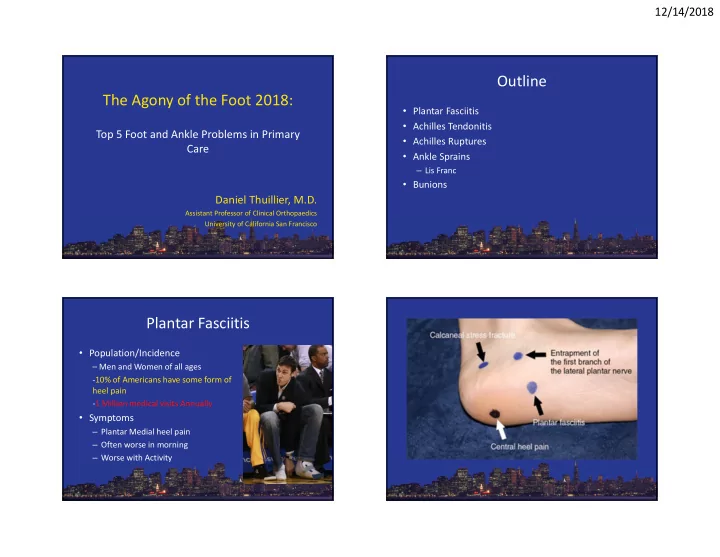
Outline The Agony of the Foot 2018: Plantar Fasciitis Achilles - - PowerPoint PPT Presentation

outline the agony of the foot 2018
SMART_READER_LITE
LIVE PREVIEW

Outline The Agony of the Foot 2018: Plantar Fasciitis Achilles - - PowerPoint PPT Presentation

12/14/2018 Outline The Agony of the Foot 2018: Plantar Fasciitis Achilles Tendonitis Top 5 Foot and Ankle Problems in Primary Achilles Ruptures Care Ankle Sprains Lis Franc Bunions Daniel Thuillier, M.D. Assistant


slide-1
SLIDE 1

12/14/2018 1

The Agony of the Foot 2018:

Daniel Thuillier, M.D.

Assistant Professor of Clinical Orthopaedics University of California San Francisco

Top 5 Foot and Ankle Problems in Primary Care

Outline

  • Plantar Fasciitis
  • Achilles Tendonitis
  • Achilles Ruptures
  • Ankle Sprains

– Lis Franc

  • Bunions

Plantar Fasciitis

  • Population/Incidence

– Men and Women of all ages

  • 10% of Americans have some form of

heel pain

  • 1 Million medical visits Annually
  • Symptoms

– Plantar Medial heel pain – Often worse in morning – Worse with Activity

slide-2
SLIDE 2

12/14/2018 2

Pathophysiology

  • Inflammation of the plantar

fascial insertion at the medial plantar aspect of the calcaneus Physical Examination/Studies

  • +TTP at the plantar medial

aspect of the calcaneus

  • Achilles/Gastrocnemius

tightness

  • May or may not have

plantar calcaneal bone spur

  • n xrays

Treatment

  • Almost always Conservative
  • May Take Many months to

Resolve

  • Achilles/Gastroc/Plantar

fascial stretching

  • Heel Cups
  • OTC Arch Supports
  • Night Splints
  • CAM walker/Casting
  • *Injections- do have

increased rupture rate* “I can tell you if you’re listening out there, if you have PLANTAR FASCIITIS, stay away from surgery,’’ Kerr told reporters. “I can say that from the bottom of my heart. Rehab, rehab,

  • rehab. Don’t let anyone get

in there.”

Surgical Results are very mixed

Achilles Tendonitis/Tendinopathy

  • Incidence

– Men and women of all ages – 2-10% of general population – 24%-50% of lifetime runners

  • Symptoms

– Pain In Achilles Tendon with Activity

slide-3
SLIDE 3

12/14/2018 3

Pathophysiology

  • Chronic Overuse Injury
  • Occurs in 2 places

– Insertion – Mid-Substance

Exam/Imaging

  • +TTP in the achilles
  • Swelling of achilles in

midsubstance or insertion

  • “Pump Bump” – posterior

calcaneal bone spur

Treatment

  • Almost Always Conservative

– Ice, Rest, NSAIDS – Heel Lift – Dedicated Eccentric Stretching program – Period of Immobilization (CAM walker, Cast) – NO STEROID INJECTIONS

  • Surgery Reserved for Failed

Conservative Management

– Potentially more effective in insertional disease

Achilles Rupture

  • Incidence

– Men 30s/40s – Athletes and weekend warriors – 7/100,000 population – ~10% prior achilles symptoms

  • Symptoms

– Relatively painless!!! – “kicked in heel” – Walk funny, limp, weak

Anatomy

  • Achilles Tendon is the

biggest tendon in the body and subjected to the highest loads

  • Has a 90 degree twist
  • Inserts broadly over the

posterior calcaneus

  • Watershed area 4-6 cm

proximal to the insertion

slide-4
SLIDE 4

12/14/2018 4

Clinical Examination

  • Palpable Defect
  • Decreased plantarflexion strength
  • Decreased resting tone
  • + Thompson’s Test (Calf Squeeze and no

Plantarflexion)

  • Clinical Examination was more sensitive than MRI

in detecting acute rupture

Initial Treatment

  • Plantarflexion in Splint (20-30 degrees)
  • Alternatively, plantarflexion in CAM walker

with heel lifts (2).

Surgery vs No Surgery

Surgery

  • Pros

– Get tension to proper degree – Likely Lower rerupture rate – Feel like you did something – Slightly better – “It’s what Richard Sherman got”

  • Cons

– Cost – Higher complication rate

  • Especially wound problems

Non Op Treatment

  • Pros

– Less complications – No

  • Cons

– Higher Rerupture Rate – Tension may not be restored as well

slide-5
SLIDE 5

12/14/2018 5

  • 12 month follow up
  • Similar functional results
  • Similar re-rupture rate

Ankle Sprains

  • Men and Women of all

ages

  • ~600,000 Ankle

Sprains per year in the US

  • 3-5% of all ED visits

(UK)

  • Symptoms

– Pain in Ankle – Swelling – Difficulty with Weight bearing

Ankle Sprains

Pathophysiology

  • ATFL is the most common

ligament injured

– Resists Anterior translation of the talus

  • CFL may be injured as well

– Resists talar tilt

  • Grading Sprain

– 1-3 – how much is torn

  • Mortise is maintained no

matter what the grade

Ankle Sprains

Treatment

  • 95% of ankle sprains are

asymptomatic at 1 year no matter how they are treated

  • Recommend limiting early

immobilization (CAM boot 1-3 weeks max)

  • Slightly better functional

results with early rehabilitation

  • Surgical Repair reserved for

those with prolonged (>6 months) of symptoms of instability

slide-6
SLIDE 6

12/14/2018 6

History

“High Ankle Sprain” - Syndesmosis

  • Pain out of proportion

to injury

  • Prolonged Recovery
  • Pain posterior to fibula
  • Pain up leg towards

knee

  • Difficulty with one leg

hop

  • Pain with dorsiflexion
  • f ankle

Sprain vs Fracture?

Sprain

  • Acute twisting Injury
  • Pain swelling at ankle
  • Bruising
  • Difficulty with Weight

bearing Fracture

  • Acute twisting Injury
  • Pain Swelling at ankle
  • Bruising
  • Difficulty with weight

bearing

Ottawa Ankle Rules

Things missed in Ottawa Ankle Rules

  • Anterior Process

calcaneus fractures

  • Lateral Process Talus

Fractures

  • Osteochondral Lesions
  • f the Talus and loose

bodies

  • Neuropathics!!!!
  • If at all concerned, get

an xray

slide-7
SLIDE 7

12/14/2018 7

Lisfranc Fracture/dislocation

Anatomy

  • Lisfranc Joint runs between

the tarsal and metatarsal bones

  • Both Dorsal and plantar

ligaments

  • Plantar ligaments are stronger
  • Strongest in between medial

cuneiform and base of second metatarsal

  • Same in Adults and Kids

www.aofoundation.org

Lisfranc Fracture/Dislocation

  • Maybe direct or

indirect, contact/no contact

  • Axial Load to

plantarflexed foot

www.aofoundation.org

Assessment

  • History

– Painful walking – Pain in midfoot

  • Physical Examination
  • Midfoot Swelling
  • Midfoot Pain

– Dorsal or plantar

  • Ecchymosis
  • MUST GET Appropriate

IMAGING IF THESE ARE PRESENT (Weight bearing foot xrays)

www.aofoundation.org

Bunion (Hallux Valgus)

  • Population/Incidence

– 24% >60 yo – Women 2-4X men – Strong family History

  • Symptoms

– Pain in great toe, especially with shoewear – Deformity of first toe – Erythema, Swelling

slide-8
SLIDE 8

12/14/2018 8

Pathoanatomy

  • Complex Deformity
  • Lateral Deviation

First Toe, with Medial Deviation of Phalanx

Treatment

Conservative

  • Shoewear Modification
  • Orthotics
  • Bunion Sleeves
  • Bunion Pads
  • Gastroc Stretching

Surgical

  • Usually reserved for those

who fail non-operative treatment

  • >100 different surgical

procedures described

– Different recovery periods

  • Results vary - ~70-85%

improvement

  • LONG recovery

With Surgery, We’re able to make a bad toe good, but really tough to make a good toe great

Thank You