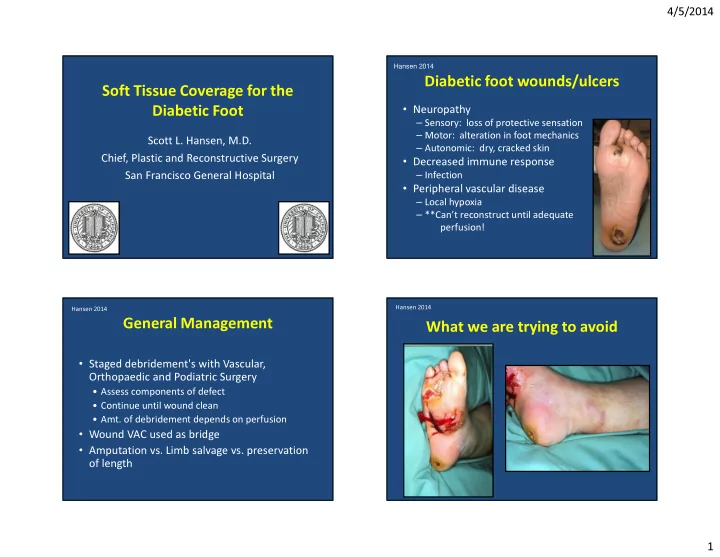
Diabetic foot wounds/ulcers Soft Tissue Coverage for the Neuropathy - - PowerPoint PPT Presentation

diabetic foot wounds ulcers soft tissue coverage for the
SMART_READER_LITE
LIVE PREVIEW

Diabetic foot wounds/ulcers Soft Tissue Coverage for the Neuropathy - - PowerPoint PPT Presentation

4/5/2014 Hansen 2014 Diabetic foot wounds/ulcers Soft Tissue Coverage for the Neuropathy Diabetic Foot Sensory: loss of protective sensation Motor: alteration in foot mechanics Scott L. Hansen, M.D. Autonomic: dry, cracked


slide-1
SLIDE 1

4/5/2014 1

Soft Tissue Coverage for the Diabetic Foot

Scott L. Hansen, M.D. Chief, Plastic and Reconstructive Surgery San Francisco General Hospital

Diabetic foot wounds/ulcers

  • Neuropathy

– Sensory: loss of protective sensation – Motor: alteration in foot mechanics – Autonomic: dry, cracked skin

  • Decreased immune response

– Infection

  • Peripheral vascular disease

– Local hypoxia – **Can’t reconstruct until adequate perfusion!

Hansen 2014

General Management

  • Staged debridement's with Vascular,

Orthopaedic and Podiatric Surgery

  • Assess components of defect
  • Continue until wound clean
  • Amt. of debridement depends on perfusion
  • Wound VAC used as bridge
  • Amputation vs. Limb salvage vs. preservation
  • f length

Hansen 2014

What we are trying to avoid

Hansen 2014

slide-2
SLIDE 2

4/5/2014 2

What we are trying to avoid

Hansen 2014

Result = Amputation

Wound Analysis

  • Location
  • Hindfoot/Midfoot/Forefoot
  • Wound size
  • Components of wound

– Skin

  • Nerve
  • Subcutaneous tissue
  • Cartilage

– Muscle

  • Bone

– Vessels

  • Etiology
  • Pressure, non-compliance

Hansen 2014

Reconstructive Ladder

Hansen 2014

Healing / Secondary Intention

  • Advantage

– pulls “like” tissue into wound

  • Disadvantage

– duration of healing

  • Consider for smaller wounds

Hansen 2014

slide-3
SLIDE 3

4/5/2014 3

Split-Thickness Skin Graft

Hansen 2014

Indications for Flap Coverage

  • Skin graft cannot be used

– Exposed cartilage, tendon (without paratenon), bone, open joints, metal implants

  • Flap coverage is preferable

– Exposed nerves or vessels, durability required, multiple tissues required, dead space present

Hansen 2014

Principles

  • The final

reconstruction should be functional

– Durable – Maintain Sensation – Contour (not bulky)

Hansen 2014

Reconstructive options depend on location of wound

Hindfoot/Heel/Malleolus Forefoot Mid plantar Hansen 2014

slide-4
SLIDE 4

4/5/2014 4

Hindfoot & Mid Plantar

  • Goal is to provide sensate coverage by using like

tissue from non-weight bearing midsole area

  • <1/3 of heel
  • Split & full thickness skin grafts
  • Sural Flap: Suprafascial rotation flap
  • 1/3 to 2/3 of heel
  • Flexor digitorum brevis muscle turnover flap
  • Instep island flap

Hansen 2014

Hindfoot & Mid Plantar

  • >2/3 of heel
  • Free tissue transfer
  • Non-weight bearing heel, instep, malleoli
  • Skin graft
  • Rotation flaps
  • Reverse pedicled fasciocutaneous flaps
  • Extensor digitorum brevis flap
  • Abductor hallucis & abductor digiti minimi muscle flap
  • Free muscle or fasciocutaneous flap if deep

Hansen 2014

Hindfoot

Calcanectomy & closure

Hansen 2014

Hindfoot

Flexor digitorum brevis flap

Hansen 2014

slide-5
SLIDE 5

4/5/2014 5

Hindfoot

Flexor digitorum brevis flap

Blood Supply: Branches of Medial and Lateral Plantar artery Hansen 2014

Hindfoot Reconstruction

Hansen 2014

Hindfoot Reconstruction

Flexor digitorum brevis flap

Hansen 2014 Hansen 2014

slide-6
SLIDE 6

4/5/2014 6

Hindfoot

Instep island flap

Hansen 2014

Based on branches of the medial plantar artery

Hansen 2014

Local rotational flap, Length:Width ratio 2:1

Hansen 2014

V to Y Advancement

Hansen 2014

slide-7
SLIDE 7

4/5/2014 7

Lateral Supramalleolar Flap

Hansen 2014

*Supplied by a perforating branch of the peroneal artery

Hansen 2014

Lateral Calcaneal Artery Flap

Hansen 2014

Lateral Calcaneal Artery Flap

Hansen 2014

Lateral Calcaneal Artery Flap

slide-8
SLIDE 8

4/5/2014 8

Neurocutaneous Flap

  • Sural artery flap
  • Small artery and vein

supplying the sural nerve

  • Pivot point is 5cm

proximal to lateral malleolus (peroneal artery)

Hansen 2014

Sural Flap

Hansen 2014

Sural Flap

Hansen 2014

Midfoot

V-Y advancement island flaps

Hansen 2014

slide-9
SLIDE 9

4/5/2014 9

Midfoot

V-Y advancement flaps

Hansen 2014 Hansen 2014

Plantar rotation flaps

  • Based on the vascular plexus superficial to the

plantar fascia

  • Donor site is skin grafted

Hansen 2014

Microvascular Transplantation (MVT)

  • Myriad of Flaps Available
  • Muscle
  • Skin
  • Combination
  • Dead space present
  • Osteomyelitis
  • Local tissues not available

Hansen 2014

slide-10
SLIDE 10

4/5/2014 10

Muscle and Musculocutaneous Flaps

  • Latissimus dorsi
  • Rectus abdominis
  • Gracilis

Hansen 2014

Fasciocutaneous and Perforator Flaps

  • Radial Forearm Flap
  • Anterolateral Thigh Flap

Hansen 2014

Heel Reconstruction

Hansen 2014

Muscle vs. fasciocutaneous flap coverage

Hansen 2014

slide-11
SLIDE 11

4/5/2014 11

Heel Reconstruction

Hansen 2014

Hindfoot

Latissimus flap

Hansen 2014

Hindfoot

Latissimus flap

Hansen 2014

Hindfoot

Latissimus free flap

Hansen 2014

slide-12
SLIDE 12

4/5/2014 12

Perforator Flap

Hansen 2014

Perforator Flap

Hansen 2014 Anterolateral thigh flap (ALT): Blood supply- Descending branch of the lateral circumflex

Perforator Flap

Hansen 2014

Forefoot

  • Plantar flaps cannot be mobilized distally due

to tethering effect by plantar nerves

  • Sensate toe flap; unfavorable donor defect
  • Free tissue transfer provide most stable,

durable coverage

– Latissimus dorsi muscle flap

Hansen 2014

slide-13
SLIDE 13

4/5/2014 13

Forefoot

Ray amputation +STSG

Hansen 2014

Forefoot

Transmetatarsal amputation

Hansen 2014

Forefoot

Transmetatarsal amputation

Hansen 2014

Forefoot

Transmetatarsal amputation

Hansen 2014

slide-14
SLIDE 14

4/5/2014 14

Forefoot

Toe filet flaps

Hansen 2014

Forefoot

Neurovascular island flaps

Hansen 2014

Forefoot

Neurovascular island flaps

Hansen 2014

Forefoot

V-Y advancement flaps

Hansen 2014

slide-15
SLIDE 15

4/5/2014 15

Forefoot

V-Y advancement flaps

Hansen 2014

Large Defects

Hansen 2014

Large Defects

Hansen 2014

Large Defects

Hansen 2014

slide-16
SLIDE 16

4/5/2014 16

Hansen 2014

Midfoot

Amputation Salvage

Hansen 2014

Midfoot

Amputation Salvage

Hansen 2014

Foot Dorsum

  • Skin grafts
  • Direct exposed tendon or bone

– Free flaps

  • Radial forearm/ALT flap
  • Latissimus muscle
  • Gracilis flap

Hansen 2014

slide-17
SLIDE 17

4/5/2014 17

Hansen 2014

Post-op Management

  • Foot immobilization post-op

– Consider ex-fix

  • Protect pressure points
  • Continue to optimize medical management
  • Close follow-up

Hansen 2014

Conclusions

  • Team approach = more chance of success
  • Reconstructive ladder helpful in choosing

reconstruction

  • Limb salvage prolongs survival of diabetic

patients

  • Diabetes is NOT a contraindication to local or

free flap reconstruction

Hansen 2014