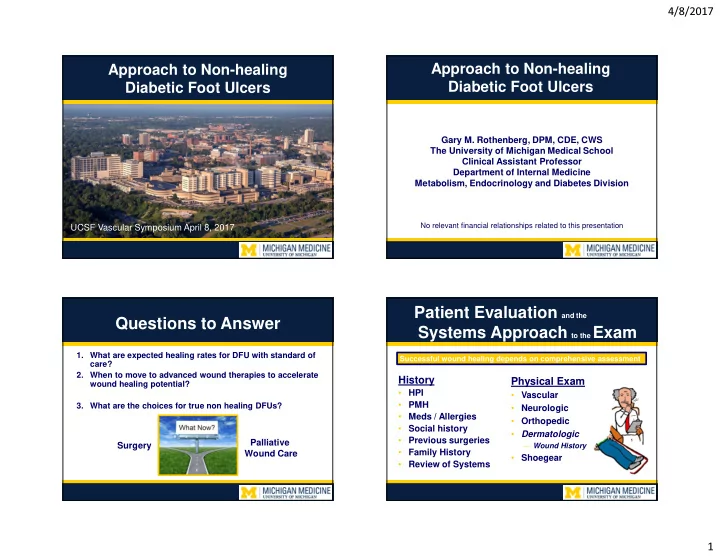
Questions to Answer Systems Approach to the Exam 1. What are - - PowerPoint PPT Presentation

questions to answer systems approach to the exam
SMART_READER_LITE
LIVE PREVIEW

Questions to Answer Systems Approach to the Exam 1. What are - - PowerPoint PPT Presentation

4/8/2017 Approach to Non-healing Approach to Non-healing Diabetic Foot Ulcers Diabetic Foot Ulcers Gary M. Rothenberg, DPM, CDE, CWS The University of Michigan Medical School Clinical Assistant Professor Department of Internal Medicine


slide-1
SLIDE 1

4/8/2017 1

Approach to Non-healing Diabetic Foot Ulcers

UCSF Vascular Symposium April 8, 2017 Gary M. Rothenberg, DPM, CDE, CWS The University of Michigan Medical School Clinical Assistant Professor Department of Internal Medicine Metabolism, Endocrinology and Diabetes Division

No relevant financial relationships related to this presentation

Approach to Non-healing Diabetic Foot Ulcers

Questions to Answer

1. What are expected healing rates for DFU with standard of care? 2. When to move to advanced wound therapies to accelerate wound healing potential? 3. What are the choices for true non healing DFUs?

Palliative Wound Care Surgery

Patient Evaluation and the Systems Approach to the Exam

History

  • HPI
  • PMH
  • Meds / Allergies
  • Social history
  • Previous surgeries
  • Family History
  • Review of Systems

Physical Exam

  • Vascular
  • Neurologic
  • Orthopedic
  • Dermatologic

– Wound History

  • Shoegear

Successful wound healing depends on comprehensive assessment

slide-2
SLIDE 2

4/8/2017 2

Patient Evaluation and the Systems Approach to the Exam

Laboratory Studies

CBC Comp panel HbA1C Pre-albumin ESR / CRP

Local Wound Evaluation

Probe to bone Moisture balance Size, structures, quality

Ancillary Testing

Plain film x-rays CT / MRI / Bone Scan Vascular Testing TCP02 / SPP Biopsy Tissue cultures

Systemic Evaluation

Smoking cessation Hypertension Glycemic control

Healing DFUs with Standard of Care

Purpose: To evaluate the

rate of neuropathic ulcer healing in 10 control groups from prospective clinical trials via meta-analysis

Good wound care

  • Debridement
  • Offloading
  • Saline gauze or gel

450 patients 12 week endpoint Healing rate 24% 172 patients 20 week endpoint Healing rate 30.9%

Margolis, D, et al. Healing of Neuropathic Ulcers: Results of a Meta-Analysis. Diabetes Care 1999;22: 692-695

There is significant need for advanced wound therapies…….

Advanced Wound Care: Predicting Healing

Percent Change in Wound Area of Diabetic Foot Ulcers Over a 4-Week Period Is a Robust Predictor of Complete Healing in a 12-Week Prospective Trial

  • Wound area changes over a

4-week period can strongly predict complete wound healing over an extended 12-week period 53%

  • 4-weeks can be a pivotal clinical decision point in

the management of diabetic foot ulcerations

Sheehan, P et al. Percent Change in Wound Area of Diabetic Foot Ulcers Over a 4-Week Period Is a Robust Predictor of Complete Healing in a 12-Week Prospective Trial. Diabetes Care, Volume 26, Number 6, June 2003

Patient Factors Affecting Wound Healing – the Science

Age Nutrition Infection Perfusion Senescent cells Bacterial bioburden Metabolic disorders Sustained inflammation Deficient growth factor response General wound appearance Periwound skin integrity Wound evolution Wound etiology Drainage

Falanga V. Wound healing and its impairment in the diabetic foot

  • Lancet. Vol 366; Nov. 2005
slide-3
SLIDE 3

4/8/2017 3

Smokers Depression Fibromyalgia Homelessness Financial distress Goals and motivation Lack of social support Patient attitude and buy-in Previous experiences with health care teams

Patient Factors Affecting Wound Healing – the Art

When to Consider Surgery?

Consider surgery when conservative therapy fails Failure of conservative treatment -- Ulcers that cannot be accommodated and offloaded by footwear,

  • rthoses, or related care

Therapeutic shoes – recurrence rates of ulcers 28% at 12 months to 100% at 40 months Deformity which places limb at risk General medical status Arterial perfusion Rigid vs. flexible

Surgeries for Treating Wounds in Patients with Diabetes

Prophylactic Procedures Correction of Deformities Hammertoes Charcot Ablative Procedures Amputation Procedures should be chosen to correct the underlying problem in the most minimally invasive

  • manner. In some cases, amputation

may offer a better functional

  • utcome.

Curative Procedures Debridements Wound closure Flaps and grafts Closure devices Ankle joint equinus Procedures addressing underlying etiology in the presence of a wound

Armstrong, DG et al. Classifying Diabetic Foot Surgery: Toward a Rational Definition. Diabetic Medicine 20.4 (2003): 329-331.

Surgeries for Treating Wounds in Patients with Diabetes

slide-4
SLIDE 4

4/8/2017 4

Tamir et al, Outpatient Percutaneous Flexor Tenotomies for Management of Diabetic Claw Toe Deformities with Ulcers: A Preliminary Report Can J Surg, Vol 51, No 1, Feb 2008

Clinic based flexor tenotomy procedure for digital ulcers Results 34 toes in 14 patients 8 male / 6 female 24 ulcers / 10 at risk 3 Osteomyelitis Average duration of ulceration 11 months Mean f/u 13 months

  • Ulcers without osteo healed within

3 weeks

  • Ulcers with osteo healed within 8

weeks

  • No complications
  • No recurrence
  • No hyperextension deformities

seen

Healing Lesser Toe Ulcers

Armstrong et al, Clinical Efficacy of the First Metatarsalphalangeal Joint Arthroplasty as a Curative Procedure for Hallux Interphalangeal Joint Wounds in Patients With DiabetesDiabetes Care, Vol 26, No 12, Dec 2003

Retrospective comparative cohort study of operative vs non-operative management of hallux IPJ ulcers

  • 21 Surgical patients

underwent Keller type arthroplasty

  • 20 age, sex-matched

patients receiving standard non-surgical care

  • 6 month f/u

Results Ulcer healing

  • 24 days vs 67 days

Ulcer recurrence

  • 5% vs 35%

Infection

  • 40% vs 38%

Amputation

  • 10% vs 5%

Healing Hallux IPJ Ulcers

Armstrong et al, Efficacy of Fifth Metatarsal Head Resection for Treatment of Chronic Diabetic Foot Ulceration. JAPMA 2005

Retrospective cohort study to evaluate

  • utcomes of operative

versus non-operative treatment of ulcerations sub 5th metatarsal head

  • 22 patients underwent

5th met head excision

  • 18 patients received

standard non-operative care

  • 6 month f/u

Results Ulcer healing

  • 5.8 weeks vs 8.7 weeks

Ulcer recurrence

  • 4.5% vs. 28%

Infection

  • 18% vs. 22%

Amputation

  • 4.5% vs. 12%

Healing Ulcers Sub 5th Met Head

Palliative Wound Care Chronic Wound Maintenance Wound Hospice Historical focus of wound care has been:

  • Curing / managing the

underlying disease

  • Healing the wound

Palliative wound care is the evolving body of knowledge and skills that take a holistic approach to relieving suffering and improving quality of life for patients and families living with chronic wounds, whether the wound is healable or not.

Approach to Patients with Non-healing DFUs?

Armstrong DG. Int Wound J. 2007;4(4):286-287

Ferris, FD et al, Palliative Wound Care: Managing Chronic Wounds across Life’s Continuum: A Consensus Statement from the International Palliative Wound Care Initiative. J Palliative Med, Vol 10;1, 2007

slide-5
SLIDE 5

4/8/2017 5

Encompasses therapeutic interventions that aim to:

  • Guide effective communication,

decision making, and care delivery

  • Stabilize the wound
  • Minimize the risk of infection

and further progression of the wound

  • Manage the multiple issues that

cause patient and family suffering

  • Optimize the patient’s function

and quality of life for as long as possible

Approach to Patients with Non-healing DFUs?

Ferris, FD et al, Palliative Wound Care: Managing Chronic Wounds across Life’s Continuum: A Consensus Statement from the International Palliative Wound Care Initiative. J Palliative Med, Vol 10;1, 2007

Would life be different if the wound healed?

Summary

The majority of wounds will not heal with standard of care Advanced wound care can accelerate wound healing in the appropriately selected patient Successful wound healing is dependent upon comprehensive local and systemic assessment Surgery has a role in the prevention and management of DFUs Palliative wound care is an acceptable alternative in many cases

Thank you!