Product types: Both x and y New abstract syntax: PAIR , FST , SND 1 - - PowerPoint PPT Presentation

product types both x and y
SMART_READER_LITE
LIVE PREVIEW

Product types: Both x and y New abstract syntax: PAIR , FST , SND 1 - - PowerPoint PPT Presentation

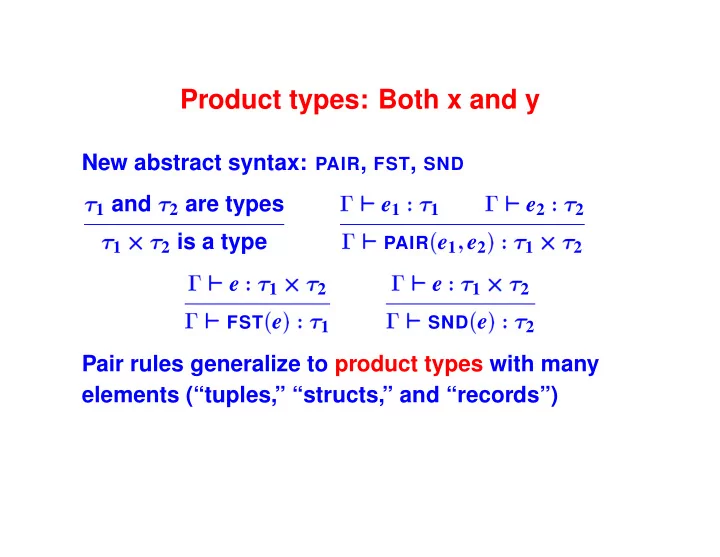
Product types: Both x and y New abstract syntax: PAIR , FST , SND 1 and 2 are types ` e 1 ` e 2 1 2 : : 2 is a type ( e 1 ; e 2 ` PAIR 1 1 2 ) : ` e ` e 1 2 1 2 :


slide-1
SLIDE 1

Product types: Both x and y

New abstract syntax: PAIR, FST, SND

1 and 2 are types 1
  • 2 is a type
  • ` e1
: 1
  • ` e2
: 2
  • ` PAIR
(e1 ;e2 ) : 1
  • 2
  • ` e
: 1
  • 2
  • ` FST
(e ) : 1
  • ` e
: 1
  • 2
  • ` SND
(e ) : 2

Pair rules generalize to product types with many elements (“tuples,” “structs,” and “records”)

slide-2
SLIDE 2

Sum types: either x or y

New abstract syntax: LEFT, RIGHT, CASE

1 and 2 are types 1 + 2 is a type
  • ` e
: 1 2 is a type
  • ` LEFT
2 (e ) : 1 + 2
  • ` e
: 2 1 is a type
  • ` RIGHT
1 (e ) : 1 + 2
  • ` e
: 1 + 2 fx1 7! 1 g ` e1 :
  • fx2
7! 2 g ` e2 :
  • ` CASE e OF LEFT
(x1 ) ) e1 j RIGHT (x2 ) ) e2 :
slide-3
SLIDE 3

Array types: Array of x

Formation:

is a type

ARRAY

( ) is a type

Introduction:

  • ` e1
: INT
  • ` e2
:
  • ` AMAKE
(e1 ;e2 ) : ARRAY ( )
slide-4
SLIDE 4

Array types continued

Elimination:

  • ` e1
: ARRAY ( )
  • ` e2
: INT
  • ` AAT
(e1 ;e2 ) :
  • ` e1
: ARRAY ( )
  • ` e2
: INT
  • ` e3
:
  • ` APUT
(e1 ;e2 ;e3 ) :
  • ` e
: ARRAY ( )
  • ` ASIZE
(e ) : INT
slide-5
SLIDE 5

References (similar to C/C++ pointers)

Your turn! Given ref

  • REF
( )

ref e

REF-MAKE

(e )

!e

REF-GET

(e )

e1 := e2

REF-SET

(e1 ;e2 )

Write formation, introduction, and elimination rules.

slide-6
SLIDE 6

Wait for it . . .

slide-7
SLIDE 7

Reference Types

Formation:

is a type

REF

( ) is a type

Introduction:

  • ` e
:
  • ` REF-MAKE
(e ) : REF ( )

Elimination:

  • ` e
: REF ( )
  • ` REF-GET
(e ) :
  • ` e1
: REF ( )
  • ` e2
:
  • ` REF-SET
(e1 ;e2 ) :
slide-8
SLIDE 8

New types are expensive

Closed world

  • Only a designer can add a new type constructor

A new type constructor (“array”) requires

  • Special syntax
  • New type rules
  • New internal representation (type formation)
  • New code in type checker (intro, elim)
  • New or revised proof of soundness
slide-9
SLIDE 9

Expense of array types

Formation:

is a type

ARRAY

( ) is a type

Introduction:

  • ` e1
: INT
  • ` e2
:
  • ` AMAKE
(e1 ;e2 ) : ARRAY ( )

Elimination:

  • ` e1
: ARRAY ( )
  • ` e2
: INT
  • ` AAT
(e1 ;e2 ) :
  • ` e1
: ARRAY ( )
  • ` e2
: INT
  • ` e3
:
  • ` APUT
(e1 ;e2 ;e3 ) :
  • ` e
: ARRAY ( )
  • ` ASIZE
(e ) : INT
slide-10
SLIDE 10

Expense for programmers

Monomorphism leads to code duplication User-defined functions are monomorphic:

(check-function-type swap ([array bool] int int -> unit)) (define unit swap ([a : (array bool)] [i : int] [j : int]) (begin (set tmp (array-at a i)) (array-put a i (array-at a j)) (array-put a j tmp) (begin)))

slide-11
SLIDE 11

Idea: Do it all with functions

Instead of syntax, use functions!

  • No new syntax
  • No new internal representation
  • No new type rules
  • One proof of soundness
  • Programmers can add new types

Requires: more expressive function types

slide-12
SLIDE 12

Better type for a swap function

(check-type swap (forall (’a) ([array ’a] int int -> unit)))

slide-13
SLIDE 13

Quantified types

Heart of polymorphism:

81 ; : : : ; n : .

In Typed

Scheme: (forall (’a1 ... ’an) type)

Two ideas:

  • Type variable ’a stands for an unknown type
  • Quantified type (with forall) enables substitution

car

: 8 : list !
  • cdr
: 8 : list ! list

cons

: 8 :
  • list
! list

’()

: 8 : list

length

: 8 : list ! int
slide-14
SLIDE 14

Quantified types

Heart of polymorphism:

81 ; : : : ; n : .

In Typed

Scheme: (forall (’a1 ... ’an) type)

Two ideas:

  • Type variable ’a stands for an unknown type
  • Quantified type (with forall) enables substitution

car : (forall (’a) ([list ’a] -> ’a)) cdr : (forall (’a) ([list ’a] -> [list ’a])) cons : (forall (’a) (’a [list ’a] -> [list ’a])) ’() : (forall (’a) (list ’a)) length : (forall (’a) ([list ’a] -> int))

slide-15
SLIDE 15

Representing quantified types

Two new alternatives for tyex:

datatype tyex = TYCON

  • f name

// int | CONAPP of tyex * tyex list // (list bool) | FUNTY

  • f tyex list * tyex

// (int int -> bool) | TYVAR

  • f name

// ’a | FORALL of name list * tyex // (forall (’a) ...)

slide-16
SLIDE 16

Programming with quantified types

Substitute for quantified variables: “instantiate”

  • > length

<procedure> : (forall (’a) ((list ’a) -> int))

  • > [@ length int]

<procedure> : ((list int) -> int)

  • > (length ’(1 2 3))

type error: function is polymorphic; instantiate before a

  • > ([@ length int] ’(1 2 3))

3 : int

slide-17
SLIDE 17

Substitute what you like

  • > length

<procedure> : (forall (’a) ((list ’a) -> int))

  • > [@ length bool]

<procedure> : ((list bool) -> int)

  • > ([@ length bool] ’(#t #f))

2 : int

slide-18
SLIDE 18

More instantiations

  • > (val length-int [@ length int])

length-int : ((list int) -> int)

  • > (val cons-bool [@ cons bool])

cons-bool : ((bool (list bool)) -> (list bool))

  • > (val cdr-sym [@ cdr sym])

cdr-sym : ((list sym) -> (list sym))

  • > (val empty-int [@ ’() int])

() : (list int)

slide-19
SLIDE 19

Create your own!

Abstract over unknown type using type-lambda

  • > (val id (type-lambda [’a]

(lambda ([x : ’a]) x ))) id : (forall (’a) (’a -> ’a)) ’a is type parameter (an unknown type) This feature is parametric polymorphism

slide-20
SLIDE 20

Polymorphic array swap

(check-type swap (forall (’a) ([array ’a] int int -> unit))) (val swap (type-lambda (’a) (lambda ([a : (array ’a)] [i : int] [j : int]) (let ([tmp ([@ Array.at ’a] a i)]) (begin ([@ Array.put ’a] a i ([@ Array.at ’a] a j)) ([@ Array.put ’a] a j tmp))))))

slide-21
SLIDE 21

Power comes at notational cost

Function composition

  • > (val o (type-lambda [’a ’b ’c]

(lambda ([f : (’b -> ’c)] [g : (’a -> ’b)]) (lambda ([x : ’a]) (f (g x))))))

  • : (forall (’a ’b ’c)

((’b -> ’c) (’a -> ’b) -> (’a -> ’c)))

Aka o :

8;
  • ;
  • :
( !
  • )
  • (
!
  • )
! ( !
  • )
slide-22
SLIDE 22

Instantiate by substitution

8 elimination:
  • Concrete syntax (@ e
1
  • n)
  • Rule (note new judgment form
;
  • ` e
: ): ;
  • ` e
: 81 ; : : : ; n : ;
  • ` TYAPPLY
(e ; 1 ; : : : ; n ) :
  • [1
7! 1 ; : : : ; n 7! n ℄

Substitution is in the book as function tysubst (Also in the book: instantiate)

slide-23
SLIDE 23

Generalize with type-lambda

8 introduction:
  • Concrete syntax (type-lambda [1
  • n] e)
  • Rule (forall introduction):
f1 :: ; : : : n :: g;
  • ` e
:
  • i
62 ftv ();

1

i n ;
  • ` TYLAMBDA
(1 ; : : : ; n ;e ) : 81 ; : : : ; n : is kind environment (remembers i’s are types)
slide-24
SLIDE 24

What have we gained?

No more introduction rules:

  • Instead, use polymorphic functions

No more elimination rules:

  • Instead, use polymorphic functions

But, we still need formation rules

slide-25
SLIDE 25

You can’t trust code

User’s types not blindly trusted:

  • > (lambda ([a : array]) (Array.size a))

type error: used type constructor ‘array’ as a type

  • > (lambda ([x : (bool int)]) x)

type error: tried to apply type bool as type constructor

  • > (@ car list)

type error: instantiated at type constructor ‘list’, whic

How can we know which types are OK?

slide-26
SLIDE 26

Let’s classify type constructors

Is a type: int;bool int

::
  • bool
::
  • Takes a type (to make a type): array, list

list

::
  • )
  • array
::
  • )
  • These labels are called kinds
slide-27
SLIDE 27

Type formation through kinds

Each type constructor has a kind, which is either:

  • , or
  • 1
  • n
)
  • Type constructors of kind
classify terms

(int

:: , bool :: )

Type constructors of arrow kinds are “types in waiting” ( list

::
  • )
, array ::
  • )
, pair ::
  • )
)
slide-28
SLIDE 28

The kinding judgment

  • `
  • ::
  • “Type
has kind ”
  • `
  • ::
  • Special case: “ is a type” (asType)

Replaces one-off type-formation rules Kind environment

tracks type constructor names

and kinds. Use asType in code!

slide-29
SLIDE 29

Kinding rules for types

  • 2
dom
  • ()
=
  • ` TYCON
() ::
  • KINDINTROCON
  • `
  • ::
1
  • n
)
  • `
i :: i ;

1

i n
  • ` CONAPP
( ; [1 ; : : : ; n ℄) ::
  • KINDAPP

These two rules replace all formation rules. (Check out book functions kindof and asType)

slide-30
SLIDE 30

Designer’s burden reduced

To extend Typed Impcore:

  • New syntax
  • New type rules
  • New internal representation
  • New code
  • New soundness proof

To extend Typed

Scheme, none of the above! Just
  • New functions
  • New primitive type constructor in
  • You’ll do arrays both ways
slide-31
SLIDE 31

Kinds of primitive type constructors

(int) =
  • (bool)
=
  • (list)
=
  • )
  • (option)
=
  • )
  • (pair)
=
  • )
slide-32
SLIDE 32

What can a programmer add?

Typed Impcore:

  • Closed world (no new types)
  • Simple formation rules

Typed

Scheme:
  • Semi-closed world (new type variables)
  • How are types formed (from other types)?

Standard ML:

  • Open world (programmers create new types)
  • How are types formed (from other types)?
slide-33
SLIDE 33

How ML works: Three environments

  • maps names (of tycons and tyvars) to kinds
  • maps names (of variables) to types
  • maps names (of variables) to values or locations

New val def val x = 33 New type def type ’a transformer = ’a -> ’a New datatype def datatype color = RED | GREEN | BLUE

slide-34
SLIDE 34

Three environments revealed

  • maps names (of tycons and tyvars) to kinds
  • maps names (of variables) to types
  • maps names (of variables) to values or locations

New val def modifies

,
  • val x = 33 means
fx : int g; fx 7! 33g

New type def modifies

  • type ’a transformer = ’a list * ’a list

means

ftransformer ::
  • )
g

New datatype def modifies

; ;
  • datatype color = RED | GREEN | BLUE

means

fcolor :: g; fRED : color ;GREEN : color ;BLUE : colorg, fRED 7! 0;GREEN 7! 1;BLUE 7! 2g
slide-35
SLIDE 35

Exercise: Three environments

datatype ’a tree = NODE of ’a tree * ’a * ’a tree | EMPTY means

ftree 7!
  • )
g, fNODE 7! 8’a : ’a tree * ’a * ’a tree ! ’a tree,

EMPTY

7! 8’a : ’a tree g, fNODE 7! (l ;x ;r ) :
  • ;EMPTY
7! 1 g