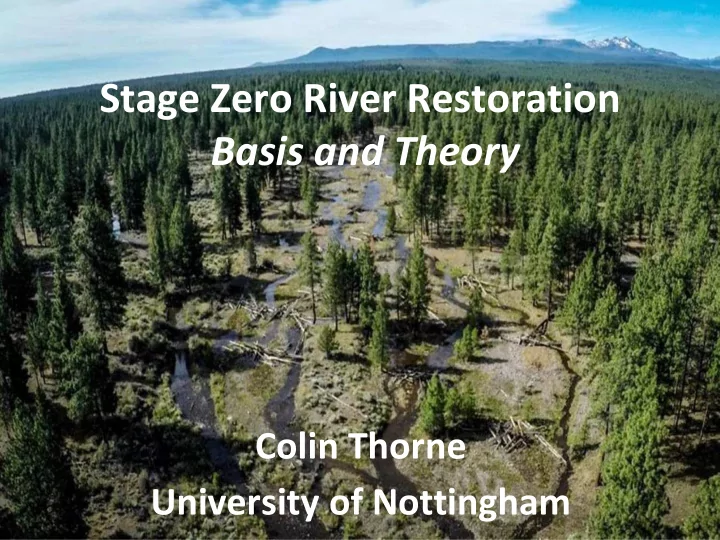
Stage Zero River Restoration Basis and Theory Colin Thorne - - PowerPoint PPT Presentation

stage zero river restoration basis and theory
SMART_READER_LITE
LIVE PREVIEW

Stage Zero River Restoration Basis and Theory Colin Thorne - - PowerPoint PPT Presentation

Stage Zero River Restoration Basis and Theory Colin Thorne University of Nottingham OVERVIEW Basis: The Stream Evolution Model Anabranching Rivers in Nature Theory: Bankfull Flow in Transport and Response reaches Valley Confinement:


slide-1
SLIDE 1

Stage Zero River Restoration Basis and Theory

Colin Thorne University of Nottingham

slide-2
SLIDE 2

OVERVIEW

Basis: The Stream Evolution Model Anabranching Rivers in Nature Theory: Bankfull Flow in Transport and Response reaches Valley Confinement: ‘Strings of Beads’ & Ribbons Single-thread, stable channels: not the only choice?

slide-3
SLIDE 3

THE STREAM EVOLUTION MODEL ANABRANCHING CHANNELS IN NATURE

Basis:

slide-4
SLIDE 4

1984

Channel Evolution Models…

INCISED CHANNELS Morphology, Dynamics, and Control

Schumm, Harvey & Watson

Water Resources Publications, Littleton, Colorado

slide-5
SLIDE 5

Floodplain Disconnection: Crowder Creek, North Mississippi: late-1970s

slide-6
SLIDE 6

Response to Channel – Floodplain Disconnection

Disconnected floodplain system: Connected floodplain system:

slide-7
SLIDE 7

Schumm, S. A., Harvey, M. D., & Watson, C. C. (1984). Incised channels: morphology, dynamics, and control. Water Resources Publications.

Stanley Schumm, Mike Harvey and Chester Watson 1984

slide-8
SLIDE 8

Historical evidence - US East Coast –

Watts Branch, Seneca Creek, Brandywine Creek etc.

“…before European settlement, the streams were small, anabranching channels within extensive, vegetated wetlands”

Walter, R.C. and Merritts, D.J., 2008. Natural streams and the legacy of water-powered mills. Science, 319(5861), pp.299-304.

2008

slide-9
SLIDE 9

Until global vegetation, most rivers BRAIDED. After plants appeared rivers started MEANDERING and become ANASTOMOSED after modern trees evolved. Slide compiled by Dr Matt Johnson, Nottingham U.

River Planforms over Geological Time

Cambrian Ordovician Silurian Devonian

300 350 400 450 500 550

Carboniferous Permian

Trunk meandering Small meandering Channel-braided Sheet-braided

Anastomosed and Island-braided

Log jams Gymnosperms Seed plants Early Forests Definitive roots Root-like forms Plant Evolution Fluvial Style Mya

“…expansion of tree habitats led to the crossing of a threshold in vegetative control of floodplain and river morphology.”

Davies, N.S. and Gibling, M.R., 2011. Nature Geoscience, 4(9), pp.629-633

slide-10
SLIDE 10

Mical Tal: Interactions between vegetation and braiding leading to a single-thread channel

Dissertation submitted to the faculty of the graduate school of the University of Minnesota

slide-11
SLIDE 11

Mical Tal: Interactions between vegetation and braiding leading to a single-thread channel

“Fight the enemy where he isn’t”

General Sun Tzu - ‘The Art of War’ (512 BC)

slide-12
SLIDE 12

Published January 10,

2013.

slide-13
SLIDE 13

Cluer and Thorne, RRA, 2013

Channelization of Stage 0 streams

slide-14
SLIDE 14

BANKFULL FLOW IN TRANSPORT AND RESPONSE REACHES VALLEY CONFINEMENT STABLE CHANNEL DESIGN

Theory:

slide-15
SLIDE 15

Bankfull stage and discharge - key restoration design factors

Natural levee Natural levee

slide-16
SLIDE 16

Adapted from Wolman and Miller (1960)

Bankfull Discharge = Flow doing most Sediment Transport

Return period ~1.5 years

slide-17
SLIDE 17

Source Transport Response

slide-18
SLIDE 18
slide-19
SLIDE 19

Transport Reach – Qsin = Qsout

slide-20
SLIDE 20

Depositional Reach – Qsin > Qsout

slide-21
SLIDE 21

BANKFULL FLOW IN TRANSPORT AND RESPONSE REACHES VALLEY CONFINEMENT STABLE CHANNEL DESIGN

Theory:

slide-22
SLIDE 22

Fryirs et al. (2016)

“ valley confinement - a primary control on many fluvial geomorphic processes that

  • ccur on (and along) valley bottoms…..

downstream sequence of valley settings - a key control on longitudinal patterns of hydrology and sediment flux, as well as dictating the pattern of river types”

slide-23
SLIDE 23

Valley Confinement and Confining Features

slide-24
SLIDE 24

Beads on a string

Mark Beardsley Riparian

slide-25
SLIDE 25
slide-26
SLIDE 26
slide-27
SLIDE 27
slide-28
SLIDE 28

Floodplains as Ribbons

slide-29
SLIDE 29

BANKFULL FLOW IN TRANSPORT AND RESPONSE REACHES VALLEY CONFINEMENT STABLE CHANNELS

Theory:

slide-30
SLIDE 30

Source Transport Response

slide-31
SLIDE 31

Channel patterns after Schumm 1985, modified from Knighton, 1998.

Stable Bed Mobile Bed Sediment Rich Sediment Poor Resistant Banks Erodible Banks Suspended Load Mixed Load Bedload

Dynamically Stable, Multi-thread planforms Dynamically Stable, Single-thread planforms Anastomosed Straight Island Braided Braided Meandering

slide-32
SLIDE 32

Copeland Stable Channel Design Method: for a given Width: Flow resistance: Q = f (Depth, Slope) Sediment transport: Qs = f (Depth, Slope)

Stable width Slope Width

Sedimentation Erosion

US Army Corps of Engineers: SAM = Stable Analytical Method

slide-33
SLIDE 33

Source Transport Response

slide-34
SLIDE 34

Channel patterns after Schumm 1985, modified from Knighton, 1998.

Stable Bed Mobile Bed Sediment Rich Sediment Poor Resistant Banks Erodible Banks Suspended Load Mixed Load Bedload

Dynamically Stable, Multi-thread planforms Dynamically Stable, Single-thread planforms Anastomosed Straight Island Braided Braided Meandering

slide-35
SLIDE 35

Biology Geology Hydrology

SET with the planform patterns defined by Schumm (1985). Castro and Thorne (2019).

Castro, J.M. and Thorne, C.R. 2019. The Stream Evolution Triangle: linking Geology, Hydrology and Biology, River Research and Applications. https://doi.org/10.1002/rra.3421

The Stream Evolution Triangle

slide-36
SLIDE 36

Colorado River, USA

slide-37
SLIDE 37

Rakaia River, NZ

slide-38
SLIDE 38

Rio Negro, BR

slide-39
SLIDE 39
slide-40
SLIDE 40

Why don’t we see many anastomosed rivers?

Anastomosed Anabranched Meandering 1828 – Prior to 1872 – after re-alignment 1963 – fully canalised river training by Johann Gottfried Tulla single-thread

River Rhine, Germany

slide-41
SLIDE 41

Parana Japura Brahmaputra Orinoco

slide-42
SLIDE 42

Post-2000 research challenges single-thread, meandering as a natural, ubiquitous pre-disturbance condition: Europe - Tony Brown, John Lewin, Nicola Surian Eastern US - Robert Walter and Dorothy Merrits California – Robin Grossinger and others Pacific Northwest - Dave Montgomery and Brian Collins

,

Photograph by Brian Cluer

slide-43
SLIDE 43

Further Reading

Walter, R.C. and Merritts, D.J., 2008. Natural streams and the legacy of water- powered mills. Science, 319(5861), pp.299-304. Cluer, B. and Thorne, C., 2014. A stream evolution model integrating habitat and ecosystem benefits. River Research and Applications, 30(2), pp.135-154. Pollock, M., Beechie, T., Wheaton, J., Jordan, C., Bouwes, N., Weber, N. & Volk, C.

  • 2014. Using Beaver Dams to Restore Incised Stream Ecosystems. BioScience. xx.

1-12. DoI. 10.1093/biosci/biu036. Davies, N.S. and Gibling, M.R., 2011. Nature Geoscience, 4(9), pp.629-633 Schumm, S.A., 1977. The fluvial system. New York: Wiley. Wolman, M.G. and Miller, J.P., 1960. Magnitude and frequency of forces in geomorphic processes. The Journal of Geology, 68(1), pp.54-74. Hey, R.D., 1979. Dynamic process-response model of river channel development. Earth Surface Processes, 4(1), pp.59-72. Fryirs, K.A., Wheaton, J.M. and Brierley, G.J., 2016. An approach for measuring confinement and assessing the influence of valley setting on river forms and

  • processes. Earth Surface Processes and Landforms, 41(5), pp.701-710.

Thomas, A., Copeland, R. and McComas, D. 2002. SAM (Stable Alluvial Method) Design Package for Channels, USACE-CHL, ERDC, Vicksburg. https://www.fs.fed.us/biology/nsaec/fishxing/fplibrary/ACOE_2002_SAM_Hydr aulic_Design_Package_for_Channels.pdf