Stable Water Isotopes Type MW % of total ppb 1 H 1 H 16 O 18 - - PDF document

stable water isotopes
SMART_READER_LITE
LIVE PREVIEW

Stable Water Isotopes Type MW % of total ppb 1 H 1 H 16 O 18 - - PDF document

CEE 680 Lecture #4 1/28/2020 Print version Updated: 28 January 2020 Lecture #4 Isotopes (cont); Kinetics and Thermodynamics: Fundamentals of water and Ionic Strength (Stumm & Morgan, pp.1 15 Brezonik & Arnold, pg 10 18)


slide-1
SLIDE 1

CEE 680 Lecture #4 1/28/2020 1

Lecture #4 Isotopes (cont); Kinetics and Thermodynamics: Fundamentals of water and Ionic Strength

(Stumm & Morgan, pp.1‐15 Brezonik & Arnold, pg 10‐18)

David Reckhow CEE 680 #4 1

(Benjamin, 1.2, 1.3, 1.5)

Updated: 28 January 2020

Print version Best source for stable isotopes is: Eby, Chapter 6, especially pg. 181-186

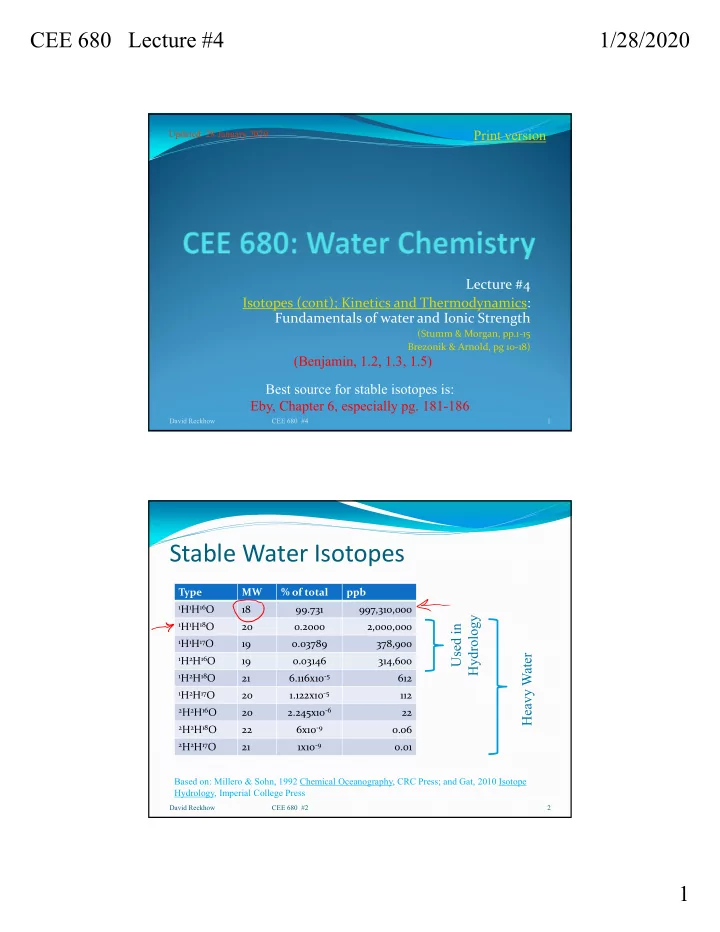
Stable Water Isotopes

Type MW % of total ppb

1H1H16O

18 99.731 997,310,000

1H1H18O

20 0.2000 2,000,000

1H1H17O

19 0.03789 378,900

1H2H16O

19 0.03146 314,600

1H2H18O

21 6.116x10‐5 612

1H2H17O

20 1.122x10‐5 112

2H2H16O

20 2.245x10‐6 22

2H2H18O

22 6x10‐9 0.06

2H2H17O

21 1x10‐9 0.01

David Reckhow CEE 680 #2 2

Based on: Millero & Sohn, 1992 Chemical Oceanography, CRC Press; and Gat, 2010 Isotope Hydrology, Imperial College Press

Heavy Water Used in Hydrology

slide-2
SLIDE 2

CEE 680 Lecture #4 1/28/2020 2

Properties of Stable Water Isotopes

Property

1H1H16O 1H1H18O 1H2H16O 2H2H16O

units Density @30°C 1.107845 1.04945 1.10323 g/mL Temp@ dmax 4.305 11.24 °C Boiling Pt 100.14 101.42 °C Melting Pt 0.28 3.81 °C Diffusivity in water @25°C 2.66 2.34 103 cm2s‐1 Relative diffusivity in air 1.0000 0.9723 0.9755

David Reckhow CEE 680 #3 3

From: Gat, 2010 Isotope Hydrology, Imperial College Press and references therein

Measurement

David Reckhow CEE 680 #3 4

 Requires separation of H from O in water

 Hydrogen goes to H2 with help of a hot metal catalyst  Oxygen goes to O2 by hydrolysis or fluorination or to

CO2 by aqueous equilibration  Then use an isotope ratio instrument

 Magnetic sector

Mass Spectrometer

 Wavelength‐Scanned

Cavity Ring Down Spectrometer (WS‐CRDS)

slide-3
SLIDE 3

CEE 680 Lecture #4 1/28/2020 3

Relative Isotopic Abundance

 Reflects environmental fractionation

 Helps describe origins, pathways, processes  Tracer

 Calculation based on a standard material

 Uses ratios of abundance; eg:

 Where: R is the isotopic ratio, e.g., for oxygen

David Reckhow CEE 680 #2 5

Fundamentals of Isotope Geochemistry

   

O O R

16 18

𝜀 𝑆 𝑆 𝑆 𝑦1000

Isotopic Standards in %

Ratio Nominal V‐SMOW PDB

2H/1H

0.015 0.015576

13C/12C

1.1 1.12375

18O/16O

0.2 0.20052 0.20672

 Key to Standards

 V‐SMOW = Vienna Standard Mean Ocean Water

 established by IAEA in Vienna; blend of ocean waters around globe

 PDB = PeeDee Belemnite (high 13C/12C ratio)

 Fossilized cephalopods from the PeeDee River in SC

David Reckhow CEE 680 #3 6

slide-4
SLIDE 4

CEE 680 Lecture #4 1/28/2020 4

Evaporation of water: fractionation

David Reckhow CEE 680 #3 7

 For 2H

Temperature (oC)

  • 20

20 40 60 80 100

Fractionation Factor (D)

1.00 1.02 1.04 1.06 1.08 1.10 1.12 1.14 1.16

Temperature (oC)

  • 20

20 40 60 80 100

Fractionation Factor (18)

1.000 1.002 1.004 1.006 1.008 1.010 1.012 1.014 1.016

 For 18O

𝜷𝟐𝟗 𝑷

𝟐𝟗

𝑷

𝟐𝟕

  • 𝒎𝒋𝒓𝒗𝒋𝒆

𝑷

𝟐𝟗

𝑷

𝟐𝟕

  • 𝒘𝒃𝒒𝒑𝒔

𝜷𝑬 𝑰

𝟑

𝑰

𝟐

  • 𝒎𝒋𝒓𝒗𝒋𝒆

𝑰

𝟑

𝑰

𝟐

  • 𝒘𝒃𝒒𝒑𝒔

Data from: Dansgaard, 1964

example

 A rainwater sample from Boston has an 18O/16O ratio of

0.0019750 as determined by isotope ratio MS.

1.

Calculate the delta value vs V‐SMOW (in ‰)

2.

Determine the delta value for the water vapor that is in equilibrium with at 20C

David Reckhow CEE 680 #3 8

𝜀 𝑆 𝑆 𝑆 𝑦1000 0.0019750 0.0020052 0.0020052 𝑦1000 𝟐𝟔. 𝟐

𝜷𝟐𝟗 𝑷

𝟐𝟗

𝑷

𝟐𝟕

  • 𝒎𝒋𝒓𝒗𝒋𝒆

𝑷

𝟐𝟗

𝑷

𝟐𝟕

  • 𝒘𝒃𝒒𝒑𝒔

𝟐. 𝟏𝟏𝟘 𝜷𝟐𝟗 𝟏. 𝟏𝟏𝟐𝟘𝟖𝟔𝟏 𝑺𝒘𝒃𝒒𝒑𝒔 𝟐. 𝟏𝟏𝟘

𝑆 0.0019574

𝜀 0.0019750 0.0020052 0.0020052 𝑦1000 𝟑𝟒. 𝟗

slide-5
SLIDE 5

CEE 680 Lecture #4 1/28/2020 5

 Rayleigh distillation

 Water vapor is enriched in

the light isotopes (16O and

1H) compared to the water

from which it evaporated

 As rain drops form there is

selective loss of the heavier isotopes (18O and 2H) from the vapor to the rain drops

David Reckhow CEE 680 #3 9

Vapor washout

Selective enrichment in nature

 Mass‐based Effects: Fractionation

 Evaporation & freezing

 selective concentration of heavy isotopes

 Bonding Effects

 plants preferentially take up

carbon dioxide containing the lighter carbon isotope (12C‐CO2) in photosynthesis, but the degree of preference depends on water availability, CO2 availability and

  • n the photosynthetic pathway

 C3 vs C4 plants (PEP carboxylase)

David Reckhow CEE 680 #2 10

slide-6
SLIDE 6

CEE 680 Lecture #4 1/28/2020 6

Radioactive isotopes for dating

 Radioisotope dating

David Reckhow CEE 680 #3 11

Image from: https://www.phy.anl.gov/mep/atta/ research/atta.html

Radio‐ isotope Half‐life (years)

10Be

1,360,000

36Cl

301,000

81Kr

229,000

14C

5,730

39Ar

269

3H

12

85Kr

11

Radioactive tracers

 Carbon‐14

David Reckhow CEE 680 #3 12

Image from: https://www.skepticalscience. com/print.php?n=3962

slide-7
SLIDE 7

CEE 680 Lecture #4 1/28/2020 7

Molecular Weight and boiling point

 Organic Compounds: Homologous series

David Reckhow CEE 680 #4 13 Image from: http://chemed.chem.purdue.edu/genchem/topicrevie w/bp/ch14/liquids.php Image from: https://socratic.org/questions/how-does-molar-mass- affect-boiling-point

Water and related heteroatoms

 Water is different

David Reckhow CEE 680 #4 14

Image From: http://schoolbag.info/chemistry/central/100.html

“hydrides” Groups

slide-8
SLIDE 8

CEE 680 Lecture #4 1/28/2020 8

Water is exceptional

 From Eby, 2016 (Table 1‐7)

David Reckhow CEE 680 #4 15

Property Comparison to other substances Heat capacity Highest of all common liquids (except ammonia) and solids Latent heat of fusion Highest of all common liquids (except ammonia) and most solids Latent heat of vaporization Highest of all common substances Dissolving ability Dissolved more substances (particularly ionic compounds), and in greater quantity than any other common liquid Transparency Relatively high for visible light Physical state The only substance that occurs naturally in all three states at the earth’s surface Surface tension Highest of all common liquids Conduction of heat Highest of all common liquids (Hg is higher) Viscosity Relatively low viscosity for a liquid

Structure of Water

 sp3 hybridization

 2 bonding and 2 non‐bonding

  • rbitals

 Dipolar Character  Origin of Water’s Unusual

properties

 High melting and boiling point  High heat of vaporization  Expands upon freezing  High surface tension  Excellent polar solvent

David Reckhow CEE 680 #4 16

S&M: Fig. 1.3

S&M: Fig. 1.4

B: Fig 1.1

slide-9
SLIDE 9

CEE 680 Lecture #4 1/28/2020 9

Hydrogen bonding

David Reckhow CEE 680 #4 17

 Dipole nature of water and hydrogen bond

formation

 H2O H4O2

H6O3

Images courtesy of Benjamin

Water’s intermolecular structure

 Dominated by Hydrogen

Bonds

 Ice

 Open tetrahedral structure

 Water

 Flickering cluster model

 100 ps lifetime  0.1 ps molecular vibration

David Reckhow CEE 680 #4 18

  • Fig. 1.5b
  • Pg. 8
  • Fig. 1.5a
  • Pg. 8
slide-10
SLIDE 10

CEE 680 Lecture #4 1/28/2020 10

Freezing and density

 Crystalline structure

 Lower density than liquid water

 Max density is at 4°C

David Reckhow CEE 680 #4 19

Images from Eby, 2016

Solutes in Water

 Great solvent for ionic or

ionizable substances

 Ion‐dipole bonds improves

stability

 Energy increases with charge of ion

and decreases with size

 Solvent hole model

 As solute‐water bonding strengthens

compared to water‐water bonding, solubility goes up

 Hydrophilic solute

 Weak solute‐water bonds reduce

solubility

 Hydrophobic solutes

David Reckhow CEE 680 #4 20

S&M: Fig. 1.6

B: Fig 1.3

slide-11
SLIDE 11

CEE 680 Lecture #4 1/28/2020 11

Periodic Table

David Reckhow CEE 680 #4 21

“680 Periodic Table”

 Ocean residence time (log yr)  Predominant species  River Water conc. (‐log M)  Seawater conc. (‐log M)

David Reckhow CEE 680 #4 22

H 4.5

H2O

  • 1.74 -1.74

Li 6.3

Li+ 4.6

Be

BeOH+ (?) 9.2

B 7.0

H3BO4 3.39

C 4.9

HCO3

  • 2.64 3.0

N 6.3

N2, NO3

  • 1.97

O 4.5

H2O, O2

  • 1.74 -1.74

F 5.7

F-, MgF+ 4.17 5.3

Ne

8.15

Na 7.7

Na+ 0.33 3.57

Mg 7

Mg+2, MgSO4 1.27 3.77

Al 2

Al(OH)4

  • 7.1

Si 3.8

H4SiO4 4.15 3.8

P 4

HPO4

  • 2

5.3

S 6.9

SO4

  • 2,NaSO4
  • 1.55 3.92

Cl 7.9

Cl- 0.26 3.66

Ar

6.96

K 6.7

K+ 1.99 4.23

Ca 5.9

Ca+2, CaSO4 1.99 3.42

As

HAsO4

  • 2

7.3

Se 4

SeO3

  • 2

8.6

Br 8

Br- 3.08

Kr

8.6

He

8.8

Sr 6.6

Sr+2 4.05

Ba 4.5

Ba+2 6.8

I

6 I-, IO3

  • 6.3

After S&M:Fig. 1.7, Pg. 10

slide-12
SLIDE 12

CEE 680 Lecture #4 1/28/2020 12

Law of Mass Action

 The rate of an elementary reaction is proportional to

the product of the concentrations of the participating molecules, atoms or ions

 Chemical equilibria comes from the combination of

two competing rates

 Consider the autodecomposition of water

 Other examples

 acid dissociation, Precipitation, Redox, Adsorption,

volatilization

David Reckhow CEE 680 #4 23

𝐼𝑃 ↔ 𝐼 𝑃𝐼 Equilibrium Quotients

Activity

 Activity is the “effective” concentration or

“reactivity”, which may be slightly different from the true “analytical” concentration

 These two differ substantially in waters with high TDS,

such as sea water.

 We identify these two as follows:

 Curved brackets ({X}) indicate activity  Square brackets ([X]) indicate concentration

 Usually this is molar concentration  This may also be used when we’re not very concerned about the

differences between activity and concentration

David Reckhow CEE 680 #4 24

slide-13
SLIDE 13

CEE 680 Lecture #4 1/28/2020 13

Why the difference?

 Mostly long‐range interactions between uninterested bystanders

(chemical species that are not involved in the reaction) and the two dancers of interest (those species that are reacting)

 Relative importance in determining activity

 Concentration >> charge > polarity > MW

David Reckhow CEE 680 #4 25

Activity & Ionic Strength

 Equilibrium quotients are really

written for activities, not concentrations

 in most natural waters activities are

nearly equal to the molar concentrations

 In saline waters, we must account for

differences between the two

 activity coefficients (f or γ) are used for

this

 Ionic Strength (I) is used to determine the

extent of correction

David Reckhow CEE 680 #4 26

2 2 1 i iz

m I

   

A f A

A

       

b a d c

B A D C K 

   

A A 

   

A A

A

 

slide-14
SLIDE 14

CEE 680 Lecture #4 1/28/2020 14

Correlations for ionic strength

 µ vs. specific conductance: Russell Approximation

 µ = 1.6 x 10⁻⁵ x K (in µmho/cm)

 µ vs. TDS: Langlier approximation

 µ ~ 2.5 x 10⁻⁵ x TDS (in mg/L)

David Reckhow CEE 680 #4 27

Equilibrium Constants

 Consider a simple acid/base

reaction

 HA = H+ + A‐

 The activity‐based constant is:  The concentration‐based constant

is:

 And a mixed constant would be:

David Reckhow CEE 680 #4 28

   

 

   

 

  

 

                  

   

      HA A H HA A H

HA A H HA A H HA A H K      

  

 

                 

 

 

HA A H K K

A H HA c

  

  

 

                  

 

HA A H K K

A HA

 

slide-15
SLIDE 15

CEE 680 Lecture #4 1/28/2020 15

Corrections to Ion Activity

Approximation Equation Applicable Range for I

Simple Debye- Hückel

I z f

2

5 . log  

<10-2.3 Extended Debye-Hückel

I a I z f 33 . 1 5 . log

2

  

<10-1 Güntelberg

I I z f    1 5 . log

2

<10-1, solutions

  • f multiple

electrolytes Davies

            I I I z f 2 . 1 5 . log

2

<0.5

David Reckhow CEE 680 #4 29

Based on: S&M, Table 3.3; B, Table 1.4a

note: Mihelcic cites 0.3

Ion Size Parameter

Ion Size Parameter, a (Å)

Ions

9

H+

8

Al+3, Fe+3

6

Mg+2

5

Ca+2, Zn+2, Cu+2, Sn+2 Mn+2, Fe+2

4

Na+, HCO3

  • , H2PO4
  • , CH3COO-, SO4
  • 2, HPO4
  • 2, PO4
  • 3

3

K+, Ag+, NH4

+, OH-, Cl-, ClO4

  • , NO3
  • , I-, HS-

David Reckhow CEE 680 #4 30

See also: B, Table 1.4b

slide-16
SLIDE 16

CEE 680 Lecture #4 1/28/2020 16

Debye‐Hückel

 Effect of charge (z)

David Reckhow CEE 680 #4 31

0.2 0.4 0.6 0.8 1 1.2

  • 5
  • 4
  • 3
  • 2
  • 1

Log I f z=1 z=2 z=3 z=4

Debye-Hückel

Extended Debye‐Hückel

 Benjamin: Figure 1.6a

David Reckhow CEE 680 #4 32

slide-17
SLIDE 17

CEE 680 Lecture #4 1/28/2020 17

Activity Coefficients compared

 Different approximations at low charge

 a=3

David Reckhow CEE 680 #4 33

0.2 0.4 0.6 0.8 1 1.2

  • 5
  • 4
  • 3
  • 2
  • 1

Log I f DH EDH Guntelberg Davies

a=3 z=1

  • Act. Coeff. Comparison (cont.)

 Different Approximations at low charge

 a = 9

David Reckhow CEE 680 #4 34

0.2 0.4 0.6 0.8 1 1.2

  • 5
  • 4
  • 3
  • 2
  • 1

Log I f DH EDH Guntelberg Davies

a=9 z=1

slide-18
SLIDE 18

CEE 680 Lecture #4 1/28/2020 18

  • Act. Coeff. Comparison (cont.)

 Different Approximations at high charge

David Reckhow CEE 680 #4 35

0.2 0.4 0.6 0.8 1 1.2

  • 5
  • 4
  • 3
  • 2
  • 1

Log I f DH EDH Guntelberg Davies

a=3 z=3

Calcluation

 What is the activity coefficient for ferric iron in a

solution of 0.1 M NaCl?

 Solution

 Use Extended Debye‐Huckel  Determine value of “a” and “I”

David Reckhow CEE 680 #4 36

log 𝑔 0.5𝑨 𝐽 1 0.33𝑏 𝐽

slide-19
SLIDE 19

CEE 680 Lecture #4 1/28/2020 19

David Reckhow CEE 680 #4 37

 SIT is the specific

interaction model

 Incorporates

interactions between specific ions

 Quite accurate for high

brines, but requires more coefficients

 Benjamin, Figure 1.6b

Comparison: CaCl2 dissolution

Activity Coefficients (cont.)

 For neutral species:

 log = kI

 k is a function of species, T and P

 k=0.13 for O2 in NaCl  in fresh water, I=0.002, O2 = 1.0006

 Molar vs. Molal

 in principle, activity predictions are based on molal

concentrations (mole/kg solvent), but since we are often most concerned with dilute solutions, we frequently use molar concentrations

David Reckhow CEE 680 #4 38

slide-20
SLIDE 20

CEE 680 Lecture #4 1/28/2020 20

Salting out Coefficients

Compound ks (L/mole) Reference Tetrachloroethene 0.213

Gossett, 1987

Trichloroethene 0.186

Gossett, 1987

1,1,1-Trichloroethane 0.193

Gossett, 1987

1,1-Dichloroethane 0.145

Gossett, 1987

Chloroform 0.140

Gossett, 1987

Dichloromethane 0.107

Gossett, 1987

Benzene 0.195

Schwarzenbach et al., 1993

Toluene 0.208

Schwarzenbach et al., 1993

Naphthalene 0.220

Schwarzenbach et al., 1993

Oxygen 0.132

Snoeyink & Jenkins, 1980

David Reckhow CEE 680 #4 39

Activity for isotopes

 Most subtle of the effects  For saline waters (chloride is counterion)

 Deuterium  Oxygen‐18  Where () represents the molal concentration (moles/Kg‐water)

David Reckhow CEE 680 #4 40

𝑚𝑜 𝛿

  • 𝛿
  • 0.0022 𝑂𝑏 0.0025 𝐿

0.0051 𝑁𝑕 0.0061 𝐷𝑏 𝑚𝑜 𝛿

  • 𝛿
  • 0.0016 𝐿 0.0111 𝑁𝑕

0.0047 𝐷𝑏

slide-21
SLIDE 21

CEE 680 Lecture #4 1/28/2020 21

To next lecture

David Reckhow CEE 680 #4 41