A new earth observation tool using multiple stable isotopes : an - - PowerPoint PPT Presentation

a new earth observation tool using multiple stable
SMART_READER_LITE
LIVE PREVIEW

A new earth observation tool using multiple stable isotopes : an - - PowerPoint PPT Presentation

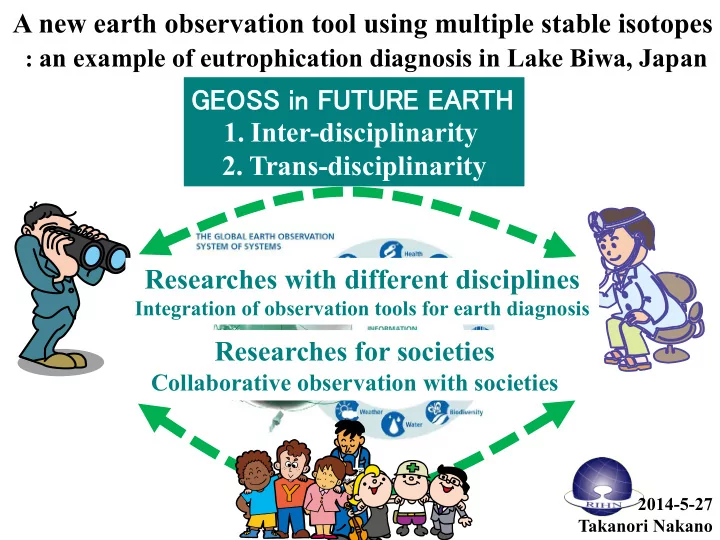
A new earth observation tool using multiple stable isotopes : an example of eutrophication diagnosis in Lake Biwa, Japan GEOSS in in F FUTURE EARTH 1. Inter-disciplinarity 2. Trans-disciplinarity Researches with different disciplines


slide-1
SLIDE 1

2014-5-27 Takanori Nakano

A new earth observation tool using multiple stable isotopes : an example of eutrophication diagnosis in Lake Biwa, Japan

西条市役所

環境衛生課

GEOSS in in F FUTURE EARTH

  • 1. Inter-disciplinarity
  • 2. Trans-disciplinarity

Researches with different disciplines

Integration of observation tools for earth diagnosis

Researches for societies

Collaborative observation with societies

slide-2
SLIDE 2

A new earth observation tool using multiple stable isotopes : an example of eutrophication diagnosis in Lake Biwa, Japan

Water-cycle

(AWCI)

Water-diversity Bio-diversity

Separate unify communicate (AP-BON) GEOSS in in F FUTURE EARTH

  • 1. Usefulness of stable isotopes as a tool of

inter-disciplinary science

  • 2. Social implementation of environmental

diagnosis using stable isotopes from trans-disciplinary approach

slide-3
SLIDE 3

海底湧出水

AWCI

The diversity of water-quality is formed during the water circulation process

seepage

slide-4
SLIDE 4

海底湧出水

DIVESITAS

The diversity of water-quality is reflected in that of biota

seepage

slide-5
SLIDE 5

海底湧出水

水質の多様性が生物に反映される

The diversity of human activities affects and alters those of water-quality and biota

seepage

It is important to develop an integrated observation tool regarding the diversity of water quality, covering bio-diversity, water-cycle, food and health risks…. ・Biota and water are composed of many elements. ・Earth observation using multiple stable isotopes (fingerprint of element) can link the researches among biodiversity, water cycle, agriculture, food….. ・Stable isotope method has been applied separately.

IHDP

food and health security

slide-6
SLIDE 6

Deterioration of freshwater lake ecosystem in Asia

Major Lake in the world

slide-7
SLIDE 7

(年)

Environmental Problems in lake Biwa

Population change in the lake Biwa watershed

Population increased double during last 50 years.

Population (x104) year

slide-8
SLIDE 8

Corbicula

(endemic species)

(year) Fishery (ton) Biodiversity-loss

slide-9
SLIDE 9

Eutrophication

Deficiency of oxygen

nitrogen(N) phosphorous(P)

slide-10
SLIDE 10

(%)

下水道普及率

20 40 60 80 100

1970 1980 1990 2000 ( 年)

全国 滋賀県

Provision of Shiga prefecture

(Shiga P.) (Japan)

Penetration rate

  • f sanitary sewers

Rapid sewerage after 1980

(year)

slide-11
SLIDE 11

0.005 0.015 0.025 0.035 1975 1980 1985 1990 1995 2000 2005

全リン

(mg/L)

北湖 南湖

environmental criteria

!!

RESULT

N

South

North

TP

total phosphorous

(year)

slide-12
SLIDE 12

0.06 0.08 0.10 0.12 0.14 0.16 0.18 1975 1980 1985 1990 1995 2000 2005(年)

NO3

(mg/L)

北湖 南湖

? ?

North basin South basin

Yearly change of dissolved nitrogen

(year)

slide-13
SLIDE 13

Development of water quality diagnosis

slide-14
SLIDE 14
  • R. Seri
  • R. Ado
  • R. Ane
  • R. Ishida
  • R. Yasu
  • R. Echi
  • R. Kamo
  • R. Hinbo

Monitoring Transparency, Escherichia coli N, P・・・

nitrogen(N): 61% phosphrous(P): 91% are removed in lake bybiological activities!

Limitation using N and P as environmental indicators

A new tool to elucidate the linkage among lake, river, human activity

slide-15
SLIDE 15

(N) (P) (Ca) (S) (Sr)

determine the isotope ratios

  • f dissolved elements
slide-16
SLIDE 16

87Sr 86Sr

0.70918

Strontium isotope ratio (87Sr/86Sr) of water varies dependent on geology

slide-17
SLIDE 17

北部 西部 東部 南部

87Sr/86Sr of tributary river at downstream site

north west east south north west east south R.Ado R.Ishida R.Kamo R.Hira

  • R. Ane
  • R. Echi

R.Hino R.Seri

  • R. Okoto

R.Mano R.Oura

seasonal change is small

slide-18
SLIDE 18

北部 西部 東部 南部

north west east south north west east south R.Ado R.Ishida R.Kamo R.Hira

  • R. Ane
  • R. Echi

R.Hino R.Seri

  • R. Okoto

R.Mano R.Oura

Lake Biwa

The concentration and isotope ratio of Sr in lake water is the average of those of rivers.

link between lake and river

87Sr/86Sr of tributary river at downstream site

slide-19
SLIDE 19

Lake water quality in the past

Lake Biwa around 1980s

slide-20
SLIDE 20

life

Mollusca Aquatic plant

Water in river+lake

Organisms have the same 87Sr/86Sr as ambient water

If the 87Sr/86Sr ratio of water changed, that of biota would accordingly change.

B I W A

Yanomune R. Mano R. Momose R. Oura R. Seri R.

reconstruct lake water quality in the past using lives in lake Biwa

slide-21
SLIDE 21

ISAZA(endemic species,one year)

By using stable isotope ratios of Isaza, it is possible to reconctruct the yearly change of water quality in lake Biwa. Biota and water contains various elements nitrogen、oxygen、hydrogen、sulfur、strontium

slide-22
SLIDE 22

1960 1980 2010 2000 1990 1970 0.7128 0.7126 0.7124 0.7122 0.7120

87Sr

Sr

86

(year)

yearly change of 87Sr/86Sr of lake water

(Ishi et al、2001、Ito et al、unpublished data)

Jomon period

dominance of light Sr (86Sr) with time

slide-23
SLIDE 23

Biwa 北部 西部 東部 南部

north west east south north west east south

87Sr/86Sr of tributary river at downstream site

Dominant contribution of tributaries with lower 87Sr/86Sr than lake Biwa

slide-24
SLIDE 24

N-isotope

(Ogawa et al., 2001)

dominance of heavy-N (15N) with time

slide-25
SLIDE 25

4.5 ‰ < δ15N 3.0 ‰ < δ15N < 4.5 ‰ 2.0 ‰ < δ15N < 3.0 ‰ δ15N < 2.0 ‰

Population density

(Hyodo et al)

Heavy-N in populated area Humans produce heavy-N

Nitrogen isotope of mud in the tributary

link between human and river

slide-26
SLIDE 26

(S-isotope)

34 32

S S

Lake water

Dominance of light S (32S) with time

(year)

(Ito et al., unpublished data)

slide-27
SLIDE 27

Lake Biwa (past) (present)

north west east south

Sulfur isotope ratios (δ34S)

  • f tributary river

Tributaries with higher δ34S than lake Biwa are less contributted

slide-28
SLIDE 28

low 34S/32S and low 87Sr/86Sr and high 15N/14N

Compared to lake Biwa

small rivers in eastern plain

Rivers which can explain the yearly change of Sr, N, and S isotope ratios of lake water. River with high 34S/32S

  • r high87Sr/86Sr
  • r low 15N/14N
slide-29
SLIDE 29

Bunroku R. Nomazu R. Rivers in agricultural area

slide-30
SLIDE 30

View at the mouth of Bunroku river on May 2004.

Muddy water enriched in P and N from paddy

Paddy water management

change of agriculture system disappearance of inland lake after 1970s

slide-31
SLIDE 31

Workshop with local people to the ecosystem preservation of lake

Satsuma town Shinkai town

Inari town

from environmental diagnosis to action

slide-32
SLIDE 32

Communication between researchers and citizens through collaborative making of water- quality map (Akanoi Bay in Lake Biwa)

Water collection

analysis

Report on water quality map

Discussion

Capacity building

Akanoi

slide-33
SLIDE 33

Environmental diagnosis using stable isotopes and using samples of water and biota is useful and contributes to inter-disciplinary researches, but in order to develop this method in many fields of environmental studies and to be used as monitoring tool, trans-disciplinary approach would be prerequisite and effective.

西条市役所

環境衛生課

Trans-disciplinary approach with inter-disciplinary observation method using multiple isotopes

slide-34
SLIDE 34

Global map of δ18O value of precipitation by IAEA

(http://nds121.iaea.org/wiser/gui/map.php)

>-30

  • 30 -28

  • 28 -26

  • 6 -4

  • 8 -6

  • 12 -10

  • 14 -12

  • 16 -14

  • 18 -16

  • 20 -18

  • 22 -20

  • 24 -22

  • 26 -24

  • 10 -8

  • 3 0

  • 4 -3

~ < 0

δ18O

(‰)

Monitoring from 1957

Circulation of water vapor → Bio-diversity, origin of food..

slide-35
SLIDE 35

Hydrogen isotope ratios in mean annual precipitation. Courtesy of Gabriel Bowen.

Annual mean oxygen isotope ratios in leaf water. Courtesy of Jason West.

http://isoscapes2008.wordpress.com/

Ox Oxygen i iso soto tope pe map o p of pla plant le t leaf

δ

18

ISO SOSC SCAPE (map ap of stab able i le isotope)

Water ⇒Biota⇒Food・health

>-30
  • 30 -28
  • 28 -26
  • 6 -4
  • 8 -6
  • 12 -10
  • 14 -12
  • 16 -14
  • 18 -16
  • 20 -18
  • 22 -20
  • 24 -22
  • 26 -24
  • 10 -8
  • 3 0
  • 4 -3
~ < 0 δ18O (‰)
slide-36
SLIDE 36

Food security

Nation project in EU 50 Research

  • rganizations and

Universities

Voerkelius et al., 2010, FC

Sr isotope map of bottled water

slide-37
SLIDE 37

Promotion o

  • f environmental

diagn gnosis u using g multi-isotopes

Soc

  • cial recog
  • gnition a

as a tool

  • ol of
  • f

env enviro ironm nment ental d dia iagno gnosis is

Laboratory

  • f RIHN

Inter-university research institute

62 stable isotopes in nature

slide-38
SLIDE 38

西条市役所

環境衛生課

場所 水温 井戸深度

location

RIHN as Inter-university Research Institute

Water-quality map

in collaboration with Universities visualization of water quality

slide-39
SLIDE 39

Otsuchi Yuza Laoss Philippine

slide-40
SLIDE 40

Otsuchi Yuza Laoss Philippine

slide-41
SLIDE 41

Otsuchi Yuza Laoss Philippine

Water quality map

  • f elements and their

stable isotopes Pollution and Traceability information

slide-42
SLIDE 42

西条市役所

環境衛生課

Co-monitoring between researchers and societies

場所 水温 井戸深度

location

GEOSS in Asia In order to build a co-monitoring network in Asia-Pacific region (extension of AP-BON) ・ collaboration research system among research institute, universities, and societies… ・ making a local water-quality map including stable isotopes and its bottom-up extension to Asia ・ contributing to the creation of trans-disciplinary science with capacity-building

RIHN as Inter-university Research Institute