SLIDE 1
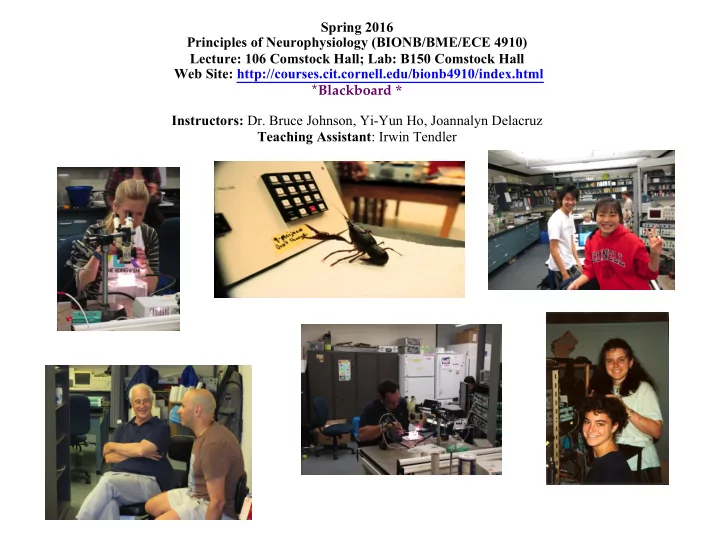
Spring 2016 Principles of Neurophysiology (BIONB/BME/ECE 4910) Lecture: 106 Comstock Hall; Lab: B150 Comstock Hall Web Site: http://courses.cit.cornell.edu/bionb4910/index.html *Blackboard * Instructors: Dr. Bruce Johnson, Yi-Yun Ho, Joannalyn Delacruz Teaching Assistant: Irwin Tendler
SLIDE 2
- 1. Gain an intuitive understanding for important concepts in Cellular Neurobiology.
- 2. Gain experience and competence in electrophysiological techniques (Job Skills!)
- 3. Understand and appreciate the experimental paradigms of the field.
- 4. Polish your scientific thinking and writing.
- 5. Appreciate the personal excitement of a research physiologist interacting with a
living system. What’s a Model System? What are the main research model systems?
4910 Course Objectives
SLIDE 3
Fab 4 Research Model Systems (not to scale!) Why are invertebrate animals used as model systems to teach signal transmission in human nervous systems?
SLIDE 4 Reasons to use invertebrates for teaching neuroscience
- 1. Evolutionary conservation of excitability and synaptic transmission
- 2. Inexpensive to buy and maintain
- 3. No animal protocols (no IAUCUC)
- 4. Hardy nervous systems
- 5. Often cultured for food
SLIDE 5
500 million
Neuronal excitability and synaptic trans- mission changed little in a half-billion years
Hille, 2001
"Never the less, all living things are about the same" C. Darwin
SLIDE 6 Spring 2016 Schedule
0.0 0.4 0.2
100 200 300 400 500
Time (ms) Amplitude (mV) Telson stimulated
SLIDE 7
4910 Schedule (cont)
SLIDE 8
Required “Texts”
Wyttenbach, R.A., Johnson, B.R. and R.R. Hoy (2014) Crawdad: An Online Lab Manual for Neurophysiology. Sinauer Associates, Inc. Sunderland, MA. http://www.sinauer.com/crawdad-an-online-lab-manual-for-neurophysiology.html Moore, J.W. and A.E. Stuart (2007) Neurons in Action, Vers. 2, Sinauer Associates, Inc., Sunderland, MA (http://www.sinauer.com/catalog/neuroscience/neurons- in-action-2-tutorials-and-simulations-using-neuron.html ) “Order from the website for a 15% discount from the suggested list price as reflected in “price to individuals” and free standard shipping to US addresses on orders over $40.00.*
SLIDE 9
- A. ¡ 35%- Lab Reports
- B. ¡ 15%- Problem Sets and Other Assignments
- C. ¡ 20%- Midterm Paper
- D. ¡ 30%- Final Paper (25%) and Presentation (5%)
Submit to BLACKBOARD!
4910 Grading
SLIDE 10
Lab exercise Results Due Report Due
SLIDE 11
- A. ¡35%- Lab Reports
- B. ¡ 15%- Problem Sets and Other Assignments
- C. ¡20%- Midterm Paper
- D. ¡ 30%- Final Paper (25%) and Presentation (5%)
4910 Grading
Blackboard; Neuronal Simulation Assignments
Tutorial Assignment Page Due Date Assignment 1: Introduction to NIA 1 January 30 The Membrane Tutorial 9
SLIDE 12
- A. ¡35%- Lab Reports
- B. ¡15%- Problem Sets and Other Assignments
- C. ¡20%- Midterm Paper
- D. 30%- Final Paper (25%) and Presentation (5%)
4910 Grading
SLIDE 13
- A. ¡35%- Lab Reports
- B. ¡15%- Problem Sets and Other Assignments
- C. ¡20%- Midterm Paper
- D. ¡30%- Final Paper (25%) and Presentation (5%)
4910 Grading
Extra ¡credit ¡for ¡helping ¡lead ¡lab ¡exercises ¡for ¡an ¡Engineering ¡class!
10 s 20 mV
Snail neuron
SLIDE 14
Next week First Lab: Model Neuron membrane resistance, time constant, oscilloscope. LabChartsoftware tutorial