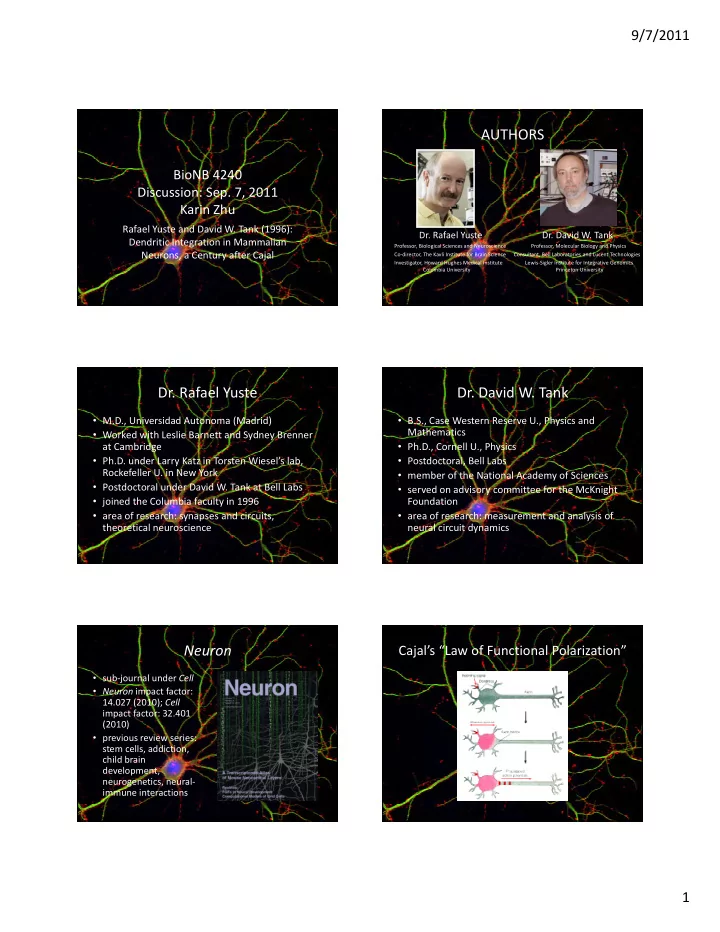
AUTHORS BioNB 4240 Discussion: Sep. 7, 2011 Karin Zhu Karin Zhu - - PDF document

authors
SMART_READER_LITE
LIVE PREVIEW

AUTHORS BioNB 4240 Discussion: Sep. 7, 2011 Karin Zhu Karin Zhu - - PDF document

9/7/2011 AUTHORS BioNB 4240 Discussion: Sep. 7, 2011 Karin Zhu Karin Zhu Rafael Yuste and David W. Tank (1996): Dr. Rafael Yuste Dr. David W. Tank Dendritic Integration in Mammalian Professor, Biological Sciences and Neuroscience Professor,


slide-1
SLIDE 1

9/7/2011 1

BioNB 4240 Discussion: Sep. 7, 2011 Karin Zhu Karin Zhu

Rafael Yuste and David W. Tank (1996): Dendritic Integration in Mammalian Neurons, a Century after Cajal

AUTHORS

  • Dr. Rafael Yuste
  • Dr. David W. Tank

Professor, Biological Sciences and Neuroscience Professor, Molecular Biology and Physics Co‐director, The Kavli Institute for Brain Science Consultant, Bell Laboratories and Lucent Technologies Investigator, Howard Hughes Medical Institute Lewis‐Sigler Institute for Integrative Genomics Columbia University Princeton University

  • Dr. Rafael Yuste
  • M.D., Universidad Autonoma (Madrid)
  • Worked with Leslie Barnett and Sydney Brenner

at Cambridge

  • Ph.D. under Larry Katz in Torsten Wiesel’s lab,

y , Rockefeller U. in New York

  • Postdoctoral under David W. Tank at Bell Labs
  • joined the Columbia faculty in 1996
  • area of research: synapses and circuits,

theoretical neuroscience

  • Dr. David W. Tank
  • B.S., Case Western Reserve U., Physics and

Mathematics

  • Ph.D., Cornell U., Physics
  • Postdoctoral, Bell Labs

,

  • member of the National Academy of Sciences
  • served on advisory committee for the McKnight

Foundation

  • area of research: measurement and analysis of

neural circuit dynamics

Neuron

  • sub‐journal under Cell
  • Neuron impact factor:

14.027 (2010); Cell impact factor: 32.401 (2010) (2010)

  • previous review series:

stem cells, addiction, child brain development, neurogenetics, neural‐ immune interactions

Cajal’s “Law of Functional Polarization”

slide-2
SLIDE 2

9/7/2011 2

Passive Dendrites and Cable Theory

Dendritic Boosting

from Renshaw (1942)

Active Dendrites

from Kandel and Spencer, 1960

Imaging Techniques

  • Sensitive optical

indicators of [Calcium]

  • cCCD
  • Patch‐clamp + infrared

Patch clamp infrared video

  • Confocal microscopy
  • Two‐photon microscopy

from Stuart and Hausser, 1994

So what are the properties of dendrites?

  • varies from neuron to

neuron

  • “influenced by

influenced by conductances that are active at rest”

  • basically unknown

How do neurons initiate spikes?

  • primarily

axonal/somatic

  • but the role of

calcium?

from Stuart and Sakmann, 1994

slide-3
SLIDE 3

9/7/2011 3

Inhibition and Turning off Dendrites

  • “the intrinsic properties of neurons can turn off

certain dendrites in an activity‐dependent fashion”

  • activity from one dendrite affects the rest
  • dendrites are just another branch point

dendrites are just another branch point

  • example: horizontal cell

How do dendritic trees work?

  • smallest functional

compartment is a spine

  • spine soma, but

soma all spines

  • functional

interaction by separate compartments

Llinás and Sugimori, 1980

Dendrites as Output

  • antidromic spikes
  • possibility of closed

circuits comprised entirely of dendrites

Considerations for the Future

  • active conductance in dendrites
  • antidromic spikes and their purpose
  • roles of different compartments
  • spatial inputs
  • spatial inputs
  • temporal codes
  • logic of dendrites
  • dendrite activity during behavior

SUMMARY

  • Cajal’s law of

“functional polarization” still stands…for the most part part

  • dendrites are active
  • the property of

dendrites varies widely

  • Neuroscience is

technique‐driven